



Description
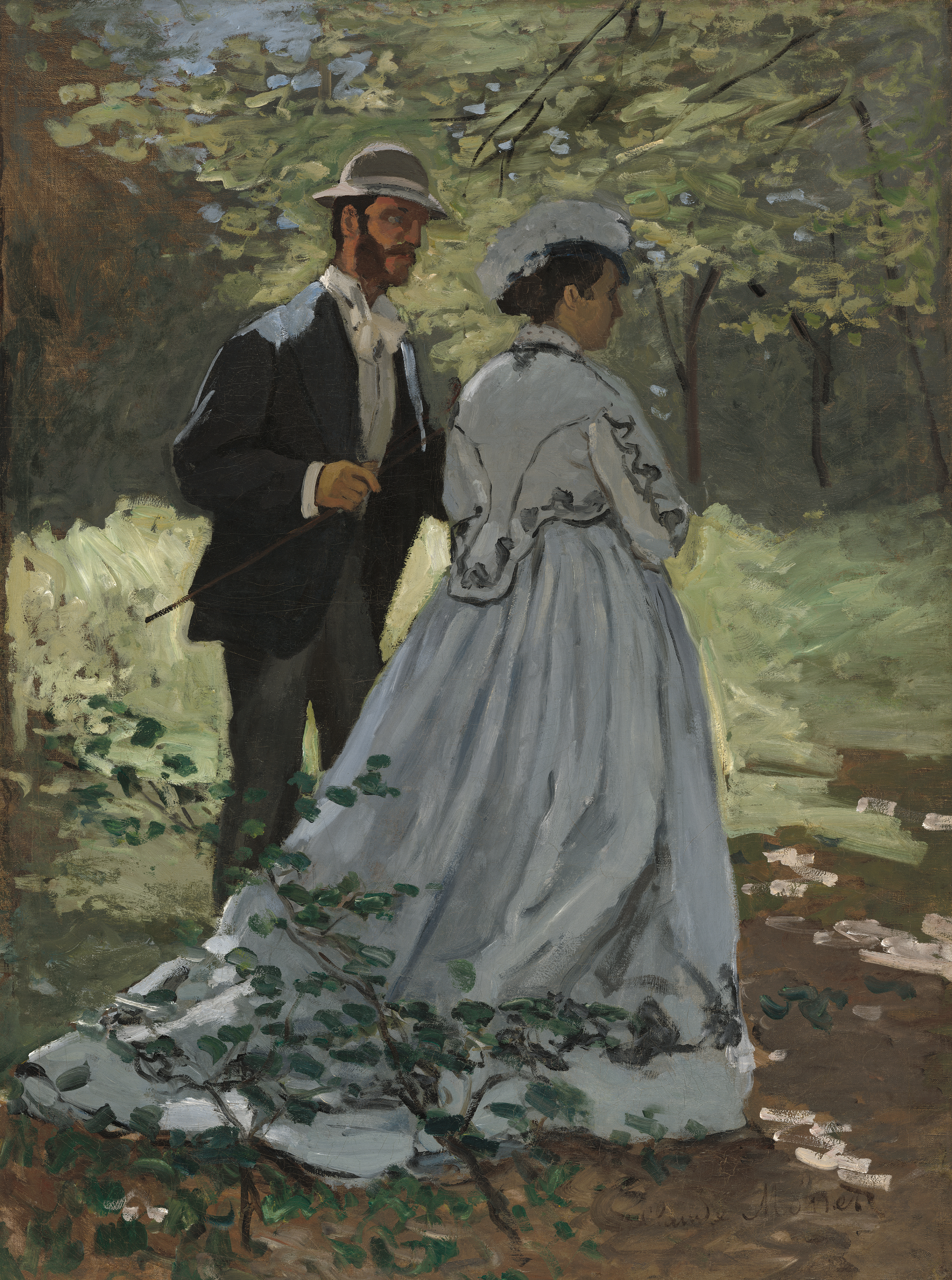
Bazille and Camille (Study for “Le Déjeuner sur l’herbe”) is a hand-painted reproduction of Monet’s canvas in the National Gallery of Art in Washington: a woman in a long slate-grey gown with a train walks away along a woodland path, a man in a dark jacket and round grey cap stands to her left, and light through the leaves gathers on the path in white dabs. The original measures 68.9 x 93 cm and is oil on canvas, accession 1970.17.41. The museum dates it to 1865 and records it with the qualifier Attributed to. We paint it in eight sizes or to your own measurement, with a photograph of the finished work sent for approval before dispatch.
| Title: | Bazille and Camille (Study for “Le Déjeuner sur l’herbe”) |
| Other titles: | Bazille and Camille (Study for “Déjeuner sur l’Herbe”) (the name in the museum record); Les Promeneurs, The Strollers, the name it was exhibited under in Paris in 1931; in the Wildenstein catalogue the work is number 61 |
| Painter: | Claude Monet – attributed (1840–1926) |
| Year painted: | 1865 according to the museum record, the year with no reservation; the canvas carries a signature with no year |
| Original size: | 68.9 cm x 93 cm |
| Original technique: | Oil on canvas |
| Painting style: | Impressionism |
| Located at: | National Gallery of Art, Washington (inv. 1970.17.41) |
| Our reproduction: | Hand-painted oil on canvas, eight sizes or made to measure |
Bazille and Camille (Study for “Le Déjeuner sur l’herbe”) – Claude Monet
What is on the canvas?
A woman walks away from us along the path, angled to our right, so we see her right cheek and the tip of her nose. Her dark hair is in a bun under a wide silver-grey hat. The close-fitting bodice is trimmed with dark swirling lines across the nape, sleeves and lower edge; the full skirt spreads behind her into a short train on the earth path.
To her left stands a man, his body turned toward her and toward us at once, in a round grey cap with a brim, his long sideburns running into a full beard and moustache. He wears a navy jacket, a white shirt and a white bow; one hand holds a short stick, the other reaches out toward the woman.
Everything else is woodland: leaves in celery and sage green, trunks in dark brown, a few strokes of blue sky between the canopies. On the path at the lower right, white strokes: the light through the leaves.
One thing the museum record does not name, and it is plain to see: a low shrub grows in front of the hem of the skirt, brown woody stems rising out of the earth and round dark-green leaves overlapping the pale grey cloth. It stands between us and the dress.
What did the painter write on the canvas?
At the lower right, over the brown earth, the signature stands in dark brown: Claude Monet, and after it nothing, no year and no digits.
The museum gives the same, “lower right: Claude Monet”, with no year. The year 1865 in the table is therefore the museum’s and not the canvas’s.
The museum does not give the work to Monet without reservation
On the museum’s page, under the painter’s name, stands one further line: Attributed to. That is a qualifier about authorship, not about the subject – the museum records it as Monet’s with a reservation.
That this is not the museum’s general habit we checked: on two other Monet pages of the same museum — the Rouen cathedral under 1963.10.49 and The Willows under 2015.19.65 — that line is absent, and both records name the painter with no qualifier.
Why the museum set that reservation we do not claim, because the page does not say; we say only what stands there and on two other pages.
What does the museum record say about the size?
The work is held by the National Gallery of Art in Washington under 1970.17.41. It publishes the measurements height by width, 93 x 68.9 cm, and in inches; our table puts the width first, so you read 68.9 x 93 cm here. With the frame, 98.4 x 121.9 cm and a depth of 10.7 cm.
What is this a study for?
The museum calls it a preparatory study for a much larger work, and that work in Paris today is not one canvas but two: the Musée d’Orsay records two under the same title, Le Déjeuner sur l’herbe — one of 218 x 248.7 cm under RF 1987 12 and one of 150 x 418 cm under RF 1957 7.
The museum dates both to a range, between 1865 and 1866, so we write no year for them; for our canvas we do, because the museum gives it with no range.
So we say only what the records say — one work, two canvases, two accession numbers, and a range instead of a year.
Three works with the same name, and one of them is not a painting
The same museum holds another work titled The Luncheon on the Grass, under 1995.47.60, and it is not a painting but a drawing, black chalk on blue laid paper, 46.8 x 30.5 cm, dated to about 1865. We do not sell it.
A third work with a similar name we do sell, and it is neither of those. The Luncheon is a canvas from the Musée d’Orsay in Paris under RF 2774 and shows an entirely different scene. Look for that canvas by its accession number, not its title.
From the same early years we sell other works with figures and woodland. Women in the Garden is the other large canvas of figures outdoors, Woman with a Parasol is also a figure in a landscape, Camille Monet on Her Deathbed shows the same woman much later, and Le Pavé de Chailly is a woodland road with no one in it.
Whose was it before it reached Washington?
The museum publishes a chain of owners with four stations, and for two it adds where it learned that: first Michel Monet (1877–1966) at Giverny, the painter’s son; then Captain Edward H. Molyneux (1891–1974) in Paris, by 1940 according to the record; then Ailsa Mellon Bruce (1901–1969) in New York, who bought the canvas on 15 August 1955; then the museum itself, which received it in 1970 with her bequest.
In its notes the museum adds that Michel Monet inherited his father’s stock at his death in 1926 and sold it off over decades, that he lent this canvas to a Paris exhibition in 1931, and that it infers Molyneux as the later owner from the annotated catalogue of the 1940 exhibition. The great picnic in the forest of Fontainebleau that Monet worked towards in 1865–1866, in its only complete version, is Luncheon on the Grass.
How is our hand-painted version made?
Every order is painted individually by an artist, in oil on cotton or linen: that is how every canvas painting of ours is made, with no print and no machine step. An oil painting reproduction of this motif is demanding in its light – the white strokes on the path must stay separate dabs, or the path turns into one bright surface.
The second test is the dress: the slate-grey skirt must have folds rather than shadows, or the woman loses the lightness of her walk. An impressionist painting does not take a high gloss, so every Monet reproduction leaves our studio matt.
Which size for which wall?
Eight sizes are available, from 40 x 55 to 150 x 200 cm, and here there is one answer: 70 x 95 cm is nearest by size and by ratio at once, 1.1 cm wider and 2 cm taller than the canvas in Washington, at 1.3571 against the original’s 1.3498.
For a large wall 90 x 120 cm keeps the shape. As a painting for the office the motif works, because the figures are turned away and the scene does not press itself on you. Every size is listed in our Claude Monet gallery.
How high to hang the painting: the centre about 150 cm above the floor, so the path with its white dabs sits below eye level.
Made to measure, stretcher and frame
For a size that is not on the list, made to measure is the only route: write to us with the width and height. The canvas arrives stretched on a stretcher or rolled in a tube. A frame is not included; the museum’s own stands 10.7 cm deep, well clear of the wall.
Delivery and guarantee
Making takes two to three weeks, a few days longer at the largest sizes. If the work arrives damaged or differs noticeably from the approved photograph, we replace it or refund the price. A hand-painted copy is not a factory article and small differences in the brushwork are to be expected; damage is not.
If the painting is a gift and you are unsure of the size, there is a voucher: the recipient chooses the size and the subject.
Frequently asked questions
Where is the original?
In Washington, in the National Gallery of Art, under 1970.17.41, in Gallery 82.
Who is in the picture?
According to the record, Frédéric Bazille posed for the male figure and Camille Doncieux, later the painter’s wife, for the female.
What is it about, in one sentence?
About two people on a woodland path and the light through the leaves.
Is the original for sale and what is it worth?
It is not for sale, because it belongs to a museum collection; we give no value, and the museum writes no price.
- Subject. A woman in a grey gown walking away along a woodland path, a man in a dark jacket to her left, a low shrub in front of the skirt, white dabs of light on the path.
- Original. Oil on canvas, 68.9 x 93 cm, 1865; National Gallery of Art, Washington, inv. 1970.17.41, with the qualifier Attributed to.
- Ours. Eight sizes; 70 x 95 cm is nearest by size and ratio at once.
- Worth knowing. The same museum holds another Luncheon on the Grass, but as a drawing on paper; the large work in Paris is two canvases under one title.