


Description
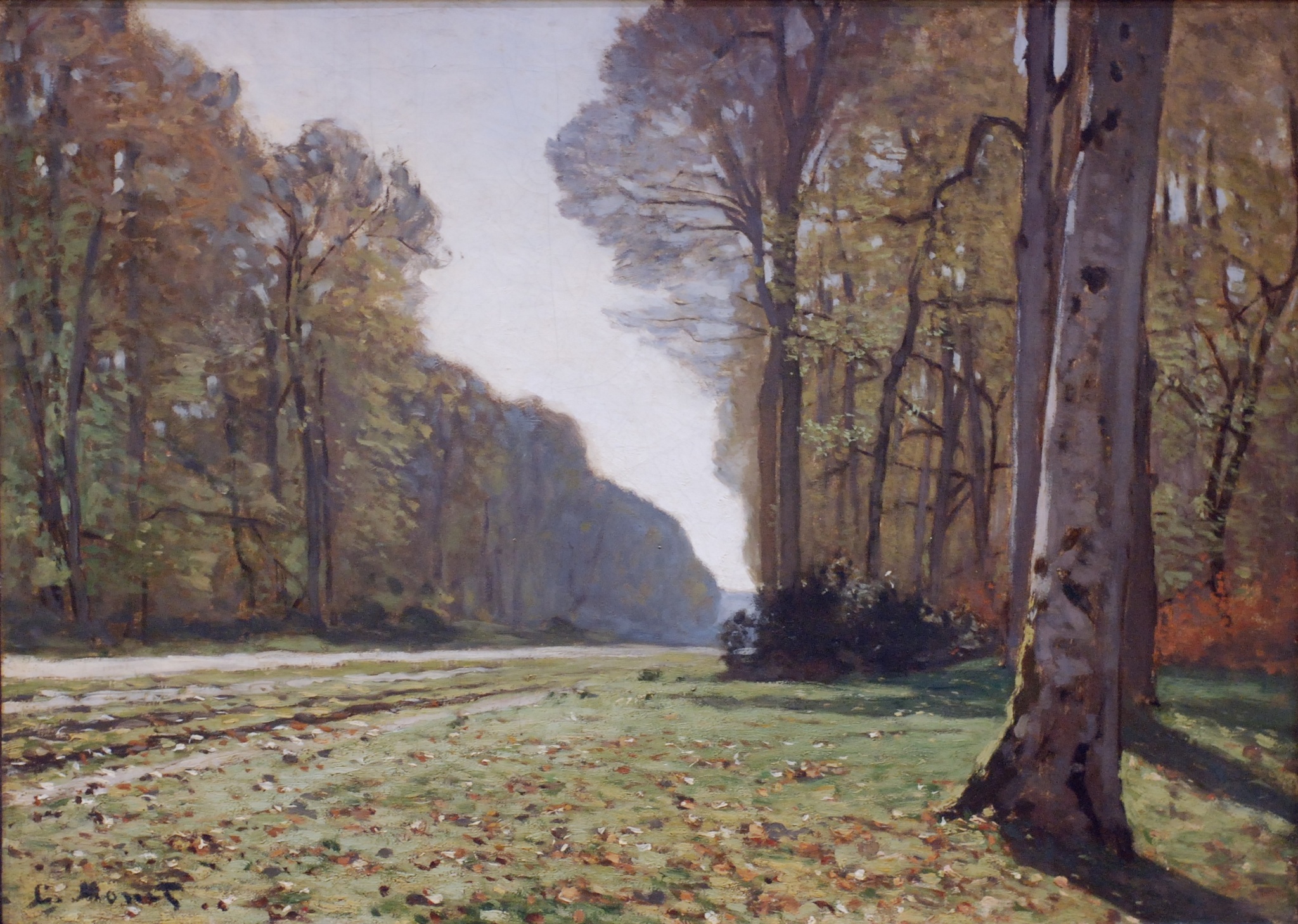
Le Pavé de Chailly is a hand-painted reproduction of Monet’s canvas in the Musée d’Orsay in Paris: a broad grassy road strewn with fallen leaves runs between two rows of tall autumn trees towards a narrow strip of pale sky, a grey trunk stands close to us on the right, and a cart track crosses the grass in the left foreground. The original measures 59.3 x 43.5 cm, is oil on canvas and carries inventory number RF 1672. The museum dates it »vers 1865«, that is about 1865. We paint it in eight sizes or to your own, with a photograph of the finished work sent for approval before dispatch.
| Title: | Le Pavé de Chailly |
| Other titles: | Le Pave de Chailly ; Route du Bas-Breau (the museum’s machine-readable record, accents omitted); Le Pavé de Chailly (the French title in Wikidata) |
| Painter: | Claude Monet (1840–1926) |
| Year painted: | about 1865: the museum writes »vers 1865«, that is with a reservation |
| Original size: | 59.3 cm x 43.5 cm |
| Original technique: | Oil on canvas |
| Painting style: | Impressionism |
| Located at: | Musée d’Orsay, Paris (inv. RF 1672) |
| Our reproduction: | Hand-painted oil on canvas, eight sizes or made to measure |
Le Pavé de Chailly – Claude Monet
What is on the canvas?
A road through a forest in autumn. A broad band of grass, strewn with brown and orange leaves, runs from the foreground into the distance between two rows of tall trees. Across its left side a pale cart track curves away, and the grass on the right lies partly in the long shadow of the trees.
The trees on the left form a single closed wall of green, ochre and brown leaves. On the right stand tall slender trunks, a dark bush at the end of the row, reddish undergrowth along the edge and, close to us, a large grey trunk with dark patches in its bark. Above, the sky shows only as a narrow pale wedge between the two rows of trees.
When was it painted, and why does it say »vers«?
The museum’s record gives »vers 1865«, meaning about 1865; it does not claim an exact year.
Better no figure than one that nobody claims.
What does the museum record say about the work?
The work is held by the Musée d’Orsay in Paris under inventory number RF 1672. It gives the size height first, 43.5 by 59.3 cm, and 75.2 by 92.3 cm with the frame, and the technique as oil on canvas. Wikidata carries the French title with its accent, Le Pavé de Chailly.
Monet«.
How did the canvas reach the museum?
The museum gives a single entry: »Donation Etienne Moreau-Nelaton, 1906«, a gift from Étienne Moreau-Nélaton in 1906. That is the way it was acquired, not a chain of owners, so we write no provenance section here.
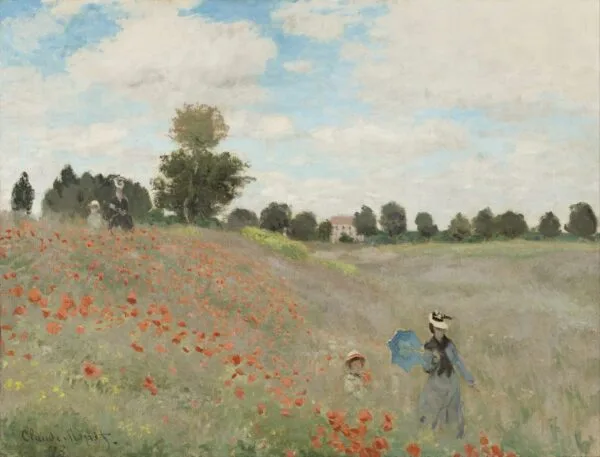
The Musée d’Orsay records the same 1906 gift for three more canvases we sell: Poppies near Argenteuil, RF 1676, which it dates 1873, Still Life with Meat, RF 1675, which it dates »vers 1864«, and Carrières-Saint-Denis, RF 1674, which it dates 1872.
A larger forest canvas of 1865
The Metropolitan Museum of Art in New York holds a canvas dated 1865 whose title names the Forest of Fontainebleau, The Bodmer Oak, Fontainebleau Forest, oil on canvas, 129.2 x 96.2 cm, more than twice as wide as ours. Ours is RF 1672 in the Musée d’Orsay, 59.3 x 43.5 cm and dated about 1865; if you are looking for this work in particular, go by that number.
Why does this work matter?
Because it shows the young painter with a subject cut down to a road, trees and light: nothing happens on the canvas except leaves on the grass, a long shadow on the right and the pale gap of the sky.
Two more canvases in our collection are dated by Wikidata to 1865 and 1867: Bazille and Camille (Study for “Le Déjeuner sur l’herbe”) of 1865, in the National Gallery of Art in Washington, and A Cart on the Snowy Road at Honfleur of 1867, in the Musée d’Orsay. An impressionist painting of this kind tells no story; it holds one clear autumn day on a forest road. The great picnic in the forest of Fontainebleau that Monet worked towards in 1865–1866, in its only complete version, is Luncheon on the Grass.
How is our hand-painted version made?
Every order is painted individually by an artist, in oil on cotton or linen. That is how every canvas painting leaves us, with no print and no machine step. This oil painting reproduction is demanding in the leaves on the grass: each leaf is a small separate touch of brown or orange, and they must stay scattered rather than melt into a carpet.
The second test is the shadow on the right, which must stay transparent enough for the grass to show beneath it. A Monet reproduction of this kind depends on the far end of the road staying pale and soft while the foreground stays sharp. Work of this kind will not take a high gloss, so ours is matt. A hand-painted copy is not a facsimile; two canvases of the same size always differ in the brushwork.
Before dispatch you receive a photograph of the finished canvas. Check three things on it: whether the fallen leaves are separate touches, whether the far end of the road stays pale, and whether the signature stands at the lower left, as on the original. If any of these is wrong, tell us before you approve the work.
Which size for which wall?
There are eight sizes, from 50 x 40 to 150 x 110 cm. By size the closest to the original is 60 x 40 cm, 0.7 cm wider and 3.5 cm lower, but at 1.5000 more elongated than the original’s 1.3632. By proportion the closest is 150 x 110 cm at 1.3636, almost exactly the original’s shape; then come 80 x 60 and 120 x 90 cm, both at 1.3333.
If you want nearly the size of the original, take 60 x 40; if you want its exact shape, 150 x 110, and 80 x 60 for a smaller wall. A small, quiet forest road suits a wall you look at while you work, which makes this a good painting for the office. All sizes are listed with the product in our Claude Monet gallery.
Light matters as much as size. The canvas is built from green, ochre and brown tones with one pale strip of sky, so it looks best in daylight or warm light; under cold light the autumn colours go dull. Hang it so that the far end of the road sits at about eye level.
Custom size, stretcher bar and frame
For a size not on the list, made to measure is the only route; send us the width and height and we keep the proportion of the original. The canvas is stretched on a wooden bar. A frame is not included; the museum’s own measures 92.3 x 75.2 cm.
Delivery and guarantee
Making it takes two to three weeks, a few days more at the largest sizes. It arrives stretched on its bar in a rigid box, or rolled in a tube, with tracking. If it arrives damaged or differs noticeably from the approved photograph, we replace it or refund. Small differences in the brushwork are expected in handwork; damage is not.
If the painting is a gift and you are unsure of the size, there is a voucher: the recipient chooses the size and the subject.
Frequently asked questions
Where is the original?
In Paris, at the Musée d’Orsay, inventory number RF 1672.
What year is it from?
The museum writes »vers 1865«, about 1865.
What does it show?
A broad grassy road through a forest in autumn, fallen leaves, a large grey trunk on the right and a narrow strip of pale sky.
Where is the Pavé de Chailly?
A road through the Fontainebleau forest by the village of Chailly-en-Bière, south-east of Paris. Monet worked there in the summer of 1865, at the edge of the forest where many landscape painters worked at the time.
- Subject. A grassy forest road in autumn between tall trees, with fallen leaves and a narrow strip of pale sky.
- Original. Oil on canvas, 59.3 x 43.5 cm, about 1865; signed at the lower left »C. Monet«; Musée d’Orsay, Paris, inv. RF 1672.
- Ours. Eight sizes; 60 x 40 cm is closest by size, 150 x 110 cm by proportion.
- Worth knowing. The Musée d’Orsay received this canvas in 1906 as a gift from Étienne Moreau-Nélaton, by its own records together with three more canvases from our collection.