


Description
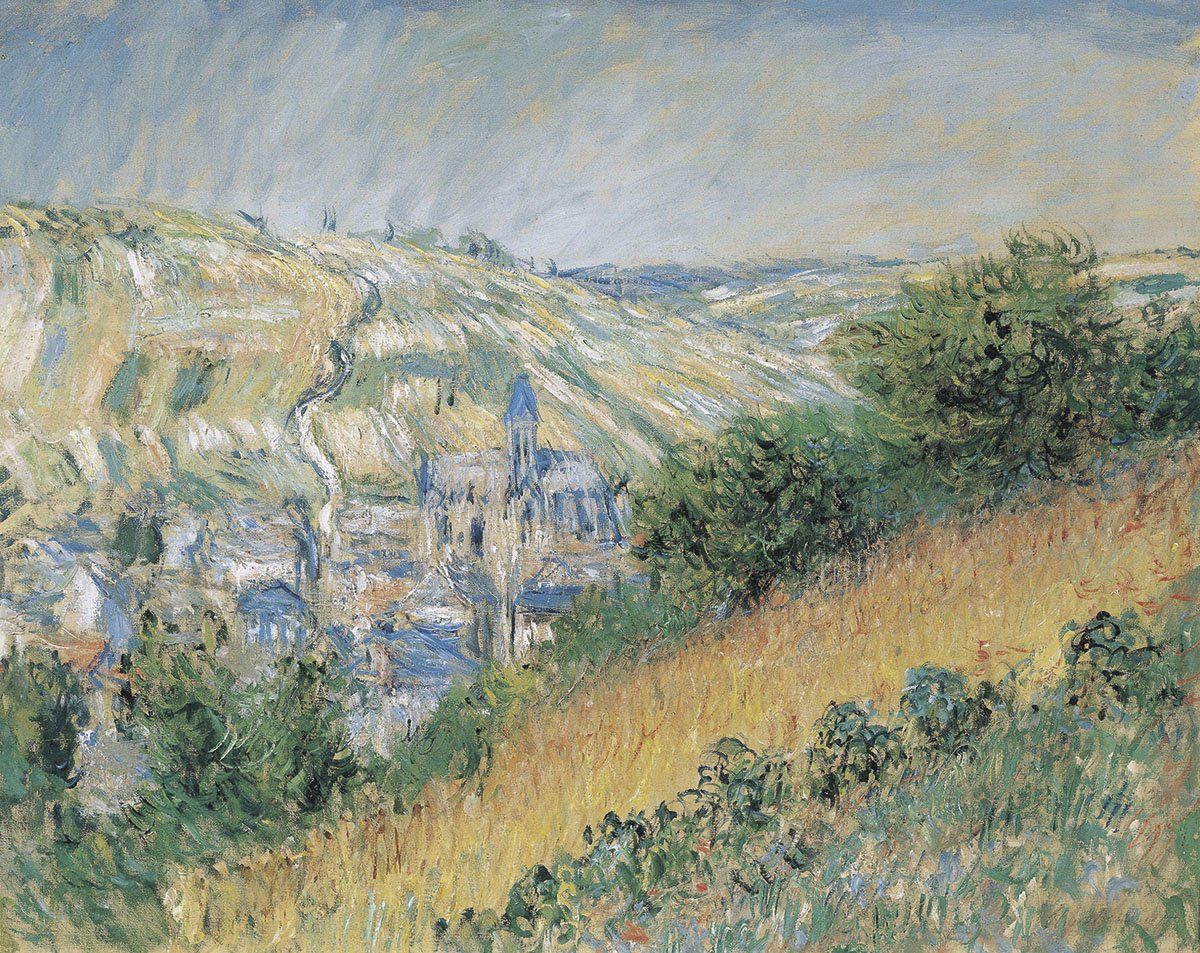
View of Vétheuil is a hand-painted oil painting after a Monet view from the hillside: the village with its pointed spire lies in a hollow below us, and a dry ochre field falls steeply away on the right. We paint it in eight sizes or to your own measurement, oil on canvas, with a photograph of the finished work sent for approval before dispatch. Which of Monet’s canvases of Vétheuil is the original of this particular reproduction has not been established, so you will find neither a year nor a museum here.
| Title: | View of Vétheuil |
| Painter: | Claude Monet |
| Original: | not reliably identified |
| Our reproduction: | Hand-painted oil on canvas, eight sizes or made to measure |
View of Vétheuil – Claude Monet
What is shown?
The canvas lies wide, and we look from above, down the slope. At the lower right a steep dry field falls away on the diagonal in ochre yellow, scattered with low dark green scrub and tiny red-orange dots. Dense dark green trees stand along the right edge and foreground. Left of centre and lower lies the village: white and greyish houses with blue roofs, pressed into the hollow. Above them rises a grey-blue church with a tall pointed spire — the tallest thing in the village, and still well below the ridge that closes over it. Behind the village a pale limestone slope climbs to a ridge, streaked cream, white and green; a path runs along it and a few small dark trees stand on the skyline. Far off to the right, low blue-grey hills recede one behind another. The upper third belongs to a pale grey-blue sky, painted in long slanting strokes that fall to the right. There is not a single figure in this canvas painting, and nothing happens in it.
Why do the two slopes meet at the village?
Because there are two opposing diagonals, not one. The limestone slope on the left falls from the upper left corner towards the centre; the dry ochre field on the right falls the other way, from the right edge to that same centre. Where they meet, at the foot of that V, lies the village. The village is also painted differently: short vertical blocks, one beside another, while everything around it runs on the slant. So the village is the one thing standing still, and the eye sliding down either slope ends in the same place. A painting like this is ordered by the rhythm of the stroke and not by perspective: depth comes only from the size of the houses and the fading of the hills in the distance.
How is the work made?
Fast and thin. The paint is dragged across rather than worked, and the canvas grain shows through in places — most of all in the limestone slope, where the cream and white bands lie beside one another rather than over one another. The dark green scrub is set down in short, thicker touches standing above the ochre, and that difference in thickness, more than colour, separates growth from field. The red-orange dots come last and there are fewest of them; the only warm colour that is not ochre, and the eye reads them as flowers although they are only dots. An impressionist painting of this kind depends on that balance between speed and precision.
Deliberately not stated here
Monet painted Vétheuil again and again — from the river and from the hillside, in summer and under snow, over several years and in several sizes — and the surviving canvases differ in framing, size and year. Which of them is the original of this particular reproduction has not been established; so you will not find a year of creation here, nor a collection name, nor an inventory number — nor the size of the original. We would rather say less than put a figure we cannot stand behind on someone else’s painting. We tell you what is visible on the canvas, and nothing else.
Other Monet landscapes here
The same village in winter, when everything is white and quiet, is Snow Effect in Vétheuil. The river below the village, seen from the flat instead of from the slope, is Banks of the Seine, Vétheuil. What the same water does in morning mist is Morning on the Seine, near Giverny. And open country with no settlement at all, only grass and light, is Meadow at Giverny.
How is our hand-painted version made?
The difficulty here is not the drawing but keeping the whole thing tilted. The painter begins with the sky and the limestone slope, because those set the tilt of everything else, and lays them in with long slanting strokes rather than horizontal ones. Then the dry field on the right, same direction, denser colour. Only after that the village — and this is where things most often go wrong: lean it against the same slant and it disappears, and the canvas becomes nothing but hillside. So the houses go in as short vertical blocks, and the spire last, the final stroke the eye looks for. A work this size takes several days, and the hand-painted copy you receive is an oil painting reproduction made in exactly that order.
Which size for which wall?
Short answer: 80 x 62 cm above a chest of drawers, 100 x 80 cm above a sofa, 150 x 120 cm for a large open wall, and 50 x 40 cm for a hallway or a small wall. A painting for living room walls sits in proportion when it takes up about two thirds of the width of the sofa beneath it. The subject is wide and light, with much cream and ochre, so it takes a wall that is not pure white and sits well beside wood. Impressionist wall art like this wants a little distance: close up the village breaks into patches, from three steps back it is houses and a spire again.
How high to hang the painting: put the centre of the canvas about 150 cm above the floor. Because we are looking down from above, it works better a little higher than lower: the view onto the village then lines up with our own.
Made to measure, stretcher and frame
If none of the eight sizes suits, we paint to the size you set — send width and height and we will quote a price and a lead time. We keep the ratio of the sides so the slope holds its tilt. The canvas is stretched over a wooden stretcher with the edges painted, so it does not look unfinished without a frame. Lighter wood or a narrow dark moulding suits this subject; a wide gilt frame pulls the ochre field towards brown and the slope loses the light that is the point of it.
Delivery and guarantee
The finished work travels to sixteen EU countries — Slovenia, Croatia, Austria, Germany, Italy and Hungary among them — wrapped in protective film inside a rigid box. You see a photograph before it is sent, and anything wrong on it is put right while the piece is still in the workshop. The largest sizes take longer. You will find our other Monet reproduction subjects in the Claude Monet gallery, and we write about painting and choosing a subject on the blog.
If the painting is a gift and you are unsure of the size, there is a gift voucher: the recipient chooses the size and the subject.
Frequently asked questions
Which village is this?
We list the work under a title naming Vétheuil, a village on the Seine north-west of Paris where Monet lived and painted for a few years. Which of his canvases of it is the model for this reproduction has not been established, so we claim nothing further about the canvas.
What is the tallest thing in the middle?
The church spire — but only within the village. It breaks the skyline nowhere: the limestone slope closes over it and surrounds it on every side. That is exactly what makes the village look more deeply set than it is.
When did Monet live in Vétheuil?
From 1878 to 1881. He rented a house in the village on the Seine, not far from Paris, and painted Vétheuil and its surroundings many times; it was there that Camille died in 1879.
Is the original for sale, and what is it worth?
That cannot be answered for this canvas: which of Monet’s views of Vétheuil is its original has not been established, so there is no owner and no price to name. What we can state is the price of our hand-painted version: it is shown on this page for the size you choose.
- Subject. A village with a pointed spire in the hollow, a dry ochre field from the right, a limestone slope with a path along the ridge.
- Hand-painted. Oil on canvas, no print and nothing applied by machine.
- Eight sizes or made to measure. From 50 x 40 to 150 x 120 cm, and otherwise by arrangement.
- We invent nothing. We give no year, collection, inventory number or size of the original, because this canvas is not reliably identified.