







































Description
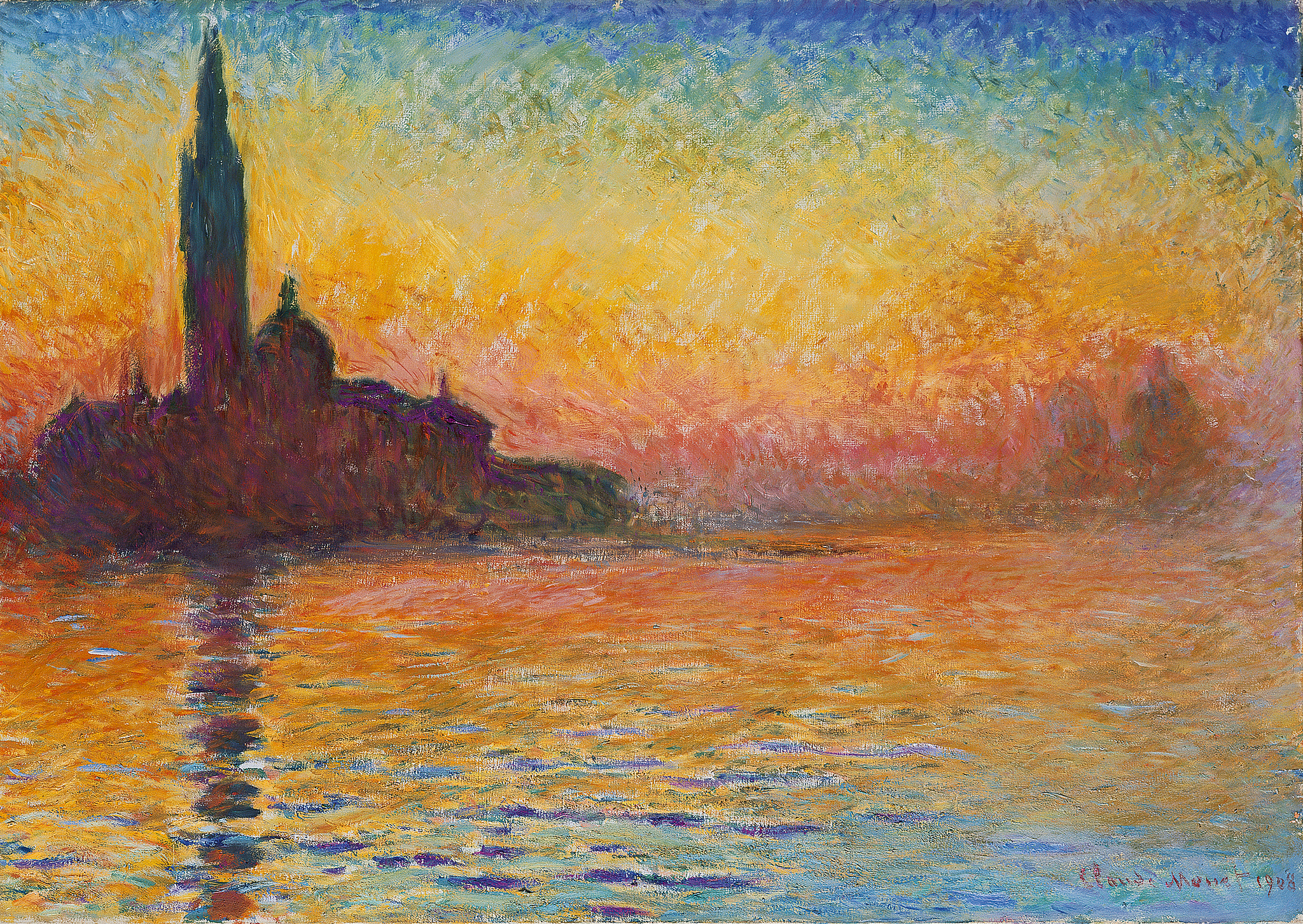
San Giorgio Maggiore at Dusk is Monet’s canvas of 1908: the church of San Giorgio Maggiore across the lagoon in Venice as a dark silhouette against a sky burning orange, red and violet, with the sunset doubled in the water. The original belongs to the National Museum in Cardiff, Wales. We make it as a hand-painted reproduction in oil on canvas, in eight sizes or to your own measurement, with a photograph of the finished work sent for approval before dispatch.
| Title: | San Giorgio Maggiore at Dusk |
| Other titles: | Saint-Georges majeur au crépuscule · San Giorgio Maggiore al crepuscolo |
| Painter: | Claude Monet (1840–1926) |
| Year painted: | 1908 |
| Original size: | 92.4 cm x 65.2 cm |
| Original technique: | Oil on canvas |
| Painting style: | Impressionism |
| Located at: | National Museum Cardiff, Amgueddfa Cymru (inv. NMW A 2485) |
| Our reproduction: | Hand-painted oil on canvas, eight sizes or made to measure |
San Giorgio Maggiore at Dusk – Claude Monet
What is shown?
Evening on the lagoon in Venice. Across the water rises the church of San Giorgio Maggiore, its dome and tall campanile reduced to a single dark blue shape against the sunset. The sky behind it runs from deep orange near the horizon through red to violet and blue at the top, and the water below repeats all of it in broken horizontal strokes. There are no boats and no people: only the building, the light and its reflection.
Where is the sun?
Behind the church, low on the horizon, slightly to the right of the campanile: that is where the orange is strongest. Monet does not paint the sun itself. He paints what it does to the air and the water, and the brightest strokes on the canvas lie on the lagoon in front of the building, where the sunset meets its own reflection.
Why does this painting matter?
It belongs to the small group of canvases Monet painted on his only stay in Venice, in the autumn of 1908, when he was nearly seventy. He finished them later in his studio at Giverny and showed them in Paris in 1912. Here a familiar building is turned into pure colour.
Venice in 1908
Monet travelled to Venice with his wife Alice and stayed about two months, first at the Palazzo Barbaro and then at the Hotel Britannia on the Grand Canal. From there San Giorgio Maggiore stands right across the water. He painted it at different hours; in the dusk version the sky is set on fire.
Other Monet cities in colour and fog
Venice is one of three cities Monet turned into light. A Venetian façade seen from the water is Venice, Palazzo Dario; the port of Le Havre at dawn, the canvas that gave Impressionism its name, is Impression, Sunrise; and Westminster dissolving in the fog is London, the Houses of Parliament in the Fog.
How is our hand-painted version made?
The painter starts with the sky, from the orange at the horizon upwards into violet and blue, without hard borders between the colours. Then the water, in short horizontal strokes that repeat the sky but break it up. The church comes last, as one dark shape laid over the light: if its edges are drawn too sharply it looks cut out, so they are kept soft, as in the original.
Every piece is a hand-painted copy in oil on canvas, made for your order. An impressionist painting lives on its visible brushwork, so we do not smooth it away: the strokes stand slightly above the surface and catch the light, which a printed oil painting reproduction cannot do.
Which size for which wall?
Short answer: 105 x 75 cm above a sofa or sideboard, 60 x 40 cm for a hallway or a smaller wall, and 150 x 110 cm for a large empty wall. A painting for the living room should take up about two thirds of the width of the furniture below it. All eight sizes, from 50 x 35 to 150 x 110 cm, follow the format of the original.
How high to hang the painting: put the centre of the canvas about 150 cm above the floor; above a sofa, leave 20 to 30 cm between the back and the lower edge.
Made to measure, stretcher and frame
If none of the sizes suits, we paint to measure — send the width and the height and we will quote a price and a lead time. The original measures 92.4 x 65.2 cm, a ratio of about 1.42 : 1. Every canvas painting we make is stretched over a wooden stretcher with painted edges, so it does not look unfinished without a frame. A dark wood or a narrow black moulding makes the orange glow; a warm gold frame also works, because it picks up the sunset.
Delivery and guarantee
We ship to the United Kingdom, Ireland and across the EU, wrapped in protective film and packed in a rigid box. Before dispatch we send you a photograph of the finished work; if something on it is not right, we correct it while the canvas is still in our workshop. Every other Monet reproduction we paint is in the Claude Monet gallery, and we write about the painter and about choosing a subject on our blog.
If the painting is a gift and you are unsure of the size, there is a wall art voucher: the recipient chooses the size and the subject.
Frequently asked questions
Where is the original?
In the National Museum Cardiff (Amgueddfa Cymru – National Museum Wales), under inventory number NMW A 2485. The work is recorded in Wikidata, and the photograph we paint from is on Wikimedia Commons.
What year is it from?
From 1908. Monet painted it during his stay in Venice that autumn and completed it later at Giverny; it was first shown in Paris in 1912.
Why did Monet paint San Giorgio Maggiore at dusk?
Because of the light. From his rooms on the Grand Canal he looked straight across at the church, and at sunset it turned into a dark shape against a burning sky. That moment, not the building, is the real subject.
Is the original for sale, and what is it worth?
No. It belongs to the National Museum Cardiff and is not for sale, so it has no market price. What we can state is the price of our hand-painted version: it is shown on this page for the size you choose.
- Painted by hand. Oil on canvas, no print and no machine application.
- Eight sizes or made to measure. From 50 x 35 to 150 x 110 cm, all in the format of the original.
- A photograph before dispatch. You see the finished work before it leaves the workshop.
- About the original. Year, size and inventory number as the National Museum Wales records them.