







































Description
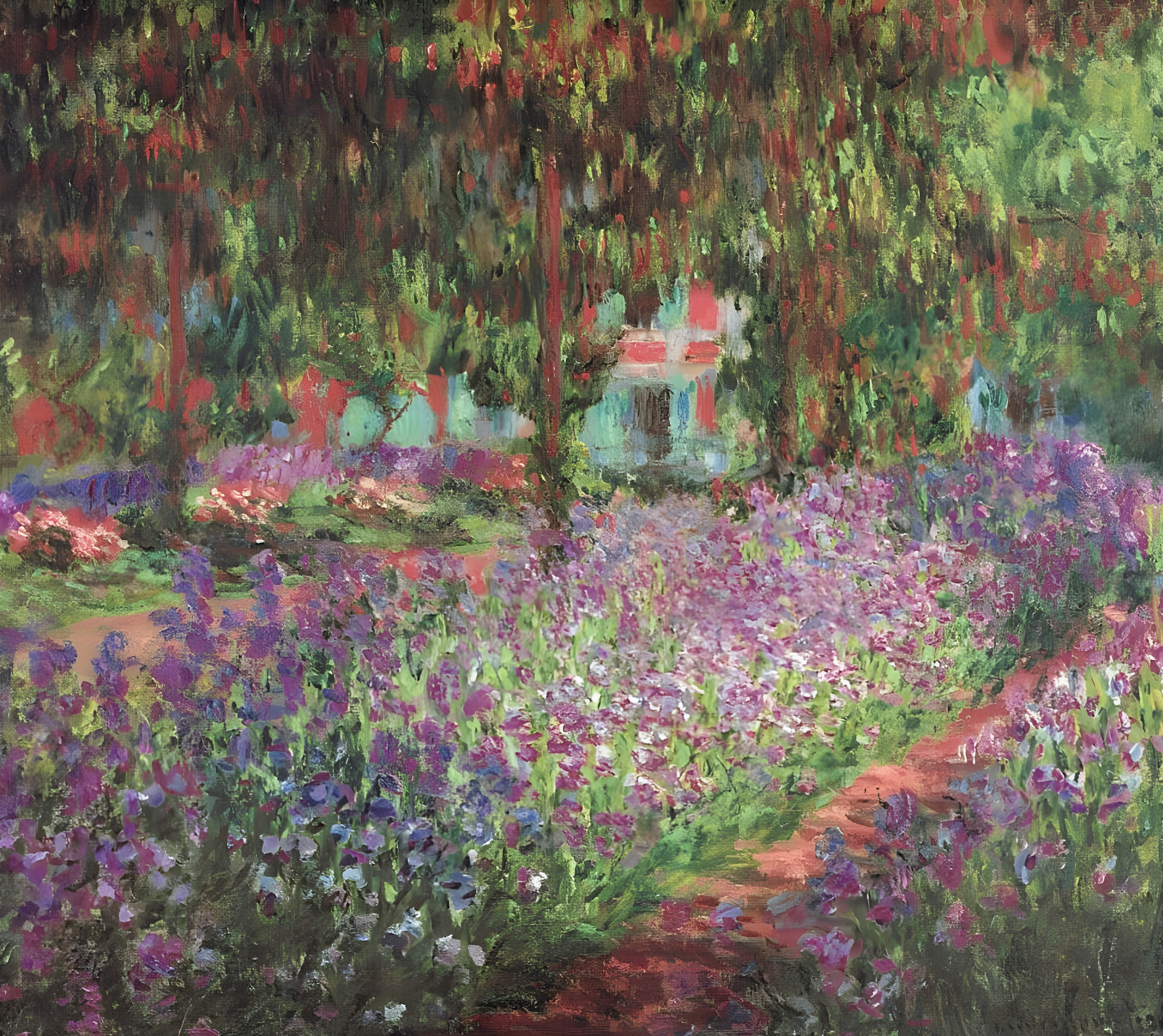
The Artist’s Garden at Giverny is Monet’s canvas of 1900: Monet’s own flower garden in full bloom, with beds of purple and violet irises, a reddish path curving away to the right and the pink house with green shutters glimpsed through the trees. The original hangs in the Musée d’Orsay in Paris. We make it as a hand-painted reproduction in oil on canvas, in seven sizes or to your own measurement, with a photograph of the finished work sent for approval before dispatch.
| Title: | The Artist’s Garden at Giverny |
| Other titles: | Le Jardin de l’artiste à Giverny · Der Garten des Künstlers in Giverny · Il giardino dell’artista a Giverny |
| Painter: | Claude Monet (1840–1926) |
| Year painted: | 1900 |
| Original size: | 92.6 cm x 81.6 cm |
| Original technique: | Oil on canvas |
| Painting style: | Impressionism |
| Located at: | Musée d’Orsay, Paris (inv. RF 1983-6) |
| Our reproduction: | Hand-painted oil on canvas, seven sizes or made to measure |
The Artist’s Garden at Giverny – Claude Monet
What is shown?
Late spring in the garden Monet made at Giverny. Almost the whole lower half is a sea of irises in purple, violet and blue, with flashes of pink and white between them. A reddish-brown path curves in from the lower right and disappears among the flowers; behind them stand the trunks of trees, their branches hanging down from the top edge, and through them shows the pink wall and green shutters of Monet’s house. There is no person in the garden: the flowers are the whole subject.
A garden planted to be painted
Monet moved to Giverny, about 75 km from Paris, in 1883 and spent the rest of his life turning the land around the house into a garden. He chose the plants for their colours and their season, and he painted the result again and again. Here the irises are planted so densely that the beds read as one moving surface of colour rather than as separate flowers.
Why does this painting matter?
It shows the garden at the moment Monet was turning from painting places he visited to painting the place he had made. A few years later the water garden across the road took over his work completely. This flower garden is the other half of Giverny, louder and warmer than the pond, and it is painted with the same freedom.
Colour instead of outline
No iris is drawn. Each flower is a short touch of violet, blue or pink, and the leaves are strokes of green between them. Seen from close up the canvas is almost abstract; from a few steps back it becomes a garden. That double reading is what makes it work so well on a wall, where it is seen from both distances.
Giverny in other Monet paintings
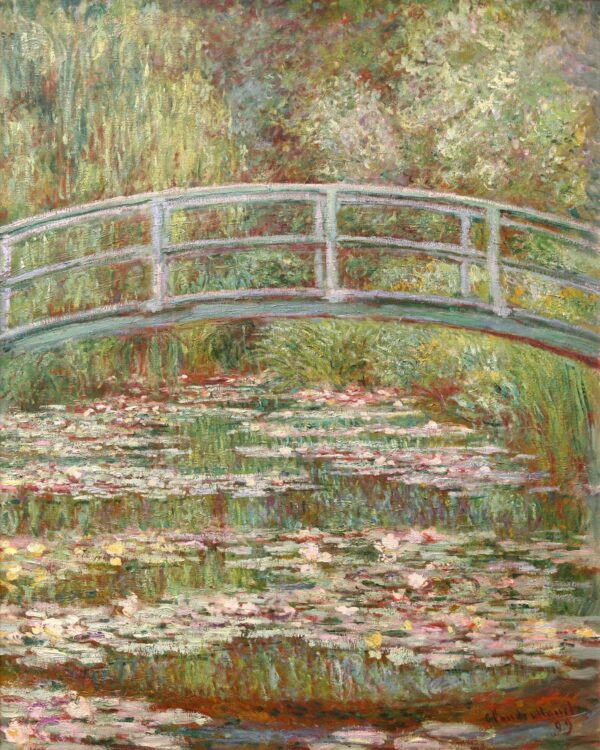
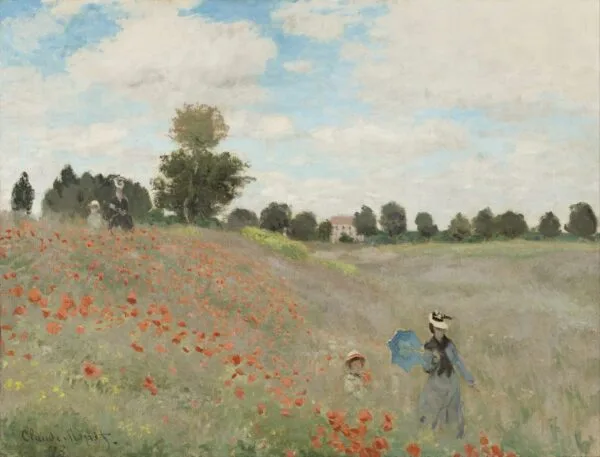
Giverny gave Monet his last great subjects. The water garden seen straight down into the pond is Water Lilies; the wooden bridge over the same pond is The Water Lily Pond (Japanese Bridge); and the fields just outside the village in summer are Poppy Field (Giverny).
How is our hand-painted version made?
The painter starts with the dark parts: the tree trunks, the shadows under the branches and the green between the flowers. Then the path and the glimpse of the house, and only after that the irises themselves, laid on in short touches of violet, blue and pink, thicker in the foreground and finer towards the back. If the flowers are painted as neat shapes, the garden stiffens; it has to stay loose, as in the original.
Every piece is a hand-painted copy in oil on canvas, made for your order. An impressionist painting lives on its visible brushwork, so we do not smooth it away: the strokes stand slightly above the surface and catch the light, which a printed oil painting reproduction cannot do.
Which size for which wall?
Short answer: 90 x 80 cm above a sofa or sideboard, 60 x 50 cm for a hallway or a smaller wall, and 150 x 140 cm for a large empty wall. A painting for the living room should take up about two thirds of the width of the furniture below it. All seven sizes, from 60 x 50 to 150 x 140 cm, follow the format of the original.
How high to hang the painting: put the centre of the canvas about 150 cm above the floor; above a sofa, leave 20 to 30 cm between the back and the lower edge.
Made to measure, stretcher and frame
If none of the sizes suits, we paint to measure — send the width and the height and we will quote a price and a lead time. The original measures 92.6 x 81.6 cm, almost square and a little wider than high. Every canvas painting we make is stretched over a wooden stretcher with painted edges, so it does not look unfinished without a frame. A light natural wood or a soft white moulding suits the violets and pinks; a fine antique gold frame also brings out the warm tones of the path and the house.
Delivery and guarantee
We ship to the United Kingdom, Ireland and across the EU, wrapped in protective film and packed in a rigid box. Before dispatch we send you a photograph of the finished work; if something on it is not right, we correct it while the canvas is still in our workshop. Every other Monet reproduction we paint is in the Claude Monet gallery, and we write about the painter and about choosing a subject on our blog.
If the painting is a gift and you are unsure of the size, there is a wall art voucher: the recipient chooses the size and the subject.
Frequently asked questions
Where is the original?
In the Musée d’Orsay in Paris, under inventory number RF 1983-6. The work is recorded in Wikidata, and the photograph we paint from is on fineartfree.com.
What year is it from?
From 1900. Monet had been living at Giverny since 1883, and by then the flower garden in front of the house was in full growth.
Which flowers are in the painting?
Mainly irises, in purple, violet and blue, which flower in late spring. Between them are touches of pink and white from other plants in the beds.
Where is Monet’s garden?
In Giverny, a village in Normandy about 75 km north-west of Paris. The house and the gardens are still there and can be visited today.
- Painted by hand. Oil on canvas, no print and no machine application.
- Seven sizes or made to measure. From 60 x 50 to 150 x 140 cm, all in the format of the original.
- A photograph before dispatch. You see the finished work before it leaves the workshop.
- About the original. Year, size and inventory number as recorded for the Musée d’Orsay canvas.