





Description
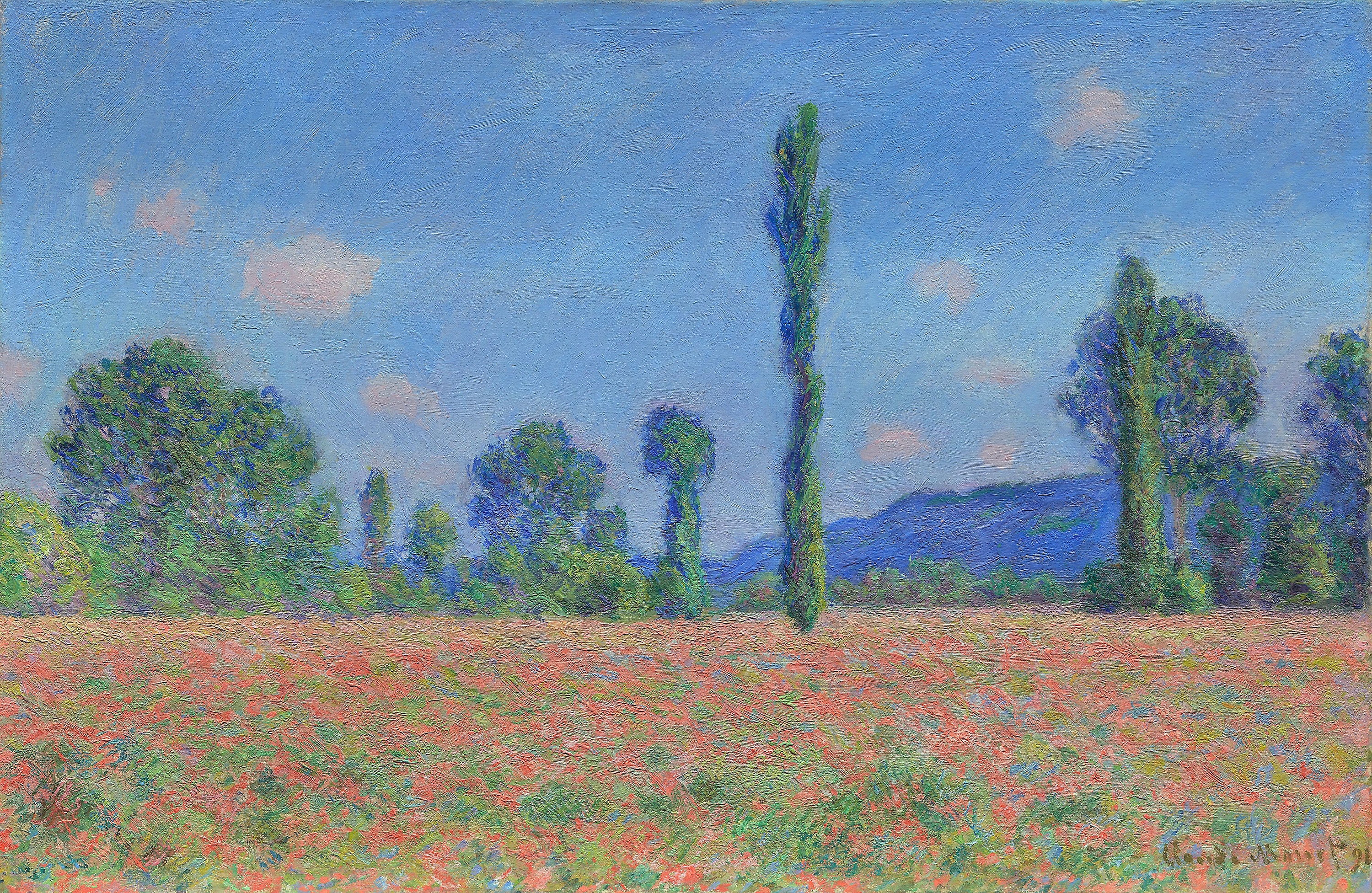
Poppy Field (Giverny) is a hand-painted reproduction of Monet’s canvas at the Art Institute of Chicago: the lower half is a dense carpet of red touches, above it a pale straw-coloured band of unmown grass, behind that a line of trees with a single slender poplar right of centre, and beyond them a blue-violet ridge. The original measures 93.4 x 61.2 cm, is oil on canvas and carries the accession number 1922.4465. The museum dates it to the span 1890–91, while the canvas is signed at the lower right “Claude Monet 91”. We paint it in eight sizes or to your own, with a photograph of the finished work for approval before despatch.
| Title: | Poppy Field (Giverny) |
| Other titles: | Champ des Coquelicots (New York 1893) · Coquelicots (Durand-Ruel, New York 1895) · Landscape (Buffalo 1896) · Red Poppies (possibly Pittsburgh 1897) · Champ de coquelicots (Durand-Ruel deposit book) · Wildenstein catalogue, no. 1253 |
| Painter: | Claude Monet (1840–1926) |
| Year painted: | 1890–91 in the museum record, with a start year of 1890 and an end year of 1891; the canvas is signed at the lower right “Claude Monet 91” |
| Original size: | 93.4 cm x 61.2 cm |
| Original technique: | Oil on canvas |
| Painting style: | Impressionism |
| Located at: | Art Institute of Chicago (acc. no. 1922.4465) |
| Our reproduction: | Hand-painted oil on canvas, eight sizes or made to measure |
Poppy Field (Giverny) – Claude Monet
What is on the canvas?
The lower half is the poppy field. The red flowers are not separate blooms but short slanting touches of vermilion in the green, with blue-violet and pale yellow strokes among them. Towards the horizon they thicken into one shimmering surface; at the bottom edge they open out on bare earth. No person is on this canvas, no parasol and no path.
A pale band of unmown grass closes the field at the top, and behind it a line of trees: a broad round crown left, pollarded trunks with globe tops at the centre, two tall trees right. Among them one slender poplar rises as a dark vertical into the upper third of the sky, the only thing here going upward. Behind it a blue-violet ridge under a plain sky of broad horizontal strokes.
When was the canvas made, and what does it say?
The Art Institute of Chicago gives no single year. Its record reads 1890–91, start year 1890 and end year 1891, a span rather than a date.
On the canvas there is a year. Span and signature do not contradict: the museum writes that Monet began these fields in July 1890, and the canvas carries the year it was finished.
What does the museum record say about the size?
The Art Institute of Chicago holds it under accession 1922.4465, by its own record on view in Gallery 240. It publishes the measurements height by width, 61.2 x 93.4 cm; our table puts width first, so here you read 93.4 x 61.2 cm. Framed, 109.3 x 77.5 x 7 cm, reordered the same way.
Here the museum and the Wikidata collection part twice. On one thing they agree: the Wildenstein number is 1253 in both.
The proportion can be checked on the picture too. Our photograph and the museum’s plate both sit at 0.651 and the measured canvas at 0.655, so both photographs are a shade wider than the canvas, which a crop to the painting gives.
From Monet’s studio to Chicago
The museum publishes a chain of owners and sources every station, yet holds back at the first: the painter possibly sold the canvas to the dealer Hamman in Paris, acting for Knoedler of New York, in September 1891, per the Wildenstein catalogue of 1996. The word possibly is the museum’s and stays.
From there the chain is firm, but three things happen on one day. By 24 January 1893 the canvas belonged to Potter Palmer of Chicago, by that same day it was on deposit with Durand-Ruel in New York, and on that same day it was sold to that firm for 5,000 francs. The museum does not explain it and neither do we.
On 16 April 1901 William W. Kimball of Chicago bought it for $3,200, and after his death Evaline M. Kimball bequeathed it to the museum in 1922.
How many names has this canvas travelled under?
Six that the museum names itself, none of them the present one. In New York in 1893 it hung as Champ des Coquelicots, at Durand-Ruel in January 1895 as Coquelicots, in Buffalo in 1896 as Landscape. Three carry a possibly: Boston 1895 Coquelicots, Pittsburgh 1897 Red Poppies, Omaha 1898 Coquelicots. The deposit book has Champ de coquelicots.
Is this a series or not?
It is not, and the museum says so plainly. In July 1890 Monet began four almost identically scaled poppy-field canvases near his home at Giverny, and he did not consider them a series, unlike the twenty-five paintings of stacks of wheat begun after that summer’s harvest. They show a far more homogeneous touch than his earlier landscapes, with a surface of tapestry-like materiality.
Nothing of the kind is in the museum record, which says the opposite. The story about hours belongs to the stacks of wheat, not to this field.
Which four are meant, the museum does not say. In the Wildenstein catalogue 1253 has 1251, 1252 and 1255 beside it, poppy fields of the same season and almost the same size; Wikidata puts 1252 in Boston and 1255 in the Hermitage. Whether those three are meant we do not know and do not choose.
Which other poppy fields by Monet do we sell?
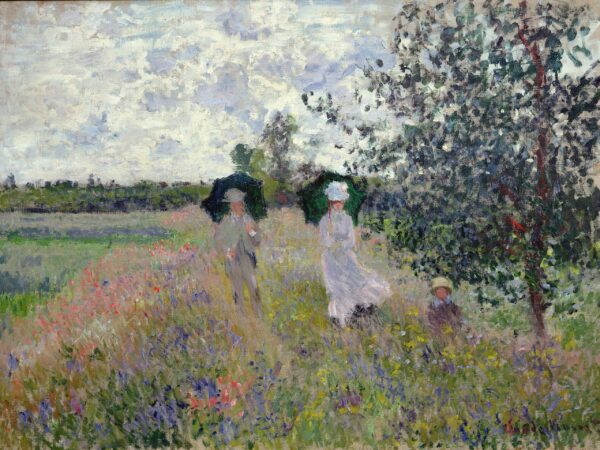
In our Claude Monet gallery the work most easily confused with this is seventeen years older. Poppies near Argenteuil is the canvas people mean by Monet’s poppies, held by the Musée d’Orsay under RF 1676, dated 1873, measuring 65.3 x 50 cm. It is more upright and a little over two thirds as wide, two figures with a parasol come down the slope, and the museum adds the name La promenade.
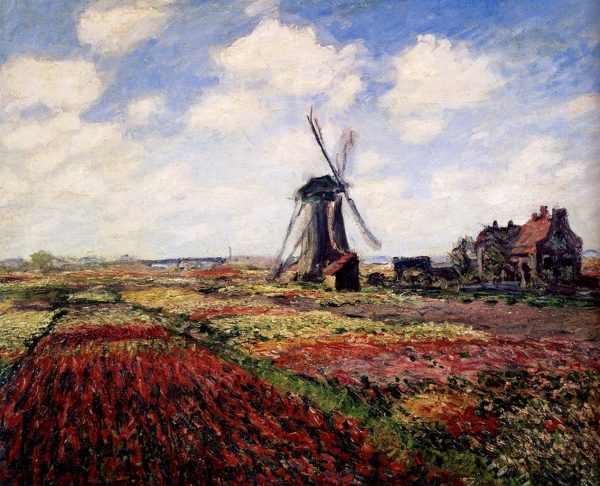
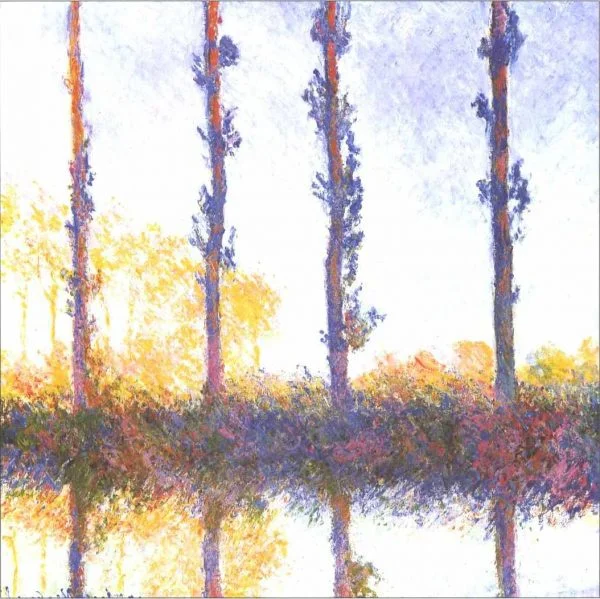
Four more works come from the same countryside or year. Stack of Wheat (Snow Effect) is from the same Chicago collection and the series begun after that harvest. Poplars carries the same year and is at the Metropolitan Museum of Art. Meadow at Giverny is of 1886. Field of Tulips in Holland is another field in flower, in another country. Monet’s own flower garden at Giverny, with rows of purple irises leading towards the house, is The Artist’s Garden at Giverny.
How is our hand-painted version made?
Every order is painted individually by an artist, in oils on cotton or linen canvas. That is how every canvas painting is made here, with no print and no machine step. This impressionist painting is hard where it looks easiest: the red field is thousands of short strokes, and laid too evenly it stiffens into a pattern.
The second test is the poplar, which must stay narrow and still read against a sky of almost the same lightness, so it takes no dark outline. Out of doors, en plein air, the underlayer stays light and the heavier paint goes into the flowers alone. An oil painting reproduction of this kind takes no gloss, so ours stays matt.
Which size for which wall?
Eight sizes are available, from 60 x 40 to 240 x 150 cm, and the two answers contradict each other. By size the nearest is 100 x 60 cm, 6.6 cm wider and 1.2 cm lower than the Chicago canvas. By ratio the nearest is the smallest, 60 x 40 cm, at 0.667 against the original’s 0.655, while 100 x 60 cm sits at 0.600, further off than any.
For the reach of the original take 100 x 60 cm; if proportion matters more, 60 x 40 cm. A hallway takes 60 x 40 cm, a dining table 100 x 60 cm, a large wall 160 x 100 cm. As a painting for dining room walls it works because the red survives evening light.
How high to hang the painting: the centre about 145 cm above the floor, the line of trees at eye level.
Made to measure, stretcher and frame
For a size not on the list, work to your own measurement is the only route, because both best listed sizes are a compromise. Send width and height in centimetres. The frame is not included; a narrow moulding in pale cool wood suits it, a wide gilt frame pushes the red towards brick.
Delivery and guarantee
Making the work takes two to three weeks, longer at the largest sizes, because the oil dries between layers. Stretched canvases travel in a rigid box, rolled ones in a tube. If it arrives damaged or differs noticeably from the approved photograph, we replace or refund it. A hand-painted copy is no factory product and small differences in the stroke are expected; damage is not.
If the painting is a gift and you are unsure of the size, there is a gift voucher: the recipient chooses the size and the subject.
Frequently asked questions
Where is the original?
At the Art Institute of Chicago, 1922.4465, by its record in Gallery 240.
What does the work say in one sentence?
That a field is red only until you look closely.
How many poppy fields did Monet paint at Giverny?
In July 1890 he began four almost identically sized canvases of poppy fields near his house at Giverny. Shortly afterwards, after the harvest that same summer, he started the stacks of wheat.
What year is it from?
The museum dates it 1890–91, and the signature at the lower right reads “Claude Monet 91”. Monet began the poppy fields near Giverny in July 1890.
- Subject. A poppy field under trees with one poplar, a ridge beyond, no figures.
- Original. Oil on canvas, 93.4 x 61.2 cm, 1890–91; Art Institute of Chicago, 1922.4465.
- Ours. Eight sizes; 100 x 60 cm by size, 60 x 40 cm by proportion.
- Worth knowing. The museum dates with a span; the canvas reads “Claude Monet 91” lower right.