







































Description
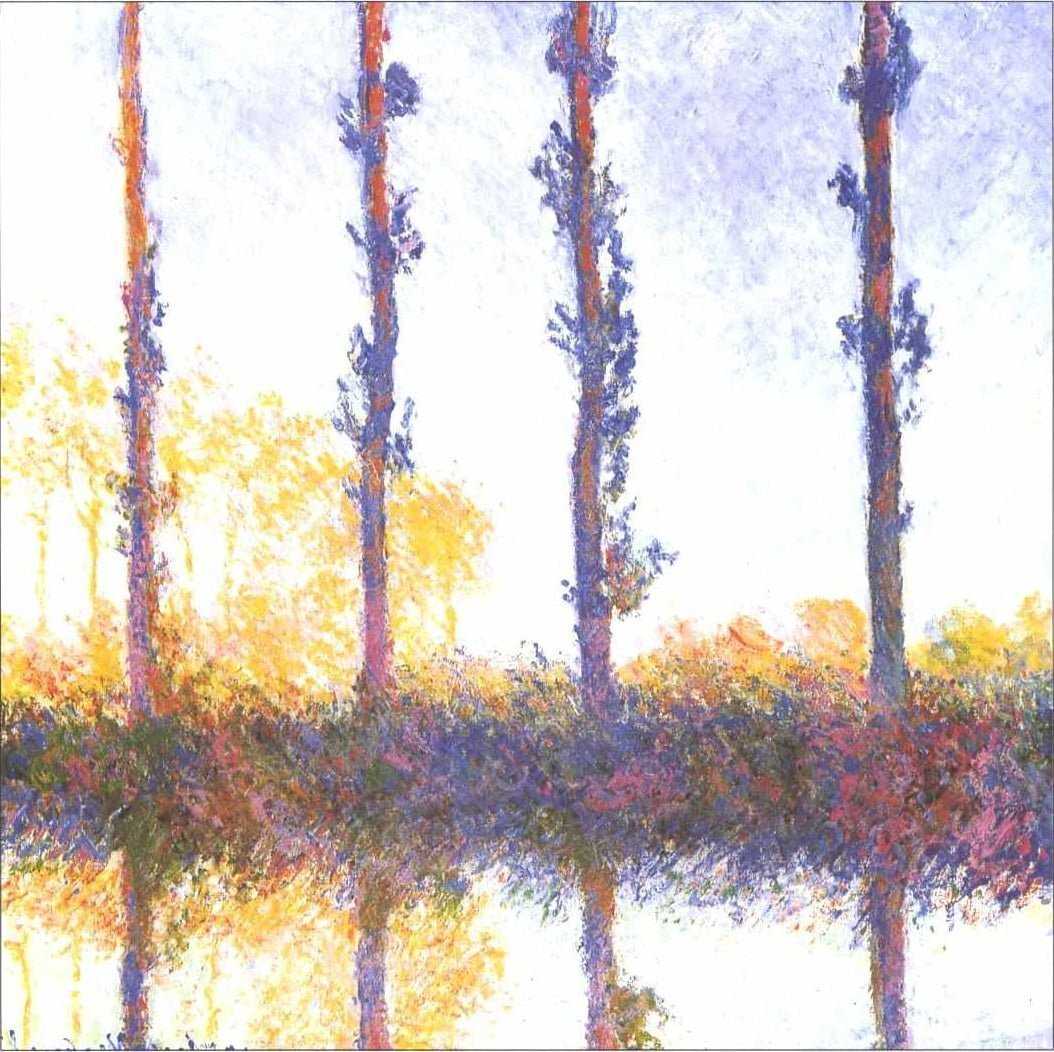
Poplars is a hand-painted reproduction of a Monet canvas of 1891: four slender trees rise the whole height of a square canvas, and behind them the row along the river Epte at Giverny recedes into the distance. The original measures 81.6 x 81.9 cm, oil on canvas, signed and dated lower left “Claude Monet 91”, and is held by the Metropolitan Museum of Art in New York under accession number 29.100.110. We paint it in eight square sizes, 60 x 60 to 180 x 180 cm or to your measurement, with a photograph of the finished work for approval before dispatch.
| Title: | Poplars |
| Other titles: | The Four Trees · Les Quatre Arbres |
| Painter: | Claude Monet (1840–1926) |
| Year painted: | 1891, signed “Claude Monet 91” lower left |
| Original size: | 81.6 cm x 81.9 cm |
| Original technique: | Oil on canvas |
| Painting style: | Impressionism |
| Located at: | Metropolitan Museum of Art, New York (inv. no. 29.100.110) |
| Our reproduction: | Hand-painted oil on canvas, eight square sizes or made to measure |
Poplars – Claude Monet
What is on the canvas?
The canvas is square; four very slender trunks rise its whole height, almost evenly spaced. They are narrow dark-brown and violet verticals with bluish tufts of foliage clinging to them; none stops below the upper edge — all four run past it. The sky behind is a pale blue-green and anything but smooth, laid on in short, plainly visible strokes. At the left, further back, is a mass of golden-yellow autumn foliage, the only warm area. Across the lower half runs a broad diagonal band of dark blue and violet strokes falling to the right: the same row of trees, receding along the river. Below it lies the water, pale green and pink, the trunks continuing downwards as softer verticals; at the bottom centre sits a small green shrub.
Where and when was the scene painted?
On the river Epte at Giverny, in the summer and autumn of 1891, outdoors — en plein air. The Metropolitan records a whole series of views of these poplars that season; some were worked from the bank, this one from a flat-bottomed boat fitted with grooves to hold several canvases at once. Accounts of how many there were differ – twenty-three or twenty-four canvases – and the museum’s record gives no number. The method was unforgiving: he worked on a canvas only as long as the effect he was chasing lasted, then set it aside for the next. Each is therefore a different moment of that season. This working in series is what impressionist painting brought to art: not the subject, but time.
Why does this canvas matter?
For two reasons, both on the record. The first is what nearly happened to the trees: the village of Limetz, across the Epte, decided to auction the poplars for timber, and the painter stepped in so that he could finish the series. The Metropolitan writes that he paid a local lumber merchant to keep them standing until he had finished; the Scottish National Gallery in Edinburgh, which holds another canvas from the series, tells it differently — that Monet bought the trees at auction in partnership with a timber merchant. We give both, because they differ. The second reason is exhibition history: the poplars, like the grainstacks, were first shown as a series, fifteen of them in Paris in 1892. A Monet reproduction such as ours comes from one of the first cycles in which the whole mattered most.
What does the scene mean?
The same row appears twice, at two scales at once: the four trunks in front are individual, measurable, almost architectural, the row further back no more than a band of colour. That is exactly why the scene reads deeper than one would expect of a square — the distance is carried by the difference between drawing and mass, not by perspective. The sky is not a backdrop but an equal surface, with the same density of stroke as the foliage; because the trees continue in the reflection, the eye finds nowhere to rest. A canvas painting of this kind is also an exercise in warm against cool: golden yellow left, blue-violet across the middle, pale green above.
The work’s road from the painter to the Metropolitan
The museum record lists four entries before the bequest — two dealers and two private owners — and no more. The first is Knoedler of New York, which held it until 1893 under stock number 7287; at its American Art Association sale of 14 April 1893 it went as “The Four Trees (Poplar Series)” for 1,175 dollars to Durand-Ruel, who carried it under stock number 1063 and sold it on 12 January 1895 to the Havemeyers. Mr and Mrs H. O. Havemeyer owned it from 1895 until his death in 1907, then Louisine W. Havemeyer alone until her death in 1929, when her bequest brought it to the Metropolitan, where it now hangs in Gallery 819. Where it was before 1893 the record does not say, and neither do we.
The poplars among our other tree subjects
From the same series and stretch of river comes “Poplars on the Epte”, at the Scottish National Gallery in Edinburgh, NG 1651; it measures 82 x 81.4 cm, almost exactly as square as this one, which is why the two are the easiest to confuse. A different view of the same row — upright, from further away and with the bend visible — is A Row of Poplars. Trees by the water as a group appear in The Willows, a single tree in Weeping Willow. When the water leads and only the reflection is left, the result is Morning on the Seine, near Giverny.
How is our hand-painted version made?
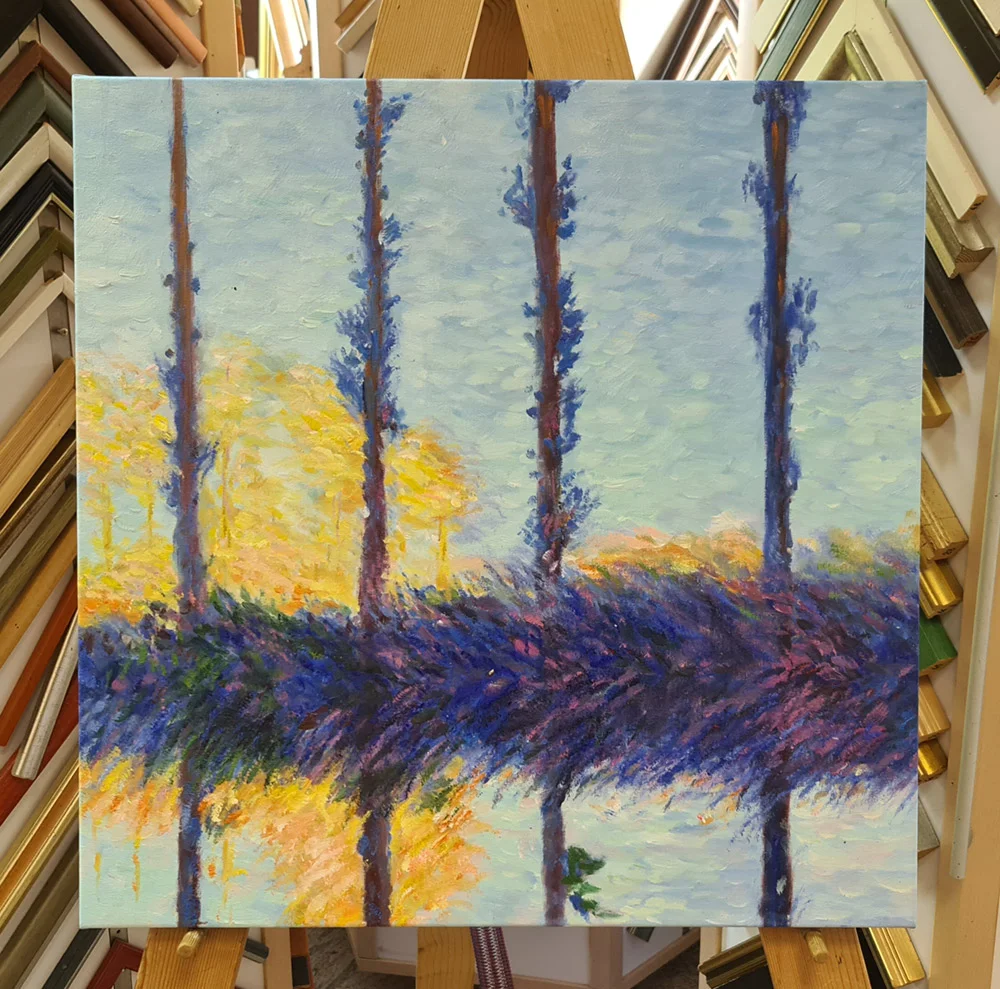
This is a hand-painted oil painting made with a brush, not a printer. In the first photograph the finished canvas stands on a wooden easel in our workshop, among the frame samples on either side: still unframed and already stretched, just before the final check; your own copy is made the same way and photographed before dispatch. It also shows what a print cannot do. The blue band of treetops is laid on thickly, the sky in thinner, quieter strokes, so the band changes more than the sky as you walk past. A print lays colour in an evenly thin film and is smooth everywhere. This is handwork: every hand-painted copy differs a little from the next.
Which size for which wall?
In short: 82 x 82 cm for the original’s size, 100 x 100 cm above a sofa. There are eight square sizes. 60 x 60 and 70 x 70 cm belong in a hallway or the narrow wall between two doors; 82 x 82 cm comes closest to the original’s 81.6 x 81.9 cm and is the most faithful choice; 90 x 90 cm and 100 x 100 cm suit a sideboard or a dining table, and are the sizes most often chosen for a painting for living room walls; 120 x 120, 150 x 150 and 180 x 180 cm are for large walls, where the verticals gain their true height. A square asks for a centre, not a wide wall. Because blue and gold are strong, this piece of impressionist wall art holds its own against a coloured wall, though it looks best on white.
How high to hang the painting: the centre 145 to 150 cm from the floor, or 15 to 25 cm above a sofa back.
Made to measure, stretcher bar and frame
If none of the eight sizes suits your room, we paint to a measurement you set yourself — send width and height and we will quote the price and the lead time. Making it to measure keeps the ratio of the sides: stretch the square sideways and the trunks stop being slender. The canvas is stretched on a wooden stretcher and the edges are painted, so it does not look unfinished even without a frame. A 3D tool is available for the frame — it is only for choosing the frame and does not show the work in your room. Seeing it on your own wall is our separate room-placement service.
Delivery and guarantee
The work is made to order in our studio, so the lead time is 15 to 45 days, nearer the upper end at the largest sizes. We ship it stretched, in protective film and firm packaging, framed if you chose a frame. Before dispatch you receive a photograph for approval: if something is wrong, we correct it while the work is here. Our returns policy applies to every order. Other Monet subjects are in the Claude Monet gallery; we write about the painter on our blog.
If the painting is a gift and you are unsure of the size, there is a gift voucher: the recipient chooses the size and the subject.
Frequently asked questions
Where is the original?
The Metropolitan Museum of Art, New York, accession number 29.100.110, on view in Gallery 819.
Is anyone shown in the scene?
No — four poplars, the row behind, water with reflections, a shrub. No figure, no building.
What does the work say in one sentence?
That the same row stands twice on one canvas — in front as four drawn verticals, behind as a band of colour.
How many poplar paintings did Monet make?
More than twenty. In 1891 he painted the row of poplars along the Epte near Giverny again and again, in different light and seasons, and fifteen of the canvases were shown together in Paris in 1892.
- Subject. Four slender trunks through the whole height of a square canvas, a diagonal blue-violet band of treetops, water with reflections below.
- Original. Oil on canvas, 81.6 x 81.9 cm, 1891, signed lower left, Metropolitan Museum of Art, inv. no. 29.100.110.
- Ours. Eight square sizes from 60 x 60 to 180 x 180 cm or made to measure; 82 x 82 cm is 4 mm wider and 1 mm taller than the original.
- Worth knowing. Limetz had decided to auction the poplars for timber, and the painter stepped in so the series could be finished.