


Description
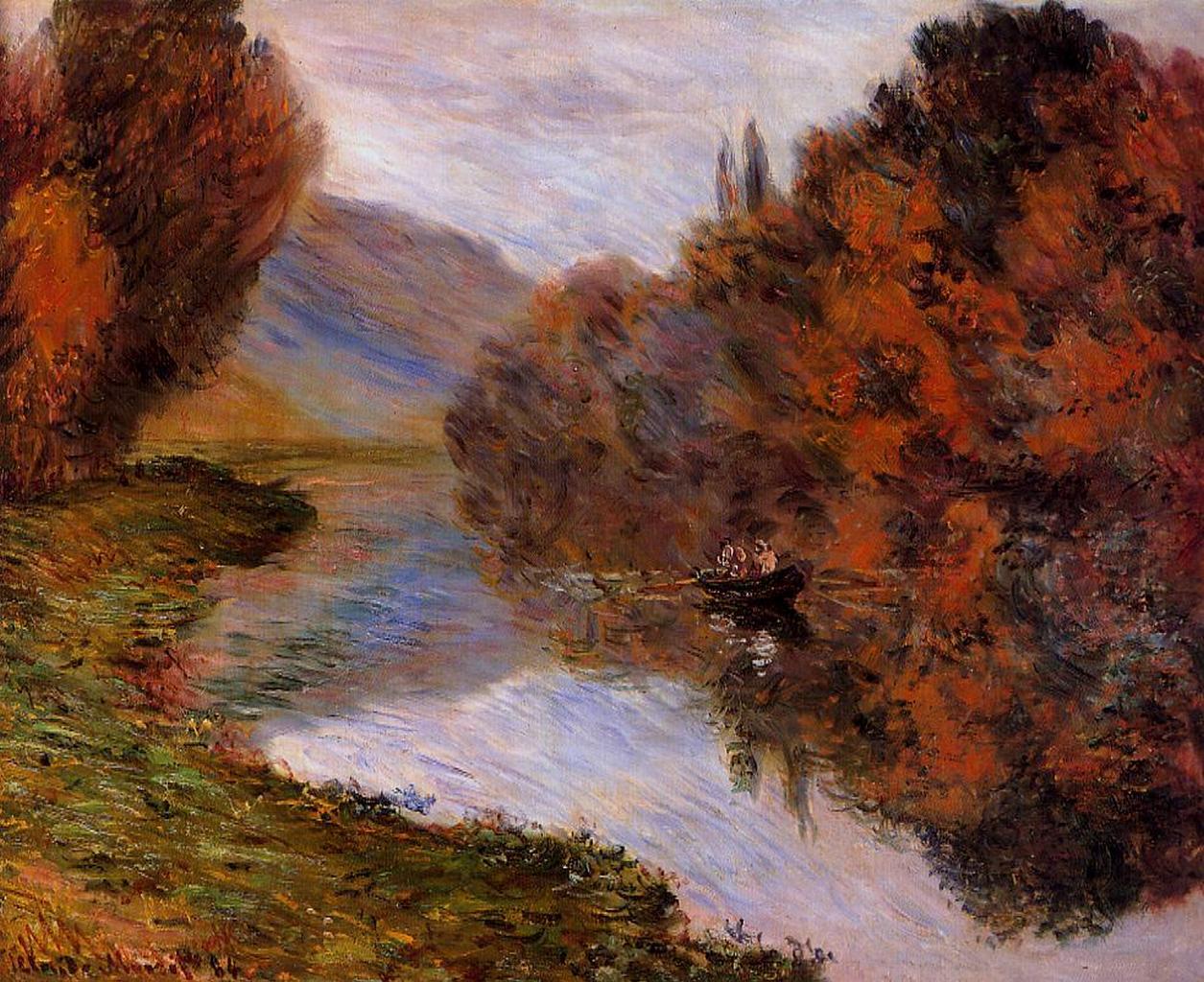
Barque sur la Seine à Jeufosse is a Monet canvas of autumn 1884: a narrow arm of the Seine between autumn trees, with a dark rowing boat and two figures on the water. The original measures 73 x 60 cm, is oil on canvas, and is signed and dated lower left “Claude Monet 84”. The catalogue raisonné lists it as number 915 and places it in a private collection rather than a museum. We paint it by hand in oil on canvas, at 73 x 60 cm — exactly the size of the original — or to your own measurement; before dispatch you receive a photograph of the finished work for approval.
| Title: | Barque sur la Seine à Jeufosse |
| Other titles: | Rowing Boat on the Seine at Jeufosse · Ruderboot auf der Seine bei Jeufosse |
| Painter: | Claude Monet (1840–1926) |
| Year painted: | 1884, signed “Claude Monet 84” lower left |
| Original size: | 73 cm x 60 cm |
| Original technique: | Oil on canvas |
| Painting style: | Impressionism |
| Located at: | In a private collection — not in a public collection and not on display (Wildenstein catalogue, no. 915) |
| Our reproduction: | Hand-painted oil on canvas, 73 x 60 cm or made to measure |
Barque sur la Seine à Jeufosse – Claude Monet
What is on the canvas?
The river runs diagonally across the canvas, from upper left to lower right, and it is narrow — a side arm rather than a broad channel. On the left a grassy bank slopes into the foreground in olive and yellow-green strokes, with small white flowers along the water. Above it stands a tall tree in rust tones. The right half is taken up by a dense mass of autumn foliage: orange, brick, in places almost red, with dark green and blue shadows between. It continues into the water as a spilled reflection, almost as dense as the trees above. Towards the centre a few narrow dark poplar tips rise into the pale sky. On the water, right of centre, sits a dark rowing boat with two pale figures, the oars out. In the distance, top centre, lies a pale blue-grey hill. The sky is grey-lilac in broad horizontal strokes, and the signature is lower left, in the grass.
Where and when was the scene painted?
On the Seine at Jeufosse, in the autumn of 1884. The catalogue records that in early September that year Monet returned to Giverny and went to paint on the left bank at Jeufosse, south-east of Port-Villez. From this stretch of river it lists ten canvases, numbered 909 to 917, with a 912a inserted between 912 and 913 — all the same piece of river in different weather. Beside number 914 the catalogue describes what we are looking at: the painter faces downstream, the mass of trees on the right is the Île de la Merville, and the hill left of the river is the Jeufosse bank, running down towards the Coteau du Gibet at Port-Villez. Our canvas is the same view, so the description holds. An impressionist painting of this motif had to be made outdoors, en plein air: the foliage changed weekly.
Why does this canvas matter?
Because of the boat. Beside this number the catalogue adds a short note — see number 914 — and says Monet painted the rowing boat he probably used to cross the river himself. The means of transport becomes part of the scene. Number 914 shows the same view in bright weather, and there the boat is absent — same river, same island, same hill, only empty water. Side by side they describe how Monet worked: the motif, then the same motif in another light, once with the boat he used daily. A canvas painting that shows its own backstage so casually is rare.
What does the scene mean?
The scene rests on two contrasts. The first is colour: nearly all the warmth sits on the right, in the foliage, while the bank and sky stay cool. The second is scale: the trees are close, dense and detailed, the hill behind only a pale surface without form. Between them runs the water, repeating both — warm right, cool left — and the narrow arm reads deeper than so small a canvas would suggest. The boat is the only dark, solid shape and the only thing that moves; the eye finds it at once because everything else is painted soft. A hand-painted oil painting with this balance is quiet without being empty.
The work’s road, as the catalogue records it
The entry on former owners is short; we give it as it stands. The catalogue lists three stations: Hermann Heilbuth, then the Durand-Ruel gallery in 1900, then the sale at Christie’s in London on 28 November 1994, where the canvas went as lot 12. Who bought it, and where it hangs now, is not publicly recorded. The catalogue also notes that the work was shown at Elberfeld in 1910, in the exhibition Art français moderne, as number 40, and that W. Dewhurst had reproduced it in 1904 in Impressionist Painting, page 46. How it passed from the painter to Heilbuth the catalogue does not say: for the neighbouring works it records a Durand-Ruel purchase in November 1884, for this one that sentence is missing, and so we do not supply it. The volume can be consulted in digitised form.
This motif among the Jeufosse canvases and in our catalogue
From the same group, Automne à Jeufosse is on public display at the Museum Barberini in Potsdam; same size as ours, 73 x 60 cm, and the same year, so Jeufosse can be seen in the original. The same motif exists here in two versions, the second being Barque sur la Seine à Jeufosse 2, which carries photographs of the finished work from our workshop. Related river subjects: The Seine at Bougival, The Promenade near Argenteuil and A Row of Poplars, where autumn trees beside water return in an upright format.
How is our hand-painted version made?
This is an oil painting reproduction made with a brush and oil paint, not with a printer. The order of work matters here. The painter starts with the sky and the pale hill behind, which set the light for everything else; then the water, in broad slanting strokes; and only at the end the foliage on the right, laid on thickest. The reflection must stay softer than the trees above it, or the scene flattens out. The boat comes last: a few dark strokes and two pale dots that must stay indefinite — the moment they become faces, the scene loses its quiet. Because this is handwork, every hand-painted copy differs a little from the next.
Which size for which wall?
Short answer: 73 x 60 cm, the only regular size of this work and exactly the size of the original. The canvas is landscape and not large, so it belongs where it can be seen closely — above a hallway chest, beside a desk, on a narrower bedroom wall. Above a sofa or dining table a size like this is lost; there, order a larger one made to measure. Because the colours are warm and dark, this Monet reproduction sits well on a white or light grey wall; on a dark one the foliage merges into it.
How high to hang the painting: the centre of the canvas 145 to 150 cm from the floor; above a chest of drawers, 15 to 25 cm above its top.
Made to measure, stretcher bar and frame
If 73 x 60 cm does not suit you, we paint the work in the size you set — send width and height and we will quote the price and the lead time. Keep the ratio of the sides: stretch the canvas too far sideways and the narrow arm becomes a broad channel. It is stretched on a wooden stretcher bar with the edges painted, so it does not look unfinished even unframed. A 3D application is available for choosing a frame — it is for the frame choice only and does not show the work in your room. Seeing it on your own wall is a separate service.
Delivery and guarantee
The work is made to order in our studio, so production takes 15 to 45 days, closer to the upper limit for larger sizes. We send it stretched on the bar, in protective film and firm packaging. Before dispatch you receive a photograph of the finished work for approval: if something is not right, we correct it while the work is still with us. Our returns policy applies to every order. Other Monet subjects are in the Claude Monet gallery, and we write about the painter on our blog.
If the painting is a gift and you are unsure of the size, there is a gift voucher: the recipient chooses the size and the subject.
Frequently asked questions
Where is the original?
Not in a museum. The catalogue lists it in a private collection; the last public trace is the 1994 Christie’s sale in London.
Who are the two figures in the boat?
The records do not name them. There are only two small pale figures with oars; the catalogue says nothing about them.
What is the painting about, in one sentence?
That the painter included the very boat he probably used to reach the motif.
Is the original for sale and what is it worth?
The last publicly recorded sale was in 1994 at Christie’s in London; the catalogue gives no price achieved. As far as is publicly known, it is not for sale today.
- Subject. A narrow arm of the Seine between autumn trees, a dark rowing boat and two figures on the water.
- Original. Oil on canvas, 73 x 60 cm, 1884, signed lower left, private collection, catalogue no. 915.
- Ours. Hand-painted oil on canvas at 73 x 60 cm, one to one with the original, or to your measurement.
- Worth knowing. The catalogue says Monet painted the very boat he probably used to cross the river.