







































Description
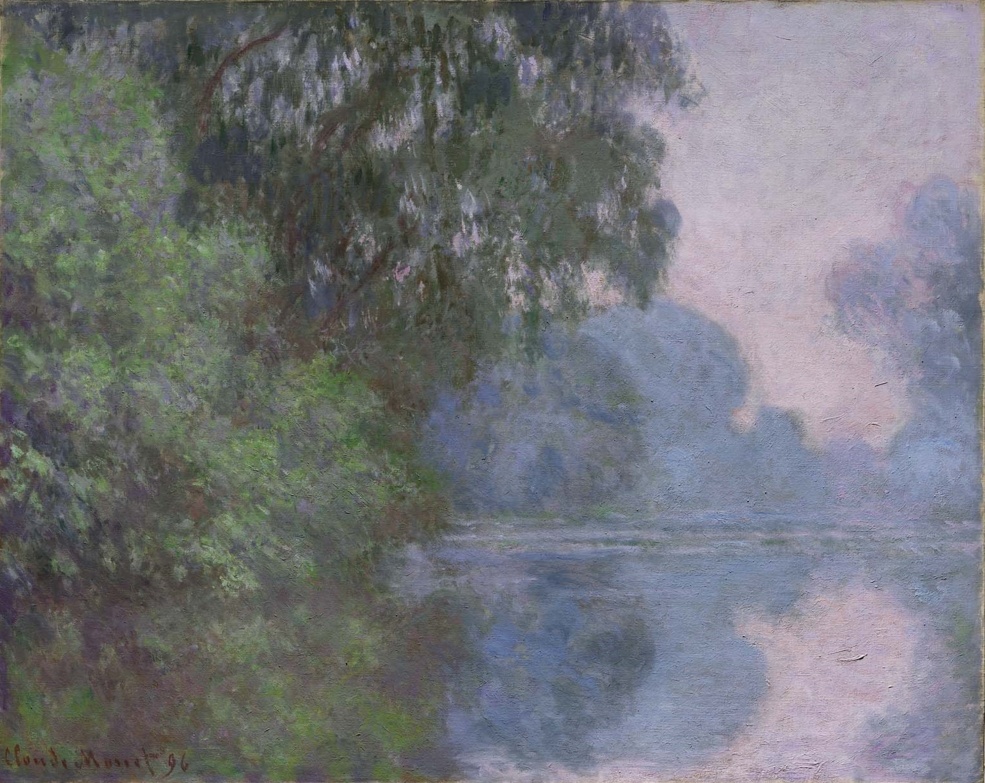
Morning on the Seine, near Giverny is a hand-painted reproduction of Monet’s canvas in the Museum of Fine Arts, Boston: from the left a dense mass of green and violet leaves hangs over the river, on the right bluish treetops barely show through the morning mist, and the pale pink sky is mirrored in still water. The original measures 93 x 73.7 cm, is oil on canvas, is signed “Claude Monet 96” at the lower left, dates from 1896 and carries accession number 39.655. We paint it in eight sizes or to your own, with a photograph of the finished work sent for approval before dispatch.
| Title: | Morning on the Seine, near Giverny |
| Other titles: | Morning on the Seine, near Giverny (the museum’s title); in the Wildenstein catalogue the work is number 1435 |
| Painter: | Claude Monet (1840–1926) |
| Year painted: | 1896 |
| Original size: | 93 cm x 73.7 cm |
| Original technique: | Oil on canvas |
| Painting style: | Impressionism |
| Located at: | Museum of Fine Arts, Boston (inv. 39.655) |
| Our reproduction: | Hand-painted oil on canvas, eight sizes or made to measure |
Morning on the Seine, near Giverny – Claude Monet
What is on the canvas?
The left two thirds of the canvas belong to foliage. From the upper left corner hangs a large mass of leaves in grey-green and violet, and below it the bank slopes down to the water in lighter yellow-green strokes. At the upper right the sky is pale pink and lilac, and in front of it two blue-violet groups of trees stand in the mist, their outlines dissolving.
About two thirds of the way down, a pale horizontal line of bank runs across the right half. Below it the water repeats everything above: the pink sky, the bluish crowns and the dark green on the left. There are no boats and no people on the canvas. The signature stands at the lower left in a reddish colour.
When and where was it painted?
The museum dates the canvas 1896, with no range, Wikidata gives the same year, and the inscription at the lower left reads Claude Monet 96. According to the museum’s record, in the summers of 1896 and 1897 Monet set up his easel at three-thirty each morning in a boat moored just off the riverbank near his house at Giverny. There he painted a series of twenty-one canvases, to which this one belongs.
What does the museum record say about the work?
The work is held by the Museum of Fine Arts, Boston, under accession number 39.655, with the credit line Juliana Cheney Edwards Collection. The museum gives the size height first, 73.7 x 93 cm, the technique as oil on canvas, and the inscription as “Lower left: Claude Monet 96”. The museum describes the series through grisaille effects of morning mist, trees half-visible in the dawn light and glimmering reflections, and calls it arguably the most subtle Monet ever painted.
Where has the canvas been?
The museum publishes the whole chain of owners. On 28 November 1898 Monet sold the canvas to Durand-Ruel in Paris, which entered it as stock number 3152 and then passed it to its New York branch, where it became number 1900. There Mrs. Potter Palmer of Chicago bought it on 29 January 1901, and on 3 March 1902 she sold it back to Durand-Ruel in New York, this time as number 2511.
On 22 March 1905 Durand-Ruel sold it to Arthur B. Crosby of New York. Crosby sold it on exactly a year later, on 22 March 1906, according to a museum note probably to Durand-Ruel. In 1907 it was with D. H. Cochran, Jr., who sold it on 19 February 1907 to Durand-Ruel in New York as number 2789.
On 21 March 1907 it was bought by Grace M. Edwards of Boston, who died in 1938; in 1939 the canvas came to the museum as her bequest, with an accession date of 11 October 1939. The museum adds that the Edwards siblings collected together and that it is not always possible to say who owned which work.
Which morning on the Seine is this?
The series runs, according to the museum, to twenty-one canvases, so the same title recurs. The Metropolitan Museum of Art in New York holds Morning on the Seine near Giverny, from 1897, oil on canvas, 93 x 81.6 cm, accession number 56.135.4, with the credit line “Bequest of Julia W. Emmons, 1956”. The Boston museum itself, according to Wikidata, holds a second canvas of the same title, 11.1261, from 1897, 92.7 x 81.3 cm. Ours is 39.655, from 1896, 93 x 73.7 cm, signed at the lower left.
Why does this work matter?
Because it shows how far Monet took the painting of light in his series. The subject is almost the same on all twenty-one canvases; the hour and the mist change. An impressionist painting of this kind tells of no place so much as of the minutes in which the mist lifts off the river.
Other series in our collection: A Row of Poplars (private collection, Wildenstein 1293) and Poplars (Metropolitan Museum, inv. 29.100.110), both from 1891. The river at Giverny also appears in The Seine at Giverny, 1897 (National Gallery of Art, Washington, inv. 1963.10.180); earlier river scenes are The Seine at Port-Villez, about 1890 (Musée d’Orsay, RF 2009), and Banks of the Seine, Vétheuil, 1880 (National Gallery of Art, 1963.10.177).
How is our hand-painted version made?
Each order is painted separately by an artist in oil on canvas, with no print and no machine step; that is how every canvas painting we send out is made. The difficulty here is the mist: the passages between tree, sky and water have to stay soft, with no hard edges, or the morning turns into afternoon.
The second test is the reflection. What lies above the bank line must repeat below it in the same tones, only darker and more diffuse. An oil painting reproduction of this canvas also depends on the palette: green, violet and pink have to stay quiet, never muddy. A Monet reproduction with contrasts this low will not take a glossy varnish, so ours stays matt. A hand-painted copy is not a facsimile: two canvases of the same size always differ in the brushwork.
Which size for which wall?
There are eight sizes, from 45 x 38 to 150 x 120 cm. By size the closest to the original is 90 x 70 cm, 3 cm narrower and 3.7 cm lower, but at 1.2857 a little longer in shape than the original at 1.2619. By proportion the closest are 50 x 40 and 150 x 120 cm at 1.2500, followed by 90 x 70 cm.
For nearly the size of the original choose 90 x 70, for a large wall 150 x 120, and for a smaller one 50 x 40. The quiet colours and the reflection calm a room, which makes this a good painting for the living room or a bedroom. All sizes are listed with the product in our Claude Monet gallery.
Custom size, stretcher bar and frame
If the size you want is not on the list, choose made to measure: send us the width and height and we keep the proportion of the original. The canvas is stretched on a wooden bar, and a frame is not included in the price.
Delivery and guarantee
Making it takes two to three weeks, a few days longer at the largest sizes. We send the canvas stretched on its bar in a sturdy box, or rolled in a tube, always with tracking. If it arrives damaged or differs noticeably from the photograph you approved, we replace it or refund you.
If the painting is a gift and you are unsure of the size, there is a voucher: the recipient chooses the size and the subject.
Frequently asked questions
Where is the original?
In Boston, at the Museum of Fine Arts, accession number 39.655.
What year is it from?
1896. The museum, Wikidata and the inscription at the lower left all give that year.
What is this work about, in one sentence?
About morning mist on the Seine, in which trees, sky and water almost merge.
How many Mornings on the Seine did Monet paint?
Twenty-one canvases, in the summers of 1896 and 1897. He set up his easel at half past three in the morning in a boat moored off the bank near his house at Giverny and painted the light as the sun came up; fifteen were shown at the Galerie Georges Petit in 1898.
- Subject. Foliage over the Seine, bluish treetops in the mist and a pink sky mirrored in the water.
- Original. Oil on canvas, 93 x 73.7 cm, 1896; inscribed at the lower left “Claude Monet 96”; Museum of Fine Arts, Boston, inv. 39.655.
- Ours. Eight sizes; 90 x 70 cm is closest by size, 50 x 40 and 150 x 120 cm by proportion.
- Worth knowing. According to the museum, Monet set up his easel in the boat at three-thirty every morning.