Description
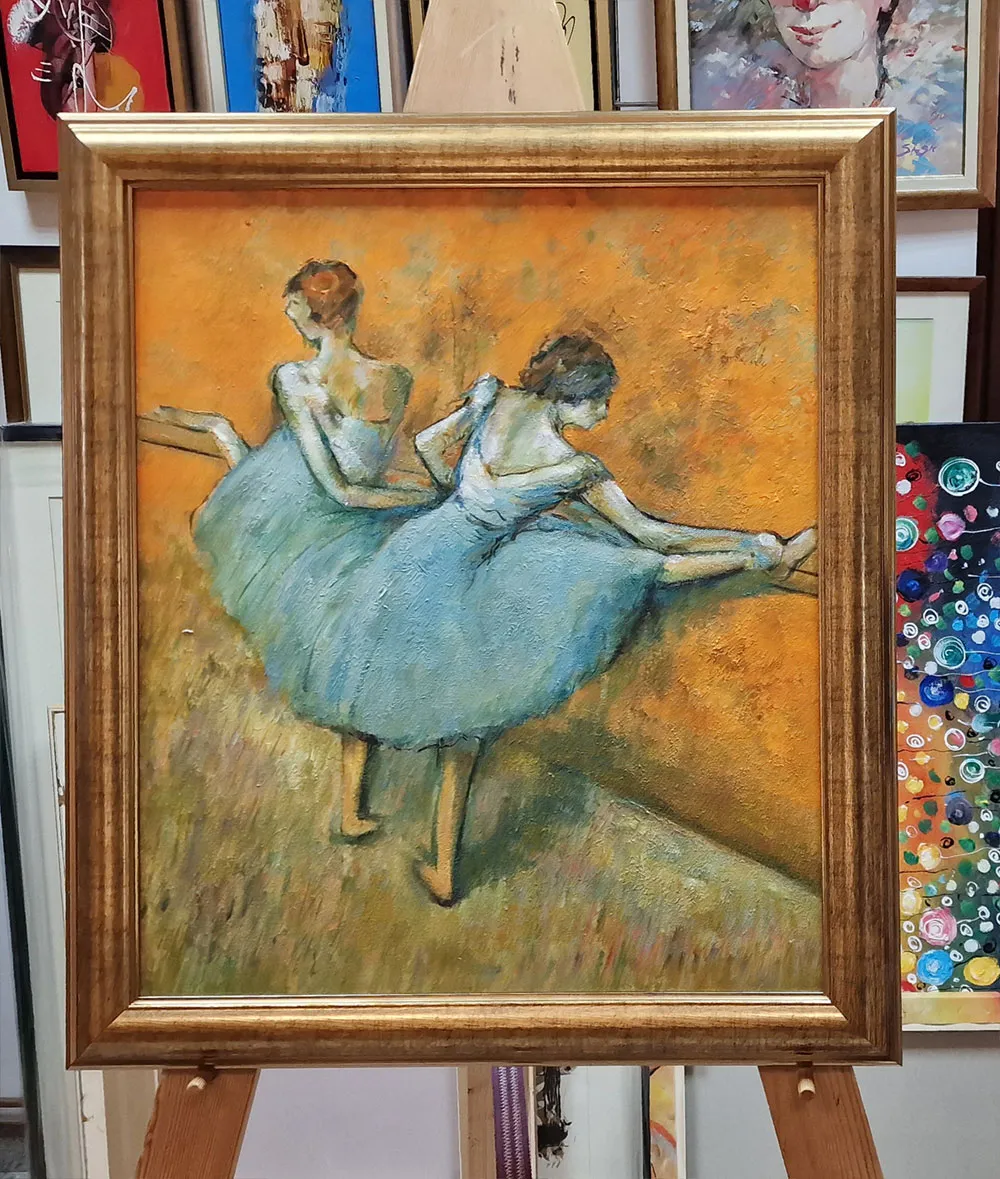

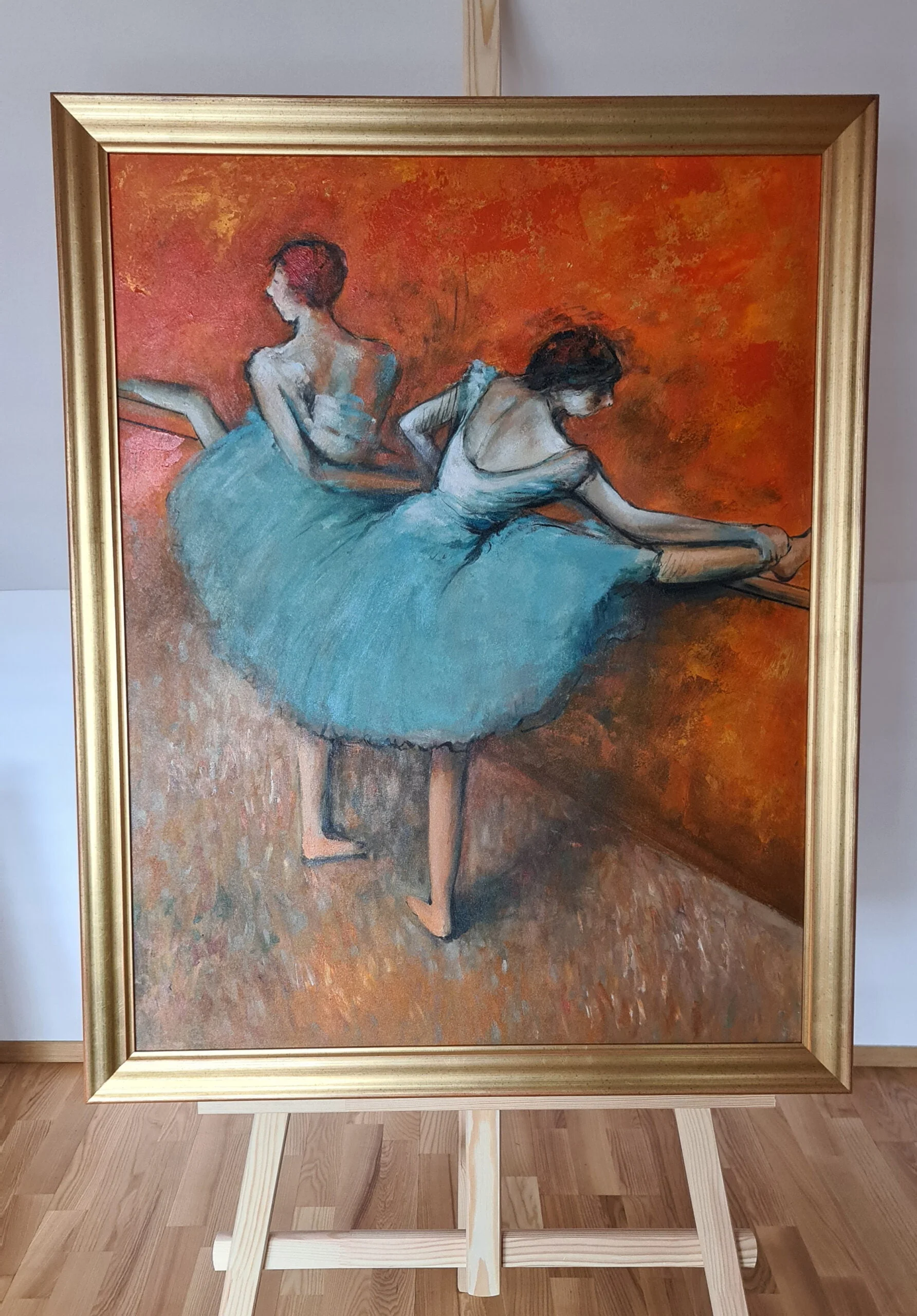
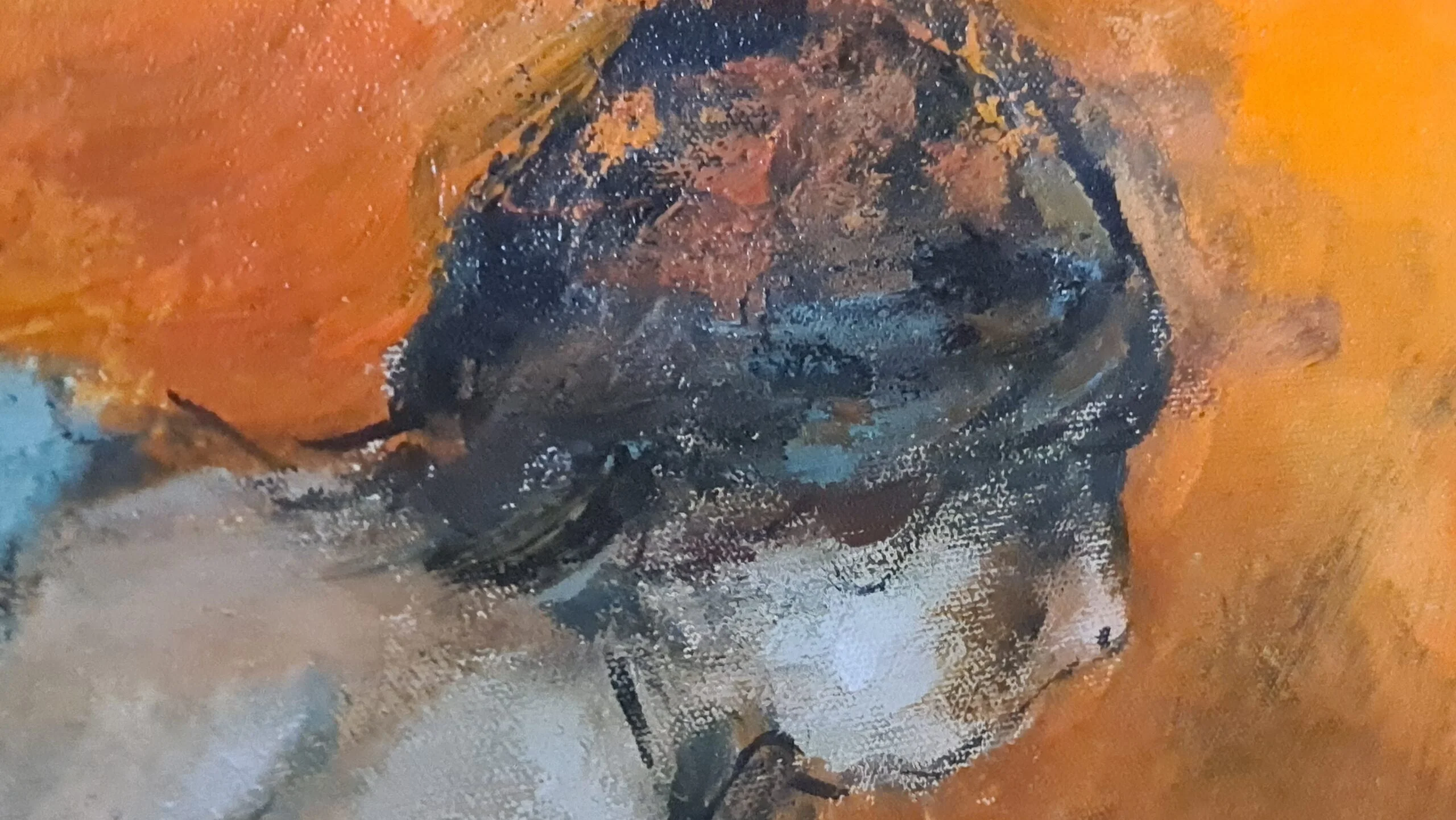
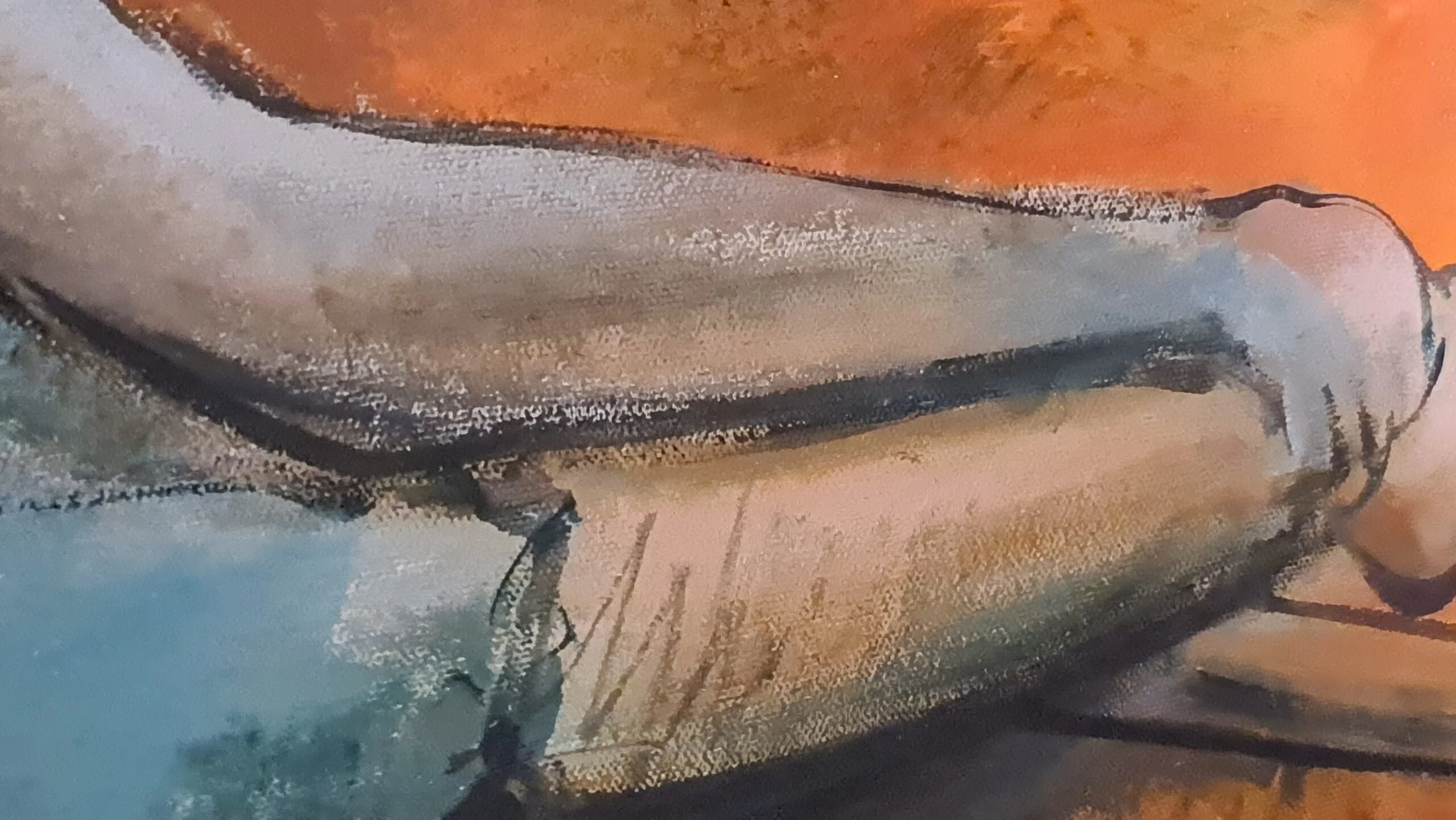
Dancers at the Barre is a work by Edgar Degas from around 1900, in which two dancers practise at a horizontal barre against a burning orange ground. The original is held by The Phillips Collection in Washington under accession number 0479, measures 130.2 x 97.8 cm and is painted in oil. We make it as a hand-painted oil on linen, in nine sizes or to your own measurements, and you receive a photograph of the finished work for approval before dispatch.
| Title: | Dancers at the Barre |
| Other titles: | Danseuses à la barre · Dancers at the Bar · Two Dancers at the Barre |
| Painter: | Edgar Degas (1834–1917) |
| Year: | around 1900 |
| Original size: | 130.2 cm x 97.8 cm |
| Original technique: | Oil on canvas |
| Style: | Impressionism |
| Location: | The Phillips Collection, Washington (acc. no. 0479) |
| Our reproduction: | hand-painted oil on linen canvas, 9 sizes from 40 x 60 cm to 110 x 150 cm, custom sizes on request |
Dancers at the Barre – Edgar Degas
What is shown?
Two dancers at a practice barre, both in blue-green skirts, both turned away from the viewer. The first stands upright and holds the barre with one hand; the second has already lifted a leg onto it and stretches along it, her back to us. Their names appear nowhere in the museum record: Degas painted rehearsal rooms at the Opéra for decades and almost never named his models, so we will not guess either. This is not a performance but a working morning – ballet when nobody is watching.
What is on the canvas?
The format is upright and almost entirely filled by two figures and a single horizontal line, the barre, which runs across the scene like an axis the bodies hang from. The background is a burning orange and describes nothing: no wall, no window, no room, only a plane of colour against which the blue of the skirts sounds louder. Below, the floor opens into a cooler green-grey wedge that props up the right-hand figure. The paint is laid in layers, in places dense enough to stand above the cloth, elsewhere so thin that the weave shows through. This swing between density and emptiness carries the whole composition; cover the orange plane and what is left is a drawing, not a painting.
Why does this work matter?
The museum record dates it to around 1900, the last decade of Degas’s working life, when he was nearly seventy and his eyesight was failing noticeably. He returned to the barre motif for more than twenty years, but the late versions are bigger, more strongly coloured and more roughly built than the early ones. This original measures 130.2 x 97.8 cm, considerably more than the earlier treatment of the same motif from 1877, which measures 75.6 x 81.3 cm – the same thought, twice the surface, twenty-four years later. It hangs today in the permanent display of The Phillips Collection, in Gallery 201, and it shows why a canvas painting often beats a photograph on a wall: it gives movement, not a pose.
What does the painting mean?
It tells no story and shows no climax. It shows the time in between: the stretch, the shift of weight, the wait for the next bar of music. Degas went to the rehearsal rooms rather than to a box at the theatre, which is why there is neither stage nor audience here – only the work that happens before anyone sees it. The orange ground is not a space but a mood; with nowhere to escape to, the eye stays on the bodies. As an impressionist painting it is an unusual case: impressionism usually means daylight caught out of doors, whereas here all the light is made of colour.
Is this the same work as Dancers Practicing at the Barre of 1877?
No. Degas came back to the motif over decades and several works carry almost the same name. Ours is most often confused with Dancers Practicing at the Barre of 1877, in the Metropolitan Museum of Art in New York (accession 29.100.34): horizontal, 75.6 x 81.3 cm, and mixed media on canvas rather than oil. A second is the Dancer Stretching at the Bar at the Art Institute of Chicago (accession 1933.1229), a pastel of 1877–1880 on paper, 31.8 x 24 cm, with a single figure. Ours is later, upright, far larger, in oil, and in Washington. If the scene you remember has a figure stretching along the barre on a tall upright format with an orange ground, this is the right page. From the same world we also have Two Dancers, The Dance Class and The Rehearsal.
How is our hand-painted version made?
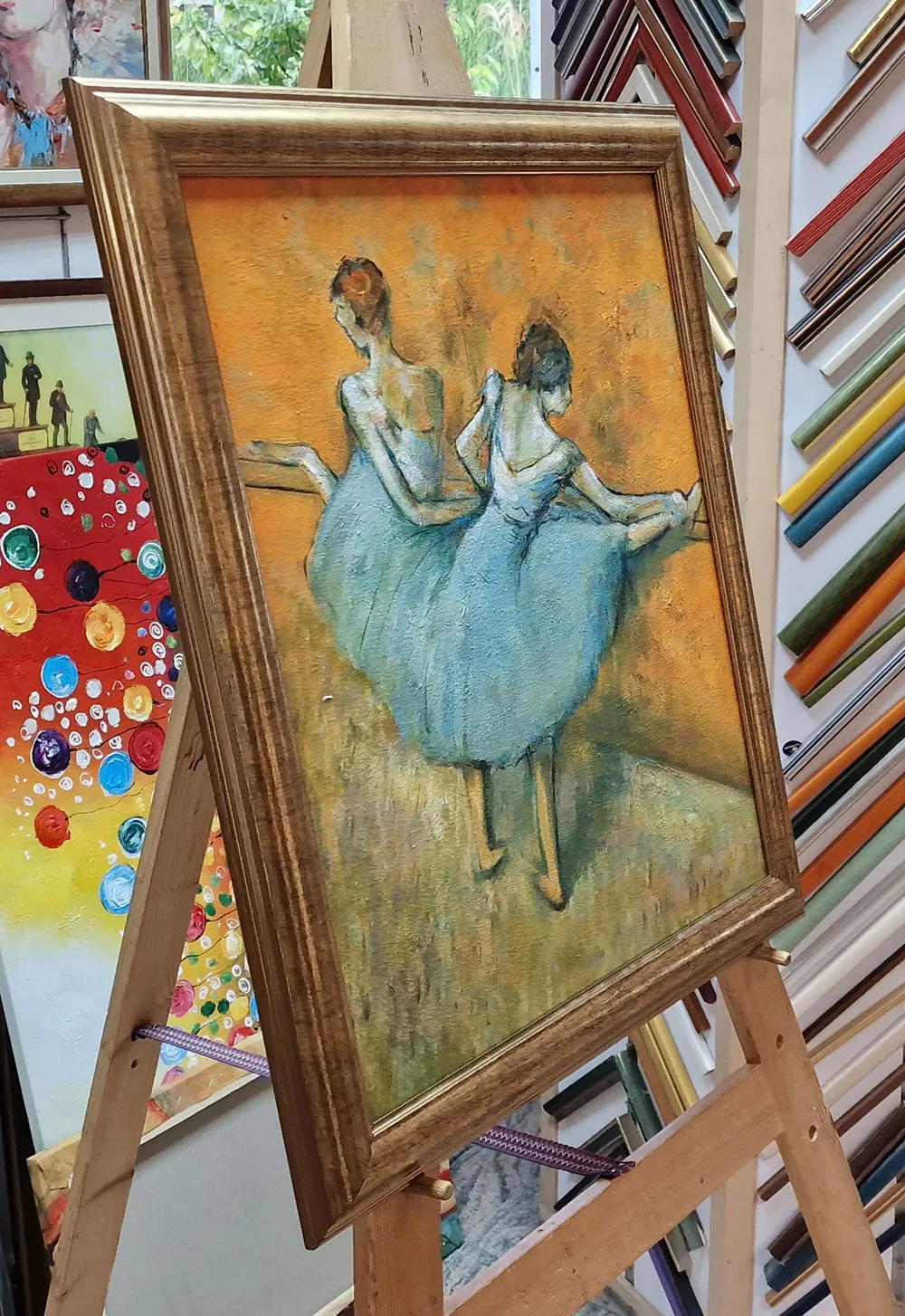
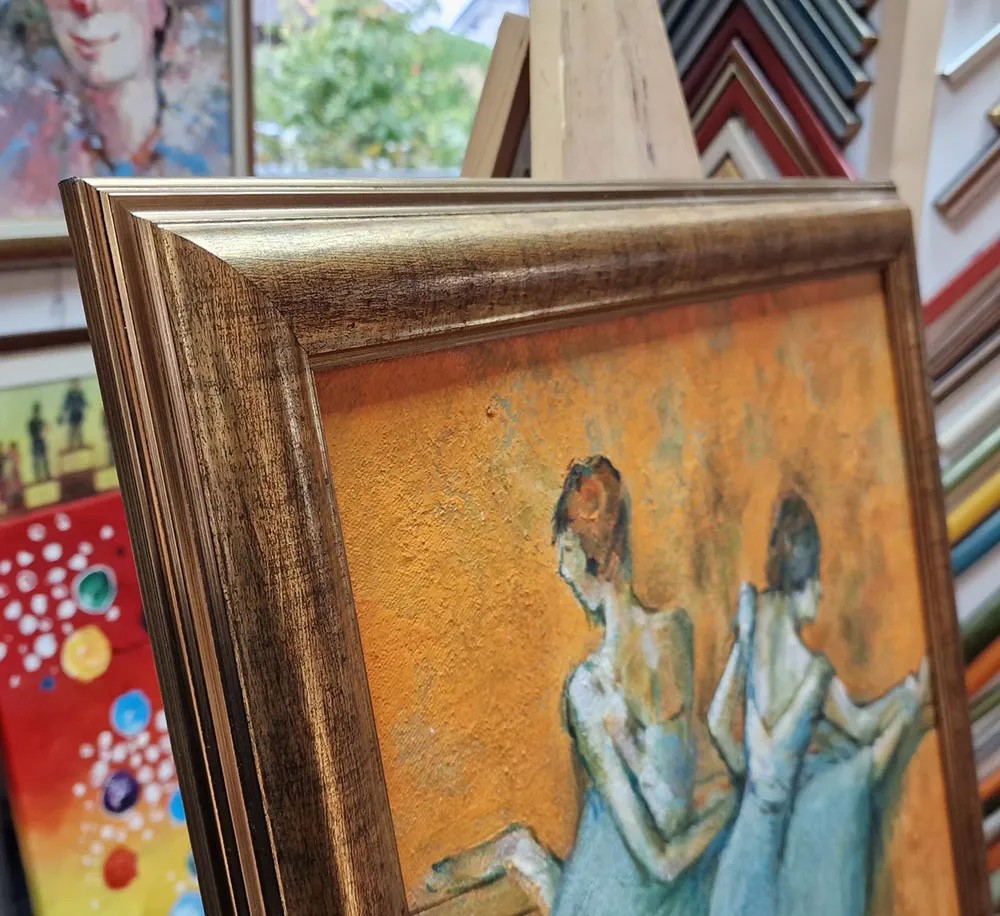
It is made with a brush and oil colours, not a printer. The painter works from a high-resolution museum reference so the orange plane and the cold blue of the skirts are right, and builds the surface as the original does: dense where the light is, thin where the linen should show. In the first photograph the finished, framed work stands on the easel in our studio, just before the final check; in the second it is shot from the side, showing the depth of the frame and the rack of moulding samples behind it. In the fourth photograph the surface is shot close up: the strokes across the second dancer’s back stand visibly above the cloth, and between them the weave itself comes through. The fifth photograph is a second copy of the same motif, painted on another occasion – the ground redder, the skirts lighter – and that is why it is there: every hand-painted copy is its own, and no two are ever quite the same. That is what you receive: a reproduction in oil on canvas, painted by hand and photographed before dispatch.
A short video runs below the description: the finished work stands framed on the easel in our studio, which is how it looks just before packing.
Which size for which wall?
If you do not know which: 70 x 90 cm. The original measures 130.2 x 97.8 cm, so our 97 x 130 cm is close to one to one with it and the only size in which the figures get exactly the room they have in Washington. The format is upright, close to 3 : 4, and because the barre sits low the scene tolerates hanging a little high. The 40 x 60 and 50 x 60 cm sizes belong in a hallway or between two doors; 50 x 70, 60 x 80 and 70 x 90 cm go above a sofa, a chest of drawers or a desk, where most wall art ends up; 80 x 110, 90 x 120 and 97 x 130 cm hold a big wall on their own; 110 x 150 cm is for a stairwell or a high room, where a large painting finally has air around it. How an oil behaves in real daylight can be seen in the fifth photograph, where the work stands in an ordinary room on a wooden floor. None of the sizes is held in stock as a finished item – every copy is made to order.
Custom size, stretcher bar and frame
If none of the nine sizes suits your wall, we paint to your measurements and keep the proportions of the original so the figures are never squeezed; that is our painting made to order. Every copy is delivered stretched on a wooden bar, ready to hang. For the frame, use our 3D application: on this motif it shows every moulding profile we carry, so you can compare gold, silver, black, white and natural wood – it is for choosing a frame and nothing else. If you want to see how the work looks on your own wall, that is our separate room-placement service.
Delivery and guarantee
Every copy is made to order in our studio in Slovenia, so allow 15 to 45 days depending on the size you choose. We send it stretched and protected for transport, framed if you chose a frame, to sixteen countries in the European Union, without customs duties; for destinations outside the EU, write to us before you order. You receive a photograph of the finished work for approval before dispatch, and our returns policy applies to every order. The whole range is in the Edgar Degas gallery, and the painter’s life is described in our article about Edgar Degas.
Frequently asked questions
Where is the original?
In The Phillips Collection in Washington, under accession number 0479, in Gallery 201; whether it still hangs there can change.
Who are the two figures?
The museum record does not name them. Degas painted rehearsal at the Opéra and as a rule did not name his models, so we give no names.
Is Danseuses à la barre the same work?
Yes. Danseuses à la barre, Dancers at the Bar and Two Dancers at the Barre are all titles of the same work from around 1900.
Is this a print?
No. It is painted by hand in oil on linen; the brushstrokes are visible and can be felt.
Which size should I choose?
The 97 x 130 cm size matches the original almost exactly; for smaller and larger walls see the size guide above.
Can I have a size that is not listed?
Yes, we paint to measure and keep the side ratio of the original while doing it.
How is it delivered?
Stretched on the bar, and framed if you chose that, in 15 to 45 days after you approve the photograph of the finished work.
What is the work about, in one sentence?
Practice instead of performance: two bodies, one barre and an orange plane that leaves them nowhere to go.
Is the original for sale and what is it worth?
No. It belongs to the public collection of The Phillips Collection and is not for sale; a canvas painted by hand is the only way to have it at home.
How high should I hang it?
Centre at eye level, roughly 145–150 cm from the floor; above a sofa, 15–25 cm above the backrest.
Is it suitable as a gift?
Yes, for an anniversary, a wedding or a birthday – especially for someone who dances or used to. Because every copy is made to order, allow for the making time; if you would rather leave the choice to them, there is our gift voucher.
- Subject: two dancers at a practice barre against an orange plane, with no stage and no audience – Paris, around 1900
- Original: 130.2 x 97.8 cm, oil, The Phillips Collection, Washington (acc. no. 0479)
- Ours: hand-painted in oil on linen, nine sizes from 40 x 60 to 110 x 150 cm, stretched and framed on request
- Worth knowing: the orange ground shows nothing – no wall, no room; cover it and the scene loses all of its depth