



Description
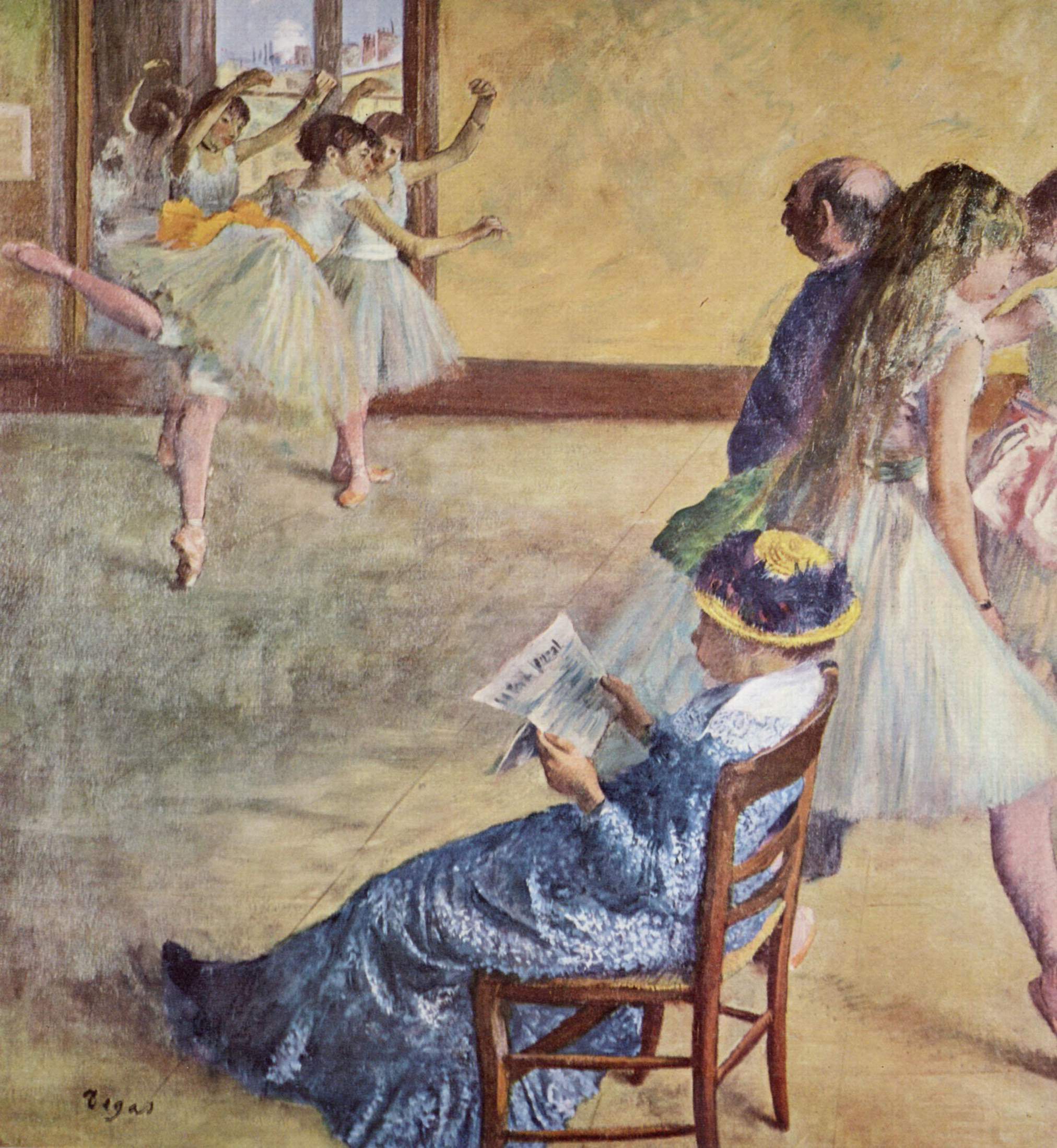
The Ballet Class shows a practice room in which the most conspicuous figure is the woman who is not dancing: in the foreground she sits on a plain wooden chair, in a bluish patterned dress and a hat with a yellow band, reading a newspaper. At the back left four dancers practise by the window, and at the right stands a group with a gentleman in dark clothes and a girl with long loose hair. As a canvas painting this is an almost square scene of waiting and of work. The original is oil on canvas and is held in the Philadelphia Museum of Art under the inventory number W1937-2-1. We make it as a hand-painted work on linen, in sizes from 50 x 60 to 120 x 130 cm or to your own measurements, and you receive a photograph of the finished work for approval before dispatch.
| Title: | The Ballet Class |
| Other titles: | La classe de danse |
| Painter: | Edgar Degas (1834–1917) |
| Year of execution: | 1878 |
| Original size: | 82,2 cm x 76,8 cm |
| Original technique: | Oil on canvas |
| Painting style: | Impressionism |
| Located at: | Philadelphia Museum of Art (inv. no. W1937-2-1) |
| Our reproduction: | hand-painted oil on linen canvas, 6 sizes from 50 x 60 cm to 120 x 130 cm, custom sizes on request |
The Ballet Class – Edgar Degas
Who is shown?
Eight or nine people, none of them named – and the most space goes to the one who is not dancing. In the foreground a woman in a bluish patterned dress sits on a plain wooden chair, her back and profile towards us, reading a newspaper. She is a chaperone, a mother or a nursemaid, of the kind who waited for the girls during rehearsal in those years. At the back left four dancers practise by a large window, one with a yellow band at her waist, one in the air with her leg extended and pink stockings. At the right stands a group: a bald gentleman in dark clothes, cut by the edge, a girl with long loose hair leaning forward, and a dancer in a pale skirt with a green sash.
What is on the canvas?
The format is almost square. The wall is a warm ochre yellow, and the floor is a large greenish-grey area that takes up nearly the whole left half and is almost empty. At the upper left is a window with white frames, through which city roofs and a pale sky can be seen – the only view out. A dark wooden rail runs along the wall. The reader’s dress is the densest mass of colour in the scene: bluish, finely patterned, spread over the chair and onto the floor. Her hat carries a yellow band and blue flowers. At the lower left is the signature, written in a reddish colour.
Why does this particular scene matter?
Because Degas gives the main place to the wrong person. The title promises a ballet class, and the middle of the canvas is taken by a woman who is not watching the rehearsal at all – she is reading. The dancers are pushed into the corner and past the edge, and one of them is cut through by the edge of the canvas. That arrangement is Degas’s invention: the scene is not set out for the viewer but caught as somebody would see it who had just come through the door. The large empty floor is as important to it as the figures are.
What does the scene mean?
Waiting. The ballet here is not a festivity but a working day of timetables, mothers and boredom. Impressionism for Degas always meant a cutting out of everyday life rather than an arranged scene; an impressionist painting of this kind therefore reads like a look through a door left ajar. As wall art it carries a room through arrangement and light rather than through a story, and you notice something different each time.
The motif among Degas’s works
The ballet is Degas’s largest subject. The Dancing Class shows the same room with the master among the girls; Ballet Rehearsal on Stage moves the same rehearsal onto the stage and paints it almost without colour; Dance Rehearsal in the Foyer brings it back into the practice room. How Degas watched the ballet from the stalls, over the heads of the strings, is shown by Ballet at the Paris Opéra at the Art Institute of Chicago, while Ballet Dancers at the National Gallery in London shows the same subject in stronger colour.
How is our hand-painted version made?
With a brush and oil colours, not a printer, and here the technique of the original is the same as ours. Every one of our canvases is made layer after layer, and in this scene the large floor is the hardest part: it has to look empty but not dead, so it is built from several thin layers of greenish and grey that stay visible beneath the surface. The other demanding part is the reader’s dress, where the pattern has to stay suggested and not drawn out. Every reproduction is made afresh and no two copies are ever quite the same, because the hand does not repeat the same stroke twice; every hand-painted copy is therefore its own. For this work we have no photographs of our finished canvases, so we show and describe none here. The photograph of your canvas reaches you before dispatch.
Which size for which wall?
If you do not know which: 80 x 90 cm – that size is nearest to the original, which measures 82,2 x 76,8 cm. The 50 x 60 and 60 x 70 cm sizes are for a smaller room or a hallway; at them the group on the right is already hard to resolve into separate figures. The 70 x 80 and 80 x 90 cm sizes are the most usual choice above a chest of drawers or in a dining room. The 90 x 100 cm size belongs above a sofa, where the almost square format holds the wall well. At 120 x 130 cm we are at the sizes where a large painting really breathes and the empty floor becomes an area in its own right; it is also the size closest to the original’s proportion. Measure your chosen size on the wall with a paper cut-out first; with an almost square format the mistake is usually made in the hanging height. None of the sizes is held in stock as a finished item: every copy is made to order and stays a single piece.
Custom size, stretcher bar and frame
If none of the six sizes suits your wall, we paint to your measurements and keep the proportions of the scene, so that the empty floor keeps its space and the group at the right does not fall off the edge; that is our painting made to order. Every copy is delivered stretched on a wooden bar, ready to hang. For the frame, use our 3D application: on this motif it shows every moulding profile we carry, so you can compare gold, silver, black, white and natural wood – it is for choosing a frame and nothing else. If you want to see how the work looks on your own wall, that is our separate room-placement service.
Delivery and guarantee
Every copy is made to order in our studio in Slovenia, so allow 15 to 45 days depending on the size you choose; for the largest sizes the time is usually at the upper end. We send it stretched and protected for transport, framed if you chose a frame, to sixteen countries in the European Union, without customs duties. You receive a photograph of the finished work for approval before dispatch, and our returns policy applies to every order. The whole range is in the Edgar Degas gallery, and the painter’s life is described in our article about Edgar Degas.
Frequently asked questions
Who is the woman in the foreground?
She is not named. She sits on a wooden chair reading a newspaper; she is a chaperone waiting for a girl during the rehearsal.
Why does someone who is not dancing get the most space?
Because that is exactly Degas’s intention. The scene is not set out for the viewer but caught as somebody would see it who had just come in.
What can be seen through the window?
City roofs and a pale sky. It is the only view out on the whole canvas.
Who is the gentleman at the right?
A bald man in a dark suit, partly cut by the right edge. Degas did not name him, and neither do we.
What is the large empty area at the left?
The floor of the practice room. It takes up nearly the whole left half and matters to the composition as much as the figures do.
Where is the original located?
In the Philadelphia Museum of Art, under the inventory number W1937-2-1.
How large is the original?
82,2 by 76,8 cm, so almost square. Our 80 x 90 cm size is nearest to it.
Is this a print?
No. The work is painted by hand in oil colours; the brushstrokes are visible and can be felt.
Which size should I choose?
Above a chest of drawers usually 80 x 90 cm, for a smaller room 60 x 70 cm. The size guide is above.
Can I have a size that is not listed?
Yes, we paint to measure and keep the proportions of the scene while doing it.
Is it suitable as a gift?
Yes, especially for someone who dances or likes scenes with several things happening at once. Because every copy is made to order, allow for the making time; if you would rather leave the choice to them, there is our gift voucher.
- Subject: a practice room, a woman reading a newspaper in front, four dancers by the window at the left, a group with a gentleman at the right
- Original: Edgar Degas, an oil painting on canvas, 82,2 x 76,8 cm, Philadelphia Museum of Art (W1937-2-1)
- Ours: hand-painted in oil, six sizes from 50 x 60 to 120 x 130 cm, stretched and framed on request
- Worth knowing: the title promises a ballet class, yet the middle of the canvas is held by a woman who is not watching the rehearsal at all