


Description
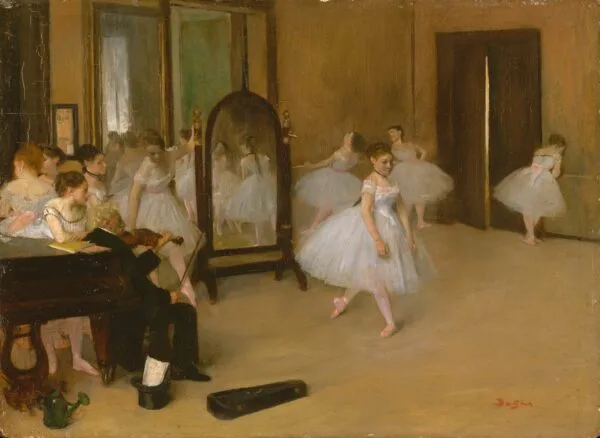
The Dance Class shows a practice room at the Paris Opéra during the lesson. Right of centre stands an old ballet master leaning on a long stick, watching a dancer working in front of him. In the foreground a dancer stands with her back to us, a red flower in her hair and a large green sash at her waist; to her left another scratches her back beside a tall piano. Along the right-hand wall a whole row of girls in white skirts sits and stands, and at the back a mirror shows through an open door. At the lower left stands a green watering can, and beside it a small dog. The original is an oil work on canvas and is held by the Musée d’Orsay in Paris under inventory number RF 1976. Ours is made by hand in eight sizes from 60 x 70 to 150 x 170 cm, or to your own measurement, and you receive a photograph of the finished work for approval before it ships.
| Title: | The Dance Class |
| Other titles: | La classe de danse, The Ballet Class |
| Painter: | Edgar Degas (1834–1917) |
| Year: | 1873 |
| Size of the original: | 85 cm x 75 cm |
| Technique of the original: | oil, canvas |
| Style: | impressionism |
| Where it hangs: | Musée d’Orsay, Paris (inv. RF 1976) |
| Our version: | hand-painted in oil on linen, 8 sizes from 60 x 70 cm to 150 x 170 cm, custom size on request |
The Dance Class – Edgar Degas
Who is in the scene?
Some twenty girls and one old man; the record names none of them. The man stands right of centre in a grey jacket and dark trousers, both hands on a long stick, looking towards the dancer in front of him. In the foreground a dancer stands with her back to us: a red flower in her hair, a black ribbon at her throat, a large green sash at her waist, a white skirt. To her left one leans on the tall piano with a fan, and a third scratches her back. Along the right-hand wall a group of girls sits, stands and talks, two of them with blue and pink ribbons. At the back, by the door, two grown women stand in dark clothes.
What is on the canvas?
A tall room with pale green walls, marbled pilasters and a broad wooden floor that fills the whole lower right third. At the back an open door carries a large mirror in which a bright window appears. At the left a small sheet of paper hangs on the wall, and beside it a cord with a yellow piece of cloth. At the lower left stands a green tin watering can, and right beside it crouches a small shaggy dog. The colours are delicate: pale green wall, dirty-white skirts, the master’s grey jacket, and within all of it one red flower and one green sash. Lower left, the signature.
Why does this scene matter?
Because the greater part of the canvas is empty floor. Degas pushed every figure to the left edge and along the right-hand wall and left the middle bare. That is exactly why the scene reads as a room rather than as a group: you see the hall first and the people in it second. The second reason is the watering can. In the corner where a commissioned portrait would put a handsome object stands an ordinary tin can, used to damp the floor so it would not raise dust. Degas did not hide it. The third is the dog, which most people notice only later.
What does the scene mean?
A lesson, not a performance. Impressionism in Degas meant a cut as the eye takes it from one particular place, and that place here is the door of the room. An impressionist painting of this kind therefore shows waiting, a sash being straightened and a back being scratched, not the appearance on stage. As wall art it is light and airy and carries a large format well; the delicate colours make it easy to live with. Choose a large painting here and the figures come close to life size, which is when the empty floor starts to read as a real room.
The subject among Degas’s works
Degas painted the dance class more than once, and no two are alike. The Ballet Class is a second version of the same subject, held by the Philadelphia Museum of Art, Dance Rehearsal in the Foyer shows the same kind of room emptier and in colder colour, and The Rehearsal takes the same subject with a spiral staircase. The work is recorded in the Degas catalogue raisonné as MS 364; the earliest practice-room scene in Degas is a small panel of 1864, MS 1642.
How is our hand-painted version made?
With a brush and oil paint, not a printer. The original is oil on canvas, so the same technique as ours. On this subject the floor is the hard part. It takes more room than anything else and has to stay interesting without detail, so we paint it in long strokes that follow the boards, weaving cooler and warmer bands into it. The white skirts are the second difficulty: they must be painted thin and in several layers so they stay translucent instead of going hard. The wall is built from two greens, or it flattens into a single field. The red flower and the green sash come last, because they are the only strong colours on the canvas. Every reproduction is painted afresh, and no two are quite alike, because a hand does not repeat the same stroke twice; each hand-painted copy is therefore its own. For this work we have no photographs of our finished canvases, so none are shown here and none are described. You receive the photograph of your own canvas before it ships.
Which size for which wall?
If you do not know which: 75 x 85 cm. On this work that size is exceptional, because it is exactly the original’s own: the original measures 85 x 75 cm, and our 75 x 85 cm has the same area and the same ratio to the last digit. The same ratio belongs to 150 x 170 cm, which is exactly twice as large. The 60 x 70 cm is the smallest and suits a smaller room, though at that size the girls along the right wall merge together. The 80 x 90 and 90 x 100 cm are the usual choice above a sofa. The 100 x 110 and 110 x 130 cm want a broader wall and some distance. The 120 x 140 and 150 x 170 cm change a room outright; there the figures come close to life size. Measure the size you choose on the wall first with a paper cut-out. No size is kept in stock as a finished piece: every copy is painted to order and stays a single piece.
Custom size, stretcher and frame
If none of the eight sizes fits, or if you want a different ratio, we paint to your measurement and keep the proportions of the scene as we do, so that the empty floor keeps its share and the row of girls along the right wall is not crowded together; this is our work painted to order. Every canvas painting ships stretched on a wooden stretcher, ready to hang. For the frame, use our 3D app: it shows every moulding we carry on this subject, so you can compare gold, silver, black, white and natural wood — it is for choosing a frame and nothing else. If you want to see how the work looks on your own wall, we have a separate service for that, placement in the room.
Delivery and guarantee
Every piece is painted to order in our workshop in Slovenia, so allow 15-45 days depending on the size chosen; at the largest sizes the time is usually at the upper end. It travels stretched and protected for transport, framed if you chose a frame, to sixteen countries in the European Union, with no customs. Before it ships you receive a photograph of the finished work for approval, and our returns policy applies to every order. The painter’s full offer is in the Edgar Degas gallery, and his life is described in our article about Edgar Degas.
Frequently asked questions
What painting is this?
It is Degas’s dance class of 1873, oil painted on canvas, 85 x 75 cm, held by the Musée d’Orsay in Paris under inventory number RF 1976.
Who is the old man with the stick?
The ballet master during the lesson. The record does not name him, so neither do we.
What is the green vessel at the lower left?
A watering can. Water was used to damp the wooden floor so that practice did not raise dust.
Is there really a dog in it?
Yes, a small shaggy dog right beside the can at the lower left. Most people notice it only on a second look.
Where is the original?
In the Musée d’Orsay in Paris, under inventory number RF 1976.
How big is the original?
85 x 75 cm. Our 75 x 85 cm has exactly the same area and the same ratio.
Why do sources give different measurements?
The catalogue raisonné gives 85 x 65 cm and the museum record 85 x 75 cm. The proportion in the photograph of the original matches 85 x 75 cm, so that is what we print.
Is this the same work as The Ballet Class?
No. The Ballet Class in our offer is a second version of the same subject, held by the Philadelphia Museum of Art.
Is this a print?
No. The work is made by hand in oil; the brushstrokes are visible and can be felt.
Can I have a size that is not on the list?
Yes, we paint to measurement and keep the proportions of the scene as we do.
Is it suitable as a gift?
Yes, and it is among this painter’s best-loved subjects. Because every piece is painted to order, allow for the making time; if you would rather leave the choice to the recipient, there is our voucher.
- Subject: a practice room during the dance class, the ballet master with his stick and some twenty girls
- Original: Edgar Degas, oil painted on canvas, 85 x 75 cm, Musée d’Orsay, Paris (RF 1976)
- Ours: painted by hand in oil, eight sizes from 60 x 70 to 150 x 170 cm, stretched and framed on request
- Note: our 75 x 85 cm is exactly the original’s own size, to the last digit