Description
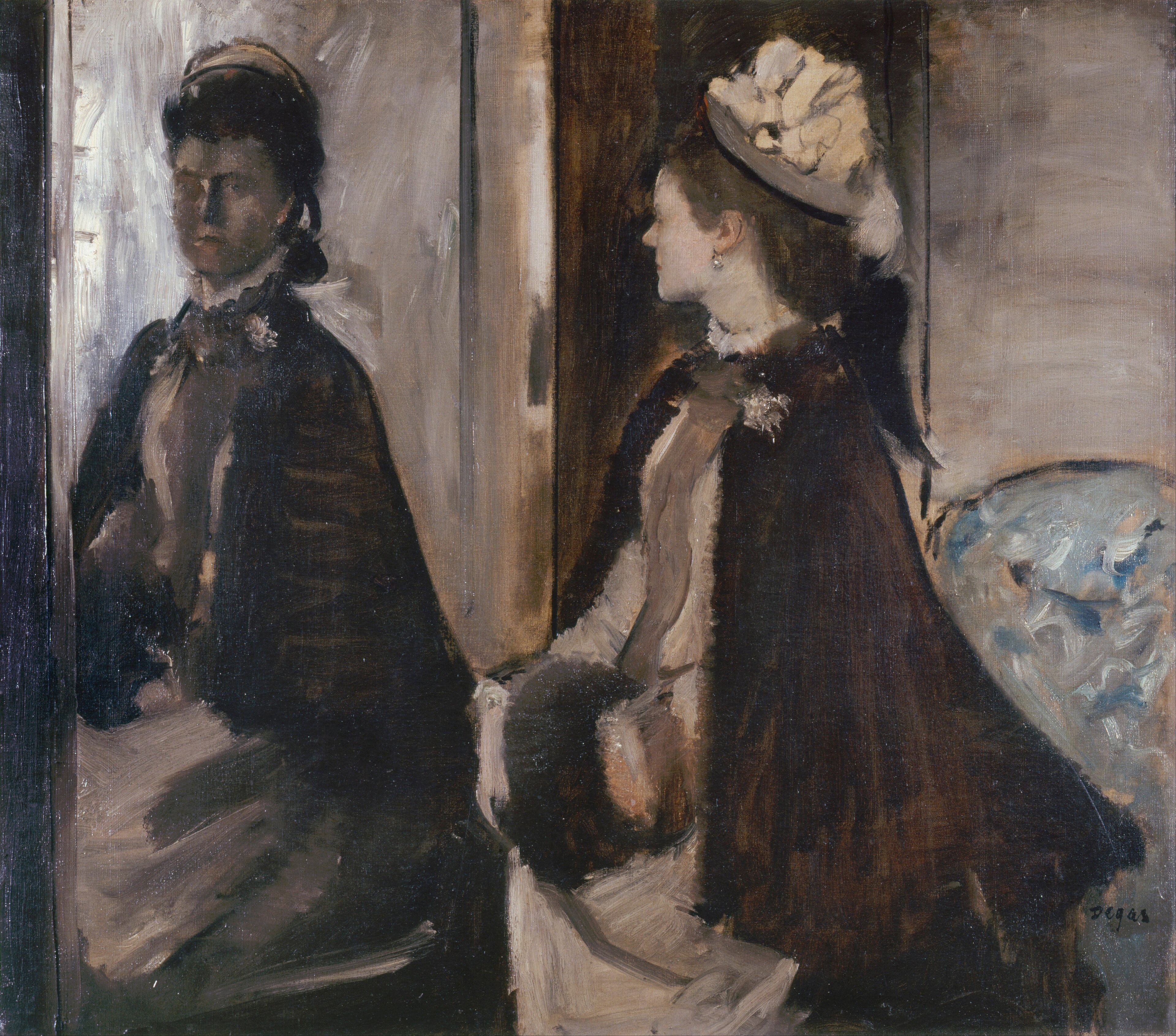
Mrs Jeantaud in the Mirror puts the same face on one canvas twice. At the right a woman stands in profile, turned to the left: she wears a dark cloak trimmed with fur and a pale hat with white feathers, a white flower at her throat and a drop at her ear. Her face is calm and turned away from us. At the left hangs a large mirror, and in it the same face returns frontally, darker and more deeply shadowed; the reflection flatters nothing, and looks older and more tired than the woman standing a few centimetres to its right. Between the two runs the dark vertical edge of the mirror frame, dividing the canvas in half, and at the right a blue and white passage of fabric pushes into the grey wall. The original measures 85.5 x 76 cm, was made about 1875, and is held by the Musée d’Orsay in Paris under inventory number RF 1970 38. Ours is painted by hand in eight sizes from 50 x 40 to 150 x 120 cm or to your own measurement, and you receive a photograph of the finished work for approval before it ships.
| Title: | Mrs Jeantaud in the Mirror |
| Other titles: | Madame Jeantaud au miroir |
| Painter: | Edgar Degas (1834–1917) |
| Year: | about 1875 |
| Size of the original: | 85.5 cm x 76 cm |
| Technique of the original: | oil on canvas |
| Style: | Impressionism |
| Where it hangs: | Musée d’Orsay, Paris (inv. RF 1970 38) |
| Our version: | hand-painted oil on linen canvas, 8 sizes from 50 x 40 cm to 150 x 120 cm, custom size on request |
Mrs Jeantaud in the Mirror – Edgar Degas
Who is in the picture?
The museum record names her only in the title: Madame Jeantaud. It gives no occupation, no dates and no family connection, so neither do we. What can be seen is this. At the right a woman stands in profile, turned to the left. She wears a dark cloak trimmed with fur that closes over her shoulders and throat, and a pale hat with white feathers set high on pinned-up hair. A white flower sits at her throat and a small drop catches the light at her ear. Her hands are hidden under the cloak. Her face is calm, the lips closed, the gaze directed forward past the edge of the canvas; she looks neither at us nor at the mirror. It is exactly that composure which makes the other half of the picture so strange.
What is on the canvas?
Two faces of the same woman, separated by a dark vertical edge. At the left hangs a large mirror in a dark frame, and in it the same face returns to us frontally rather than in profile. The reflection is darker, more deeply shadowed and more quickly painted; it looks older and more tired than the figure standing a few centimetres to its right. The edge of the mirror frame runs down the canvas and divides it almost in half, so the two halves of the scene are joined and separated at once. The wall is grey and smooth, without ornament. At the right a blue and white passage of fabric pushes into it, the only cool bright note in the scene. Elsewhere the paint is thin: the fur at the collar is made with a few strokes, and the feathers on the hat with white touches that are never drawn out to a finish.
Why does this picture matter?
Because the reflection is not decoration but a claim. In the painting of the period a mirror usually shows the same person from another side, or extends the room; here it shows something the figure herself withholds. The woman is turned away and unavailable, while her reflection faces us directly and looks older. The painter sets the polite version and the unkind version of one person side by side and does not say which is true. The second reason is the division of the canvas: the dark vertical edge falls almost at the centre, which is rare in a portrait and refuses us a single place to look. The third is restraint. Nothing in the scene is overstated; the whole effect rests on the difference between two faces that share one picture.
What does the picture mean?
That a person is not a single image. Impressionism in Degas means close observation of people rather than effects of light, and the observation here is unsparing. As a canvas painting it is unusually quiet and unusually uneasy at the same time: the colours are dark and grey, and what happens is psychological rather than narrative. Because it is mostly brown, grey and black with one cool blue passage, it is serious wall art for a living room, a bedroom or a hall, and it works best where the light is soft. Anyone wanting a large painting with a portrait in it gets two faces here for the price of one, and they are not kind to each other. Our reproduction keeps that difference, because without it the picture is only a woman in a hat.
The motif among the painter’s works
Degas painted people from his own circle and returned to the same families. The Orsay also holds his 1871 group portrait Jeantaud, Linet and Laîné, catalogued as Schulman MS 859 and held under RF 2825; by that catalogue Charles Jeantaud bought it from the painter himself, kept it until 1906, and it then belonged to Mme Charles Jeantaud until 1929. The record for our canvas does not spell out how the two people are related, and we do not add it. Among the works by Degas we offer, the closest to this canvas are A Woman Seated beside a Vase of Flowers, where a woman is likewise pushed to the edge of her own portrait, Young Woman with Ibis, another portrait in profile, and The Convalescent, a woman in a quiet, closed room. Our canvas is held by the Musée d’Orsay under inventory number RF 1970 38.
How is our hand-painted version made?
With a brush and oil paint, in the same technique as the original, so ours is oil on canvas too. The hardest part is the relationship between the two faces. The reflection must be darker and softer than the profile without being blurred; painted too faintly the picture loses its subject, painted too strongly it becomes a second person. So we build it with less contrast and greyer flesh tones and leave the contours unsharp. The second hard part is the black of the cloak, which has to stay dense and still show the fur at its edge; we make it from brown, blue and green, never from black alone. The third is the feathers on the hat: a few white strokes that must remain strokes and not turn into plumage. Every copy is made afresh and no two are quite alike; every hand-painted copy is its own. We have no photographs of our own finished canvases for this subject yet, because we have not painted it before, so none is shown here and none is described. You receive a photograph of your own canvas before it ships.
Which size for which wall?
If you are unsure: 70 x 60 cm. The original is 85.5 x 76 cm, which puts our 90 x 75 cm closest to it in scale — within a centimetre on the height and a few centimetres wider. In proportion the nearest is 80 x 70 cm: 1.143 against the original’s 1.125. 50 x 40 and 61 x 51 cm are small, and at those sizes the reflection is hard to read, because it lives on small differences of shadow. 70 x 60 and 80 x 70 cm are the right choice above a chest of drawers, a desk or in a hall. 90 x 75 and 100 x 80 cm give the scene the room it needs, and there the two faces carry equal weight. 120 x 100 and 150 x 120 cm need a wider wall and some distance; at those sizes the difference between the faces is visible from across the room. Measure your chosen size on the wall first with a paper cut-out. None is held in stock: each piece is painted to order.
Custom size, stretcher bar and frame
If none of the eight sizes suits, or if you want exactly the proportion of the original, we paint to your measurement and keep the width, so the mirror at the left stays whole and the edge of its frame falls near the middle; that is our work made to order. Every piece is sent stretched on a wooden stretcher bar, ready to hang. For the frame use our 3D application: on this subject it shows every moulding we carry — gold, silver, black, white and natural wood — and it is for choosing a frame and nothing else. How the work sits on your own wall is shown by our separate service, placement in the room.
Delivery and guarantee
Each piece is painted to order in our workshop in Slovenia; allow 15-45 days depending on the size, at the largest sizes usually at the upper end. It travels stretched and protected for transport, framed if you chose a frame, to sixteen countries in the European Union, without customs. Before dispatch you receive a photograph of the finished work for approval, and our returns arrangement applies to every order. The full range is in the Edgar Degas gallery, and his life is described in our article about Edgar Degas.
Frequently asked questions
Which painting is this?
Degas’s oil Mrs Jeantaud in the Mirror, 85.5 x 76 cm. It is held by the Musée d’Orsay in Paris under inventory number RF 1970 38.
Who was Madame Jeantaud?
The museum record names her only that way, with no further detail. The same museum holds Degas’s 1871 group portrait Jeantaud, Linet and Laîné under RF 2825; the catalogue records that Charles Jeantaud bought it from the painter himself and that it belonged to Mme Charles Jeantaud from 1906 to 1929. How the two people are related, the record for our canvas does not say.
When was it painted?
The museum states: about 1875. We keep the approximation, because the record keeps it.
How big is the original?
85.5 cm wide and 76 cm high, by the museum’s measurement. With its frame the museum gives 114.5 x 103.5 cm. Our 90 x 75 cm is the closest to it in scale, and 80 x 70 cm the closest in proportion.
Why does the reflection look different from her face?
Because it is painted differently: darker, more shadowed and more quickly, and it shows the face frontally while the figure stands in profile. That is an observation from the picture, not a reading from the record; the museum says nothing about what the reflection means.
How did the work reach the Orsay?
As a bequest with reserved usufruct. The museum record states: bequest of Jean Edouard Dubrujeaud in favour of his son Jean Angladon-Dubrujeaud, 1970.
Is the canvas signed?
The museum record says nothing about a signature, so we make no claim. Where a signature is recorded on other works by this painter we state it; here there is no such record.
Where can it be seen?
At the Musée d’Orsay in Paris. Whether it is on display at any given moment or in storage, the record does not say.
Can I have a size that is not listed?
Yes. The eight sizes are our usual choice, but we also paint to your measurement, including exactly the proportion of the original. Tell us where the work will hang so we can fit the framing to it.
Is this a print?
No. The work is made by hand in oil; the brush strokes are visible and can be felt, particularly in the fur and the feathers on the hat.
Is it suitable as a gift?
Yes, for someone who likes portraits and darker colours — less so for a room where you want lightness. Because each piece is painted to order, allow for the making time; if you would rather leave the choice to them, there is our gift voucher.
- Subject: a woman in profile at the right, her reflection facing us in the mirror at the left, a dark frame edge between them
- Original: Edgar Degas, oil painting on canvas, 85.5 x 76 cm, Musée d’Orsay, Paris (RF 1970 38)
- Ours: painted by hand in oil, eight sizes from 50 x 40 to 150 x 120 cm
- Worth knowing: the reflection looks older and more tired than the woman standing a few centimetres to its right