












Description
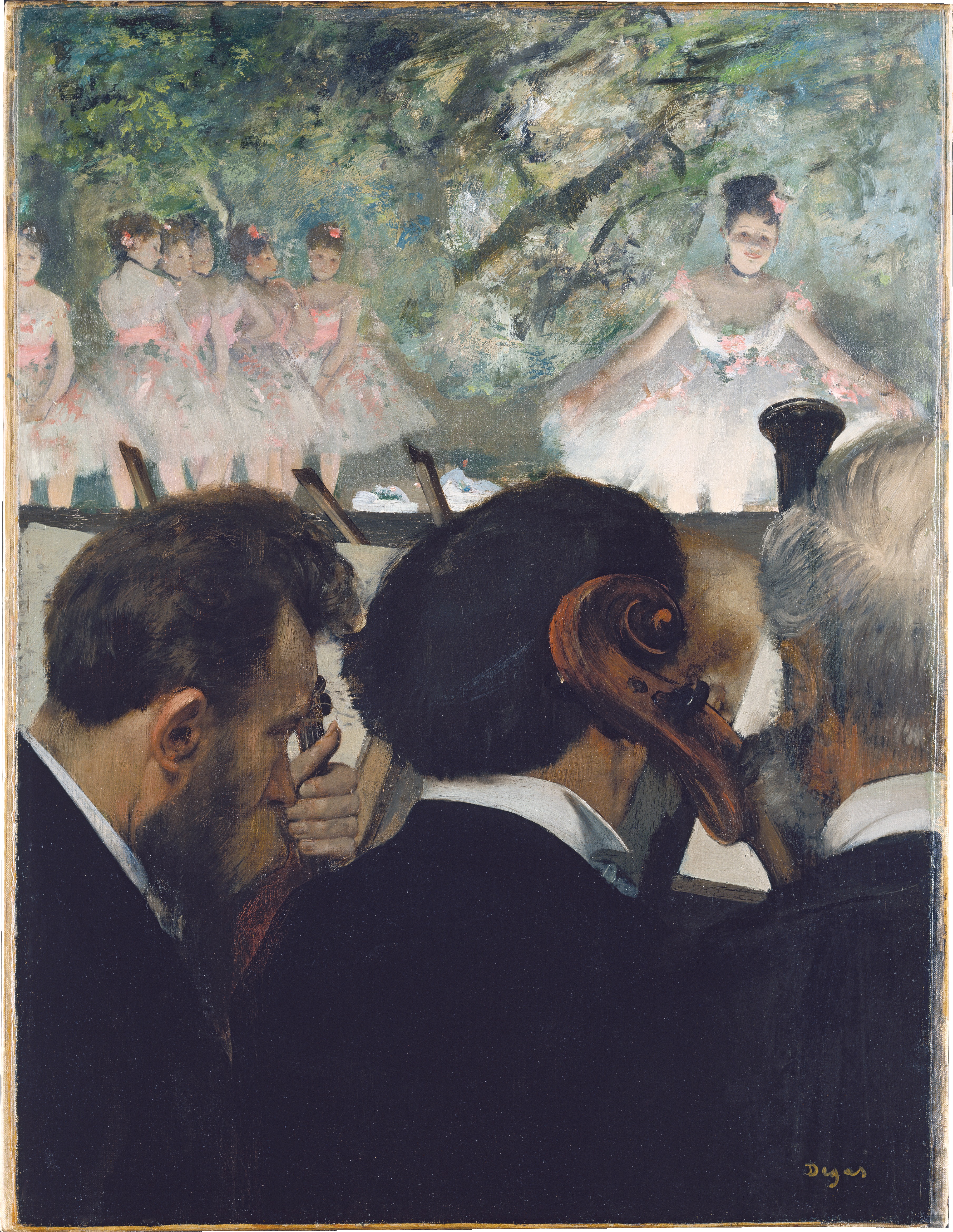
Orchestra Musicians shows three players from behind, so close that their heads reach the edge of the canvas. The one on the left is seen almost in profile, bearded, a violin below him; the middle one has thick black hair with the brown neck of a stringed instrument rising beside it; the one on the right is grey-haired, the dark bell of a brass instrument at his shoulder. Above them the stage opens: a group of dancers in pale pink on the left, and on the right a single dancer, larger and nearer, arms open and smiling — the only face turned towards us. The original is an oil work on canvas and hangs in the Städel Museum in Frankfurt under inventory number SG 237. Ours is made by hand in eight sizes from 30 x 35 to 100 x 110 cm, or to your own measurement, and you receive a photograph of the finished work for approval before it ships.
| Title: | Orchestra Musicians |
| Other titles: | Musiciens à l’orchestre, Orchestermusiker |
| Painter: | Edgar Degas (1834–1917) |
| Year: | 1872 (1874–1876) |
| Size of the original: | 63.6 cm x 49 cm |
| Technique of the original: | oil, canvas |
| Style: | impressionism |
| Where it hangs: | Städel Museum, Frankfurt am Main (inv. SG 237) |
| Our version: | hand-painted in oil on linen, 8 sizes from 30 x 35 cm to 100 x 110 cm, custom size on request |
Orchestra Musicians – Edgar Degas
Who is in the scene?
Three musicians in the foreground and seven dancers on the stage; nobody is named. The players are seen from behind and from so close that their heads and shoulders fill the lower two thirds. The one on the left turns almost into profile: dark hair, a beard, a hand under the chin, a violin. The middle one has dense black hair, and the brown neck of a stringed instrument rises beside it. The one on the right is grey-haired, with the dark bell of a brass instrument opening at his shoulder. On the stage, a group of dancers in pink to the left, and a single dancer to the right, larger and closer, arms wide.
What is on the canvas?
The scene stands upright and falls into two halves. The lower and larger half is nearly black: tailcoats, dark heads, white collars reading as narrow bright lines. The upper third turns suddenly light and coloured: pale pink skirts, a pink flower in the hair, painted scenery with green foliage behind. Between the two runs the dark horizontal line of the stage edge. Lower right, the painter’s signature in gold. There is little colour, but the relation is sharp: a dark mass below, a bright, flowering band above.
Why does this scene matter?
Because the only face that looks at us belongs to the dancer. All three musicians are turned away; we never see their eyes, and one of them is cut by the bottom edge. The dancer on the right, by contrast, faces us directly, arms open, smiling. So the scene shows not what the audience sees but what the orchestra sees — and what the orchestra sees is her face. The second point is the dating: the museum records 1872, with 1874–1876 in brackets, which means the work was not made in a single push.
What does the scene mean?
The distance between those who work and the one who performs. Impressionism in Degas always meant a cut, taken as the eye sees it from one particular place, and that place here is the orchestra pit. An impressionist painting of this kind is therefore a scene of the trade, not of the performance. As wall art it is unusually strong precisely because of the contrast, and it wants a quiet wall so the darkness below does not read as a hole. It suits a music room, and anyone looking for a dancer subject gets one here from an unexpected seat.
The subject among Degas’s works
The Paris Opéra forms a whole family of works in Degas. The Orchestra at the Opera shows the same pit from a different distance and with the players’ faces, The Ballet from Robert le Diable looks at the stage from the auditorium, and Joseph-Henri Altès is a portrait of one flautist from this very orchestra. The work is held by the Städel Museum in Frankfurt and appears in the Degas catalogue raisonné as MS 376.
How is our hand-painted version made?
With a brush and oil paint, not a printer, and here the technique of the original is the same as ours: oil on canvas. Every one of our canvases is built layer over layer, and on this subject the hardest passage is the transition between the darkness below and the light above. The dark mass has to read as three separate people rather than one surface: the white collars, the brown wood of the stringed instrument and the difference between black hair and dark brown hair are what carry it. The upper band is painted thin and fast, because the skirts must stay airy. The dancer’s face comes last, because it is the one point that looks back. Every reproduction is painted afresh, and no two are quite alike, because a hand does not repeat the same stroke twice; each hand-painted copy is therefore its own. For this work we have no photographs of our finished canvases, so none are shown here and none are described. You receive the photograph of your own canvas before it ships.
Which size for which wall?
If you do not know which: 60 x 70 cm. The original is 63.6 x 49 cm; our 50 x 55 cm is closest to it in size, while in proportion the closest are 30 x 35 and 60 x 70 cm, because our sizes are noticeably wider than the original. The 30 x 35 and 43 x 47 cm belong in a tight space, though at those sizes the dancers above become hard to make out. The 50 x 55 and 60 x 70 cm are the usual choices above a chest of drawers or beside a piano. The 70 x 80 and 80 x 90 cm want a larger wall where the dark half is given its own room. The 90 x 100 cm belongs in a hall, and at 100 x 110 cm we have a large painting, in which the work breathes and the musicians’ heads come up to life size. Measure the size you choose on the wall first with a paper cut-out; in an upright format the mistake is usually made in the height. No size is kept in stock as a finished piece: every copy is painted to order and stays a single piece.
Custom size, stretcher and frame
If none of the eight sizes fits, or if you want the proportion of the original, we paint to your measurement and keep the proportions of the scene as we do, so that the band of dancers above stays as wide as it is in Degas and the musicians’ heads below are not cut differently; this is our work painted to order. Every canvas painting ships stretched on a wooden stretcher, ready to hang. For the frame, use our 3D app: it shows every moulding we carry on this subject, so you can compare gold, silver, black, white and natural wood — it is for choosing a frame and nothing else. If you want to see how the work looks on your own wall, we have a separate service for that, placement in the room.
Delivery and guarantee
Every piece is painted to order in our workshop in Slovenia, so allow 15-45 days depending on the size chosen; at the largest sizes the time is usually at the upper end. It travels stretched and protected for transport, framed if you chose a frame, to sixteen countries in the European Union, with no customs. Before it ships you receive a photograph of the finished work for approval, and our returns policy applies to every order. The painter’s full offer is in the Edgar Degas gallery, and his life is described in our article about Edgar Degas.
Frequently asked questions
What is happening in the scene?
A performance. Below, the orchestra plays; above, dancers stand on the stage, one of them turned towards us with her arms open.
Why are the musicians seen from behind?
Because Degas placed the scene behind them. From their seats the stage is seen above their heads.
Who is the only one looking at us?
The dancer on the right. Hers is the only face on the canvas turned directly towards the viewer.
Which instruments can be seen?
A violin at the left-hand player, the neck of a stringed instrument beside the middle one, and the dark bell of a brass instrument beside the one on the right.
Where is the original?
In the Städel Museum in Frankfurt, under inventory number SG 237.
How big is the original?
63.6 x 49 cm. Our 50 x 55 cm is the closest to it in size.
Why are there two dates?
Because the museum records it that way: 1872, with 1874–1876 in brackets. Where a record reads like that, we give it back as it stands and do not simplify it.
Do your sizes follow the proportion of the original?
No — ours are noticeably wider. In proportion the closest are 30 x 35 and 60 x 70 cm; if you want the proportion of the original, we paint to your measurement.
Is this a print?
No. The work is made by hand in oil; the brushstrokes are visible and can be felt.
Can I have a size that is not on the list?
Yes, we paint to measurement and keep the proportions of the scene as we do.
Is it suitable as a gift?
Yes, especially for a musician or someone who goes to the opera. Because every piece is painted to order, allow for the making time; if you would rather leave the choice to the recipient, there is our voucher.
- Subject: three musicians from behind filling the lower two thirds, the lit stage above them with dancers dressed in pink
- Original: Edgar Degas, oil work on canvas, 63.6 x 49 cm, Städel Museum, Frankfurt (SG 237)
- Ours: painted by hand in oil, eight sizes from 30 x 35 to 100 x 110 cm, stretched and framed on request
- Note: the only face on this canvas that looks at us is the dancer’s — the musicians are all turned away