


Description
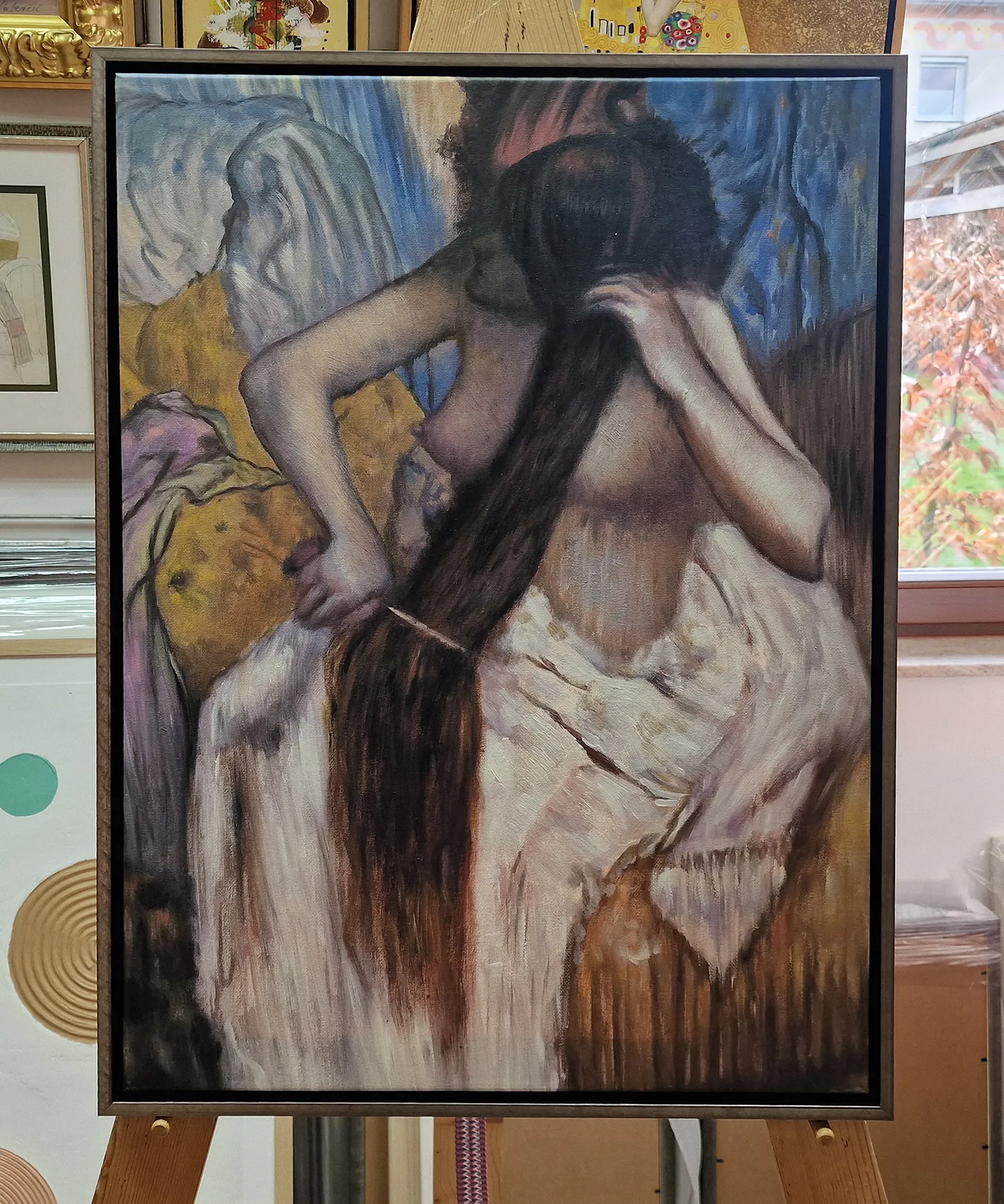
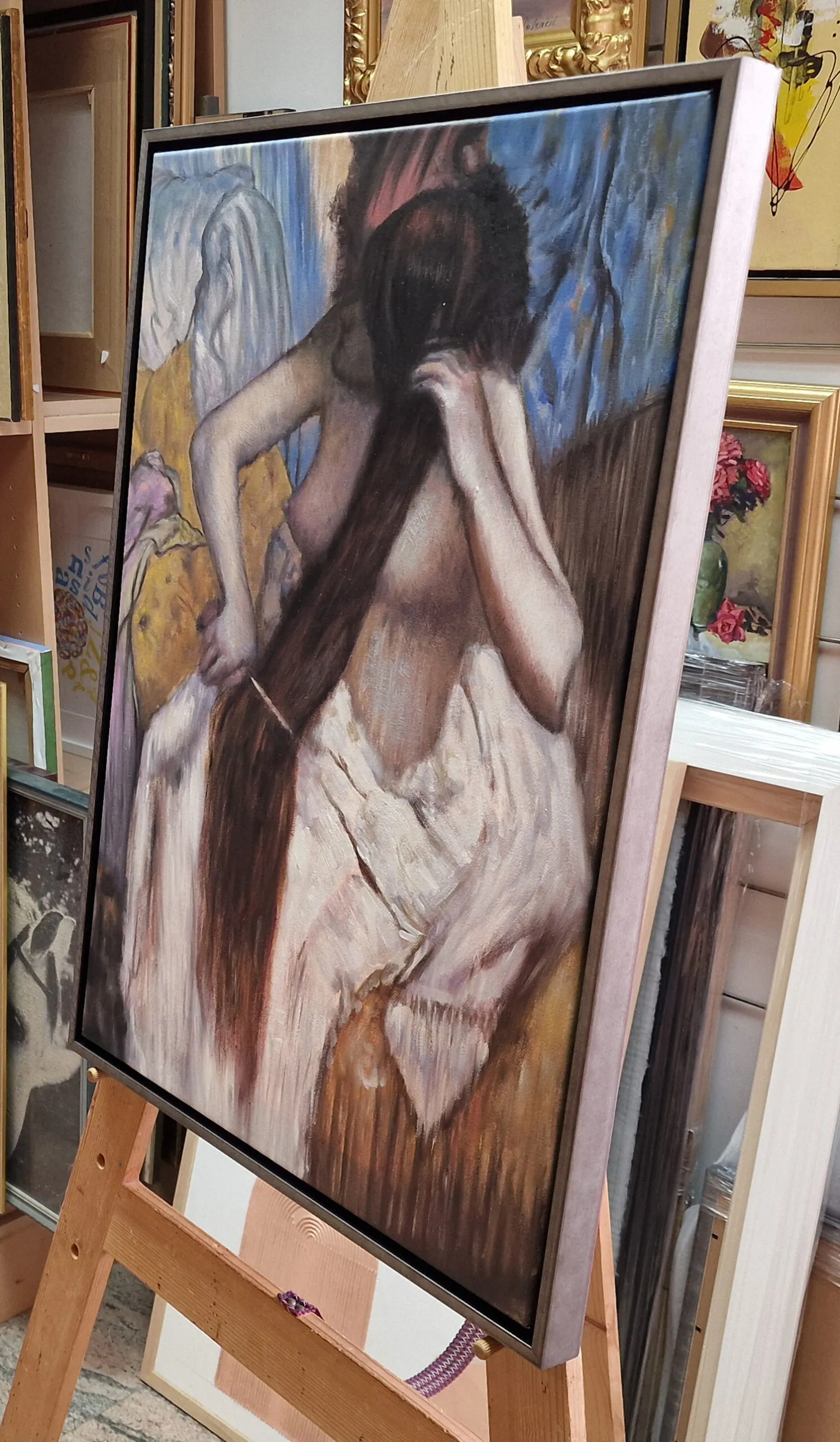
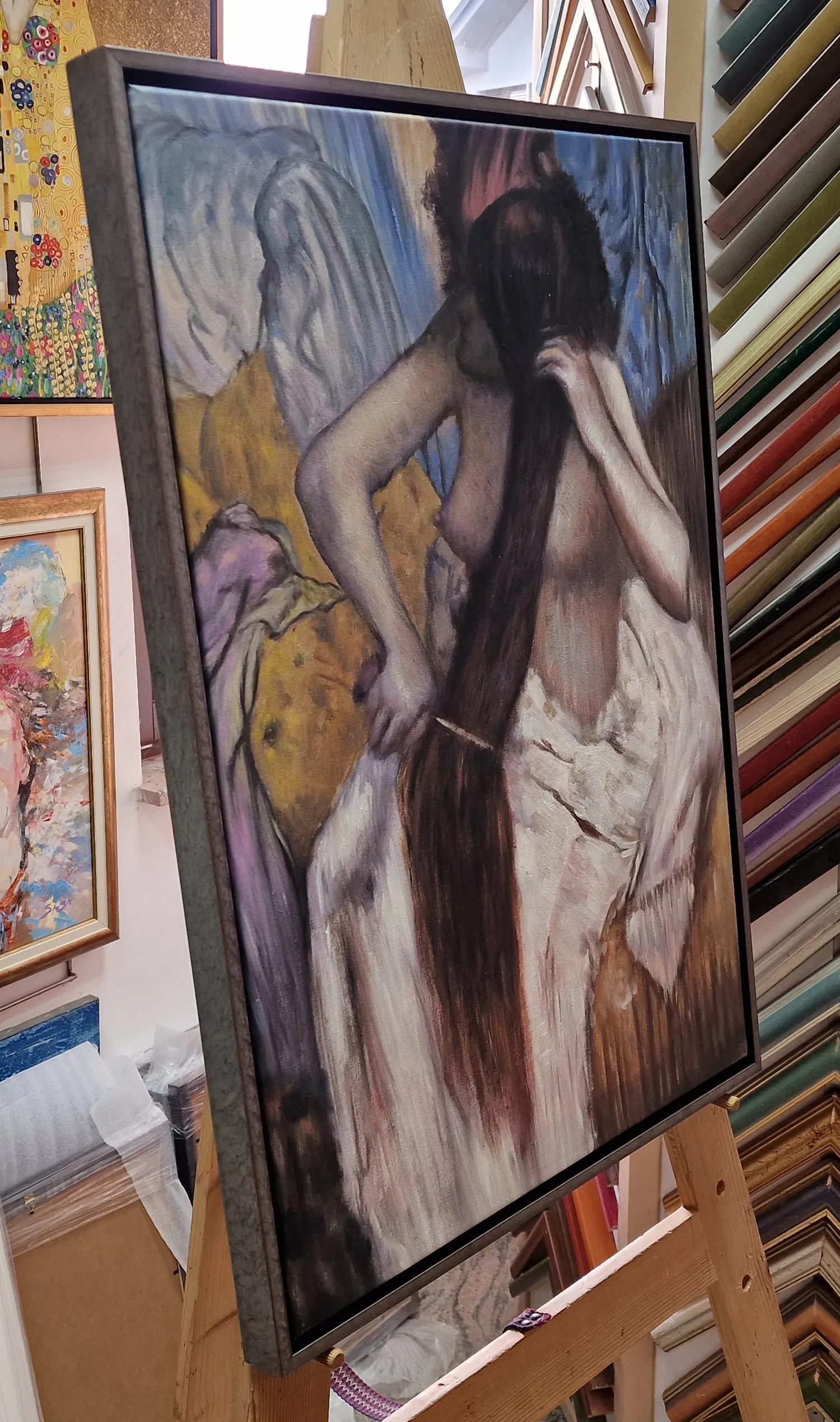
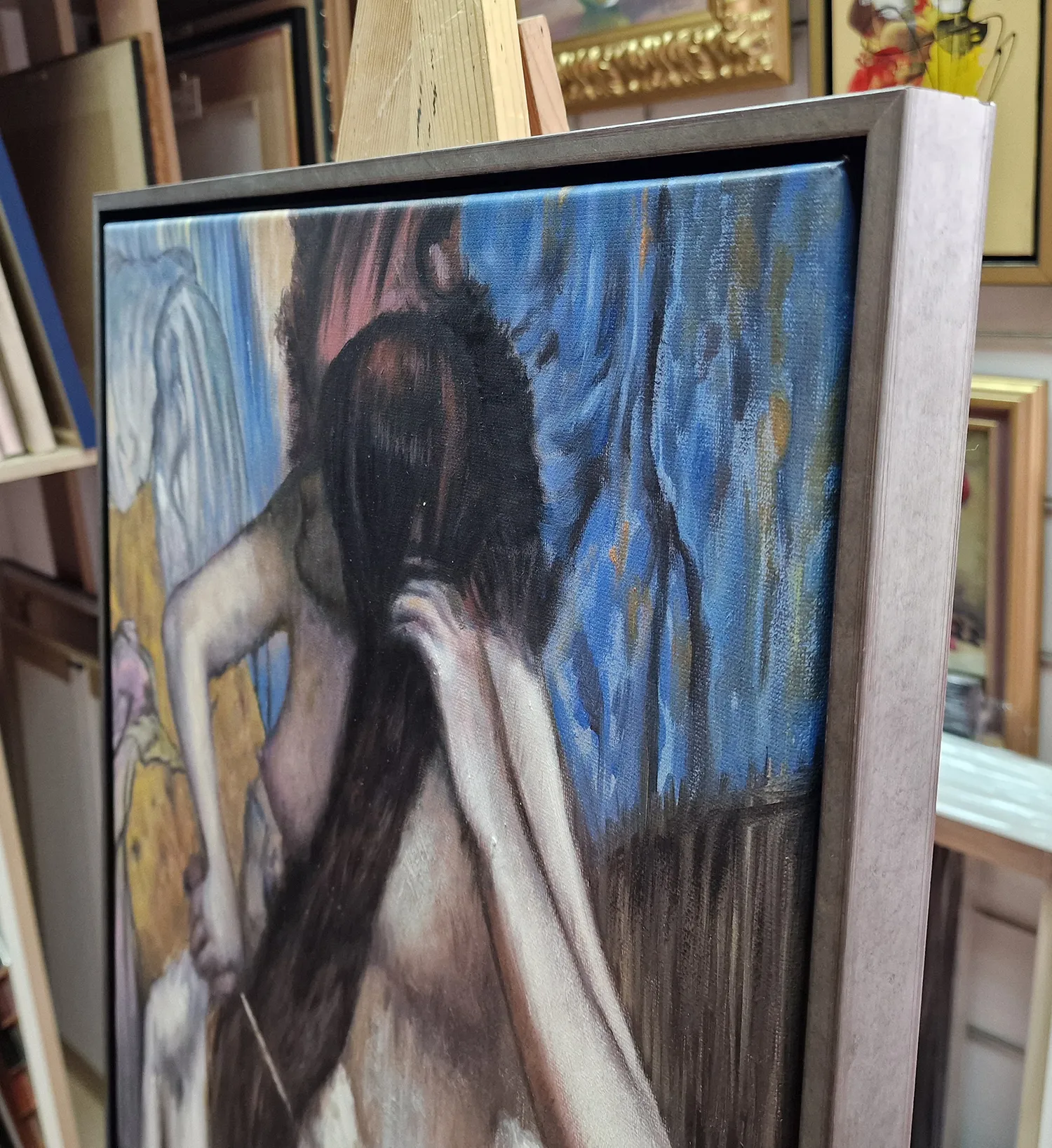
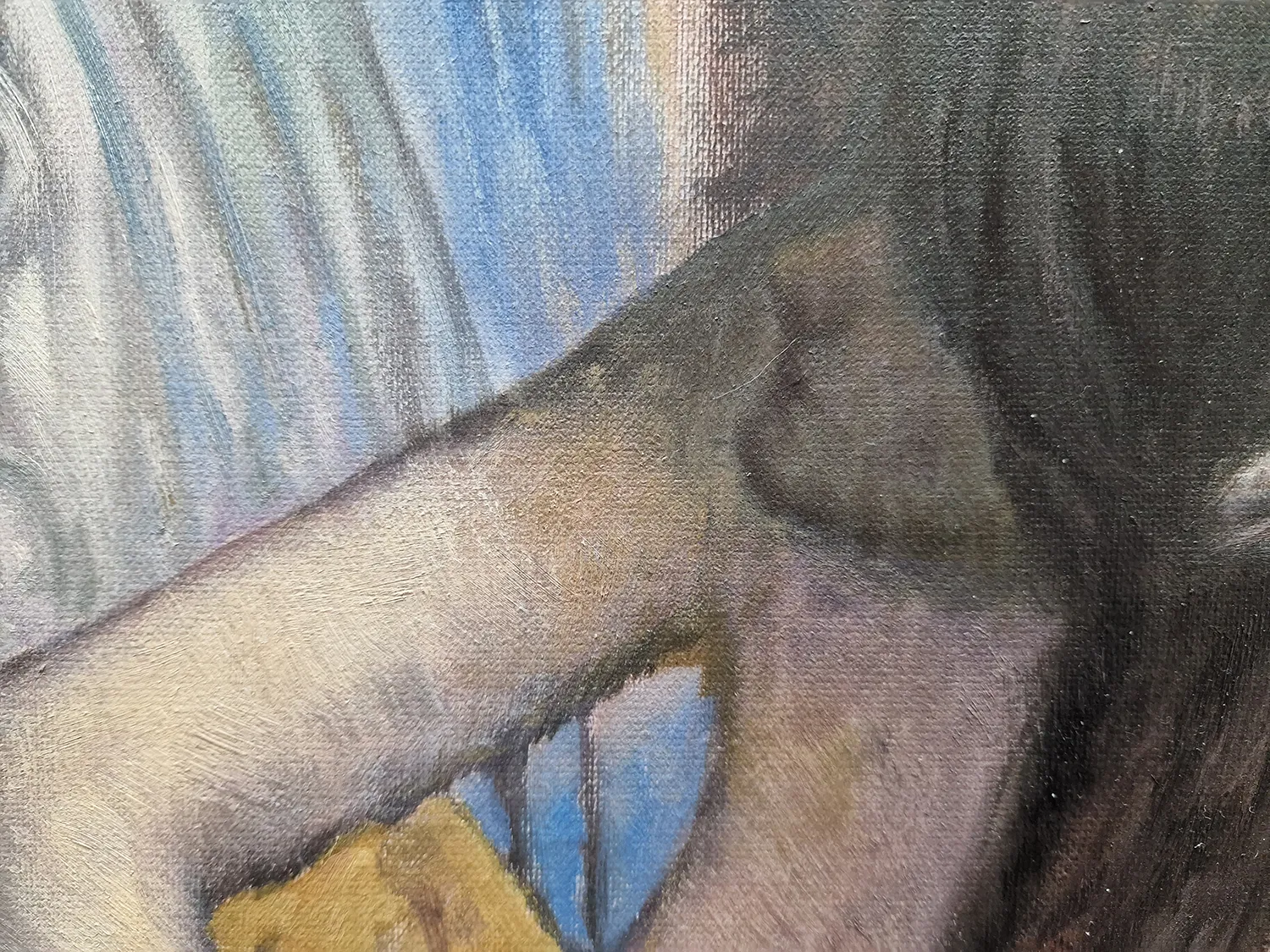
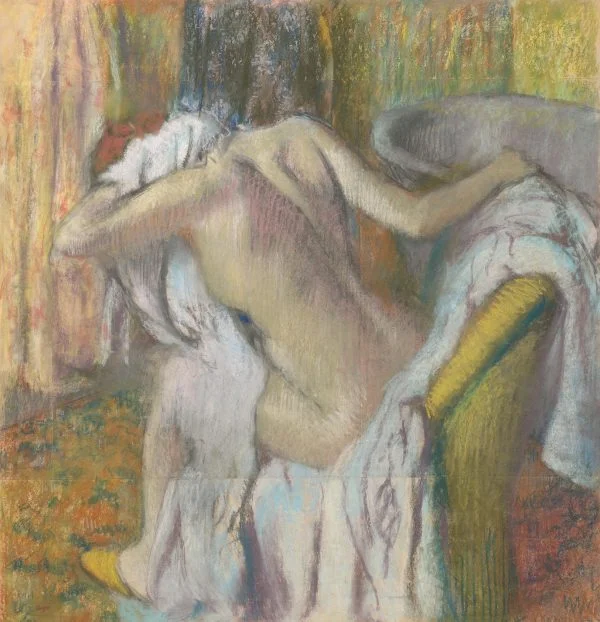
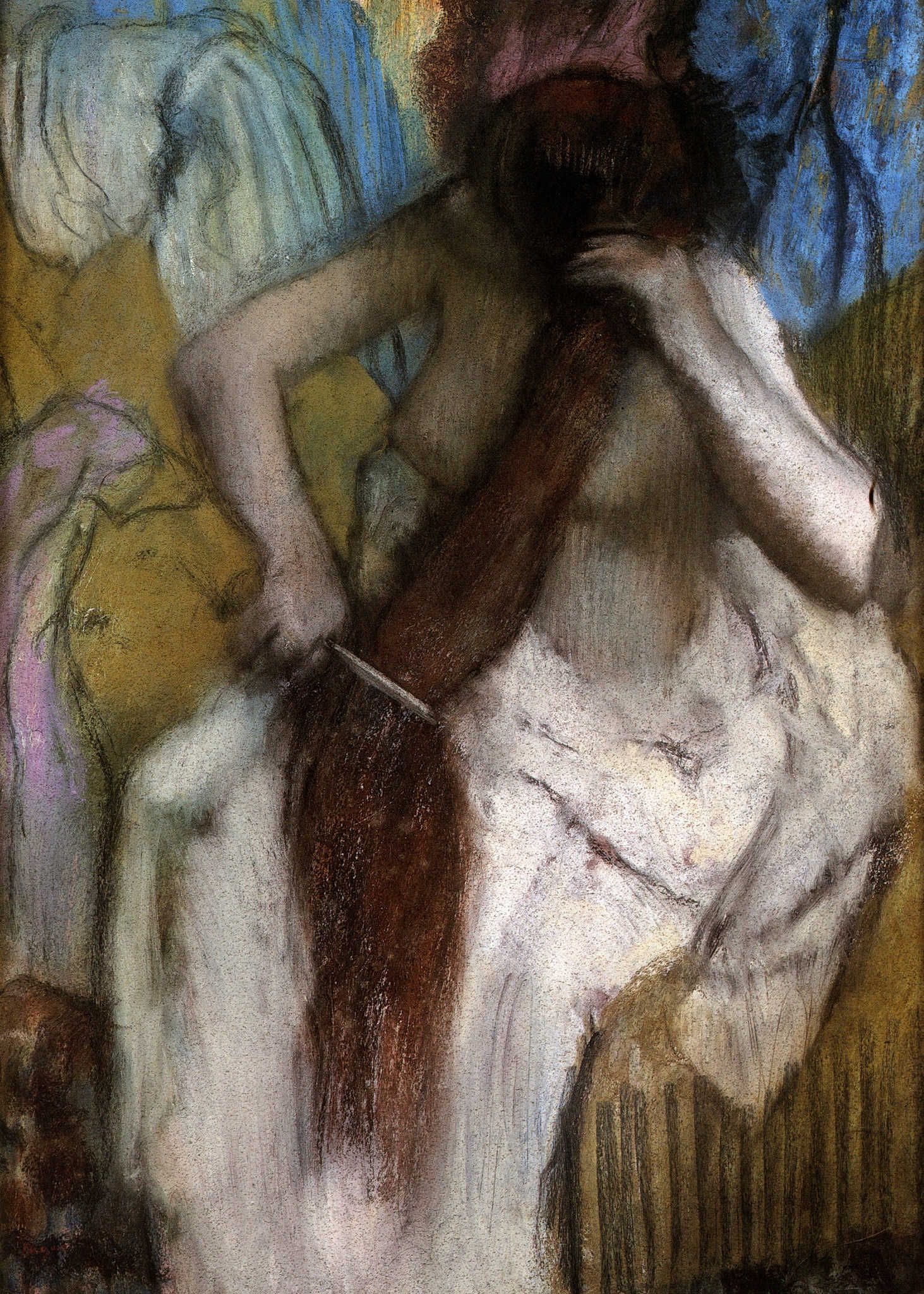
Woman Combing Her Hair shows a woman seated with her back to us, bare to the waist, a white cloth falling across her lap and legs. She has pulled her long chestnut hair forward over her shoulder; her right hand holds it at the crown, her left hand low down grips a comb — only a pale narrow stroke, easy to miss. Her face stays hidden. At the upper left hangs a pale blue-green curtain, at the upper right a stronger blue, the wall is ochre-olive, and along the left edge sits a patch of pink-lilac. The pastel strokes stay visible as separate lines. The original is a pastel on paper mounted on board and is held by the Musée d’Orsay in Paris under inventory number RF 1942-13. Ours is made by hand in eight sizes from 30 x 45 to 100 x 140 cm, or to your own measurement, and you receive a photograph of the finished work for approval before it ships.
| Title: | Woman Combing Her Hair |
| Other titles: | Femme se coiffant, Woman combing her hair |
| Painter: | Edgar Degas (1834–1917) |
| Year: | 1887–1890 |
| Size of the original: | 82 cm x 57 cm |
| Technique of the original: | pastel on paper, mounted on board |
| Style: | impressionism |
| Where it hangs: | Musée d’Orsay, Paris (inv. RF 1942-13; Schulman catalogue MS 1238, Lemoisne III-930) |
| Our version: | hand-painted in oil on linen, 8 sizes from 30 x 45 cm to 100 x 140 cm, custom size on request |
Woman Combing Her Hair – Edgar Degas
Who is in the scene?
One woman; the record does not name her. She sits with her back to us, turned a little to the right, bare to the waist, the lower part of her body covered by a white cloth. Her right arm is raised to the crown of her head and holds the hair there; her left is lowered, gripping a comb between the fingers. Between the two hands a long chestnut lock is pulled taut. Her head is tilted forward and her face cannot be seen. Nobody else is in the room and nobody looks out at us.
What is on the canvas?
The colours are divided into large areas. At the upper left hangs a pale blue-green curtain with white folds, at the upper right stands a stronger, almost cobalt blue, and between them, above her head, runs a band of raspberry pink. The wall and floor are ochre-olive. Along the left edge sits a patch of pink-lilac, like a garment thrown over the back of a chair. At the lower right the olive thickens into vertical strokes, as if it were cloth. Across all of it lies a white sheet, painted with several different whites. The pastel strokes stay visible as separate lines and nowhere melt into a smooth surface.
Why does this scene matter?
Because the hair is the point. It is the only dark mass in a scene otherwise made of pale, chalky colour, and it runs the whole height of the sheet — from the hand at the crown to below the knees. Everything else, the blue, the ochre wall and the white sheet, is background to that one brown column. The second reason is the comb: the tool by which all this is happening is painted as a barely visible pale stroke, so that you almost miss it. The third is the attitude; the woman is not posing but caught in the middle of a task, and the scene is built so that she does not notice us.
What does the scene mean?
An ordinary task taken seriously. Impressionism in the late Degas is no longer the street or the café but a closed room and a body in it. As an impressionist painting this sheet tells no story; it has a movement and a colour. As wall art it is unusually quiet and rich in colour at once, so it carries a bright room well. Being upright and narrow, a canvas painting of this shape belongs where the wall is tall rather than wide.
The subject among Degas’s works
The bathers are a large late group in Degas. After the Bath, Woman Drying Herself is from the same years and likewise a pastel, After the Bath (bending figure) shows the same task from another side, and After the Bath (1895) the same material in another colour. This sheet is described in the Schulman catalogue of Degas’s works as MS 1238 and is held by the Musée d’Orsay under inventory number RF 1942-13. If you want to see a late Degas pastel in the flesh and cannot get to Paris, the related After the Bath, Woman drying herself is in the National Gallery in London as NG6295.
How is our hand-painted version made?
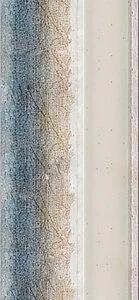
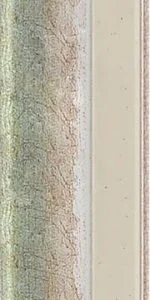
With a brush and oil paint, not a printer. The difference has to be said straight out: the original is not an oil painting but a pastel on paper mounted on board, and our version is oil on canvas, recreated from the pastel. Pastel is dry and grainy, so we do not imitate it with smooth colour but with thin passes laid over one another that let the layer below show through. The hair is the hardest part: it has to stay a single dark mass and still have direction, so it is laid in with long strokes in one direction and never outlined. In the first photograph the finished, framed canvas stands on the easel in our workshop, just before the final check; in the second the same work is shot from the side, so that the depth of the frame and the pale outer edge of the moulding can be seen. The fifth photograph is taken close up: there you can see how the strokes stand above the cloth and how the weave of the canvas itself comes through between them — the difference a print cannot give. Every reproduction is painted afresh, and no two are quite alike, because a hand does not repeat the same stroke twice; each hand-painted copy is therefore its own.
Which size for which wall?
If you do not know which: 57 x 82 cm. On this work that size is exactly the original’s — the original measures 82 x 57 cm and our fourth rung is 57 x 82 cm, the same to the centimetre, only written by width and height. The 30 x 45 and 40 x 60 cm are small, and at those sizes the patch at the left edge and the vertical strokes below merge. The 50 x 70 cm is the usual choice above a chest of drawers. The 57 x 82 cm is the original’s own size. The 70 x 100 and 80 x 110 cm want a taller wall. The 90 x 130 cm has the closest proportion to the original among the big sizes, 0.692 against 0.695. At 100 x 140 cm a large painting of this subject is very strong and the hair runs at almost life size. Measure the size you choose on the wall first with a paper cut-out. No size is kept in stock as a finished piece: every copy is painted to order and stays a single piece.
Custom size, stretcher and frame
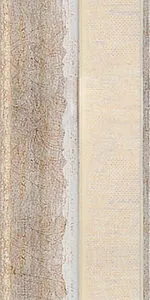
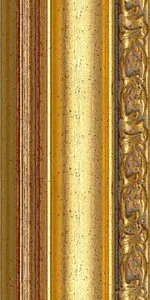
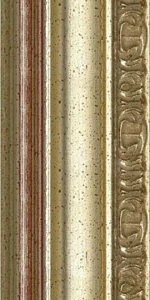
If none of the eight sizes fits, we paint to your measurement and keep the proportions of the scene as we do, so that the hair keeps the full height of the sheet and the patch at the left edge is not cropped away; this is our work painted to order. Every piece ships stretched on a wooden stretcher, ready to hang. For the frame, use our 3D app: it shows every moulding we carry on this subject, so you can compare gold, silver, black, white and natural wood — it is for choosing a frame and nothing else. If you want to see how the work looks on your own wall, we have a separate service for that, placement in the room.
Delivery and guarantee
Every piece is painted to order in our workshop in Slovenia, so allow 15-45 days depending on the size chosen; at the largest sizes the time is usually at the upper end. It travels stretched and protected for transport, framed if you chose a frame, to sixteen countries in the European Union, with no customs. Before it ships you receive a photograph of the finished work for approval, and our returns policy applies to every order. The painter’s full offer is in the Edgar Degas gallery, and his life is described in our article about Edgar Degas.
Frequently asked questions
What painting is this?
It is Degas’s pastel Woman Combing Her Hair, 1887–1890, 82 x 57 cm, held by the Musée d’Orsay in Paris under inventory number RF 1942-13.
Is the original an oil painting?
No. The original is a pastel on paper mounted on board. Ours is painted in oil on linen, recreated from the pastel.
Why is the year given as a range?
Because the catalogue records it that way: 1887–1890. Where a record gives a range, we keep it.
Did Degas sign this sheet?
No. In the lower left corner is the stamp of the sale of his studio, Vente Degas — a mark made after the painter’s death.
How did it reach the Orsay?
The catalogue gives the route: Degas’s studio, the Vente Degas sale of 1918 as lot 128, then Georges Viau in Paris, the Viau sale at the Drouot in Paris on 11 December 1942 as lot 69, the Musée du Louvre that same year, and the Musée d’Orsay in 1986.
Where can it be seen?
At the Musée d’Orsay in Paris. It was last shown there in 2023, in the exhibition Pastels du musée d’Orsay, de Millet à Redon, as number 61.
What is she holding in her left hand?
A comb. It is painted as a pale narrow stroke low among the locks, and it is easy to miss.
How big is the original?
82 x 57 cm. Our 57 x 82 cm is exactly the same, only written by width and height.
Is this a print?
No. The work is made by hand in oil; the brushstrokes are visible and can be felt, as the fifth photograph shows.
Can I have a size that is not on the list?
Yes, we paint to measurement and keep the proportions of the scene as we do.
Is it suitable as a gift?
Yes, for someone who likes quiet subjects and full colour. Because every piece is painted to order, allow for the making time; if you would rather leave the choice to the recipient, there is our voucher.
- Subject: a woman seen from behind combing her long chestnut hair; the comb is barely visible
- Original: Edgar Degas, pastel on paper on board, 82 x 57 cm, Musée d’Orsay, Paris (RF 1942-13)
- Ours: painted by hand in oil from the pastel, eight sizes from 30 x 45 to 100 x 140 cm
- Note: our 57 x 82 cm is the original’s size to the centimetre