









Description
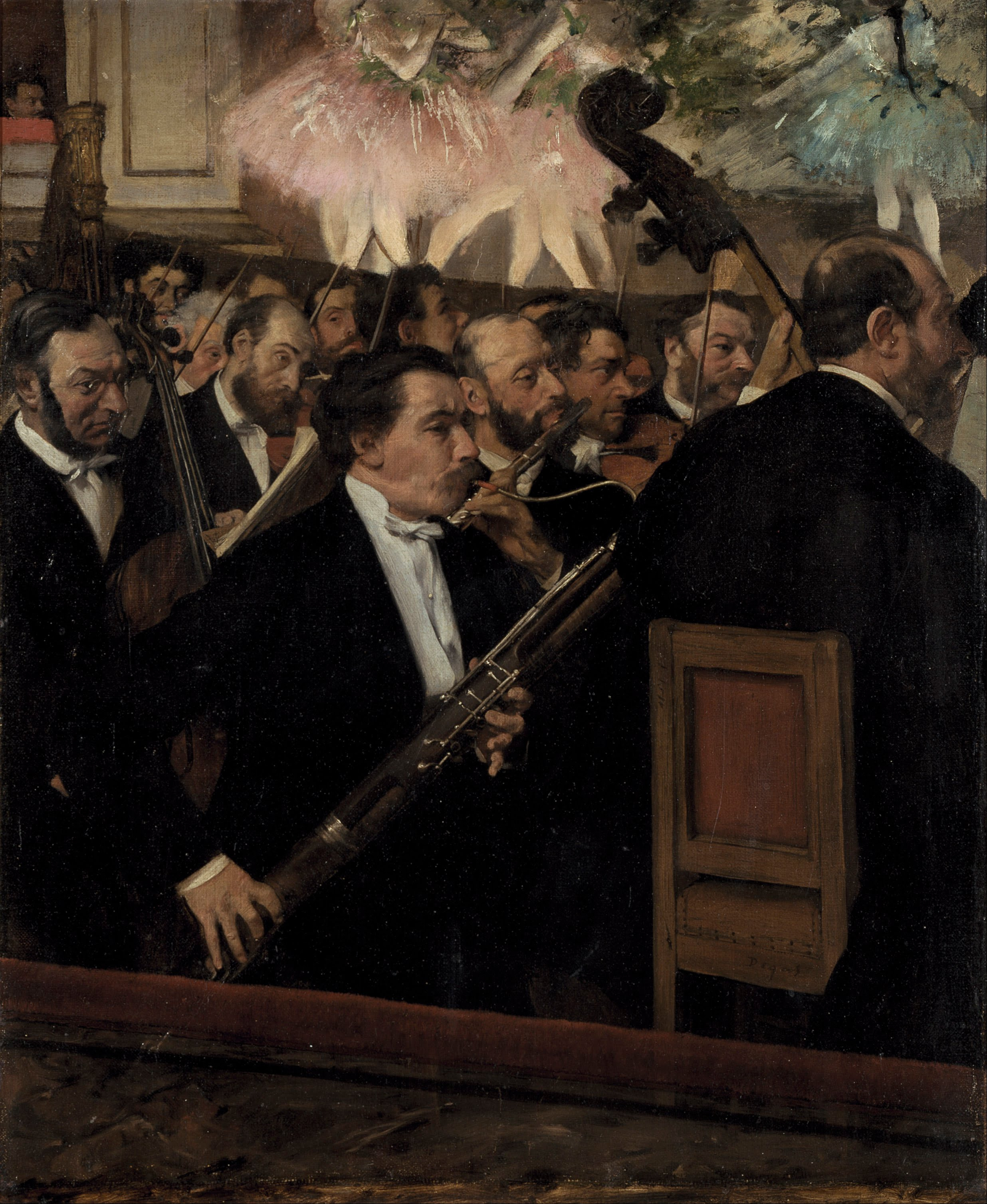
The Orchestra at the Opera shows the orchestra pit of the Paris Opéra seen close to. At the front sits a bassoonist in black with a white bow tie, turned to the right; at the left is a double-bass player with a marked face, and behind them a row of other musicians’ heads with flutes, bows and violins. At the right a man in black is seen from behind, and a wooden chair with a red panel. Above, the stage opens, but of the dancers we see only skirts and legs in pink and pale blue — not the faces. The original is an oil painting on canvas and is held by the Musée d’Orsay in Paris under the inventory number RF 2417. We make it as a hand-painted work, in sizes from 30 x 35 to 100 x 110 cm or to your own measurements, and you receive a photograph of the finished work for approval before dispatch.
| Title: | The Orchestra at the Opera |
| Other titles: | L’Orchestre de l’Opéra |
| Painter: | Edgar Degas (1834–1917) |
| Year of execution: | circa 1870 |
| Original size: | 56 cm x 46 cm |
| Original technique: | Oil on canvas |
| Painting style: | Impressionism |
| Located at: | Musée d’Orsay, Paris (inv. no. RF 2417) |
| Our reproduction: | hand-painted oil on linen canvas, 8 sizes from 30 x 35 cm to 100 x 110 cm, custom sizes on request |
The Orchestra at the Opera – Edgar Degas
Who is shown?
About a dozen musicians, none of them named. At the centre of the foreground sits a bassoonist: in a black tailcoat with a white bow tie, seen from the side, with a bassoon that rises across half the canvas. At the left is a double-bass player with dark hair and a marked, aged face. Behind them the heads of the rest are crowded together: a flute, violin bows, beards, bald crowns. At the front right is the back of a man in black, so close that we do not see his face. Above, on the stage, are dancers — but of them we see only skirts and legs.
What is on the canvas?
The scene is upright and, in its lower two thirds, dark: black tailcoats, white collars, the brown wood of the instruments. Along the bottom edge runs the red rim of the pit. The upper third is suddenly light: pink and pale blue skirts, white thighs, the green of the scenery — all of it cut off by the top edge of the canvas. At the upper left a box is visible with a man’s head in it. At the lower right stands the wooden chair back with its red panel, and on it the painter’s signature.
Why does this particular scene matter?
Because the dancers are cut off and the musicians are painted in full detail. Every other ballet scene of that time did the opposite: the dancer was the face, the orchestra a dark line beneath the stage. Here Degas reverses the relation. There are twelve faces we can know, and all of them are in the pit; on the stage there is not one. The second thing is the history of the canvas: the work passed from the painter’s studio to Désiré Dihau, the bassoonist of the Opéra orchestra, then to Marie Dihau, and only in 1935 to the Louvre. For almost seventy years it stayed with the musicians.
What does the scene mean?
That the performance is work. Impressionism for Degas always meant a cutting caught as the eye really sees it, and the eye from a good seat sees exactly this: the backs of heads, bows, a bassoon across half the view. An impressionist painting of this kind is therefore not a scene of pleasure but a scene of a profession. As wall art it is dark and dense; it needs a pale wall and a little distance. A canvas painting for a music corner, a study or a library suits it exceptionally well.
The motif among Degas’s works
The Paris Opéra was one great subject for Degas, seen from both sides of the footlights. Orchestra Musicians shows the same pit from another distance, The Ballet from Robert le Diable puts the viewer in the house behind the orchestra, and Joseph-Henri Altès is the portrait of a single flautist of this orchestra. This work is catalogued in the Degas catalogue raisonné as MS 1255, and the same stage seen over the heads of the orchestra is shown by Ballet at the Paris Opéra at the Art Institute of Chicago.
How is our hand-painted version made?
With a brush and oil colours, not a printer, and here the technique of the original is the same as ours: oil on canvas. Every one of our canvases is made layer after layer, and in this motif the lower half is the hardest part. The tailcoats are almost black, but inside them it has to stay visible where one man ends and the next begins; painted as one dark area, the orchestra disappears. That is reached with several thin layers, and with the white collars kept back until last. The other demanding part is the band of dancers above: it has to be painted quickly and loosely, or it becomes more important than the musicians and the scene turns over. Every reproduction is made afresh and no two copies are ever quite the same, because the hand does not repeat the same stroke twice; every hand-painted copy is therefore its own. For this work we have no photographs of our finished canvases, so we show and describe none here. The photograph of your canvas reaches you before dispatch.
Which size for which wall?
If you do not know which: 60 x 70 cm. The original measures 56 x 46 cm and is therefore small; our 50 x 55 cm size comes nearest to it in size, while in proportion the nearest are 30 x 35 and 60 x 70 cm, because our sizes run noticeably wider than the original. The 30 x 35 and 43 x 47 cm sizes are for a narrow space, where the individual heads in the pit already become hard to tell apart. The 50 x 55 and 60 x 70 cm sizes are the most frequent choice above a chest of drawers or beside a piano. The 70 x 80 and 80 x 90 cm sizes are for a larger wall, where the dark half is given its space. The 90 x 100 cm size is for an entrance hall, and at 100 x 110 cm we are at the sizes where a large painting really breathes and the musicians’ heads stand close to life size. Measure your chosen size on the wall with a paper cut-out first; with an upright format the mistake is usually made in the height. None of the sizes is held in stock as a finished item: every copy is made to order and stays a single piece.
Custom size, stretcher bar and frame
If none of the eight sizes suits you, or if you want the original’s proportion, we paint to your measurements and keep the proportions of the scene, so that the band of dancers above stays as narrow as it is in Degas and the bassoon below does not fall off the edge; that is our painting made to order. Every copy is delivered stretched on a wooden bar, ready to hang. For the frame, use our 3D application: on this motif it shows every moulding profile we carry, so you can compare gold, silver, black, white and natural wood – it is for choosing a frame and nothing else. If you want to see how the work looks on your own wall, that is our separate room-placement service.
Delivery and guarantee
Every copy is made to order in our studio in Slovenia, so allow 15 to 45 days depending on the size you choose; for the largest sizes the time is usually at the upper end. We send it stretched and protected for transport, framed if you chose a frame, to sixteen countries in the European Union, without customs duties. You receive a photograph of the finished work for approval before dispatch, and our returns policy applies to every order. The whole range is in the Edgar Degas gallery, and the painter’s life is described in our article about Edgar Degas.
Frequently asked questions
What is happening in the scene?
The performance is under way. The orchestra is playing in the pit below the stage and there is dancing on the stage — but of the dancers we see only the lower part.
Why are the dancers cut off?
Because Degas set the view at the height of the orchestra rather than of the house. From a musician’s seat the stage is visible only up to the waist.
Which instrument is in the foreground?
A bassoon. Its tube runs diagonally across almost half the canvas and is the most conspicuous thing in the scene.
Who are the musicians?
Nobody in the scene is named. It is on record, though, that the work went from the painter’s studio to Désiré Dihau, the bassoonist of this orchestra, and afterwards to Marie Dihau.
Where is the original located?
In the Musée d’Orsay in Paris, under the inventory number RF 2417.
How large is the original?
56 by 46 cm. Our 50 x 55 cm size comes nearest to it in size.
Why is the year given as “circa”?
Because that is how the catalogue of works gives it: circa 1870. Where the year is not exactly settled, we do not settle it either.
Are your sizes in the same proportion as the original?
No – ours run noticeably wider. In proportion the nearest are 30 x 35 and 60 x 70 cm; if you want the original’s proportion, we paint it to your measurements.
Is this a print?
No. The work is painted by hand in oil colours; the brushstrokes are visible and can be felt.
Can I have a size that is not listed?
Yes, we paint to measure and keep the proportions of the scene while doing it.
Is it suitable as a gift?
Yes, especially for a musician or for someone who goes to the opera. Because every copy is made to order, allow for the making time; if you would rather leave the choice to them, there is our gift voucher.
- Subject: the orchestra pit of the Paris Opéra close to, a bassoonist at the centre, the musicians’ heads around him, and above a narrow band of cut-off dancers
- Original: Edgar Degas, an oil painting on canvas, 56 x 46 cm, Musée d’Orsay in Paris (RF 2417)
- Ours: hand-painted in oil, eight sizes from 30 x 35 to 100 x 110 cm, stretched and framed on request
- Worth knowing: the dancers are cut off and the musicians painted in full detail – the reverse of every ballet scene of its time