




Description
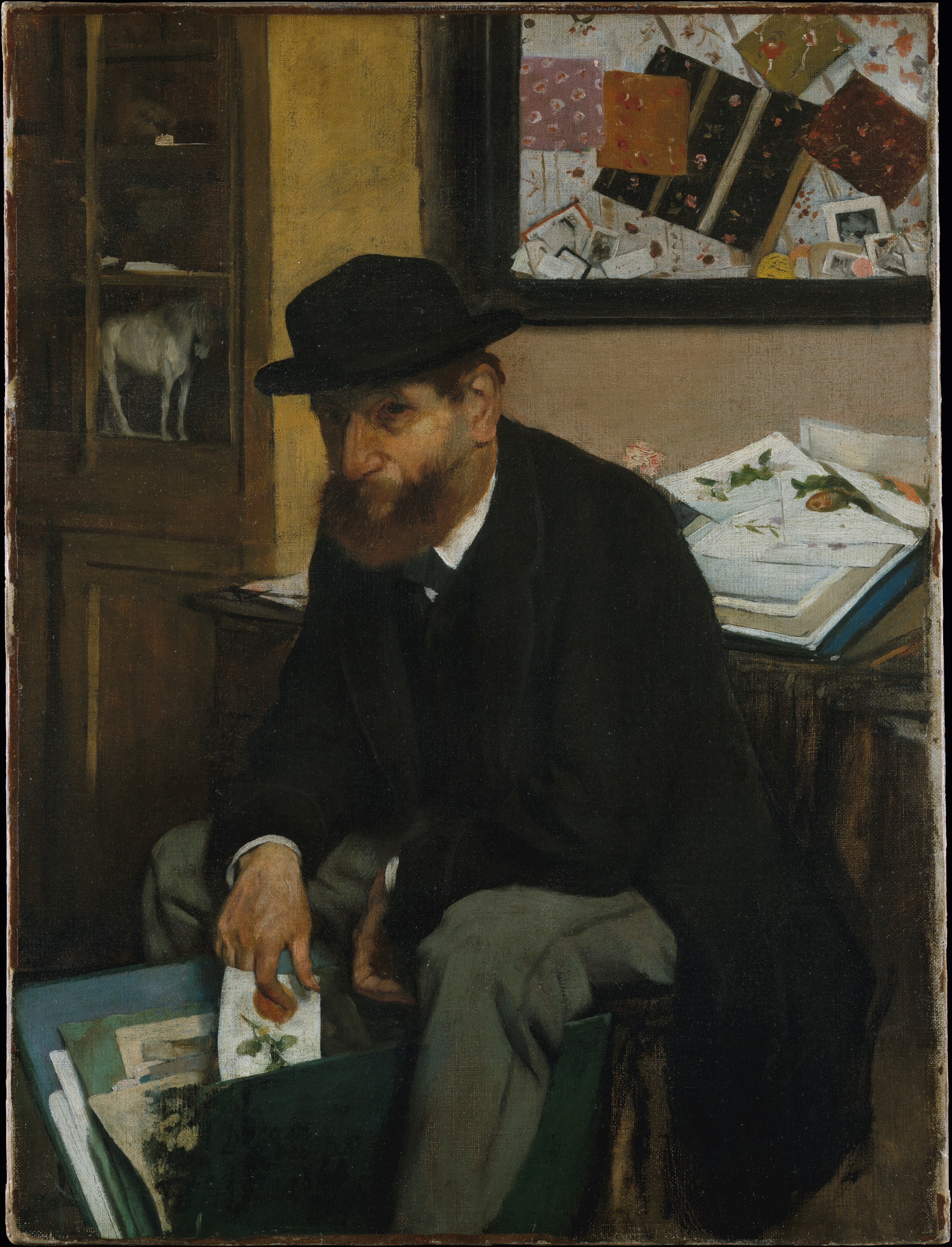
The Collector of Prints shows a bearded man in a black hat and dark coat, seated and leaning forward with a large green portfolio across his knees; his right hand rests on a sheet carrying a small plant drawing, and his gaze goes sideways past us. As a canvas painting this is an upright, tightly cropped interior full of paper. The original is oil on canvas and is held in the Metropolitan Museum of Art in New York under the inventory number 29.100.44. We make it as a hand-painted work on linen, in sizes from 40 x 60 to 110 x 150 cm or to your own measurements, and you receive a photograph of the finished work for approval before dispatch.
| Title: | The Collector of Prints |
| Other titles: | L’amateur d’estampes |
| Painter: | Edgar Degas (1834–1917) |
| Year of execution: | 1866 |
| Original size: | 53 cm x 40 cm |
| Original technique: | Oil on canvas |
| Painting style: | Impressionism |
| Located at: | Metropolitan Museum of Art, New York (inv. no. 29.100.44) |
| Our reproduction: | hand-painted oil on linen canvas, 9 sizes from 40 x 60 cm to 110 x 150 cm, custom sizes on request |
The Collector of Prints – Edgar Degas
Who is shown?
A single man, unnamed. He wears a black bowler hat and a dark coat, has a thick brown beard, and sits leaning forward as though somebody had interrupted him in the middle of an occupation. His gaze does not come to us but goes sideways past us – wary, almost unwilling. That gaze is what makes the scene: this is not the portrait of a man posing but of a man being disturbed. The title names him only by what he does.
What is on the canvas?
The format is upright and the crop is tight. Across his knees lies a large green portfolio, open and full of sheets; his right hand rests on one of them, where a small plant drawing can be seen. His left hand is loosely closed at his chest, his trousers are grey. Behind at the right stands a table with a second, bluish portfolio and scattered sheets, among them one with a red flower and a small orange fruit. At the upper right hangs a dark-framed board, densely covered with coloured papers, patterned fabrics and small photographs – the most colourful part of the canvas. At the upper left stands a dark cabinet with a glass door, and inside it, on a shelf, a white figure of a horse. The wall is greyish above and ochre in the middle.
Why does this particular scene matter?
Because it is the portrait of a habit rather than of a face. Everything on the canvas speaks of collecting: the portfolio on his knees, the portfolio on the table, the pinned papers, the figure behind glass. The man is surrounded by his sheets and almost sunk into them, while he himself is painted dark and withheld. In these years Degas was still a portrait painter in the traditional sense, but he was already shifting the weight from the person to what surrounds the person – and it was that shift that later led to the ballet and to the bathers.
What does the scene mean?
Collecting as a private matter. The man shows nothing and offers nothing; he holds his sheets the way people hold personal things. Impressionism for Degas always meant a person caught mid-occupation rather than arranged for the gaze; an impressionist painting of this kind therefore reads more as an intercepted moment than as an official portrait. As wall art it carries a room through small detail rather than through colour, and it rewards anyone who steps close.
The motif among Degas’s works
The interior portrait returns in Degas. Lorenzo Pagans and Auguste De Gas puts two men in an equally dark room, there too with papers and a score; Hilaire de Gas is the sterner, freestanding portrait of the painter’s grandfather. A Woman Seated beside a Vase of Flowers shows the same procedure reversed: the person is pushed to the edge and the object stands in the middle. How Degas saw himself is shown by the Self-Portrait at the Art Institute of Chicago, while The Millinery Shop in the same collection shows the same interest in a person among their own wares.
How is our hand-painted version made?
With a brush and oil colours, not a printer, and here the technique of the original is the same as ours. Every one of our canvases is made layer after layer, and in this scene the board at the upper right is the hardest part: it is dozens of tiny coloured patches that have to stay individually readable, or they collapse into a gaudy muddle. The green portfolio has to stay green and not go grey, because it is the only larger cool area on the canvas. Every reproduction is made afresh and no two copies are ever quite the same, because the hand does not repeat the same stroke twice; every hand-painted copy is therefore its own. For this work we have no photographs of our finished canvases, so we show and describe none here. The photograph of your canvas reaches you before dispatch.
Which size for which wall?
If you do not know which: 60 x 80 cm. The original is small, 53 x 40 cm; our smallest size, 40 x 60 cm, is nearest to it in size, while 60 x 80 cm is nearest in proportion. The 50 x 60 and 50 x 70 cm sizes are for a narrow wall or a hallway. The 60 x 80 and 70 x 90 cm sizes are the most usual choice above a chest of drawers; at them the small details on the board at the upper right already read well, which with this motif is decisive. The 80 x 110 and 90 x 120 cm sizes are for a larger wall beside a door or in a study. The 97 x 130 cm size belongs beside a sofa, and at 110 x 150 cm we are at the sizes where a large painting puts the figure close to life size. Measure your chosen size on the wall with a paper cut-out first; with an upright format the mistake is usually made in the height. None of the sizes is held in stock as a finished item: every copy is made to order and stays a single piece.
Custom size, stretcher bar and frame
If none of the nine sizes suits your wall, we paint to your measurements and keep the proportions of the scene, so that the portfolio on his knees stays whole and the board at the upper right keeps its space; that is our painting made to order. Every copy is delivered stretched on a wooden bar, ready to hang. For the frame, use our 3D application: on this motif it shows every moulding profile we carry, so you can compare gold, silver, black, white and natural wood – it is for choosing a frame and nothing else. If you want to see how the work looks on your own wall, that is our separate room-placement service.
Delivery and guarantee
Every copy is made to order in our studio in Slovenia, so allow 15 to 45 days depending on the size you choose; for the largest sizes the time is usually at the upper end. We send it stretched and protected for transport, framed if you chose a frame, to sixteen countries in the European Union, without customs duties. You receive a photograph of the finished work for approval before dispatch, and our returns policy applies to every order. The whole range is in the Edgar Degas gallery, and the painter’s life is described in our article about Edgar Degas.
Frequently asked questions
Who is the man in the scene?
He is not named. The title names him only by his habit: he is a collector of prints.
What is he holding in his lap?
A large green portfolio, open and full of sheets. His right hand rests on a sheet carrying a small plant drawing.
What is the board at the upper right?
A dark-framed surface densely covered with coloured papers, patterned fabrics and small photographs. It is the most colourful part of the canvas.
What is in the cabinet at the upper left?
Behind a glass door, on a shelf, stands a white figure of a horse, with papers beside it.
Why does the man not look at us?
Because the scene is not a pose. The gaze goes sideways past us, as though the man had been interrupted mid-occupation.
Where is the original located?
In the Metropolitan Museum of Art in New York, under the inventory number 29.100.44.
How large is the original?
53 by 40 cm, so relatively small. Our 40 x 60 cm size is nearest to it in size.
Is this a print?
No. The work is painted by hand in oil colours; the brushstrokes are visible and can be felt.
Which size should I choose?
Above a chest of drawers usually 60 x 80 cm, for a narrow wall 50 x 70 cm. The size guide is above.
Can I have a size that is not listed?
Yes, we paint to measure and keep the proportions of the scene while doing it.
Is it suitable as a gift?
Yes, especially for a collector, a librarian or anyone who likes things full of detail. Because every copy is made to order, allow for the making time; if you would rather leave the choice to them, there is our gift voucher.
- Subject: a bearded man in a black hat with a green portfolio on his knees, papers all around, a board of pinned sheets at the upper right
- Original: Edgar Degas, an oil painting on canvas, 53 x 40 cm, Metropolitan Museum of Art in New York (29.100.44)
- Ours: hand-painted in oil, nine sizes from 40 x 60 to 110 x 150 cm, stretched and framed on request
- Worth knowing: the title gives no name but a habit – the man is named after what he collects