




Description
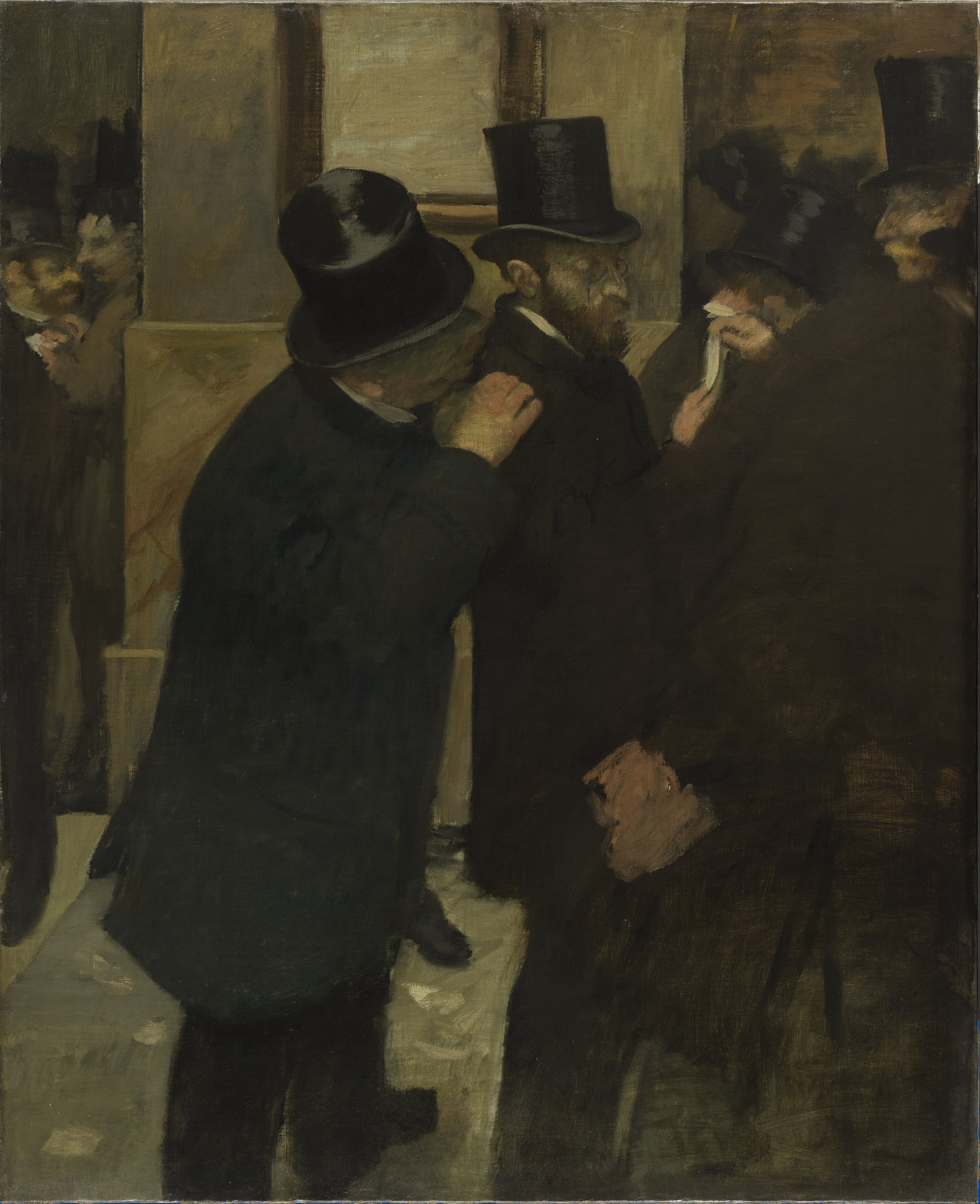
Portraits at the Stock Exchange shows a corner of the exchange floor where two men are passing a piece of information between them. A bearded man in a top hat and dark coat stands facing us, looking down at a sheet of paper he holds in front of him. From the left a man in a bowler hat leans over his shoulder, seen from behind, his hand raised close to the other man’s collar, speaking into his ear. On the right a third man holds a white slip in front of his face, and behind him another top-hatted figure appears at the edge. In the background at the left men stand by a pale pillar with a notice on it, the floor is grey and scattered with white papers. The original measures 81.5 x 100.5 cm, was made between 1878 and 1879, and is held by the Musée d’Orsay in Paris under inventory number RF 2444. Ours is painted by hand in eight sizes from 30 x 40 to 120 x 160 cm or to your own measurement, and you receive a photograph of the finished work for approval before it ships.
| Title: | Portraits at the Stock Exchange |
| Other titles: | Portraits à la Bourse, À la Bourse |
| Painter: | Edgar Degas (1834–1917) |
| Year: | between 1878 and 1879 |
| Size of the original: | 81.5 cm x 100.5 cm |
| Technique of the original: | oil on canvas |
| Style: | Impressionism |
| Where it hangs: | Musée d’Orsay, Paris (inv. RF 2444) |
| Our version: | hand-painted oil on linen canvas, 8 sizes from 30 x 40 cm to 120 x 160 cm, custom size on request |
Portraits at the Stock Exchange – Edgar Degas
Who is in the scene?
The museum record names none of the men, so neither do we; what can be said is what is visible. In the foreground stands a bearded man of middle age in a pale top hat and dark coat, turned towards us but with his head bent over a sheet of paper he holds in both hands. From the left a second man in a bowler hat leans over his shoulder; we see him almost entirely from behind, so that only the edge of a cheek and one ear remain. His right hand is raised close to the other man’s collar and his head is set against his. On the right a third man in a top hat holds a white slip so close to his face that the paper covers its lower half; behind him another figure appears at the edge, reduced to part of a head and shoulders. At the left, smaller and blurred, three more men stand by a pillar.
What is on the canvas?
A corner of the hall, not its breadth. At the left a pale pillar rises with a notice fixed to it; you can see that something is written there, but not what. The wall behind the figures is evenly warm and grey, without ornament, so nothing draws the eye away from the heads and hands. The floor is grey and smooth, with white and yellowish sheets of paper scattered over it, some folded, some thrown down flat — the only sign that something was happening here before this moment. All the clothing is dark: black and charcoal coats that almost merge into a single mass. The only light things are the faces, the white collars and the two pieces of paper. The paint is laid on thin and fast; large areas of the coats stay almost unworked, and in places the weave of the canvas shows through.
Why does this scene matter?
Because it is a portrait of a whisper. An ordinary group portrait arranges people so that we can see them; here the main figure is absorbed in a piece of paper and the second turns his back to us. What is shown is not what the two men look like but how one tells the other something — the hand at the collar, head against head, both gazes down on the same sheet. The second reason is the framing: the figures on the right are cut off by the edge of the canvas, as though the scene ran on beyond it. That is the photographic way of seeing Degas used in the theatre and at the racecourse, brought here into a place of business. The third is the choice of subject: an exchange floor was not then considered a handsome motif, and Degas painted it as a place of work rather than a stage for wealth.
What does the scene mean?
That information is a thing which travels from mouth to ear. Impressionism in Degas does not mean light in the open air but close observation of the modern city, and this scene is exactly that. As a canvas painting it works differently from flowers or a landscape: there is an action here that has to be read, and that is why it keeps its interest. Because the colours are restrained — grey, black, brown and a few white patches — it is quiet wall art for a living room, an office or a working corner, and it does not shout down the room. Anyone looking for a large painting with human content will find four faces and a single action.
Two versions of the same scene
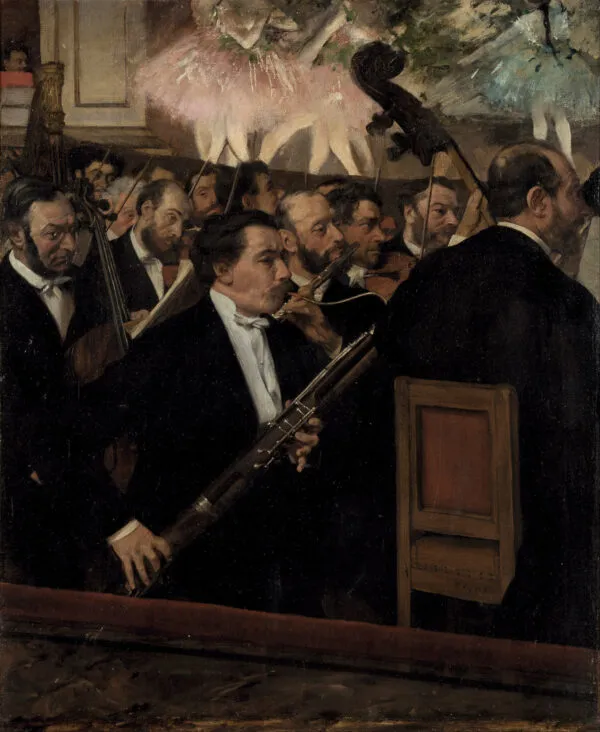
Two different works carry this title and they are easily confused. Ours is the oil in the Musée d’Orsay, recorded there under inventory number RF 2444, 81.5 x 100.5 cm, made between 1878 and 1879. Beside it there is a pastel in the Metropolitan Museum in New York under number 1991.277.1, 72.1 x 58.1 cm, in pastel on paper laid down on canvas. They are two different works of the same scene, not two photographs of one canvas. Among the works by Degas we offer, the closest to this scene are The Orchestra at the Opera, where real men are also painted at their work, The Collector of Prints, the portrait of a man to whom the paper in his hands matters more than the viewer, and Lorenzo Pagans and Auguste De Gas, a double portrait in which the gazes likewise never meet.
How is our hand-painted version made?
With a brush and oil paint, in the same technique as the original, so ours is oil on canvas too. The hardest part is the dark suits: four coats have to read as one dark mass and still show where one figure ends and the next begins, so we build them from brown, blue and green, never from black alone. The second hard part is the paper. The sheets in the hands and on the floor are the only light areas in the lower half; they need several different whites or they look like holes. The hand at the collar is the third: painted too strongly the scene becomes a threat, too weakly and the action disappears. We leave the faces until last, because who is listening to whom depends on them. Every reproduction is made afresh and no two are quite alike, because the same hand does not repeat the same stroke twice; every hand-painted copy is its own. We have no photographs of our own finished canvases for this subject yet, because we have not painted it before, so none is shown here and none is described. You receive a photograph of your own canvas before it ships.
Which size for which wall?
If you are unsure: 70 x 90 cm. The original is 81.5 x 100.5 cm, which puts it unusually close in scale to our 80 x 110 cm — that size is within a centimetre and a half of the original in width and nine and a half centimetres taller. In proportion the closest is 40 x 50 cm: 1.25 against the original’s 1.233. At 30 x 40 and 40 x 50 cm the notice on the pillar and the papers on the floor are lost; they suit a narrow wall or a shelf. 50 x 70 and 80 x 110 cm are more elongated than the original, so the scene is stretched a little in height. 60 x 80 and 70 x 90 cm are the right choice above a chest of drawers or a desk. 100 x 130 and 120 x 160 cm need a wider wall and some distance, and at those sizes the expression on all four faces becomes readable. Measure your chosen size on the wall first with a paper cut-out. No size is held in stock as a finished item: each one is painted to order and stays a single piece.
Custom size, stretcher bar and frame
If none of the eight sizes suits, or if you want exactly the proportion of the original, we paint to your measurement and keep the framing so that the figures at the right edge stay in the scene; that is our work made to order. Every piece is sent stretched on a wooden stretcher bar, ready to hang. For the frame use our 3D application: on this subject it shows every moulding we carry, so you can compare gold, silver, black, white and natural wood — it is for choosing a frame and nothing else. If you want to see how the work sits on your own wall, we have a separate service for that, placement in the room.
Delivery and guarantee
Each piece is painted to order in our workshop in Slovenia, so allow 15-45 days depending on the size chosen; at the largest sizes the time is usually at the upper end. It travels stretched and protected for transport, framed if you chose a frame, to sixteen countries in the European Union, without customs. Before dispatch you receive a photograph of the finished work for approval, and our returns arrangement applies to every order. The full range is in the Edgar Degas gallery, and his life is described in our article about Edgar Degas.
Frequently asked questions
Which painting is this?
Degas’s oil Portraits at the Stock Exchange, made between 1878 and 1879, 81.5 x 100.5 cm. It is held by the Musée d’Orsay in Paris under RF 2444, where its second name is also recorded, À la Bourse.
How big is the original?
81.5 cm wide and 100.5 cm high. With its frame the museum gives 101 x 121 cm. Our 80 x 110 cm is the closest to it in scale, and 40 x 50 cm the closest in proportion.
Who are the men in the scene?
The museum record does not name them, so neither do we. It carries a single name, the donor’s: Ernest May gave the work to the museum in 1923. Whether one of the painted men is him, the record does not say.
Is the pastel in New York the same work?
No, it is a different work with the same title: a pastel on paper laid down on canvas, 72.1 x 58.1 cm, under number 1991.277.1. Ours is the larger oil and is in Paris.
How did the work reach the Orsay?
As a gift. The museum record states: donation with reserved usufruct, Ernest May, 1923 — the donor handed the work to the museum and kept the right to use it until his death.
Where can it be seen?
At the Musée d’Orsay in Paris. Whether it is on display at any given moment or in storage, the record does not say.
What is the man on the right holding in front of his face?
A small white slip that covers the lower half of his face. What is written on it cannot be read, and the museum record is silent about it, so we make no claim either.
Is the original an oil or a pastel?
An oil, painted on canvas, as the museum record states. Our technique here is the same as the original’s. The pastel is the other version, in New York.
Can I have a size that is not listed?
Yes. The eight sizes are our usual choice, but we also paint to your measurement, including exactly the proportion of the original. Tell us where the work will hang so we can fit the framing to the wall.
Is this a print?
No. The work is made by hand in oil; the brush strokes are visible and can be felt, and on the dark coats the weave shows through, as in the original.
Is it suitable as a gift?
Yes, particularly for someone who works with papers or numbers — for an office, a working corner or a reception. Because each piece is painted to order, allow for the making time; if you would rather leave the choice to them, there is our gift voucher.
- Subject: a corner of the exchange floor; a man in a bowler hat speaks into the ear of a bearded man reading a sheet of paper
- Original: Edgar Degas, oil painting on canvas, 81.5 x 100.5 cm, Musée d’Orsay, Paris (RF 2444)
- Ours: painted by hand in oil, eight sizes from 30 x 40 to 120 x 160 cm
- Worth knowing: the museum record names none of the painted men — the only name in it is the donor’s, from 1923