







































Description
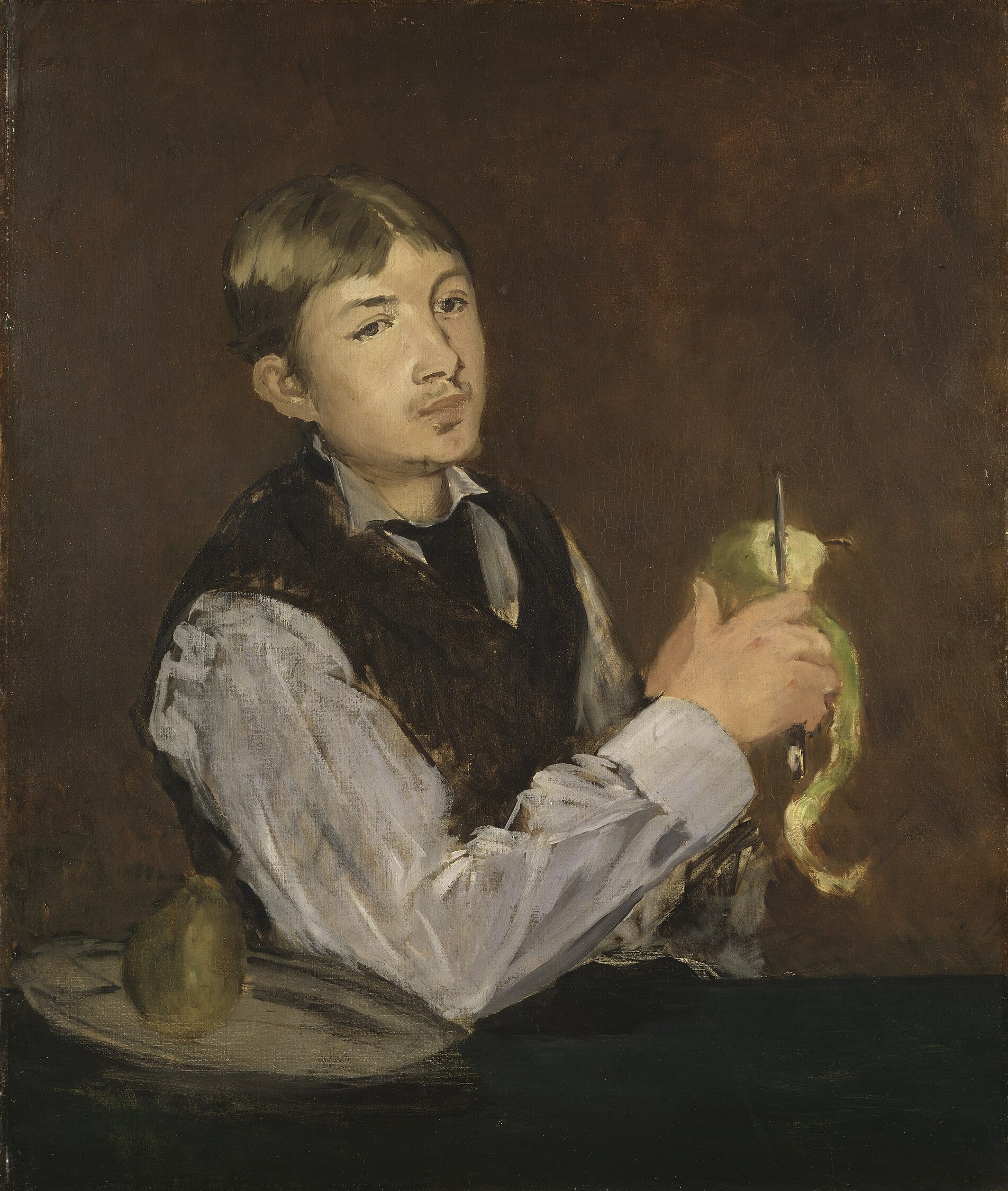
Young Boy Peeling a Pear is a painting by Édouard Manet from 1868: a youth in a white shirt and dark waistcoat peels a green pear with a knife, the peel hanging past his hand in a long, twisting ribbon. The original, oil on canvas measuring 85 x 71 cm, belongs to the Nationalmuseum in Stockholm. Our painter paints it for you by hand in oil on canvas, in 8 portrait sizes from 36 x 43 to 141 x 170 cm, or made to measure. Before we pack it, you receive a photograph of it.
| Title: | Young Boy Peeling a Pear |
| Other titles: | Jeune Garçon pelant une poire (French title) |
| Painter: | Édouard Manet (1832–1883) |
| Year painted: | 1868 |
| Original size: | 85 cm x 71 cm (height x width) |
| Original technique: | Oil on canvas |
| Painting style: | Realism and Impressionism |
| Located at: | Nationalmuseum, Stockholm, Sweden |
| Our reproduction: | Hand-painted in oil on canvas, 8 sizes or made to measure |
Young Boy Peeling a Pear – Édouard Manet
What does Young Boy Peeling a Pear show?
Against a dark brown, almost empty ground sits a young man with short brown hair combed to one side. He wears a soft-collared white shirt, a dark tie and, over the shirt, a dark brown waistcoat. His head tilts slightly, and his eyes do not rest on the fruit; they slide sideways, towards the viewer.
His right hand holds a thin knife, his left the half-peeled green pear. The peel drops in a long spiral towards the table and catches a little light. At the lower left a second pear waits on a white plate, whole and unpeeled, and a dark green table closes the bottom edge of the canvas.
The shirt sleeve is laid down in broad, quick strokes that are plain to see up close, while the face and fingers are worked with more care. Because the background stays even, all attention remains on the boy, his hands and the fruit.
Who is the young man at the table, and what does the scene mean?
The model is Léon Leenhoff (1852–1927), son of the pianist Suzanne Leenhoff, whom Manet married in 1863. When the picture was painted, Léon was about sixteen.
The work tells no hidden story. Manet most likely drew on everyday scenes from earlier periods, such as kitchen interiors, still lifes and pictures of household tasks, all of them much loved in France in the nineteenth century.
From that tradition he took a simple task and painted it with a sitter from his own household. What remains is a portrait of a young man at an ordinary chore, with no anecdote and no moral.
Why does this painting deserve a closer look?
Édouard Manet (1832–1883) was among the first artists of the nineteenth century to paint modern life, and he is seen as a pivotal figure in the move from Realism to Impressionism. His Le Déjeuner sur l’herbe of 1863 and his Olympia of 1865 caused great scandals in Paris.
The boy with the pear shows the quieter side of the same painter. There is no scandal here and no grand scene, only a young man, a fruit and a knife, set down in firm, visible strokes and a handful of colours: brown, white, black and green.
The Swedish painter Anders Zorn acquired the canvas on a visit to Paris. A short article on French Wikipedia, written in French, covers the sitter and the painting’s journey to Sweden.
Where is the original today?
The original, oil on canvas measuring 85 x 71 cm (height x width), belongs to the Nationalmuseum in Stockholm, where it is listed under inventory number NM 1498.
Anders Zorn gave it to that very museum in 1896, so the work has been in Sweden for well over a century.
The boy with the pear or another Manet?
This canvas painting suits people who like quiet scenes, white linen against a dark ground and fruit on the table. Its upright format sits well in a kitchen, a dining room or a home office.
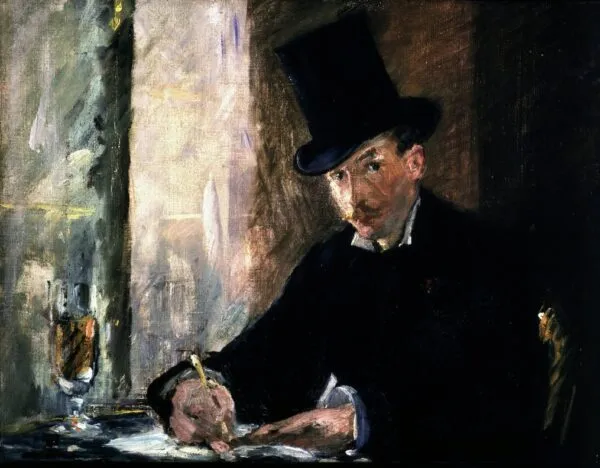
Elsewhere, too, Manet painted the people closest to him. His youngest brother Gustave posed for Young Man in the Costume of a Majo, and his brother Eugène for The Matador Saluting, raising a black hat in greeting with a red cape in his other hand.
Two views of Paris strike a very different note: the winter scene Effect of Snow on Petit-Montrouge, from the time of the siege of the city, and the unfinished The Funeral, with a small procession below the domes of the city.
More famous Manet paintings, all painted to order by our painters, are on the Édouard Manet page.
How do we hand-paint the boy with the pear?
Manet’s original is an oil on canvas 85 cm high. Ours is an oil painting reproduction: the painter works it in oil on new canvas, in the size you choose, and builds it up in several layers.
He first places the outline of the boy, the table edge and the plate, then lays in the dark brown ground and the waistcoat. Only after that comes the white shirt, where the stroke must stay broad and fresh, the way Manet left it.
Last come the face, the fingers, the knife blade and the green peel curling towards the table. They are the smallest areas on the canvas, yet they are what the eye reads first.
Which size suits which wall?
In short: 36 x 43 or 46 x 55 cm for a kitchen or a narrow wall, 54 x 65 and 60 x 75 cm for a dining room or bedroom, 77 x 95 and 100 x 120 cm above a chest of drawers or a sofa, and 112 x 135 or 141 x 170 cm for a tall wall or a stairwell.
We paint it in 8 portrait sizes (width x height): 36 x 43, 46 x 55, 54 x 65, 60 x 75, 77 x 95, 100 x 120, 112 x 135 and 141 x 170 cm. The original measures 71 x 85 cm (width x height). The four sizes up to 60 x 75 cm are smaller than it, 77 x 95 cm is already a little larger, and 100 x 120, 112 x 135 and 141 x 170 cm are clearly larger.
As a painting for the living room it works best at 77 x 95 or 100 x 120 cm, where the white shirt and the green peel read clearly from across the room.
Can I order another size or a frame?
Yes. If your wall needs different proportions, we keep the boy, both pears and the plate whole and adjust only the dark ground around them, so nothing essential is lost. Tell us the size you have in mind for that wall, and we will come back with a price and the time it takes.
The boy with the pear ships rolled, stretched on a stretcher bar or already framed. Our workshop in Slovenia does the stretching and framing and prepares every canvas for a safe journey. The moulding is chosen in our 3D app, whose only job is the frame; a view of the painting on your own wall is a separate service.
A slim dark moulding melts into the brown ground, while a lighter wood lifts the white of the shirt.
How long do painting and delivery take?
Once you confirm the order, we need 15 to 45 working days until the boy with the pear is painted, dry and ready to travel. Before the boy and his pear are packed, you get a photograph of the finished work, and any change you ask for is made.
The parcel with the boy and his pears travels within Slovenia and to every other EU country without customs duties, and our returns policy covers each order.
This quiet pear scene makes a fine gift for a new home, for someone who loves to cook or for a collector of portraits. Not sure which wall it will hang on? A wall art voucher leaves the choice of size to the person who receives it.
Frequently asked questions
Where can I see the original?
At the Nationalmuseum in Stockholm, where it is listed as NM 1498.
Who sat for the boy?
Léon Leenhoff, son of the pianist Suzanne Leenhoff, who became Manet’s wife in 1863.
Is this a print?
No. Every hand-painted copy is made with brushes and oil paint on real canvas, with no print underneath.
What size is the original?
It is 85 cm high and 71 cm wide; our sizes from 77 x 95 cm upwards are larger.
Can I order the boy with the pear in a size that is not listed?
Yes, write to us with the width and height you want, and we will send an offer with a price and a date.
How long will I wait for my order?
Usually 15 to 45 working days, with a photograph of the finished boy and pear sent to you before shipping.
Does it suit a kitchen or dining room?
Very well, since the pears, the knife and the plate sit naturally in a room where people cook and eat.
Does the scene carry a hidden meaning?
No, it shows an everyday task; Manet probably drew on older kitchen scenes and still lifes.
- Subject: a young man in a white shirt and dark waistcoat peels a green pear, with a second pear on a plate.
- Original: oil on canvas, 1868, 85 x 71 cm, Nationalmuseum, Stockholm.
- Ours: an Édouard Manet reproduction painted by hand in oil on canvas, 8 sizes from 36 x 43 to 141 x 170 cm, or made to measure.
- Worth knowing: the Swedish painter Anders Zorn gave it to the museum in 1896.