







































Description
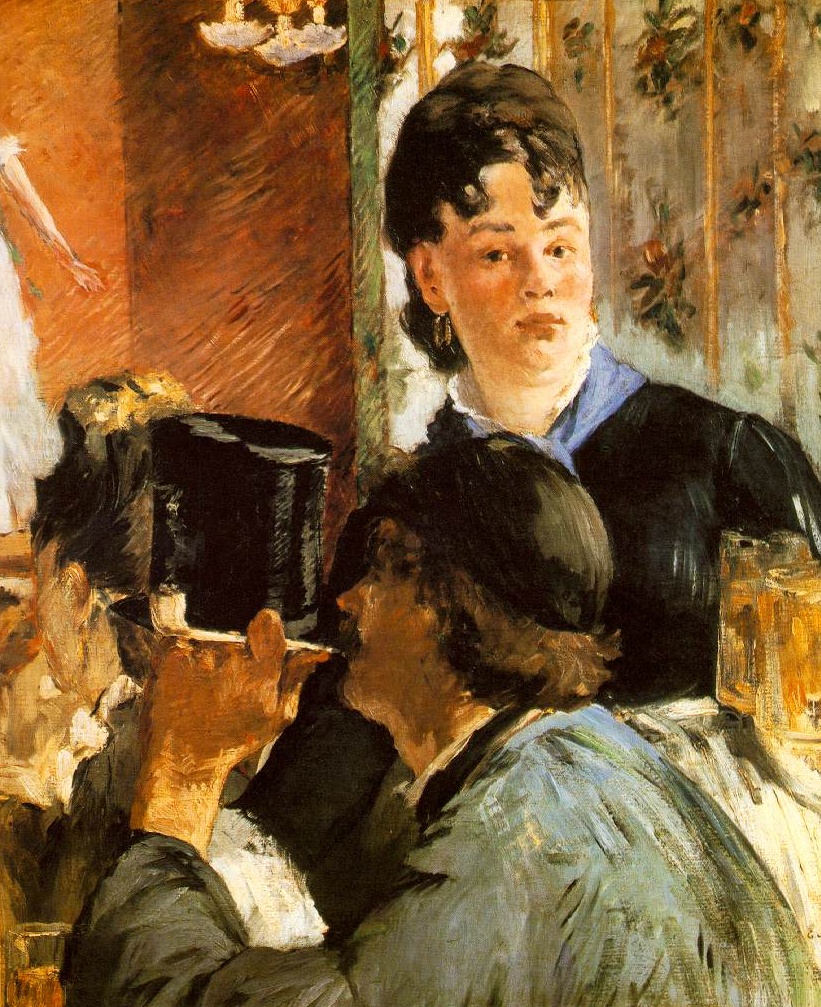
The Waitress is a painting by Édouard Manet from 1879: a young woman with her dark hair pinned up high and a blue scarf at her throat carries glasses of beer through a café-concert and catches our eye for a moment, while a guest in a black top hat and a man in a blue smock sit right in front of her. The original, oil on canvas measuring 77.5 x 65 cm, belongs to the Musée d’Orsay in Paris. Our painter paints it by hand in oil on canvas, in 6 portrait sizes from 36 x 43 to 70 x 83 cm. Before your Waitress leaves us, you see it in a photograph.
| Title: | The Waitress |
| Other titles: | La Serveuse de bocks (French title) |
| Painter: | Édouard Manet (1832–1883) |
| Year painted: | 1879 |
| Original size: | 77.5 cm x 65 cm (height x width) |
| Original technique: | Oil on canvas |
| Painting style: | Realism and Impressionism |
| Located at: | Musée d’Orsay, Paris, France |
| Our reproduction: | Hand-painted in oil on canvas, 6 sizes or made to measure |
The Waitress – Édouard Manet
What does The Waitress show?
In the right half stands the waitress, her dark hair gathered on top of her head, a few curls over her forehead. She wears an almost black dress, a white ruffled collar, a pale blue scarf and an earring. At the right edge she holds glasses of beer that glow gold, and her gaze rests for an instant on the viewer, serious and calm.
In front, very close to us, sit two customers: a man in a glossy black top hat who raises his hand to his face, and a man in a pale blue smock seen in profile from behind. Both look left, towards the stage, and neither notices her.
On the left glows the warm orange and red wall of the stage, with a chandelier above and part of a pale-clad figure at the edge. Behind the waitress the wall is hung with pale flowered paper striped in gold. Orange, black and blue carry the whole picture.
How is The Waitress linked to Corner of a Café-Concert?
The work is directly related to Manet’s larger Corner of a Café-Concert, 98 x 79 cm, in the National Gallery in London: the same room, stage and waitress. Some art historians took the smaller canvas for a second version or preparatory work; the French Wikipedia says it is neither.
The two differ like two photographs of one scene. Here the figures are closer, as if Manet had enlarged one part of the London composition, so the scene is sharper and better lit; on this reading the London picture finds its fulfilment in the Paris one, not the reverse.
Manet never wrote down what the scene means. We see a woman at work among customers whose eyes are on the stage, and she alone looks straight at us.
Why do people love looking at this painting?
Manet (1832–1883), the son of a wealthy Paris family, trained under Thomas Couture and copied Velázquez and Titian in the Louvre. Painting modern life early on, he became a bridge between Realism and Impressionism.
This canvas shows that modern eye on a small scale: an ordinary evening, a top hat beside a work smock, quick brushstrokes and a woman who is working, not posing. A friend of the Impressionists, Manet still preferred the Salon to their shows.
The Wikipedia entry on the work is short, but it ties the two canvases together; you can read it as the English Wikipedia article on The Waitress, written in English.
Where is the original, and how did it get there?
The original is oil on canvas, 77.5 x 65 cm (height x width). It belongs to the Musée d’Orsay in Paris, under accession number RF 1959 4.
Its path is not fully clear: it appears neither in the inventory made at the artist’s death nor in the notebook where Manet recorded his sales. The catalogue by Denis Rouart and Daniel Wildenstein has it passing from Auguste Pellerin’s collection to Bernheim-Jeune in 1907. It later belonged to Denys Cochin; in 1919 it was sold to the Bernheim-Jeune gallery, which sold it on to Prince Kōjirō Matsukata.
When Matsukata’s property was returned in 1959, the painting went to the Louvre, and it is now in the Musée d’Orsay.
The Waitress or another Manet?
This canvas painting suits anyone who loves the city at night, theatre and crowded cafés.
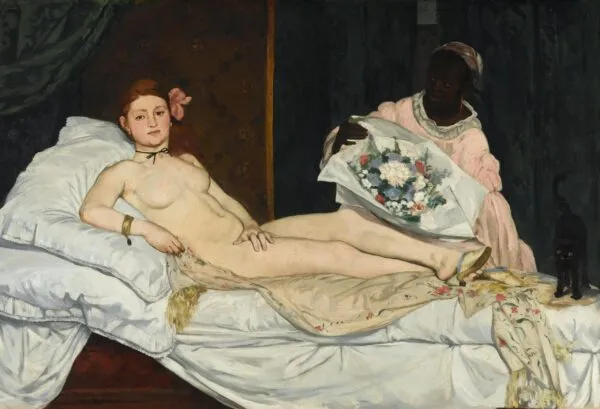
For a quiet domestic scene, choose Young Boy Peeling a Pear: a youth in a white shirt peels a green pear over a white plate. Manet painted the winter view Effect of Snow on Petit-Montrouge during the Siege of Paris, while he served in the National Guard, and close to it in style is The Funeral, an unfinished view of Paris with domes under a stormy sky and a small procession.
A full-length portrait in Spanish dress is Young Man in the Costume of a Majo, for which Manet’s youngest brother Gustave posed. More scenes from Manet’s Paris, and all the other famous Manet paintings we paint to order, wait on the Édouard Manet page.
How do we hand-paint The Waitress?
Manet’s original is a mid-sized oil on canvas, 65 cm wide and 77.5 cm high. Ours is an oil painting reproduction worked by hand in oil on canvas, layer upon layer, at the size you pick.
The painter first fixes three shapes: the waitress’s face, the black top hat and the blue back in front, because these accents carry the composition. Then come the orange stage wall and the pale wallpaper, the dark dress, scarf and collar, and last the golden beer and the small chandelier lights. Like Manet, he keeps the smock and background broad and fast, the face more careful.
Which size fits which wall?
In short: 36 x 43 or 40 x 49 cm for a shelf or a narrow wall, 46 x 55 and 54 x 65 cm above a chest of drawers or in a dining corner, and 60 x 75 or 70 x 83 cm above a sofa or as the main piece in a smaller room.
We paint it in 6 portrait sizes (width x height): 36 x 43, 40 x 49, 46 x 55, 54 x 65, 60 x 75 and 70 x 83 cm. The original measures 65 x 77.5 cm (width x height), so the sizes up to 54 x 65 cm are clearly smaller than it, 60 x 75 cm comes very close, and 70 x 83 cm is slightly larger than the original.
We offer nothing larger, because the only good photograph of the original, which our painter works from, is small; on a bigger canvas the face and hands would lose detail. As a painting for the living room it works best at 60 x 75 or 70 x 83 cm, where her gaze greets everyone who walks in.
Can I have other proportions or a frame?
Yes, within these sizes. If you need other proportions, the waitress and both customers stay whole and we adjust only the edge of the stage or the wallpaper. Send us the size you need, up to 70 x 83 cm, and we will reply with a price and a date; larger canvases we do not paint, because the photograph is small.
It travels rolled, stretched on a stretcher bar or already framed. Our workshop in Slovenia makes the stretcher and the frame and gets each painting ready for transport. You choose the moulding in our 3D app, which serves only to pick the frame; seeing the work on your own wall is a separate service. Black suits the dress and top hat, slim gold the beer.
When will my painting arrive?
Work on the beer glasses and the top hat begins once you confirm, and your Waitress is ready to ship within 15 to 45 working days. Before packing you receive a photograph of the finished work, and we make any corrections you ask for.
The Waitress travels without customs duties within Slovenia and to every other EU country, under our returns policy.
It makes a fine gift for lovers of theatre, cafés and Paris; if the wall is unknown, a wall art voucher lets the recipient choose.
Frequently asked questions
Where can I see the original?
At the Musée d’Orsay in Paris, where it has accession number RF 1959 4.
Who are the people in the painting?
Two customers in front, one in a top hat, one in a blue smock; the waitress stands behind them.
Is this a print?
No. You get a hand-painted copy, brushed in oil on fresh canvas.
How big is the original?
77.5 x 65 cm (height x width); our 70 x 83 cm size is only a little bigger.
Why are there no larger sizes?
The only good photograph of the original is small, so a bigger canvas would lose precision.
How long does it take to make?
15 to 45 working days, with a photograph of your painting before dispatch.
Is it for a dining room, or better as a gift?
Both: the café scene suits a dining room or home bar and pleases anyone who loves Paris.
Is it a second version of the London picture?
No. The French Wikipedia calls it neither a second version nor preparatory work.
- Subject: a waitress with glasses of beer in a café-concert, a guest in a top hat and a man in a blue smock in front.
- Original: oil on canvas, 1879, 77.5 x 65 cm, Musée d’Orsay, Paris.
- Ours: an Édouard Manet reproduction hand-painted in oil on canvas, 6 sizes from 36 x 43 to 70 x 83 cm.
- Worth knowing: closely related to Corner of a Café-Concert in the National Gallery, London.