


Description
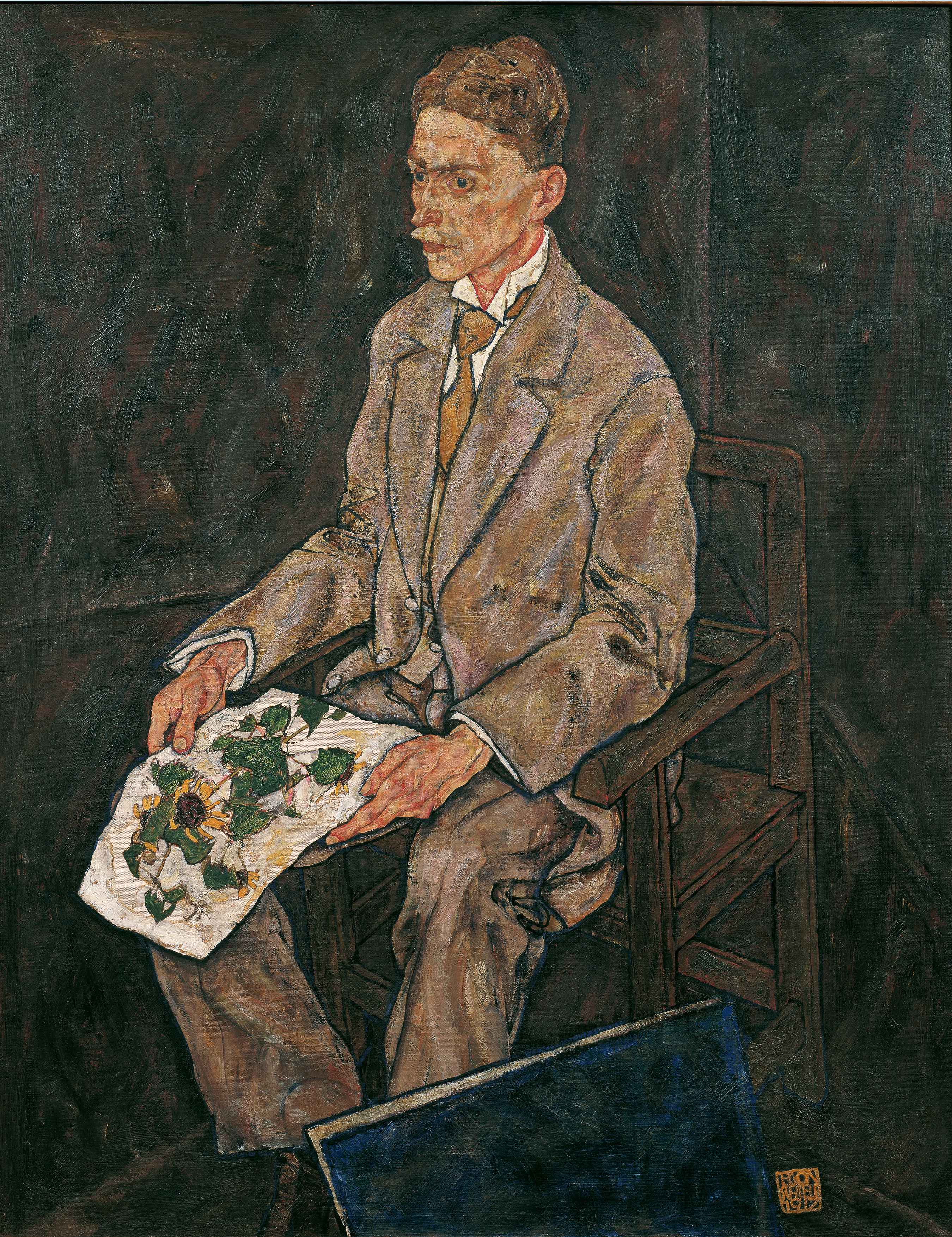
Portrait of Dr Franz Martin Haberditzl is a painting by Egon Schiele from 1917: a man in a loose grey-beige suit sits on a dark wooden chair, holding a large white sheet painted with sunflowers open across his knees. We paint it by hand in oils at the size you choose, and before dispatch we send you a photograph of the finished work for approval.
| Title: | Portrait of Dr Franz Martin Haberditzl |
| Other titles: | Bildnis Dr. Franz Martin Haberditzl · Portrait of Dr. Franz Martin Haberditzl |
| Painter: | Egon Schiele (1890–1918) |
| Year: | 1917, signed and dated lower right “EGON / SCHIELE / 1917” |
| Original size (width × height): | 110 cm x 140 cm |
| Original technique: | Oil on canvas |
| Style: | Expressionism |
| Location: | Belvedere, Vienna |
| Our reproduction: | hand-painted oil on canvas, 13 sizes from 50 x 65 cm to 160 x 205 cm, or a made-to-measure size |
Portrait of Dr Franz Martin Haberditzl – Egon Schiele
What does the painting show?
The Austrian painter seats Dr Franz Martin Haberditzl on a plain dark wooden chair against an almost empty ground of dark brown and green. The body is turned to one side and the head to the other, so the gaze passes by us. He wears a loose grey-beige suit with a waistcoat, touched with violet and ochre, a white collar and an ochre tie. The face is lean, the hair short and reddish-brown, the moustache short and light. Across his knees lies a large white sheet with sunflowers on it – yellow flower heads and green leaves – and he holds it open with both hands, the fingers long and bony. At the lower right a dark blue rectangular panel leans in front of his legs, and beside it, in the corner, the signature sits in a small ochre square.
Why do people love it?
Because of the one bright spot. Almost everything in the picture is muted – the dark ground, the brown chair, the soft grey-beige suit – and then the white sheet with its yellow and green flowers lights up in his lap. The eye travels from the face down the sleeves to the hands and the sunflowers, and back again. The pose is quiet, with no gesture and no drama, which makes the work easy to live with every day. It suits a study, a hallway or a living room with calm, dark furniture, and the flowers add a touch of colour that reads from across the room.
Provenance
The painting was owned by Franz Martin Haberditzl in Vienna, then from 1944 to 1976 by Margarete Haberditzl in Vienna, from 1976 to 2003 in private hands in Vienna and Paris, and was acquired from that private collection in 2003; it is today in the Belvedere in Vienna.
Where does it sit among Schiele’s works?
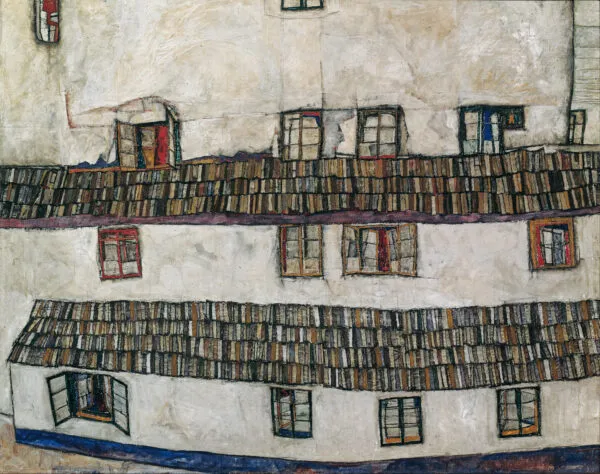
Among the other Schiele works in our shop, you can compare it with House Wall (Windows), The Hermits and Trude Engel; if you are choosing between them, open them side by side. The full selection is in the Egon Schiele gallery, with more on his life in our article about Egon Schiele.
How is our hand-painted version made?
One of our artists paints it by hand in oils, stroke by stroke, for your order – it is not a print. As a hand-painted painting in oils, its brushstrokes stay visible and can be felt on the surface. Two areas decide the result. The first is the suit: soft, without hard edges, built from greys, beiges and touches of violet that must not run together into a single flat grey. The second is the sheet of sunflowers, the only bright area in the work: worked too hard it looks like a sticker, worked too little it disappears into the lap. Any painter is tempted to smooth the dark ground; we leave it uneven and brushy, as it is in the original. Like the original, our version is oil on canvas. When it is finished we photograph it and send you the photograph for approval, and only then does it ship. This work has not yet been photographed in our workshop.
Which size for which wall?
Short answer: a seated figure with plenty of dark ground around it looks best at a larger size. We offer it in thirteen sizes, from 50 x 65 cm to 160 x 205 cm. In a study or above a desk, 60 x 75 cm or 70 x 90 cm; in a hallway or beside a door, 80 x 100 cm or 90 x 115 cm; above the sofa in a living room, 100 x 130 cm or 110 x 140 cm; on a large wall or in a stairwell, 140 x 180 cm or 160 x 205 cm. A canvas painting of this size needs some distance: close up you see the single strokes in the suit and the ground, and the face, the hands and the flowers come together from a few steps away.
Custom size, stretcher bar and frame
If none of the thirteen sizes suits your wall, we paint the work to your own measurement. If you choose “YES” under the Stretcher option, the canvas comes stretched on a wooden stretcher bar, ready to hang. Our 3D application is for choosing a frame only, not for showing the work on your wall. The frame is chosen separately and need not be part of the order.
Delivery and guarantee
We paint to order and deliver to sixteen countries in the European Union, among them Slovenia, Croatia, Austria, Italy, Hungary, Germany and France; the United Kingdom and Ireland are not currently among them. The work travels protectively packed. Before dispatch we send you a photograph of the finished work to approve. Production time depends on the size and on the studio’s workload. Every order is covered by our Returns and Refund Policy.
Frequently asked questions
Who was Dr Franz Martin Haberditzl?
An Austrian art historian (1882–1944) who took charge of the Staatsgalerie in the Belvedere in 1915 and became its director in 1916. In the 1920s he divided its collections into separate museums of Baroque, 19th-century and modern art, and in 1938 the Nazi regime removed him from office. He and Schiele were friends.
What did Haberditzl have to do with Schiele?
In 1918, under his direction, the Staatsgalerie bought Schiele’s portrait of his wife Edith, the first painting by Schiele acquired by an Austrian museum during his lifetime. According to the museum records, Haberditzl found the first version too “arts-and-crafts”, and Schiele reworked Edith’s dress in more muted hues.
When did Schiele paint Portrait of Dr Franz Martin Haberditzl?
In 1917, a year before Schiele’s death. It is signed and dated at the lower right “EGON / SCHIELE / 1917”, inside a small ochre square in the corner.
Where is Portrait of Dr Franz Martin Haberditzl today?
In the Belvedere in Vienna, the museum Haberditzl once directed; it measures 110 x 140 cm. Its provenance lists Franz Martin Haberditzl and then, from 1944 to 1976, Margarete Haberditzl as owners; after private hands in Vienna and Paris, it was acquired in 2003.
What is Haberditzl holding on his knees?
A large white sheet with sunflowers on it, yellow flower heads and green leaves, which he holds open with both of his long, bony hands. In a work kept almost entirely in dark brown, green and grey-beige, it is the one bright spot, and the eye travels from his face down to the flowers and back.
Does it work as a gift?
Yes; if you are unsure which size to choose, there is a gift voucher.