







































Description
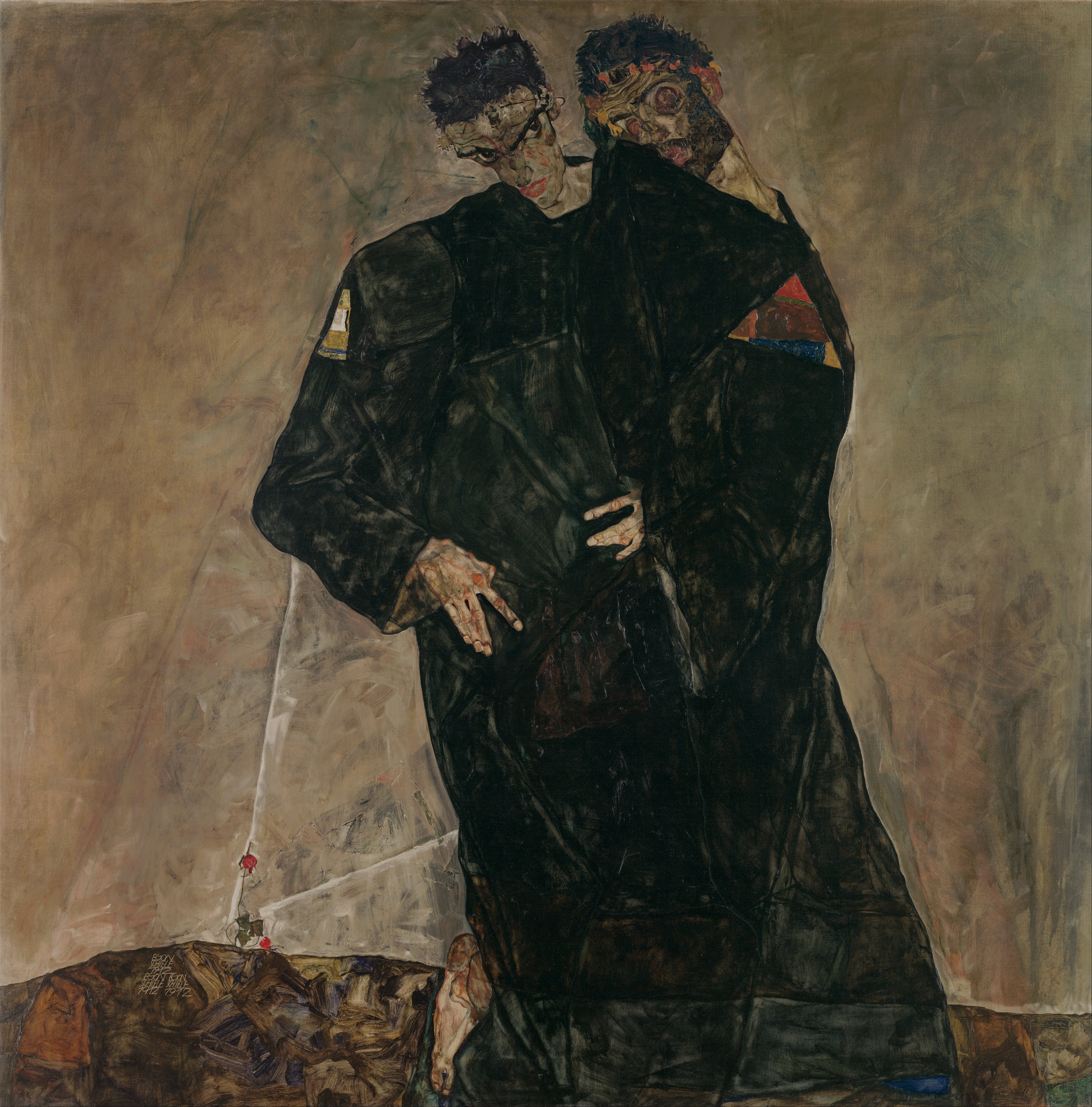
The Hermits is a 1912 work by Egon Schiele: two men in dark robes, pressed so close that the robes merge into one mass, standing on a strip of brown earth against a pale ground, with a small red flower at the lower left. The original is held by the Leopold Museum in Vienna under inventory number 466; it measures 181 x 181 cm, a square, and is signed and dated three times at the lower left. We paint it by hand in oils, in fifteen sizes or to your own measurement, and before dispatch we send you a photograph of the finished work for approval.
| Title: | The Hermits |
| Other titles: | Hermits · Eremiten |
| Painter: | Egon Schiele (1890–1918) |
| Year: | 1912, signed and dated three times lower left “EGON SCHIELE 1912” |
| Original size (width × height): | 181 cm x 181 cm (square) |
| Original technique: | Oil on canvas |
| Style: | Expressionism |
| Location: | Leopold Museum, Vienna (inv. 466) |
| Our reproduction: | hand-painted oil on canvas, 15 sizes from 50 x 50 cm to 200 x 200 cm, or a made-to-measure size |
The Hermits – Egon Schiele
Who is in the painting?
Two men, and only one of them has a name. The left figure, the one with the bowed head, is a self-depiction of the Austrian painter Egon Schiele (1890–1918), according to the Leopold Museum’s record. The person standing behind him cannot be identified with certainty. The museum names three possibilities: another portrait of Schiele himself, his mentor Gustav Klimt (1862–1918), or his father Adolf. It notes that this open question has inspired many different readings of the double portrait, and it does not choose between them. Neither do we.
What is on the canvas?
Two figures seen from the front, pressed against each other. Their robes, near-black with dark greens and browns, merge into one large mass that fills the middle of the square from near the top edge almost to the bottom. The left man bows his head forward and to the side, his eyes lowered. Across the robe at his waist lies a hand with spread fingers, and beside it a second hand grips the cloth. Behind him, to the right, a second head leans against his, half hidden, with one wide-open eye and a band of small coloured flowers in the hair. Two patches of colour sit on the sleeves: a small pale one on the left arm and, on the right shoulder, a larger triangle of red, orange, blue and yellow. At the bottom a bare foot shows beneath the robe, and the men stand on a strip of brown earth laid on in broad, crossing strokes. At the lower left a thin stem with green leaves carries small red flowers, and beside it the signature is written into the earth in pale letters. The ground is a mottled grey-brown, lighter and crossed by fine white lines around the flower.
Why does this painting matter?
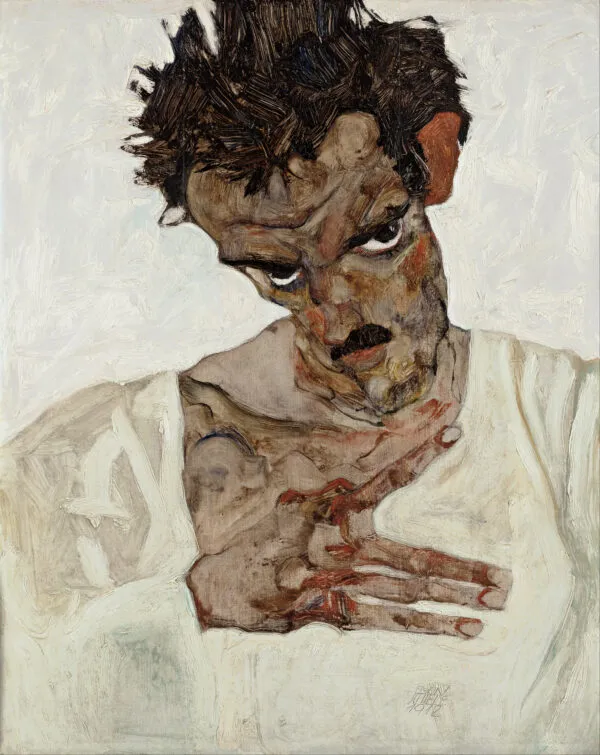
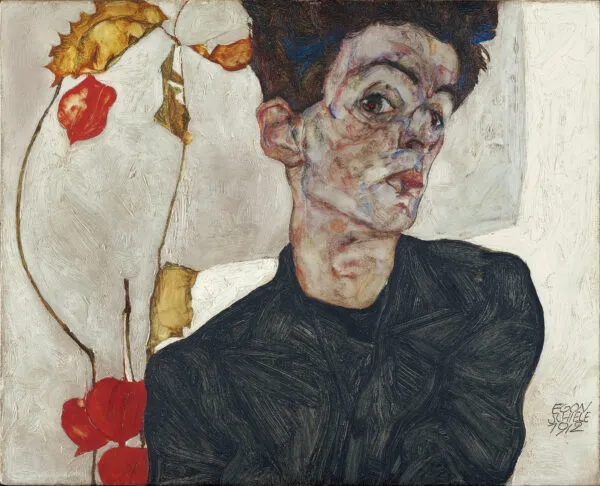
For three reasons. The first is scale: the canvas is 181 cm each way, and the museum describes the two men as approximately life size. The second is that Schiele explained the work himself. In a letter to his collector Carl Reininghaus (1857–1929), which the museum quotes, he set out what the figures, the colours and even the flower were meant to do. The third is a link the museum draws to another work of the same year, the Self-Portrait with Lowered Head: in its record for that work it writes that the posture of the head and the gesture of the wide-spread fingers are reflected in the left-hand figure of this painting.
What does the painting mean?
Schiele answered that himself, in the letter the museum quotes. What the painting shows, he wrote, is “not a gray sky, but a grieving world in which the two bodies are moving”; the whole world, figures included, is meant to represent the “decrepitude” of all things. The left figure is the one who bows before such a serious world. The faded colours are intentional, and the figures are meant as sunken into themselves – “bodies of men tired of life … but bodies of feeling men”. He asked the viewer to see them as a cloud of dust that wants to build itself up and must collapse, powerless. Against the flowers wreathed on the two heads, which he wanted to look cold and extinguished, he set “a single withered rose that exhales its white innocence”: the small flower at the lower left.
Where does the work come from, and what does the museum publish?
The Leopold Museum’s online record, linked in the table above, lists the work under its English title, Hermits, and carries a provenance section naming four owners in order. The last of them is the Leopold Museum Private Foundation in Vienna, which has held the painting since 1994 and keeps it under inventory number 466. Among the sources the museum gives is Nirenstein’s catalogue of 1930, where the work is number 106. The record carries no restitution or claim note. The owners before the foundation are given in the note below.
Provenance
From Schiele’s estate (1918) the painting passed to Arthur Stemmer (Vienna/London, 1918–1953) and then to Rudolf Leopold (1953–1994); it is now at the Leopold Museum in Vienna.
Where does this work sit among Schiele’s works?
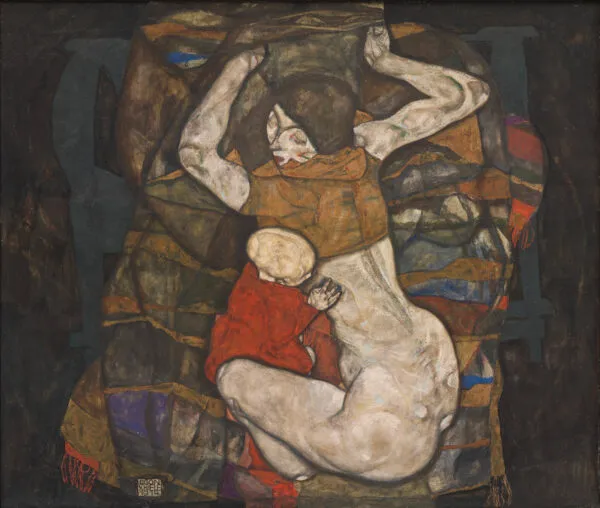
Beside other paintings in which Schiele sets two figures together. Two such paintings, as their titles suggest, are in our selection: Self-Seers II (Death and Man) and Cardinal and Nun (Caress). We also paint The Lyricist. The full selection is in the Egon Schiele gallery, with more on his life in our article about Egon Schiele.
How is our hand-painted version made?
A painter works every canvas in oils, stroke by stroke: a hand-painted copy made for your order, not a machine print. Two passages are the hardest here. The first is the robe: from a distance it reads as black, but it is built from dark greens, browns and near-blacks; painted as one flat black, it turns the two men into a silhouette. The second is the pale ground with its fine white lines, which must stay light, thin and slightly uneven – Schiele’s grieving world, not an empty wall. The original is painted in oils on canvas, and so is our copy. When the work is finished we photograph it and send you the photograph for approval, and only then does it ship. This work has not yet been photographed in our workshop; we will add photographs to this page once we have them. Like every canvas we send, it can arrive stretched on a wooden stretcher bar; you choose that under the Stretcher option.
Which size for which wall?
Short answer: a large, dark square wants the middle of a wall and space around it. None of our sizes matches the original’s 181 x 181 cm. The nearest is 170 x 170 cm, which is 11 cm narrower and 11 cm lower; the next one up is our largest size, 200 x 200 cm, 19 cm wider and 19 cm higher. All fifteen sizes are square, like the work, so you choose scale, not shape. For a hallway or beside a bed, 50 x 50 cm or 60 x 60 cm; above a chest of drawers or a desk, 70 x 70 cm or 80 x 80 cm; above a sofa in a living room, 100 x 100 cm or 120 x 120 cm; on a large wall, in a stairwell or in a tall room, 150 x 150 cm and up. A canvas painting this dark needs light and distance: from a few metres the robe reads as one mass. A hand-painted painting hangs best with its centre at eye level, roughly 145–150 cm from the floor; above a sofa, 15–25 cm above the backrest.
Custom size, stretcher bar and frame
If none of the fifteen sizes suits your wall, we paint the work to your own measurement, including the original’s 181 x 181 cm. If you choose “YES” under the Stretcher option, the canvas comes stretched on a wooden stretcher bar, ready to hang. Our 3D application is for choosing a frame only, not for showing the work on your wall; seeing it on your wall is a separate service. The frame is chosen separately and need not be part of the order.
Delivery and guarantee
We paint to order and deliver to sixteen countries in the European Union, among them Slovenia, Croatia, Austria, Italy, Hungary and Germany; the United Kingdom and Ireland are not currently among them. Before dispatch we send you a photograph of the finished work to approve. Production time depends on the size and on the studio’s workload. Every order is covered by our Returns and Refund Policy.
Frequently asked questions
Who are the two men in The Hermits?
The left figure, with the bowed head, is Schiele himself, according to the Leopold Museum. The man behind him cannot be identified with certainty: the museum names another self-portrait, his mentor Gustav Klimt or his father Adolf as possibilities. That open question has inspired many different readings of the double portrait.
What does The Hermits by Schiele mean?
Schiele explained it himself in a letter to the collector Carl Reininghaus: it shows not a grey sky but “a grieving world” in which the two bodies move, and the whole world is meant to stand for the decrepitude of all things. The figures are sunk into themselves, men tired of life but men who feel. Against the wreaths on their heads he set a single withered rose, the small flower at the lower left.
When did Schiele paint The Hermits?
In 1912; the canvas is signed and dated three times at the lower left. On 27 February 1912 Schiele was already defending it in a letter to Carl Reininghaus, who had criticised the composition. In that letter he wrote that the work grew out of experiences after his father’s death.
Where is The Hermits today?
In the Leopold Museum in Vienna, under inventory number 466. From Schiele’s estate it passed to Arthur Stemmer and in 1953 to Rudolf Leopold; the Leopold Museum Private Foundation has held it since 1994.
Is Eremiten the same painting as The Hermits?
Yes: Eremiten is Schiele’s German title, and the Leopold Museum’s English record lists the same canvas as Hermits. It is the square work of 181 x 181 cm with two approximately life-size men, which Schiele also calls “Eremiten” in his letter to Reininghaus.
Does it work as a gift?
Yes; if you are unsure which size to choose, there is a gift voucher.
- Subject: two men in dark robes that merge into one, the left one Schiele, with a small red flower at the lower left.
- Original: 1912, oil on canvas, 181 x 181 cm, signed and dated three times lower left, Leopold Museum, Vienna, inv. 466.
- Ours: hand-painted in oils, 15 square sizes or made to measure, stretched on a stretcher bar if you choose Stretcher: “YES”.
- Worth knowing: Schiele described the painting himself, in a letter to Carl Reininghaus that the museum quotes.