





Description
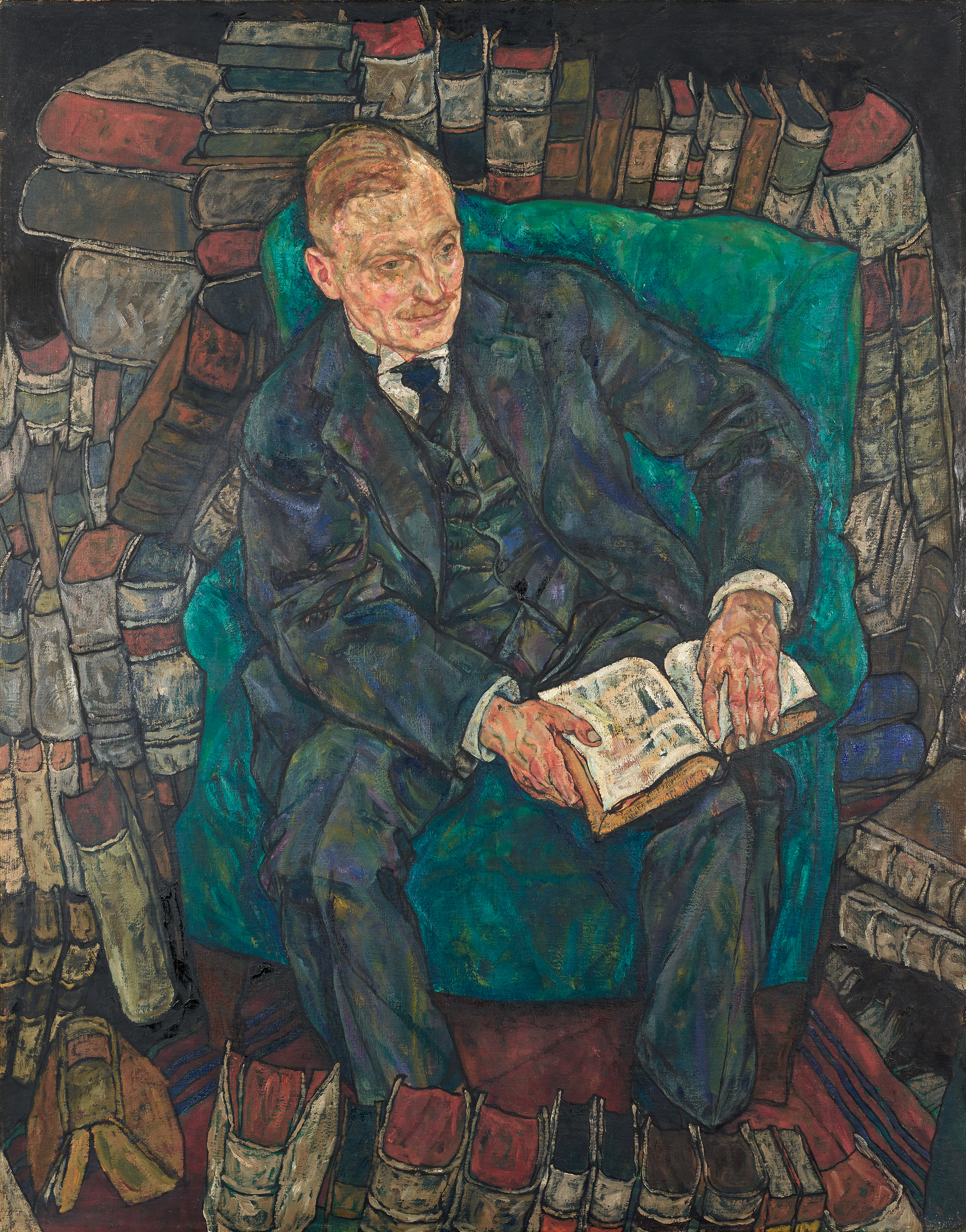
Portrait of Dr Hugo Koller is a painting by Egon Schiele from 1918: a man in a dark suit sits in a deep green armchair with an open book in his lap, surrounded on every side by books. We paint it by hand in oils at the size you choose, and before dispatch we send you a photograph of the finished work for approval.
| Title: | Portrait of Dr Hugo Koller |
| Other titles: | Dr. Hugo Koller · Bildnis Dr. Hugo Koller |
| Painter: | Egon Schiele (1890–1918) |
| Year: | 1918, inscribed in the artist’s own hand on the reverse of the stretcher |
| Original size (width × height): | 110 cm x 140.3 cm |
| Original technique: | Oil on canvas |
| Style: | Expressionism |
| Location: | Belvedere, Vienna |
| Our reproduction: | hand-painted oil on canvas, 13 sizes from 50 x 65 cm to 160 x 205 cm, or a made-to-measure size |
Portrait of Dr Hugo Koller – Egon Schiele
What does the painting show?
The Austrian painter seats Dr Hugo Koller in a deep turquoise-green armchair and builds a wall of books around him. Koller wears a dark three-piece suit, worked in blue, green and violet strokes, with a white collar, a dark tie and white cuffs. His head is almost bald, with a little reddish hair and a short moustache, and he looks off to one side rather than at us, with the hint of a smile. An open book rests on his knee: one hand grips its edge, the other lies across the pages. Both hands are painted large, the knuckles and veins picked out in pink and red. The books fill the rest of the canvas – stacked in piles at the left and along the top, standing in rows at the upper right and lined up along the bottom edge – in red, grey, olive and cream against a dark ground. Beneath the chair a red rug with dark stripes shows through.
Why do people love it?
Because of the contrast. The man is still and quiet, while the books around him are restless: a crowd of slanting, uneven shapes that keeps the eye moving. The green armchair sits in the middle like a calm island, and against it the dark suit, the pink face and the hands stand out. The hands are worth a second look; they are observed as carefully as the face. The work suits a study, a home library or any room with bookshelves, and on a large wall the pattern of books reads from across the room.
Where does it sit among Schiele’s works?
Among the other Schiele works in our shop, you can compare it with Cardinal and Nun (Caress), House Wall (Windows) and The Hermits; if you are choosing between them, open them side by side. The full selection is in the Egon Schiele gallery, with more on his life in our article about Egon Schiele.
How is our hand-painted version made?
One of our artists paints it by hand in oils, stroke by stroke, for your order – it is not a print. As a hand-painted painting in oils, its brushstrokes stay visible and can be felt on the surface. Two areas decide the result. The first is the books: painted too neatly they turn into wallpaper, painted carelessly they lose the pattern that holds the whole surface together. Any painter is tempted to tidy them into straight rows; we keep them as uneven as they are in the original. The second is the hands, which must keep their knuckles, veins and warm pink and red without turning heavy. We also keep the armchair a clear turquoise-green, because it is what separates the dark suit from the dark background. Like the original, our version is oil on canvas. When it is finished we photograph it and send you the photograph for approval, and only then does it ship. This work has not yet been photographed in our workshop.
Which size for which wall?
Short answer: there is a lot to see here – a whole seated figure and a room full of books – so this subject rewards a larger size. We offer it in thirteen sizes, from 50 x 65 cm to 160 x 205 cm. In a study or above a desk, 60 x 75 cm or 70 x 90 cm; in a hallway or beside a bookcase, 80 x 100 cm or 90 x 115 cm; above the sofa in a living room, 100 x 130 cm or 120 x 150 cm; on a large wall or in a stairwell, 140 x 180 cm or 160 x 205 cm. A canvas painting of this size needs some distance: close up you see the single strokes on the book spines and the suit, and the figure comes together from a few steps away.
Custom size, stretcher bar and frame
If none of the thirteen sizes suits your wall, we paint the work to your own measurement. If you choose “YES” under the Stretcher option, the canvas comes stretched on a wooden stretcher bar, ready to hang. Our 3D application is for choosing a frame only, not for showing the work on your wall. The frame is chosen separately and need not be part of the order.
Delivery and guarantee
We paint to order and deliver to sixteen countries in the European Union, among them Slovenia, Croatia, Austria, Italy, Hungary, Germany and France; the United Kingdom and Ireland are not currently among them. The work travels protectively packed. Before dispatch we send you a photograph of the finished work to approve. Production time depends on the size and on the studio’s workload. Every order is covered by our Returns and Refund Policy.
Frequently asked questions
Who was Dr Hugo Koller?
According to the Belvedere, Hugo Koller (born 1868) was a physician and physicist. His wife was the artist Broncia Koller-Pinell (1863–1934), whose house in Oberwaltersdorf, south of Vienna, was a meeting place for artists, and Schiele was a regular visitor. In August 1918 Schiele and his wife stayed there, and she painted the couple.
When did Schiele paint Portrait of Dr Hugo Koller?
In 1918, the last year of his life: he died that October in the influenza epidemic. On the back of the stretcher he inscribed, in his own hand, his name, his Vienna address and the year 1918. A black chalk study for the portrait, from the same year, is in the Albertina in Vienna.
Where is Portrait of Dr Hugo Koller today?
In the Belvedere in Vienna, under inventory number 4296; it measures 110 x 140.3 cm and is painted in oils on canvas. The museum’s record lists Hugo Koller and then Rupert and Silvia Koller of Oberwaltersdorf as owners, and records its purchase through the Galerie Welz in Vienna in 1948.
Why is Hugo Koller surrounded by books?
The books suit the sitter: Koller was a physician and physicist, and descriptions of the work read the wall of volumes as the scholarly setting of a learned man. They also hold the composition together: the slanting, uneven piles and rows keep the eye moving, while Koller sits still in the green armchair at the centre.
Does it work as a gift?
Yes; if you are unsure which size to choose, there is a gift voucher.