







































Description
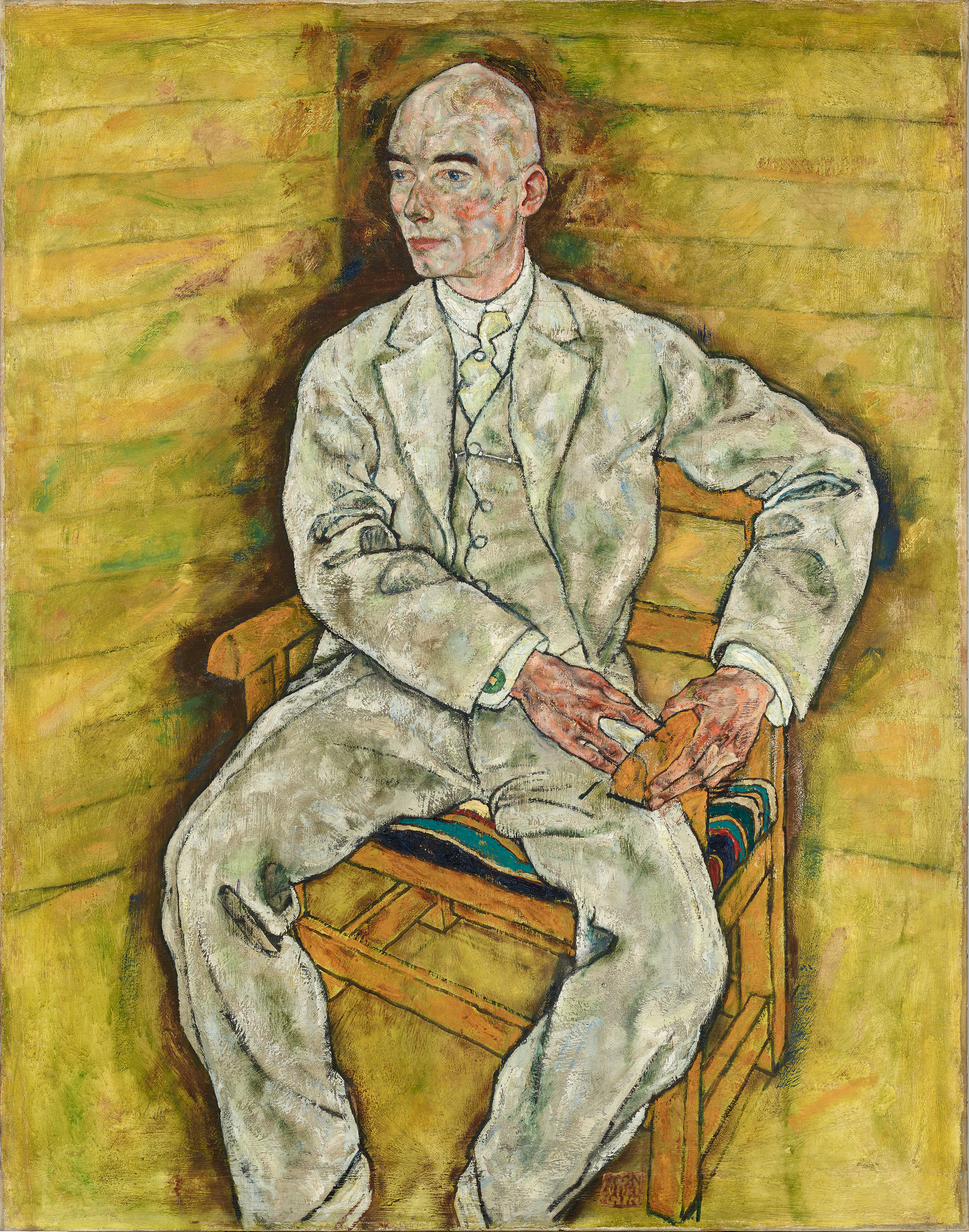
Portrait of Victor Ritter von Bauer is a painting by Egon Schiele from 1918: a man in a pale three-piece suit sits on a yellow wooden chair with armrests, his hands together in his lap, in front of a wall of yellow boards. We paint it by hand in oils at the size you choose, and before dispatch we send you a photograph of the finished work for approval.
| Title: | Portrait of Victor Ritter von Bauer |
| Other titles: | Victor Ritter von Bauer · Bildnis Victor Ritter von Bauer |
| Painter: | Egon Schiele (1890–1918) |
| Year: | 1918, signed and dated bottom centre “EGON / SCHIELE / 1918” |
| Original size (width × height): | 109.8 cm x 140.6 cm |
| Original technique: | Oil on canvas |
| Style: | Expressionism |
| Location: | Belvedere, Vienna |
| Our reproduction: | hand-painted oil on canvas, 13 sizes from 50 x 65 cm to 160 x 205 cm, or a made-to-measure size |
Portrait of Victor Ritter von Bauer – Egon Schiele
What does the painting show?
The Austrian painter shows a man seated on a wooden chair with armrests, painted in yellow and ochre. His head is almost bald, his face is lean and pale with touches of pink and green, and his blue eyes look past us to one side. He wears a pale, almost white suit with a buttoned waistcoat, a white shirt and a pale yellow-green tie; grey and green shadows run through the fabric. His knees are apart, and his long hands with reddish knuckles meet in his lap around a small ochre object. On the seat lies a cloth with stripes of dark blue, green, red and yellow. Behind him is a wall of horizontal yellow boards, and a brown shadow surrounds the figure, darkest beside the head. The signature and the year stand near the bottom edge.
Why do people love it?
Because of the light and the calm. Almost the whole canvas is yellow, ochre and off-white, so the work brings warmth into a room without being loud. The man sits still and relaxed; the only strong colours are the striped cloth on the seat and the reddish tone of his hands and face, and that is where the eye comes to rest. The long hands and the sideways look make it a portrait you keep coming back to. It suits a study, a living room, a hallway or a wall above a desk.
Provenance
The painting was owned by Karl Grünwald in Vienna and was acquired in 1930 by Wolko Gartenberg in Vienna. The Belvedere’s published record of ownership ends there; the work is today in the Belvedere in Vienna.
Where does it sit among Schiele’s works?
Among the other Schiele works in our shop, you can compare it with The Lyricist, Cardinal and Nun (Caress) and House Wall (Windows); if you are choosing between them, open them side by side. The full selection is in the Egon Schiele gallery, with more on his life in our article about Egon Schiele.
How is our hand-painted version made?
One of our artists paints it by hand in oils, stroke by stroke, for your order – it is not a print. Two places decide the result. The first is the suit: it reads as white, but it is built from greys, greens and pinks; painted an even white, the figure goes flat. The second is the hands, which have to stay long and bony and keep their reddish tone. The original is oil on canvas, and so is ours. When it is finished we photograph it and send you the photograph for approval, and only then does it ship. This work has not yet been photographed in our workshop.
Which size for which wall?
Short answer: a seated figure against a warm yellow ground wants a size you can see from across the room. We offer it in thirteen sizes, from 50 x 65 cm to 160 x 205 cm. In a hallway or a study, 60 x 75 cm or 70 x 90 cm; above a desk or a chest of drawers, 80 x 100 cm or 90 x 115 cm; above the sofa in a living room, 110 x 140 cm or 120 x 150 cm; on a large wall or in a stairwell, 140 x 180 cm or 160 x 205 cm. A canvas painting of this size needs some distance: close up you see the single strokes in the suit and the boards, and the figure comes together from a distance of a few steps. A hand-painted painting hangs best with its centre at eye level, roughly 145–150 cm from the floor; above a sofa, 15–25 cm above the backrest.
Custom size, stretcher bar and frame
If none of the thirteen sizes suits your wall, we paint the work to your own measurement. If you choose “YES” under the Stretcher option, the canvas comes stretched on a wooden stretcher bar, ready to hang. Our 3D application is for choosing a frame only, not for showing the work on your wall. The frame is chosen separately and need not be part of the order.
Delivery and guarantee
We paint to order and deliver to sixteen countries in the European Union, among them Slovenia, Croatia, Austria, Italy, Hungary, Germany and France; the United Kingdom and Ireland are not currently among them. The work travels protectively packed. Before dispatch we send you a photograph of the finished work to approve. Production time depends on the size and on the studio’s workload. Every order is covered by our Returns and Refund Policy.
Frequently asked questions
Who was Victor Ritter von Bauer?
Victor Moritz Peter Maria Ritter von Bauer-Rohrfelden (1876–1939) was a wealthy Jewish industrialist in Vienna with a passion for travel and aviation. In 1915 he founded an Institute for Cultural Research (Institut für Kulturforschung) in Vienna.
How did Schiele come to paint Victor Ritter von Bauer?
Through Erwin Hanslik, Bauer’s editorial director, whom Schiele met in September 1917 and who acted as go-between for the commission. Schiele began with a watercolour study and a study of the hands at the end of 1917, and the sittings followed in January 1918. According to the Cerruti Collection, which holds the watercolour study, Bauer never bought the finished painting.
Where is Portrait of Victor Ritter von Bauer today?
In the Belvedere in Vienna, under inventory number 3158. Before that it belonged to Karl Grünwald in Vienna, and in 1930 it was acquired by Wolko Gartenberg, also in Vienna; the Belvedere’s published record of ownership ends there.
Did Kokoschka also paint Victor Ritter von Bauer?
Yes: the painter Oskar Kokoschka portrayed him in 1914, four years before Schiele, in a dark green suit against a dark, undefined background. Schiele chose the opposite palette, a pale suit in front of a wall of yellow boards. In both portraits the hands carry much of the expression: Kokoschka raises one before the chest, Schiele lays the long, reddish hands together in the lap.
Is it one of Schiele’s last works?
Yes, it dates from 1918, his last year: Schiele died in Vienna on 31 October 1918, aged 28, of the Spanish flu, three days after his wife Edith. It belongs to the portrait commissions that came to him in 1917 and 1918, when he was at last in demand as a portraitist.
Does it work as a gift?
Yes; if you are unsure which size to choose, there is a gift voucher.