


Description
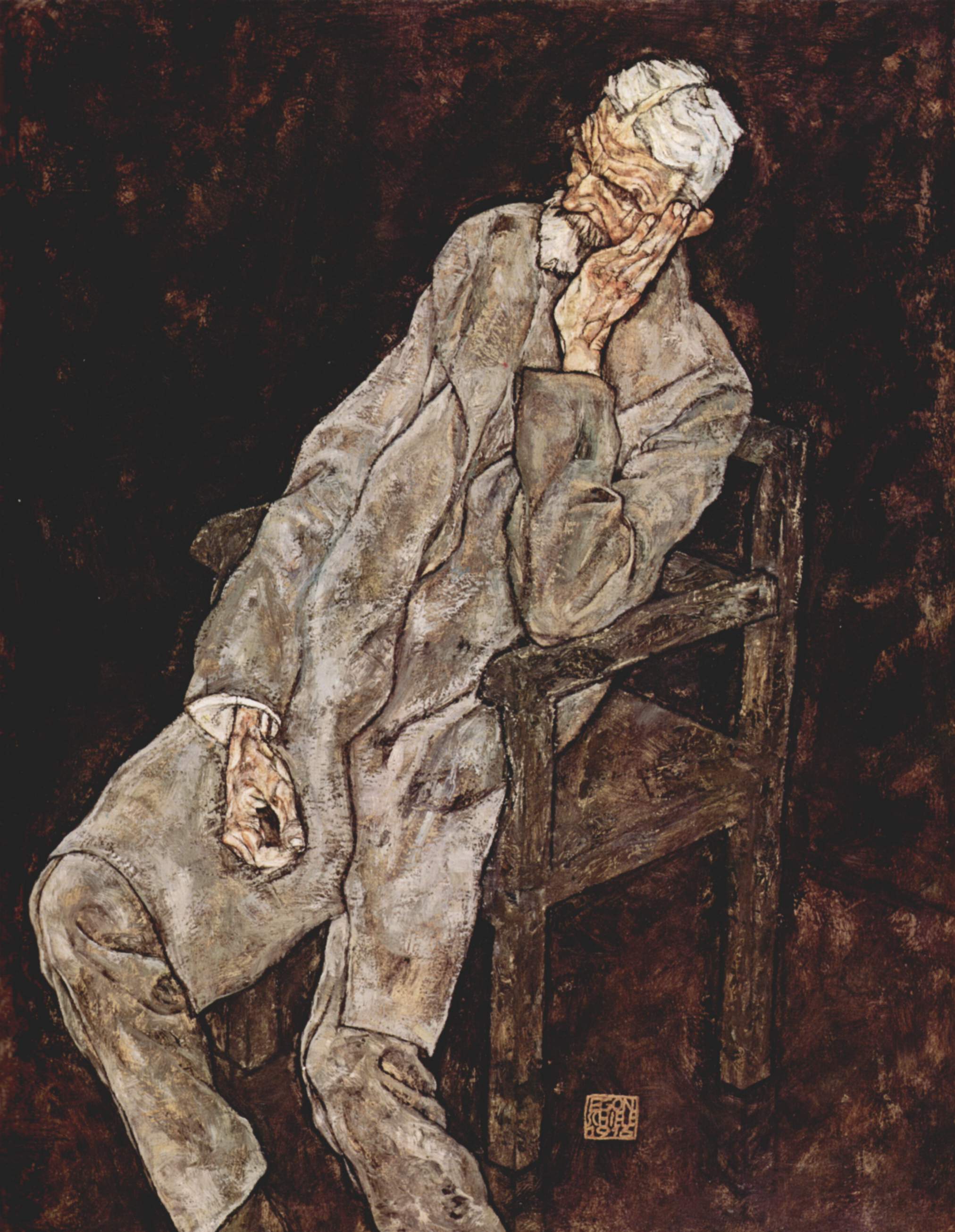
Portrait of Johann Harms is a work of 1916 by Egon Schiele: an old man sitting sideways on a plain wooden chair, his head resting on his hand, in a wide grey coat against a deep brown ground. The original is in the Solomon R. Guggenheim Museum in New York under inventory number 69.1884; it measures 110.8 x 141 cm and is painted in oil with wax and charcoal on canvas. We make it as a hand-painted oil painting on canvas, in ten sizes or to your own measurement, and we send you a photograph of the finished work for approval before it ships.
| Title: | Portrait of Johann Harms |
| Other titles: | Portrait of an Old Man (Johann Harms) · Bildnis Johann Harms |
| Painter: | Egon Schiele (1890–1918) |
| Year: | 1916 |
| Original size (width × height): | 110.8 cm x 141 cm |
| Original technique: | Oil with wax and charcoal on canvas |
| Style: | Expressionism |
| Location: | Solomon R. Guggenheim Museum, New York (inv. 69.1884), permanent collection |
| Our reproduction: | hand-painted oil on canvas, 10 sizes from 50 x 65 cm to 130 x 165 cm, or a made-to-measure size |
Portrait of Johann Harms – Egon Schiele
What does the work show?
An old man sitting sideways on a plain wooden chair, turned slightly to our left. His head rests on his right hand, the elbow on the armrest; the hair and beard are white, the face densely lined, the gaze lowered. A wide, pale grey coat covers him from shoulders to ankles, laid in broad planes with dry, sparing strokes; the left hand hangs open over the knee, the fingers half closed. The chair is bare: square legs, a simple armrest, the seat visible beside him. The ground is deep brown and mottled, with no wall and no floor, so the figure and the chair are given no place. At the lower right, on the brown, stands Schiele’s block signature with the year.
Who was Johann Harms?
The painter’s father-in-law. The museum record says so plainly and adds two things: that he was 73 when the work was made, and that he was a retired machinist with the Austrian railway. Edith Harms, the painter’s wife, was his daughter. The record also notes that Schiele’s fondness for him carried beyond this portrait — after Harms died in 1917, the painter made a death mask of him. All of that is the reading of the museum that holds the work, and we give it as theirs; the record’s text is signed by Cornelia Lauf.
Why is the chair so plain?
Because it is the painter’s own. Per the museum record Schiele designed this chair for his studio and used it several times for portraits. As a prop it let him push his sitters forward, towards the front of the canvas, flattening and enlarging the contours of their bodies. The record goes further: the chair’s handcrafted style recalls the furniture in Vincent van Gogh’s paintings of his own bedroom, a reminder of how important the decorative arts were in Vienna then. The chair is not scenery; it is part of the construction.
Why does a family portrait look so solemn?
The museum record makes exactly that point: although this is a family portrait, it conveys a somber monumentality. The stateliness the work carries, per the record, transcends its subject — it is reminiscent of papal portraits by Raphael or Titian. An old man in a housecoat on a hard chair is set out the way honour used to be paid, and that distance between subject and form is what holds the work upright.
Where does this work stand in Schiele’s development?
At the start of something. Per the record it is known as the first in a series of so-called painterly portraits, as opposed to the earlier canvases Schiele executed in a more graphic style. He painted it two years before his death in the influenza epidemic, and the record reads it as an example of his mature style, one that goes far in abolishing fixed notions of Austrian Expressionism as only an art of angst. It adds the circumstance: in 1916, after initial difficulties in his marriage to Edith Harms, Schiele was beginning to enjoy a sense of domestic happiness that would lead to other intimate family portraits.
What is the original painted on?
On canvas — but not in oil alone. The museum record gives oil with wax and charcoal, a mixed technique, and that is what gives the surface its dry, finely granular build. With us it is oil on canvas in the narrower sense: oil paint on canvas, with no wax and no charcoal. The support is of the same kind, the cloth is a different one.
Is the format upright or horizontal?
Upright. Our steps follow it in a portrait format, from 50 x 65 cm to 130 x 165 cm, with the width given first.
Can I have it at the size of the original?
Very nearly, and this is the place to be exact. The original’s ratio of sides is 1 : 1.2726, and our step of 110 x 140 cm hits it to two hundredths of a centimetre — closer than anyone can paint. The same step is also nearest by size: eight millimetres narrower and one centimetre shorter than the original. The rest are between half a centimetre and just under three centimetres off the proportion; the worst is 100 x 130 cm at 2.74 cm. If you want the original’s size exactly, choose a made-to-measure size.
Where is the work today, and what does the museum say about it?
In New York. It is held by the Solomon R. Guggenheim Museum under inventory number 69.1884 and listed in its record in the permanent collection. The record gives the title Portrait of an Old Man (Johann Harms), the year 1916, the technique and the measurements, and the text we have drawn on above. It publishes no chain of ownership — from whom, and when, the work came to the museum is not on that page, and we do not fill it in. Where the museum does not say, we do not assume.
Where does this work sit among Schiele’s works?
Among the portraits of his last years. From the same circle we carry Portrait of the Artist’s Wife, Edith Schiele (Seated) — Harms’s daughter — Portrait of Dr Hugo Koller and Portrait of Victor Ritter von Bauer. The full selection is in the Egon Schiele gallery, with more on his life in our article about Egon Schiele; the work in the New York collection is presented on the Guggenheim page for Egon Schiele. Schiele was a younger contemporary of Gustav Klimt, and the Vienna Secession was the milieu he came out of; Viennese Expressionism is the movement he helped define, and Austrian art of those years is still read through those two names. As an expressionist painting the portrait shows no room at all — only the weight of an old body inside cloth.
How is our hand-painted version made?
Every canvas is painted by an artist in oils, stroke by stroke – not a machine impression but a hand-painted copy made for your order. Two things are hardest here. The first is the coat: a large pale plane that has to stay soft and yet not flat, or it becomes an empty grey patch and the figure loses its weight. The second is the face and the hand: the only places carrying fine drawing, where age is read out of the lines, so any error there adds or removes a decade. When the work is finished we photograph it and send you the photograph for approval, and only then does it ship. We hold no studio photographs of this work yet – it has not been photographed in our workshop, and nothing has been removed; when it is painted, the images will be added here. As a canvas reproduction it arrives stretched on a wooden bar, ready to hang.
Which size suits which wall?
An upright work wants height, not width: it sits well between two windows or above a narrow chest. Above a desk or in a hallway 50 x 65 cm or 60 x 75 cm; above a sideboard or an armchair 80 x 100 cm or 90 x 115 cm; in a larger room 110 x 140 cm and up to 130 x 165 cm. Since every step in this series is upright, the choice is a question of size and not of shape. As a canvas painting with a dark ground it gains with size: at the larger steps you can see that the brown is not one colour but a mottled layer.
How do I order a made-to-measure size, stretcher bar and frame?
If none of the ten sizes suits your wall, we paint the work to your own measurement. The canvas comes stretched on a wooden bar; our 3D application is for choosing a frame only, not for showing the work on your wall. The frame is chosen separately and need not be part of the order.
How is it delivered and what do we guarantee?
We paint to order and deliver to sixteen countries in the European Union, among them Germany, France, Italy, the Netherlands and Poland. Before dispatch we send you a photograph of the finished work for approval, and if you are not satisfied we correct the work or paint it again. Production time varies with the size and the studio’s workload.
Frequently asked questions
Who was Johann Harms to Schiele?
Johann Harms was the father of Edith Harms, whom Schiele married in 1915, and so the painter’s father-in-law. According to the Guggenheim he was 73 when the portrait was made and a retired machinist with the Austrian railway. He died in 1917, and Schiele made a death mask of him.
When did Schiele paint Portrait of Johann Harms?
In 1916, a year after his marriage to Edith and two years before the painter’s own death in the influenza epidemic of 1918. Schiele’s block signature with the year stands at the lower right, on the brown ground.
Where is Portrait of Johann Harms today?
In the Solomon R. Guggenheim Museum in New York, under inventory number 69.1884, where it is catalogued as Portrait of an Old Man (Johann Harms). The canvas measures 110.8 x 141 cm and is painted in oil with wax and charcoal.
Why is Portrait of Johann Harms important?
The Guggenheim describes it as the first in a series of so-called painterly portraits, as opposed to the more graphic style of Schiele’s earlier canvases. Although it is a family portrait, the museum finds in it a somber monumentality reminiscent of papal portraits by Raphael or Titian.
Why is Johann Harms sitting on a plain wooden chair?
The chair was the painter’s own: Schiele designed it for his studio and used it for several portraits. Per the museum, it let him push his sitters towards the front of the canvas, and its handcrafted style recalls the furniture in Vincent van Gogh’s paintings of his bedroom.
Does it work as a gift?
It does; if you are unsure which size to choose there is a gift voucher.
- Subject: an old man on a plain wooden chair, head on his hand, in a wide grey coat against a brown ground.
- Original: 1916, oil with wax and charcoal on canvas, 110.8 x 141 cm, Guggenheim, New York, inv. 69.1884.
- Ours: hand-painted in oils on canvas, 10 sizes or a made-to-measure size.
- Worth knowing: the sitter was the painter’s father-in-law, and Schiele designed the chair himself.