













Description
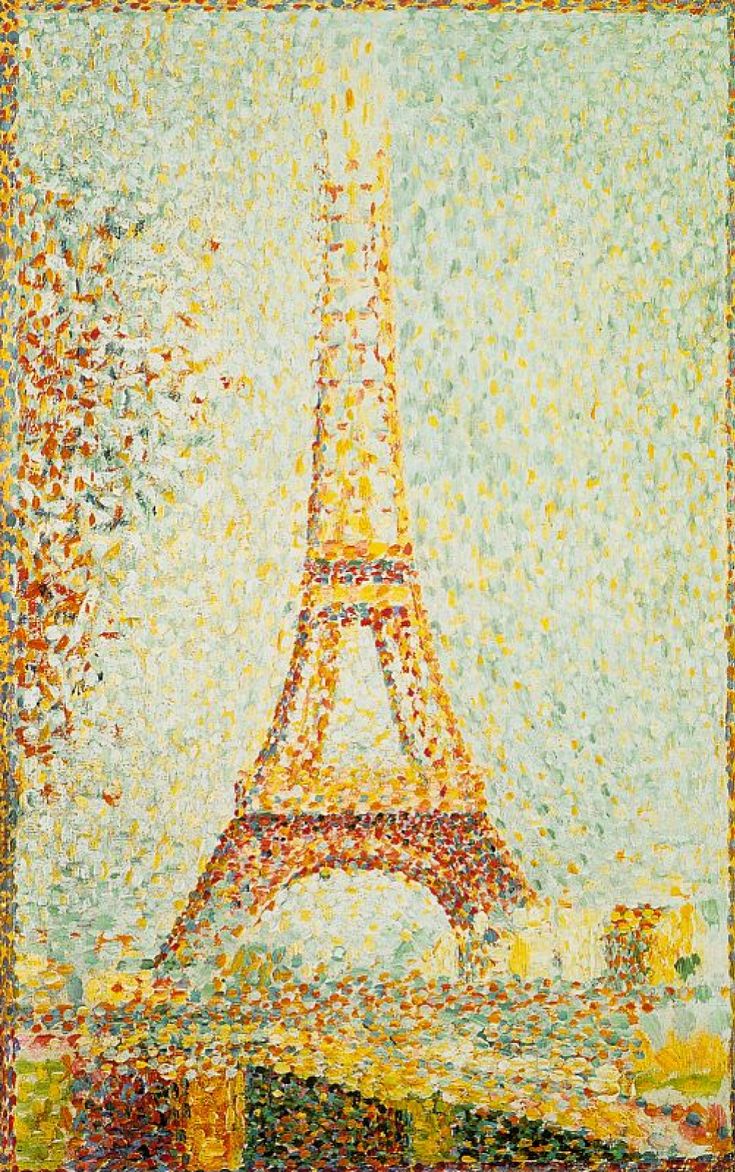
The Eiffel Tower is Seurat’s oil on wood of about 1889: the tower stands in the middle of an upright panel, built entirely from tiny dots of orange, red and violet, and the sky around it is a dense weave of blue, lilac and cream touches. The museum records that the tower was not quite finished when the work was painted. The original is held by the Fine Arts Museums of San Francisco under accession number 1979.48. We make it as a hand-painted canvas painting in oils, in eight sizes or to your own measurements, and you receive a photograph of the finished work for approval before dispatch.
| Title: | The Eiffel Tower |
| Other titles: | Eiffel Tower · La Tour Eiffel |
| Painter: | Georges Seurat (1859–1891) |
| Year painted: | about 1889 |
| Original size: | 15.7 cm x 25.1 cm |
| Original technique: | Oil on wood |
| Painting style: | Pointillism |
| Located at: | Fine Arts Museums of San Francisco (acc. no. 1979.48) |
| Our reproduction: | hand-painted in oil on linen, 8 sizes from 15 x 24 cm to 100 x 160 cm, custom sizes on request |
The Eiffel Tower – Georges Seurat
What is in the painting?
The Eiffel Tower, alone, in the middle of an upright panel. It takes the whole height: from the wide arches at the ground it narrows to a thin point just below the upper edge. To its left lies a paler, more thinly dotted field in which a tree can barely be made out. Along the foot runs a low band of small buildings in cream and pink, below that a green-blue plane, and at the very bottom a darker brown-red strip. The sky is not uniform: thousands of tiny dots of blue, lilac, cream and yellow, which fall apart from close up and settle into bright summer air from a distance.
Who is in the painting?
Nobody. This is one of the few works by Seurat with no people in it — no bathers, no Sunday strollers, no models. Only the structure remains, and the air around it. That is exactly why it works differently from his large scenes: instead of a society we watch a construction, and the only “event” is light breaking on metal. Where another painter would put a figure, here stands the tower.
Why does this work matter?
Because it was made while the tower was not yet finished. The museum records that in 1889, when it was painted, the tower was almost but not quite complete, and that Seurat shows it in exactly that becoming, dissolving into his network of dots. The tower was built for the World’s Fair of 1889 and was then the tallest structure on earth; much of Paris thought it an eyesore. A French painter with no such reservations, Seurat painted it at once, giving one of the first depictions that take it seriously as a subject. The museum calls him the inventor of the Neo-Impressionist, or pointillist, technique, which builds form and light out of tiny dots of pure, contrasting colour.
What does the scene mean?
The new that is not yet old. What we see is not a monument but a building site just turning into the sign of a city — and the method matches the content: a structure of iron parts, painted as a structure of particles of colour. For Seurat neo-impressionism was exactly that, a method and not a style. At home it reads bright and upright, with a quiet strength: a single object carrying the whole surface, and a sky that behaves differently in every light.
What happened to the original?
The museum publishes the panel’s whole route. It belonged to Roger Marx in Paris; after his death it was sold on 11 and 12 May 1914 at the Galerie Manzi-Joyant as lot 72 and bought by Bernheim-Jeune, who still had it in 1920. By 1924 it was with Princess Marguerite Gilbert Caetani Bassiano in Rome, by 1934 with Georges Bernheim in Paris, then with Jacques Seligmann and Co. in New York, where it still was in 1941. By 1942 it was with Cesar de Hauke; that same year Germain Seligman bought it, and it stayed in his estate until 1978. Through E.V. Thaw and Co. the Fine Arts Museums of San Francisco bought it in 1979. Those details are the museum’s; we add none of our own.
Where does this work sit in Seurat’s work?
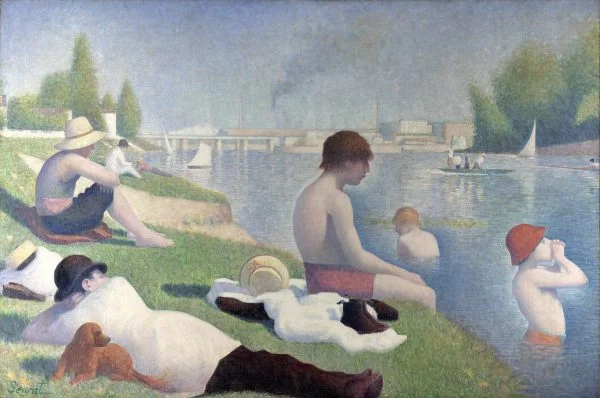
In the last years, close to the large canvases. The same method of tiny dots carries Sunday Afternoon on the Island of La Grande Jatte, held by the Art Institute of Chicago, and The Models (Les Poseuses), where the same technique is tried out in the studio. Bathers at Asnières came earlier, still without dots, and The Circus is the painter’s last, unfinished canvas. Among them the Eiffel Tower is the only one with not a single person in it.
How is our hand-painted version made?
It is made with a brush and oil paint, never a printer. On this subject pointillism is the substance of the work and not decoration: our painter sets dot after dot, because they are what holds it together, and because a smoothed surface would make a different work. We also keep the narrow band of dots the painter laid along the edge of the panel — that is not a frame but part of the work. Because everything is done by hand, no two canvases are ever quite alike and every hand-painted copy stays a one-off. We do not yet hold our own photographs of a finished canvas for this subject; the first time it is painted we will photograph it and the photographs will appear here.
Which size for which wall?
If you do not know which: 60 x 90 cm. The original measures 15.7 x 25.1 cm, so our smallest size, 15 x 24 cm, is effectively one to one with it. The format is upright, close to a 5 : 8 ratio, so it fits a narrow recess, beside a door, between two windows, or above a stairwell where a landscape shape has no room. 40 x 60 and 50 x 80 cm suit a hallway or bedroom; 60 x 90 and 70 x 110 cm are the everyday living-room sizes; 80 x 130, 90 x 140 and 100 x 160 cm are for tall walls and stairwells, where the tower gets its real height. Every oil painting reproduction of this subject is made to order.
Custom size, stretcher bar and frame
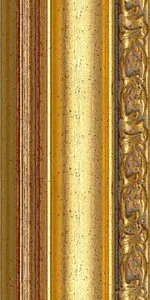
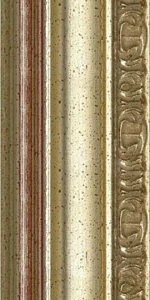
If none of the eight sizes fits your wall, we paint to your measurements and keep the ratio of the original so the tower does not become wider or shorter than it is; that is our custom size painting service. You can order the painting in three forms: as a rolled canvas without a stretcher, stretched on a wooden stretcher bar and ready to hang, or framed; you choose the form when you order. You choose the frame in our 3D frame viewer: on this subject it shows every profile we carry — gold, silver, black, white and natural wood — and it is for choosing a frame and nothing else. To see how the work looks on your own wall, use our separate room-visualisation service, ordered on its own.
Delivery and guarantee
Every copy is made to order in our Slovenian studio, so allow 15 to 45 days depending on the size. We ship it in the form you chose when ordering — rolled, stretched or framed — protected for transport, across the EU, customs-free. Before dispatch you approve a photograph of the finished work, and our returns policy applies to every order. The full range is in the Georges Seurat gallery, and his career is described in our article about Georges Seurat, which also explains what separates a good fine art reproduction from a poor one.
Frequently asked questions
Where is the original?
In the Fine Arts Museums of San Francisco, under accession number 1979.48. The museum bought it in 1979 from the William H. Noble Bequest Fund.
Is the tower in the painting finished?
No. The museum records that in 1889, when it was painted, the tower was almost but not quite complete, and that Seurat shows it in the making.
Why is the original so small?
Because it is painted on a panel barely 15.7 x 25.1 cm. Seurat worked on such panels on the spot; from us you can have it ten times that size.
Is this a print?
No. The work is painted by hand in oil on canvas; the dots are set one by one and can be felt.
Which size should I choose?
For a living room, 60 x 90 cm; for the size of the original, 15 x 24 cm. The full guide is above.
Can I have a size that is not listed?
Yes. We paint to measure, keeping the side ratio of the original.
Are the dots really set one by one?
They are. That is the whole method: the colours do not mix on the palette but in the viewer’s eye, and every dot is a brushstroke of its own.
What is that band of dots along the edge?
The painter’s own border, set in different colours from the surface. It is not a frame and we do not cut it away — it belongs to the work.
Is the original for sale and what is it worth?
No. The panel is in the public collection of the Fine Arts Museums of San Francisco and is not for sale; a hand-painted canvas from us is the only way to have it at home.
How high should I hang it?
Centre at eye level, about 145–150 cm from the floor. At the large upright sizes hang it lower, so the point does not leave your field of view.
Is it suitable as a gift?
Yes, particularly for someone who likes Paris or architecture. If you would rather leave the choice to the person receiving it, there is our gift voucher.
- Subject: the Eiffel Tower in tiny dots, shortly before completion – about 1889
- Original: 15.7 x 25.1 cm, oil on wood, Fine Arts Museums of San Francisco (acc. no. 1979.48)
- Ours: a famous painting recreated by hand in oils, eight sizes from 15 x 24 to 100 x 160 cm, as a rolled canvas, stretched or framed — your choice
- Worth knowing: there is not a single person in this work – among Seurat’s known paintings that is the exception