



Description
Study for Bathers at Asnières (Kansas City) is Seurat’s oil study on panel from 1883: a nude bather sits on the bank of the Seine looking across the water, a clothed figure lies in the grass behind him, and a bridge with factory chimneys crosses the river in the distance. The museum also records the work under its original French title Une Baignade, Asnières. The original is held by the Nelson-Atkins Museum of Art in Kansas City under accession number 33-15/3. We make it as a hand-painted canvas painting in oils, in seven sizes or to your own measurements, and you receive a photograph of the finished work for approval before dispatch.
| Title: | Study for Bathers at Asnières (Kansas City) |
| Other titles: | Une Baignade, Asnières · Study for “La Baignade” |
| Painter: | Georges Seurat (1859–1891) |
| Year painted: | 1883; the museum record states expressly that the work is not signed |
| Original size: | 24.92 cm x 15.88 cm |
| Original technique: | Oil on wood |
| Painting style: | Post-Impressionism – the museum’s own term; early oil study |
| Located at: | Nelson-Atkins Museum of Art, Kansas City (acc. no. 33-15/3) |
| Our reproduction: | hand-painted in oil on linen, 7 sizes from 25 x 16 cm to 120 x 75 cm, custom sizes on request |
Study for Bathers at Asnières (Kansas City) – Georges Seurat
Who is in the painting?
Two bathers by the river, whom the museum record does not name. At the right, close to the water, a nude young man sits with his back to us, dark-haired, his pale back turned to the light and his head just turned towards the river. At the left a second figure rests in the grass, dressed in dark clothes, propped on one elbow with the legs drawn under. Between them white garments lie on the bank, and beside them a dark red bundle. Asnières was an industrial suburb west of Paris where workers went down to the Seine on hot days; these are not sitters but people the painter saw there. Because the record does not name them, neither do we.
What is on the panel?
A horizontal wooden panel barely the size of a hand. The lower third is the grassy bank in strong greens, and across the middle the water opens out in blue with pink and violet flecks. Along almost the full width above runs a low bridge; behind it slender factory chimneys rise into the pale sky with their smoke, and pale buildings stand on the far bank. Trees and a light-coloured house fill the upper left, a dark green canopy the right edge. The paint is not laid in fine dots but in short, crossing strokes that stay visible one by one: the panel was made on the spot, in a single sitting.
Why does this study matter?
Because it holds what the finished work no longer shows. Bathers at Asnières was this artist’s first large canvas, and here the bridge and the chimneys are still a plain part of the scene — the industry that gives the moment its real place. A French painter of patient method, Seurat laid in a run of such panels on the bank in the summer of 1883, each for a single question: where the figure should sit, how light falls on a back, how much sky is needed. The pointillism he is known for today is not yet developed here — he arrived at it only after the large canvas. The museum in Kansas City bought the work in 1933 with funds from the William Rockhill Nelson Trust and shows it in Gallery 127.
What does the scene mean?
Leisure by the river, seen without embellishment. Seurat painted neither poverty nor a summer idyll; he painted a man sitting by the water because it is hot, and behind him the factories that give him work. It is exactly that quiet neighbouring that makes the scene modern: nobody poses, nobody tells a story, the clothes are simply dropped on the grass. At home it stays quiet and undemanding — water, bank, two figures and the far horizontal of the bridge holding it all together. Neo-impressionism grew out of observations like these only some years later.
What happened to the original?
The museum publishes the panel’s whole route, and it is unusually detailed. After the painter’s death in March 1891 it was inherited by Madeleine Knoblock, who sold it in 1892 to Jean-Baptiste Degreef in Auderghem, Belgium. By January 1918 it was with Walther Halvorsen in Paris, then bought by Jørgen Breder Stang in Oslo, who kept it until December 1928; de Hauke and Co. followed, jointly with Alex Reid and Lefèvre, then M. Knoedler and Co. in New York in March 1929, Stephen Carlton Clark the same year, and Knoedler again in 1931. In January 1933 the Nelson-Atkins Museum of Art bought it from Knoedler and has held it since. Those details are the museum’s; we add none of our own.
Where does this study sit in Seurat’s work?
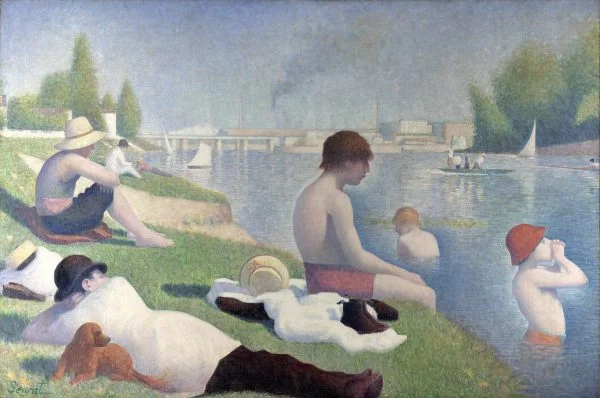
Among the preparations for Bathers at Asnières, the finished canvas held by the National Gallery in London. We also sell three different preparations for the same work: this one from Kansas City with the bridge and the chimneys, Study for Bathers at Asnières (London) with the boys on the bank, and Boys Bathing from the Musée d’Orsay. The same method led afterwards to Sunday Afternoon on the Island of La Grande Jatte.
How is our hand-painted version made?
It is made with a brush and oil paint, never a printer. Our painter works from a high-resolution museum file and keeps exactly what this work is: short, crossing strokes and a visible direction of brush. Fine dots would be wrong here, because the panel was made before the painter had worked them out, and they would turn it into a different work. Because everything is done by hand, no two canvases are ever quite alike and every hand-painted copy stays a one-off. We do not yet hold our own photographs of a finished canvas for this subject; the first time it is painted we will photograph it and the photographs will appear here.
Which size for which wall?
If you do not know which: 60 x 40 cm. The original measures 24.92 x 15.88 cm, so our smallest size, 25 x 16 cm, is effectively one to one with it. The format is horizontal, close to an 8 : 5 ratio, so it sits well above a narrow chest, between two doors, or in a group of smaller works. 50 x 30 and 60 x 40 cm are the everyday choices for a hallway or bedroom; 70 x 45 and 80 x 50 cm stand alone above a bed or a desk; 90 x 60 cm is the living-room size, and 120 x 75 cm is our largest for this subject and at the same time the upper limit the museum file will carry. Every oil painting reproduction of this subject is made to order.
Custom size, stretcher bar and frame
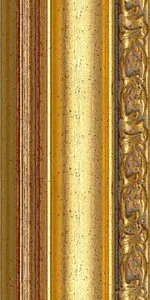
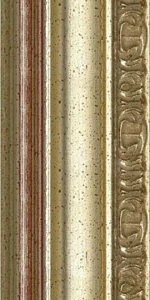
If none of the seven sizes fits your wall, we paint to your measurements, up to 120 x 75 cm, and keep the ratio of the original so the bank and the line of the bridge do not shift; that is our custom size painting service. You can order the painting in three forms: as a rolled canvas without a stretcher, stretched on a wooden stretcher bar and ready to hang, or framed; you choose the form when you order. You choose the frame in our 3D frame viewer: on this subject it shows every profile we carry — gold, silver, black, white and natural wood — and it is for choosing a frame and nothing else. To see how the work looks on your own wall, use our separate room-visualisation service, ordered on its own.
Delivery and guarantee
Every copy is made to order in our Slovenian studio, so allow 15 to 45 days depending on the size. We ship it in the form you chose when ordering — rolled, stretched or framed — protected for transport, across the EU, customs-free. Before dispatch you approve a photograph of the finished work, and our returns policy applies to every order. The full range is in the Georges Seurat gallery, and his career is described in our article about Georges Seurat, which also explains what separates a good fine art reproduction from a poor one.
Frequently asked questions
Where is the original?
In the Nelson-Atkins Museum of Art in Kansas City, Gallery 127, under accession number 33-15/3. The museum bought it in 1933.
Why does the work appear under several titles?
The museum records it as Study for “Bathers at Asnières”, the original French title is Une Baignade, Asnières, and earlier entries were Study for “A Bathing Place, Asnières” and Study for “La Baignade”. It is one and the same panel.
Is this the same work as Bathers at Asnières?
No. This is a preparatory study on wood, 24.92 x 15.88 cm; the finished canvas measures 301.5 x 201 cm and hangs in the National Gallery in London. Both are in our Seurat gallery, as separate products.
Is this a print?
No. The work is painted by hand in oil on canvas; the brushwork is visible and can be felt.
Which size should I choose?
For a hallway or bedroom, 60 x 40 cm; for the size of the original, 25 x 16 cm. The full guide is above.
Can I have a size that is not listed?
Yes. We paint to measure, up to 120 x 75 cm, keeping the side ratio of the original.
Is the work signed?
No. The museum record states expressly that this work carries no signature.
What is that band across the background?
A bridge over the Seine, with smoking factory chimneys and buildings on the far bank behind it. That band is what tells you we are in an industrial suburb and not on holiday.
Is the original for sale and what is it worth?
No. The panel is in the public collection of the Nelson-Atkins Museum of Art and is not for sale; a hand-painted canvas from us is the only way to have it at home.
How high should I hang it?
Centre at eye level, about 145–150 cm from the floor. At the small sizes hang it lower and nearer where you sit.
Is it suitable as a gift?
The smaller sizes make a good gift: the subject is quiet and fits almost any wall. If you would rather leave the choice to the person receiving it, there is our gift voucher.
- Subject: a nude bather on the bank of the Seine at Asnières, with a bridge and factory chimneys behind – 1883
- Original: 24.92 x 15.88 cm, oil on wood, Nelson-Atkins Museum of Art (acc. no. 33-15/3)
- Ours: a famous painting recreated by hand in oils, seven sizes from 25 x 16 to 120 x 75 cm, as a rolled canvas, stretched or framed — your choice
- Worth knowing: the bridge and chimneys are still a plain part of the scene here – on the finished large canvas they retreat