














Description
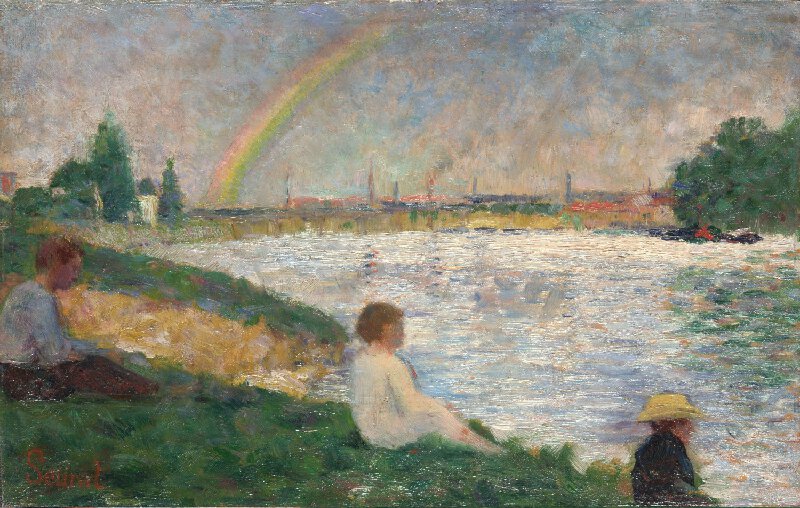
The Rainbow: Study for Bathers at Asnières is Seurat’s oil study on wood from 1883: three figures sit on the bank of the Seine looking across the water, the factories of Clichy run along the far side, and a rainbow arches over the sky. The museum records that the rainbow was painted over the sky only once the paint had dried, and that this is Seurat’s only sketch to include one. The original is held by the National Gallery in London under accession number NG6555. We make it as a hand-painted canvas painting in oils, in six sizes or to your own measurements, and you receive a photograph of the finished work for approval before dispatch.
| Title: | The Rainbow: Study for Bathers at Asnières |
| Other titles: | The Rainbow · Croqueton |
| Painter: | Georges Seurat (1859–1891) |
| Year painted: | 1883 |
| Original size: | 24.5 cm x 15.5 cm |
| Original technique: | Oil on wood |
| Painting style: | Early oil study (croqueton) – before the dots |
| Located at: | The National Gallery, London (acc. no. NG6555) |
| Our reproduction: | hand-painted in oil on linen, 6 sizes from 25 x 16 cm to 90 x 60 cm, custom sizes on request |
The Rainbow: Study for Bathers at Asnières – Georges Seurat
Who is in the painting?
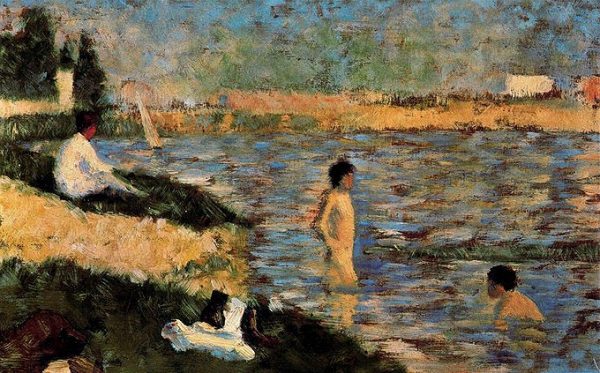
Three figures by the river, whom the museum record does not name. At the far left a man sits in a light shirt, reddish-haired, a dark red garment beside him; the museum suggests he was painted from life. In the middle, right at the water, a figure in white sits with its back to us. At the far right, lowest and furthest forward, a figure crouches in a yellow straw hat and dark clothes. All three look the same way, across the river, and the museum points out that they are placed with equal space between them — the scene is composed, then, and not merely observed. Because the record does not name them, neither do we.
What is on the panel?
A horizontal wooden panel barely the size of a hand. The lower left third is the grassy bank with a sandy gully; the rest is the wide river, laid in with long horizontal strokes that turn pink and green in a silver glitter, the water nearest us darker. Two black barges lie at the right edge. The far bank is a low band of buildings and factory roofs, and above it, in a mottled grey-violet sky, the rainbow arches down from the right towards the left bank. Dark trees stand at either edge. The paint is not laid in fine dots but in short, woven strokes that stay visible one by one.
Why does this study matter?
Because it is Seurat’s only sketch with a rainbow. The museum records that it was painted over the ground once that had dried, and that the mottled sky suggests the painter may really have seen one; the motif is evidence of his attention to light and atmosphere. Seurat, a French painter of patient method, stood on the bank facing the island of La Grande Jatte, with the factories at Clichy on the horizon — the spot his first large canvas came from. The museum adds that this panel is not normally counted among the thirteen sketches tied to that canvas, and yet the place and the row of figures all facing one way are the same. The pointillism he is known for today is not developed here.
What does the scene mean?
A hot day by the river in a working suburb, with an effect nobody can order. The sandy gully on the bank was formed by dragging boats in and out of the water, and was also used for washing horses and dogs — it is what gives the bathing place its name. So Seurat painted no summer idyll but a spot used for work and rest at once, and set a rainbow above it. At home the work stays quiet and light: wide water, three small figures and a band of colour tying it together. Neo-impressionism grew out of observations like these some years later.
What happened to the original?
The museum publishes the panel’s whole route. In 1891 it was inherited by the painter’s partner, Madeleine Knoblock, who in February 1892 sold it to Jean-Baptiste de Greef in Auderghem, Belgium; by 1894 it was with Félix Fénéon, then with Etienne Bignou at the Galerie Bignou in Paris until 1932. From 1932 until about 1939 it was with David William T. Cargill in Lanark, then the Bignou Gallery in New York and, in 1944, M. Knoedler and Co.; that February Pauline Morton, Mrs Dwight F. Davis, bought it in Washington. In 1984 it passed through Acquavella Galleries to Heinz Berggruen, who presented it to the National Gallery in 1995. Those details are the museum’s; we add none of our own.
Where does this study sit in Seurat’s work?
Bathers at Asnières is the finished canvas the same National Gallery holds; this panel is tied to it by the place and by the figures. We also sell four preparations for the same work: this one with the rainbow, Study for Bathers at Asnières (London), Study for Bathers at Asnières (Kansas City) and Boys Bathing from the Musée d’Orsay. The same method led afterwards to Sunday Afternoon on the Island of La Grande Jatte, which shows the island from the other side of this same water.
How is our hand-painted version made?
It is made with a brush and oil paint, never a printer. Our painter works from a high-resolution museum file and keeps exactly what this work is: the long horizontal strokes on the water, the short woven strokes on the bank, and the rainbow laid over a sky already dry. Fine dots would be wrong here, because the panel was made before the painter had worked them out, and they would turn it into a different work. Because everything is done by hand, no two canvases are ever quite alike and every hand-painted copy stays a one-off. We do not yet hold our own photographs of a finished canvas for this subject; the first time it is painted we will photograph it and the photographs will appear here.
Which size for which wall?
If you do not know which: 60 x 40 cm. The original measures 24.5 x 15.5 cm, so our smallest size, 25 x 16 cm, is effectively one to one with it. The format is horizontal, close to an 8 : 5 ratio, so it sits well above a narrow chest, between two doors, or in a group of smaller works. 50 x 30 and 60 x 40 cm are the everyday choices for a hallway or bedroom; 70 x 45 and 80 x 50 cm stand alone above a bed or a desk; 90 x 60 cm is our largest here and the upper limit the museum file carries — bigger, and the thin drawing of the arc would spread. Every oil painting reproduction of this subject is made to order.
Custom size, stretcher bar and frame
If none of the six sizes fits your wall, we paint to your measurements, up to 90 x 60 cm, and keep the ratio of the original so the bank and the arc do not shift; that is our custom size painting service. You can order the painting in three forms: as a rolled canvas without a stretcher, stretched on a wooden stretcher bar and ready to hang, or framed; you choose the form when you order. You choose the frame in our 3D frame viewer: on this subject it shows every profile we carry, gold to natural wood, and it is for choosing a frame and nothing else. To see how the work looks on your own wall, use our separate room-visualisation service, ordered on its own.
Delivery and guarantee
Every copy is made to order in our Slovenian studio, so allow 15 to 45 days depending on the size. We ship it in the form you chose when ordering — rolled, stretched or framed — protected for transport, across the EU, customs-free. Before dispatch you approve a photograph of the finished work, and our returns policy applies to every order. The full range is in the Georges Seurat gallery, and his career is described in our article about Georges Seurat, which also explains what separates a good fine art reproduction from a poor one.
Frequently asked questions
Where is the original?
In the National Gallery in London, under accession number NG6555. The museum received it in 1995 as Heinz Berggruen’s gift.
Is the rainbow really part of the original?
Yes. The museum records that it was painted over the sky only once the paint had dried, and that this is Seurat’s only sketch to show one.
Is this the same work as Bathers at Asnières?
No. This is a small oil study on wood, 24.5 x 15.5 cm; the finished canvas measures 301.5 x 201 cm and hangs in the same gallery. Both are in our Seurat gallery, as separate products.
Is this a print?
No. The work is painted by hand in oil on canvas; the brushwork is visible and can be felt.
Which size should I choose?
For a hallway or bedroom, 60 x 40 cm; for the size of the original, 25 x 16 cm. The full guide is above.
Can I have a size that is not listed?
Yes. We paint to measure, up to 90 x 60 cm, keeping the side ratio of the original.
Why are there no larger sizes?
Because the museum file for this subject carries 90 x 60 cm at most. Above that the thin drawing of the arc would spread, so we do not offer it.
What is that band on the far bank?
The factories at Clichy. The museum places the scene on the bank facing the island of La Grande Jatte, with those factories on the horizon.
Is the original for sale and what is it worth?
No. The panel is in the public collection of the National Gallery in London and is not for sale; a hand-painted canvas from us is the only way to have it at home.
How high should I hang it?
Centre at eye level, about 145–150 cm from the floor. At the small sizes hang it lower and nearer where you sit.
Is it suitable as a gift?
The smaller sizes make a good gift: the subject is quiet, and the arc gives it a light note that fits almost any wall.
- Subject: three figures on the bank of the Seine at Asnières, the factories at Clichy, and a rainbow over the river – 1883
- Original: 24.5 x 15.5 cm, oil on wood, The National Gallery, London (acc. no. NG6555)
- Ours: a famous painting recreated by hand in oils, six sizes from 25 x 16 to 90 x 60 cm, as a rolled canvas, stretched or framed — your choice
- Worth knowing: the rainbow is painted over a sky already dry – the only sketch by Seurat that has one