







































Description
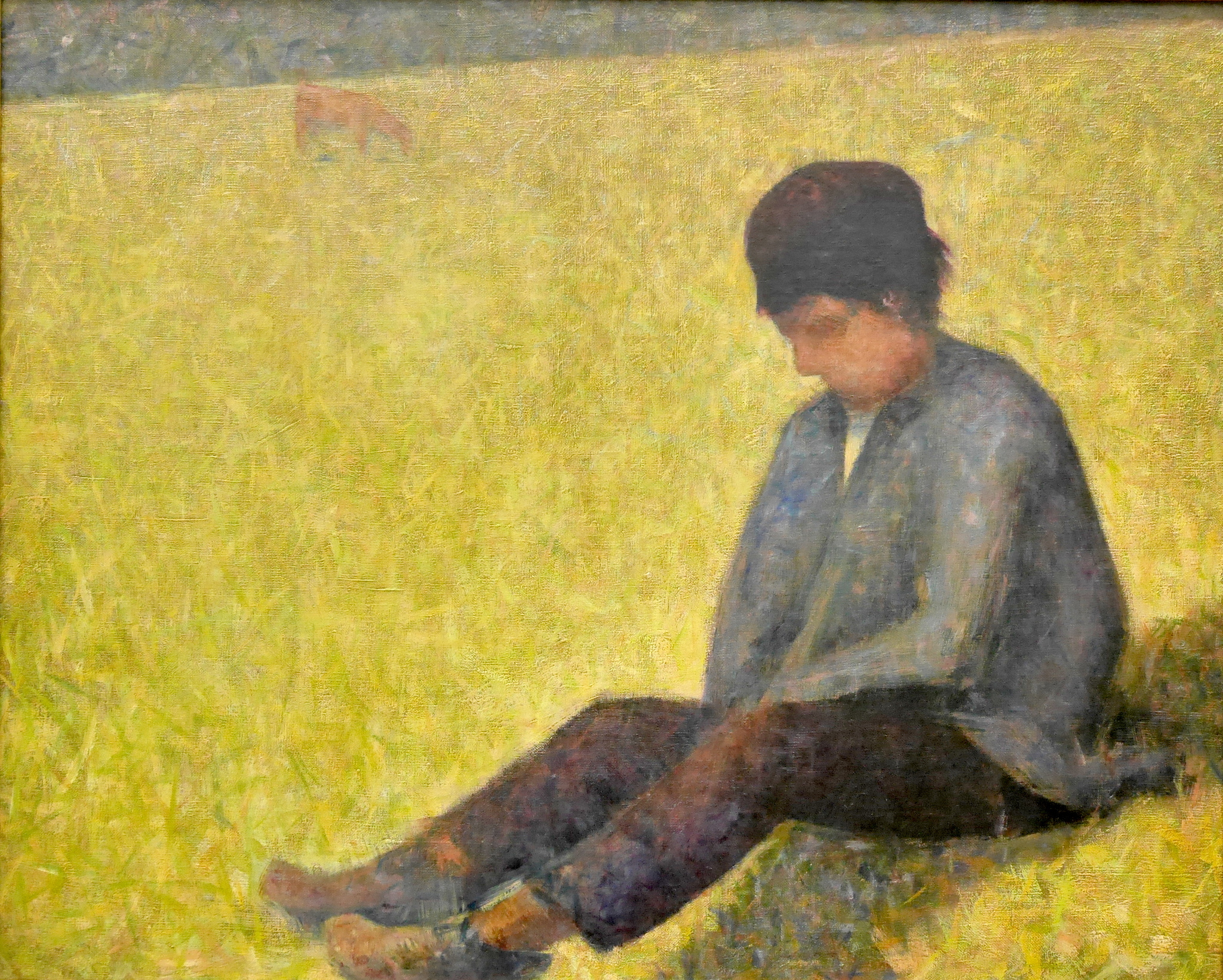
Boy Sitting in a Meadow is a painting by Georges Seurat, made c. 1882–1883: in the middle of a bright yellow-green meadow sits a boy in a dark cap and a greyish-blue jacket, head bowed and legs stretched out in front of him, while at upper left a small animal, perhaps a cow, grazes in the distance. The original, oil paint on canvas, measures 79.6 x 63.5 cm and is held by Glasgow Museums in Glasgow under number 2857. We make it as a canvas painting, painted by hand in oils, in eight sizes or to your own measurements, and before dispatch you receive a photograph of the finished work for approval.
| Title: | Boy Sitting in a Meadow |
| Other titles: | Boy Sitting in a Meadow – the title the museum itself uses |
| Painter: | Georges Seurat (1859–1891) |
| Year painted: | c. 1882–1883 |
| Original size: | 79.6 cm x 63.5 cm |
| Original technique: | Oil on canvas |
| Painting style: | Short, criss-crossing brushstrokes |
| Located at: | Glasgow Museums, Glasgow (inv. no. 2857) |
| Our reproduction: | hand-painted oil on canvas, 8 sizes from 46 x 38 cm to 150 x 120 cm, custom size on request |
Boy Sitting in a Meadow – Georges Seurat
Who is in the painting?
A boy sitting alone in the middle of a meadow. The museum record does not name him; the title tells us only that he is a boy sitting in a meadow. He sits in the right half, turned to the left and looking down, so that shadow almost hides his face. He wears a dark, brownish-black cap and a loose, greyish-blue jacket or smock, with a light piece of shirt showing at the neck. His trousers are dark, a brownish violet, and his legs stretch out in front of him towards the lower left corner, the feet light and brownish. His hands rest in his lap and his body is slightly hunched. A darker shadow lies on the grass behind him, on the right. At upper left, far behind the boy, a small reddish-brown animal, perhaps a cow, stands in the meadow with its head lowered as if grazing. Along the very top of the canvas runs a narrow, darker, grey-blue band, perhaps the edge of the meadow or a distant strip of greenery.
What is on the canvas?
A horizontal canvas taken up almost entirely by the meadow. The grass is not painted in dots but in short brushstrokes that cross one another in every direction; up close they look like a dense mesh of blades, from a distance they merge into a bright, sunlit surface. Anyone expecting the pointillism of even, round dots from Seurat will see something different here. The boy is built from strokes too: the jacket from blue, grey and lighter ones, the trousers from dark violets and browns. His outline is soft, with no sharp line, so the figure almost melts into the grass around him. In places the photograph also shows the weave of the canvas. The museum gives the size as 635 x 796 mm, height before width. The colours in the photograph in this listing may be shifted; treat them as a guide, not a sample.
Why does this painting matter?
Because it makes a whole painting out of a very simple subject. There is no story and no action on the canvas: one boy, a meadow and an animal in the distance. It shows how the French painter Georges Seurat sets a dark, still figure against a bright, lively meadow and creates a tension that holds the eye. The composition is carefully weighed. The boy is pushed into the right half, and his legs lead the eye towards the lower left corner; the small animal at upper left balances the weight of the figure on the right. The large stretch of grass between them is not empty but alive with brushstrokes. For a buyer it is a quiet, composed subject that never shouts in a room, yet holds a long look.
What does the painting mean?
A moment of rest in the countryside. The boy sits, looks down in front of him and pays no attention to the viewer; he seems lost in thought, or simply resting in the sun. The animal in the background suggests a pasture, but the painting does not say whether the boy is minding cattle, so we do not claim it either. What remains is a feeling of calm, warmth and the silence of a summer day. At home it reads as bright and warm; its yellow-green tones go well with wood, linen, white and cream walls and plants, and the dark figure gives it weight, so it never becomes merely a decorative surface.
What place does it have among Seurat’s works?
The museum record dates it to c. 1882–1883. Judging by their titles, country people are the subject of three more paintings we offer: Peasant Woman Seated in the Grass (Paysanne assise dans l’herbe) is held by the Solomon R. Guggenheim Museum in New York, where Farm Women at Work is also held, and Peasant with a Hoe is in the National Gallery of Art in Washington. For a wall of Seurat’s country scenes, Boy Sitting in a Meadow can hang beside any of them.
How is our hand-painted version made?
With a brush and oil paint, never with a printer. Our painter works from an image of the original and builds the meadow from short, criss-crossing strokes like the ones you see in the photograph. A pointillist technique with even, round dots would be the wrong choice here, because the original has no such dots. First the boy is set in place, with his cap, jacket and outstretched legs; then the grass around him is brought to life stroke by stroke, so that the figure stays softly held in the meadow and does not look cut out. We take particular care with the shadow on the boy’s face, the shadow on the grass behind him and the small animal in the distance, which must stay tiny yet legible. Because everything is done by hand, no two canvases are ever quite alike, and every hand-painted copy remains unique. We have no photographs of our own of a finished canvas of this subject yet; when we paint it for the first time, we will photograph it and publish the photographs here.
Which size for which wall?
If you are not sure which to choose, take 80 x 65 cm. It is the size closest to the original: the original measures 79.6 x 63.5 cm, and ours is 0.4 cm wider and 1.5 cm taller, so practically the same size. The horizontal format fits above a sofa, a chest of drawers or a bed. 46 x 38 and 50 x 40 cm suit smaller walls, hallways and work corners; 60 x 50 and 70 x 60 cm fill a bedroom or dining-room wall on their own; at 80 x 65 and 90 x 75 cm the brushstrokes and the boy read well even from a distance; 120 x 100 and 150 x 120 cm are for large living rooms, where the meadow becomes almost a window onto the countryside. Every oil painting reproduction of this subject is made to order.
Custom size, stretcher bar and frame
If none of the eight sizes suits your wall, we paint to your measurements and keep the proportions of the original, so that the boy and the animal stay in their places; that is our custom size painting service. You can order the painting in three forms: as a rolled canvas without a stretcher, stretched on a wooden stretcher bar and ready to hang, or framed; you choose the form when you order. You choose a frame in our 3D app, which shows gold, silver, black, white and wooden profiles on this subject; the app is for choosing the frame only. If you would like to see the painting on your own wall, our room-visualisation service is available separately.
Delivery and guarantee
Every canvas is painted to order in our studio in Slovenia, so allow 15 to 45 days depending on the size. We send it in the form you chose when ordering — rolled, stretched or framed — protected for transport, within Slovenia and across the EU with no customs duty. Before dispatch you receive a photograph of the finished work for approval, and our returns policy applies to every order. You will find all of Seurat’s subjects in the Georges Seurat gallery, and our article about Georges Seurat explains what makes a fine art reproduction of a famous painting truly good.
Frequently asked questions
Where is the original?
In the collection of Glasgow Museums in Glasgow, under number 2857. According to the museum record, it was presented to the museums in 1950 by the Trustees of D. W. T. Cargill.
Who is the boy?
The museum record neither names nor describes him. We know only what the title says and what is visible: a boy in a dark cap and a greyish-blue jacket, sitting in a meadow.
What is the animal at upper left?
A small reddish-brown animal, perhaps a cow, standing far off in the meadow with its head lowered. The museum record does not mention it.
Is this a print?
No. It is hand-painted oil on canvas; the brushstrokes are visible and can be felt.
Which size should I choose?
80 x 65 cm, the size closest to the original. The detailed guide is above.
Can I have a size that is not on the list?
Yes. We paint to measure and keep the side ratio of the original.
Is this neo-impressionism?
The museum record does not assign the painting to a movement, so neither do we. What is visible is a meadow made of short, criss-crossing strokes, not of dots.
Is Boy Sitting in a Meadow the museum’s own title?
Yes. The museum lists the painting under the English title »Boy Sitting in a Meadow«, and we use the same title for the same canvas.
Is the original for sale?
No. The canvas is part of the museum’s collection and is not for sale; we can paint it by hand for your home.
How high should I hang it?
With its centre at eye level, about 145–150 cm from the floor; hang the smaller sizes lower, nearer to where you sit.
Is it a good gift?
Yes, especially for someone who loves the countryside, nature and quiet scenes. If you would rather leave the choice to the recipient, there is our gift voucher.
- Subject: a boy in a dark cap sits in a bright meadow while a small animal, perhaps a cow, grazes in the distance – c. 1882–1883
- Original: 79.6 x 63.5 cm, oil paint on canvas, Glasgow Museums, Glasgow (inv. no. 2857)
- Ours: hand-painted, eight sizes from 46 x 38 to 150 x 120 cm, as a rolled canvas, stretched or framed — your choice
- Worth knowing: the meadow is painted not in dots but in short, criss-crossing strokes that look like blades of grass up close