




Description
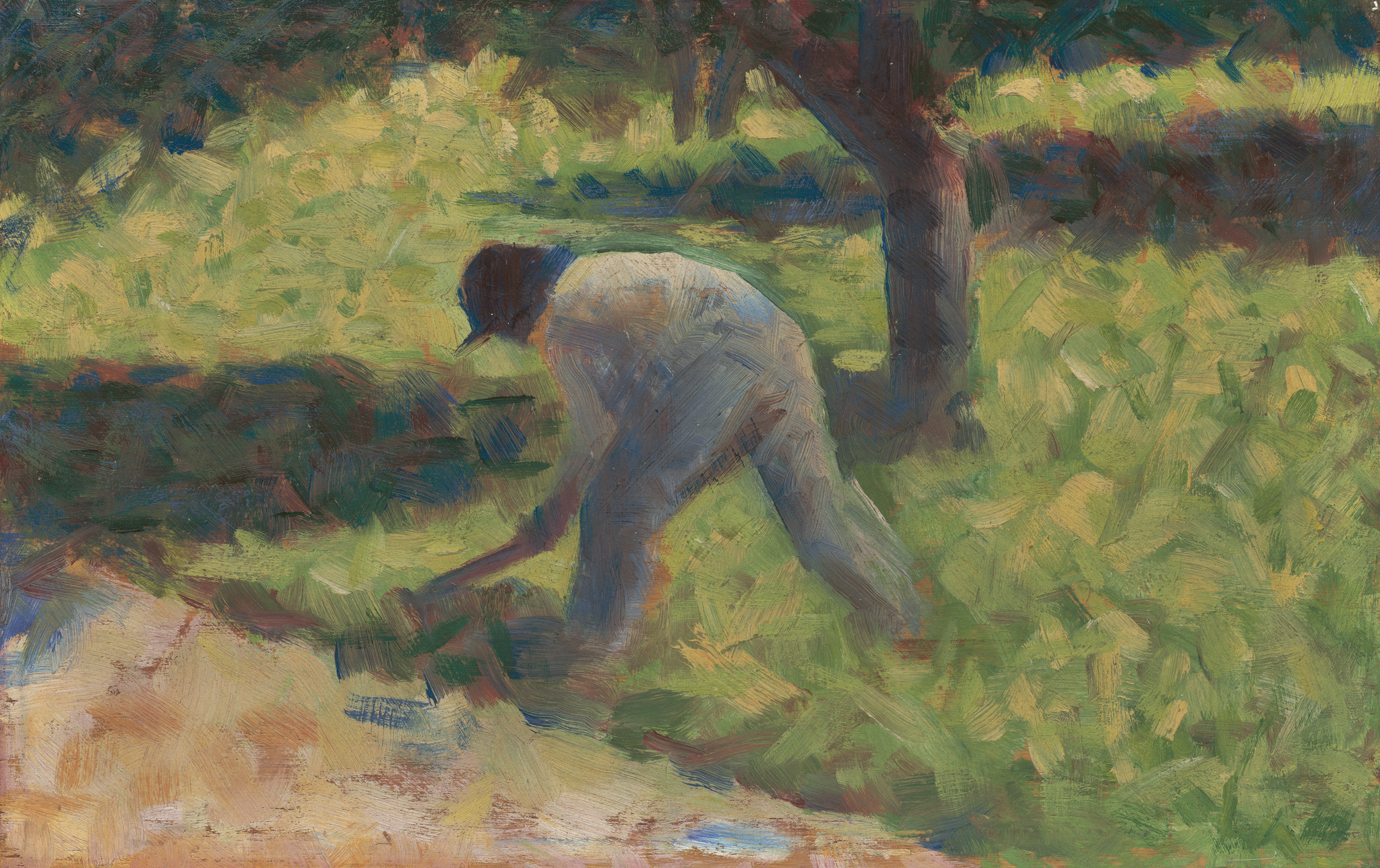
Peasant with a Hoe is a small oil painting on wood by Seurat, made in about 1882: in the middle of a green meadow a figure in grey clothes and a dark hat bends low over a patch of brown earth, working the ground with a long-handled tool, and behind him stands a tree trunk. The original, 24.13 x 14.61 cm, is held by the National Gallery of Art in Washington under accession number 2014.18.49. We make it as a fine art reproduction, hand-painted in oils on canvas, in eight sizes or to measure, and you approve a photograph of the finished work before dispatch.
| Title: | Peasant with a Hoe |
| Other titles: | »Peasant at Work« (1958 exhibition) |
| Painter: | Georges Seurat (1859–1891) |
| Year painted: | about 1882 |
| Original size: | 24.13 cm x 14.61 cm |
| Original technique: | Oil on wood |
| Painting style: | Oil painting on wood – broad, short, visible strokes in layers |
| Located at: | National Gallery of Art, Washington (inv. no. 2014.18.49) |
| Our reproduction: | hand-painted in oils on canvas, 8 sizes from 25 x 16 cm to 150 x 100 cm, custom sizes on request |
Peasant with a Hoe – Georges Seurat
Who is in the painting?
A single person working the land, whom the museum record does not name. The museum describes the figure as someone bent over work outdoors, dressed in grey and wearing a dark hat. He stands in the middle of the painting, his back arched, his head lowered almost to hip height. His arms reach forward and down to the edge of the brown patch, where the long-handled tool strikes the ground. We do not see his face; the hat hides it. The museum’s title is Peasant with a Hoe; at the 1958 exhibition it was shown as »Peasant at Work«. The record gives no other detail about the man, so we invent none.
What is on the panel?
A horizontal wooden panel, only 24.13 cm wide and 14.61 cm high. Almost the whole surface is filled with grass, built from short, slanting strokes of yellow-green, light green and olive. A band of dark shadow in blues and browns stretches across the left half, and dark foliage spreads above the worker’s head. Right of centre a brown tree trunk rises and forks towards the top. At the lower left lies a patch of light brown, pink and ochre earth, at whose edge the worker goes about his task. There is no sky, as the museum’s description also notes. The museum writes that the strokes are broad, short and visible, that small strokes of different colours overlap one another and give the scene a slightly blurred, hazy look, and it says the overlapping colours are almost like a kaleidoscope. The record lists no signature or stamp.
Why does this painting matter?
Because it shows how the French painter Georges Seurat looked at simple work in the fields around 1882. Anyone expecting pointillism from him will find something else here: instead of even dots, the strokes are broad and laid one over another, and green, blue, yellow, brown and ochre flow into each other. For this work we do not lean on labels such as neo-impressionism; we keep to the museum’s description of what is in the painting and how it is painted. It was made on a small piece of wood, so every stroke of the brush counts. The work was exhibited in Paris in 1933, in Chicago and New York in 1958 and in Washington in 1966, and it is also listed in the catalogues of Seurat’s paintings of 1959 and 1991.
What does the scene mean?
Work on the land, shown without a story and without embellishment. The man does not look at us, does not rest and does not pose; he is all movement as he drives the tool into the ground. The tree’s shadow and the sunlit grass alternate in bands, so the scene feels like a single moment on a bright day. We add no symbols to it. At home the painting brings calm and the warmth of green tones, while the man at work gives it a quiet strength familiar to anyone who has ever tended a garden or a field.
What happened to the original?
The museum publishes the panel’s history. At first it stayed with the painter until his death; in the posthumous inventory of his studio it is listed as number 58. Then, until 1956, it belonged to Jacques and Pierre Puybonnieux in Paris, sons of Marie Puybonnieux, Seurat’s cousin, who according to the museum probably inherited the painting from Seurat’s mother. The brothers were probably also the lenders to the Paris exhibition Seurat et ses amis in 1933. Next comes Wildenstein in Paris, with no date. Paul Mellon of Upperville, Virginia, owned it by 1958 at the latest, when he lent it to the exhibition in Chicago and New York. In 1999 he bequeathed it to the National Gallery of Art, with a life interest for his wife, Rachel Lambert Mellon (1910–2014). All details are taken from the museum record.
What place does this painting have among Seurat’s works?
It is one of the small paintings on wood with rural subjects that we offer in our gallery. Closest to it is The Gardener, likewise a small oil painting on wood showing a man at work, held by the Metropolitan Museum of Art in New York. Bent figures working in the fields also appear in Farm Women at Work, and a calmer rural scene in Peasant Woman Seated in the Grass (Paysanne assise dans l’herbe). Together they show that the painter kept returning to people on the land.
How is our hand-painted version made?
With a brush and oil paint, never with a printer. Our painter works from a high-resolution photograph of the original and keeps what makes this panel special: the broad, short strokes lying one over another, and the green tones flowing into blues and browns. A pointillist technique would be the wrong choice here, as it would turn a lively painting of broad strokes into a different, tidier work. Because everything is done by hand, no two canvases are ever quite alike, and every hand-painted copy stays one of a kind. We have no photographs yet of our own finished canvas of this subject; when we paint it for the first time, we will photograph it and publish the photographs here.
Which size suits which wall?
If you are not sure which to choose, take 60 x 40 cm. Our smallest size, 25 x 16 cm, is the closest in our range to the size of the original: compared with the panel, which measures 24.13 x 14.61 cm, it is 0.87 cm wider and 1.39 cm taller. The horizontal format sits well above a narrow chest of drawers or a bed, or in a group of smaller works. 50 x 30 and 60 x 40 cm suit a hallway or bedroom; 70 x 45 and 80 x 50 cm hold their own above a desk; 90 x 60 cm is the size for a living room, and 120 x 75 and 150 x 100 cm turn the small panel into a large green painting. Every canvas painting of this subject is made to order.
Custom size, stretcher bar and frame
If none of the eight sizes suits your wall, we paint to your measurements and keep the original’s proportions, so the worker, the tree and the meadow stay in balance; that is our custom size painting service. You can order the painting in three forms: as a rolled canvas without a stretcher, stretched on a wooden stretcher bar and ready to hang, or framed; you choose the form when you order. You choose the frame in our 3D app, which shows gold, silver, black, white and wooden profiles on this subject; the app is for the frame only. To see the painting on your own wall, you can order our separate room-visualisation service.
Delivery and guarantee
Each copy is painted in our studio in Slovenia, so allow 15 to 45 days depending on size. We send it in the form you chose when ordering — rolled, stretched or framed — protected for transport, within Slovenia and across the EU without customs duty. Before dispatch you approve a photograph of the finished work, and our returns policy applies to every order. You will find all of Seurat’s subjects in the Georges Seurat gallery, and our article about Georges Seurat also explains what makes a good reproduction of a famous painting.
Frequently asked questions
Where is the original?
At the National Gallery of Art in Washington, under accession number 2014.18.49; its credit line reads »Collection of Mr. and Mrs. Paul Mellon«. According to the museum record, it is not currently on view.
Who is the man in the painting?
An unnamed labourer on the land; the museum record does not name him, but says the figure is dressed in grey and wears a dark hat.
What is he holding?
A long-handled tool that he drives into the ground; the title calls it a hoe.
Why does the date say about 1882?
Because the museum gives about 1882 rather than an exact year. We write it the same way.
Is this a print?
No. Our painting is painted by hand, in oil on canvas; the brushstrokes are visible and can be felt.
Why is our painting not on wood?
The original is painted on wood, but we paint on canvas; that makes the painting lighter and equally durable in every size. You choose whether it comes as a rolled canvas without a stretcher, stretched over a stretcher bar and ready to hang, or framed.
Which size should I choose?
For a hallway or bedroom, 60 x 40 cm; for the size closest to the original, 25 x 16 cm. The detailed guide is above.
Can I have a size that is not on the list?
Yes. We paint to measure and keep the side ratio of the original.
Is the original for sale?
No. The panel is in the public collection of the Washington museum and is not for sale, but we paint its subject by hand for you.
How high should I hang it?
With its centre at eye level, about 145–150 cm from the floor. Hang the smaller sizes lower, closer to where you sit.
Is it suitable as a gift?
Yes, especially for someone who likes working in the garden or on the land. If you would rather leave the choice to the person receiving it, there is our gift voucher.
- Subject: a bent labourer with a hoe on a green meadow beneath a tree – about 1882
- Original: 24.13 x 14.61 cm, oil paint on wood, National Gallery of Art, Washington (inv. no. 2014.18.49)
- Ours: hand-painted oil painting reproduction on canvas, eight sizes from 25 x 16 to 150 x 100 cm, as a rolled canvas, stretched on a stretcher bar or framed — your choice
- Worth knowing: there is no sky in the painting – grass, earth, shadow, the tree and the labourer fill the whole space