Description
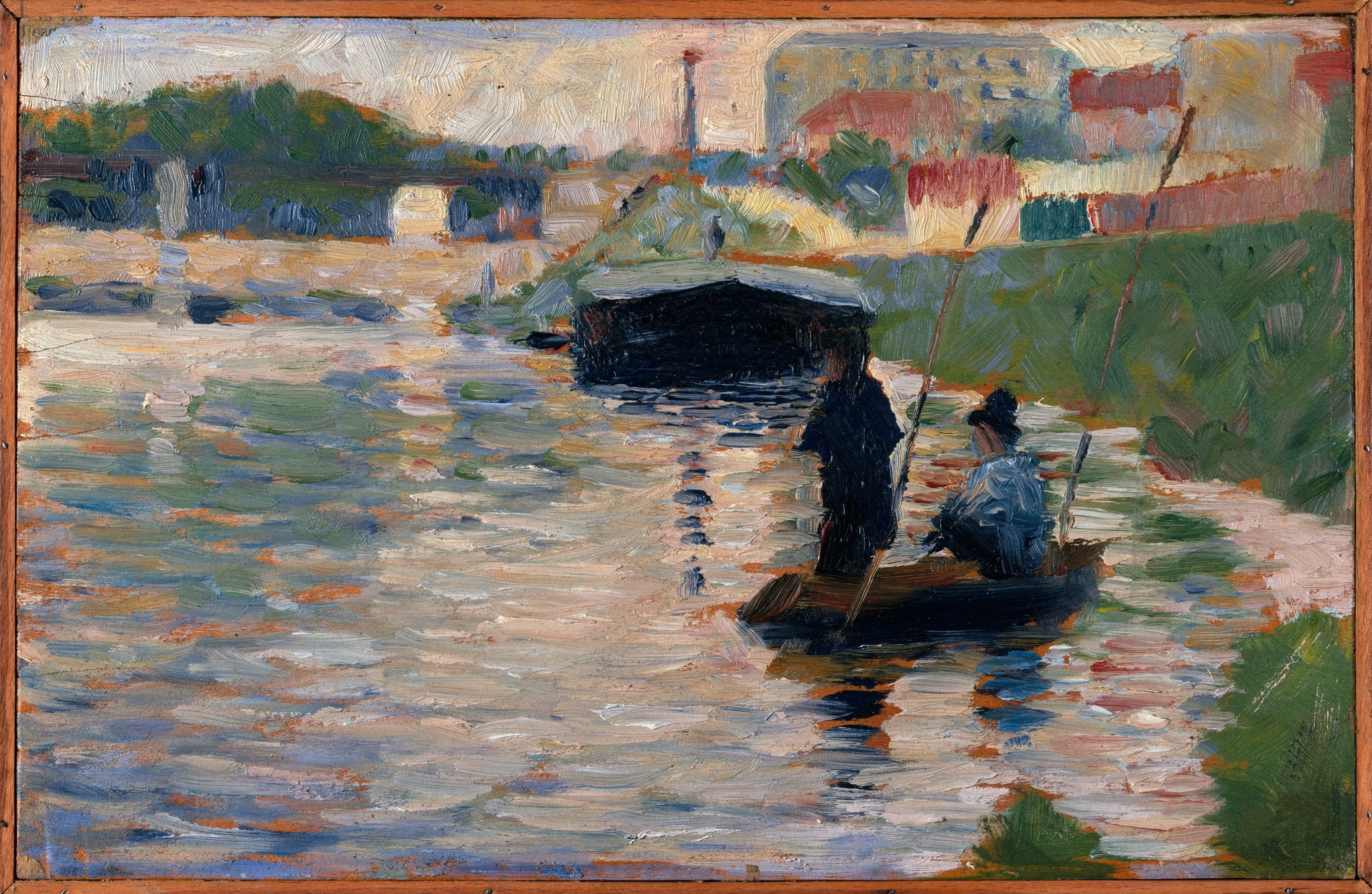
View of the Seine is Seurat’s small oil sketch on a wood panel, painted in 1882–83 by the river on the outskirts of Paris. The original measures 24.8 x 15.9 centimetres and is held in New York by The Metropolitan Museum of Art under object number 59.16.5, where it hangs in Gallery 825. From us it is painted entirely by hand, oil on canvas, in eight sizes or to your own measurements, and before dispatch you receive a photograph of the finished work for approval.
| Title: | View of the Seine |
| Other titles: | View of the Seine – the title the museum itself uses |
| Painter: | Georges Seurat (Paris 1859–1891) |
| Year painted: | 1882–83 |
| Original size: | 24.8 cm x 15.9 cm |
| Original technique: | Oil on wood |
| Painting style: | Early open-air oil sketch (croqueton) – before the dots |
| Located at: | The Metropolitan Museum of Art, New York (object no. 59.16.5, on view in Gallery 825) |
| Our reproduction: | hand-painted oil on canvas, 8 sizes from 25 x 16 cm to 150 x 100 cm, custom size on request |
View of the Seine – Georges Seurat
What is on the canvas?
The river, two anglers, and traffic behind them. The museum is explicit about it: two men in the foreground are casting their lines, and around them are commercial barges and industrial smokestacks. This is not a river for outings but a working one — the Seine on the outskirts of Paris, as it was.
A canvas painting of this kind tells no story. The scene stands as it offered itself: the anglers in front, the freight behind, the smoke over all of it. It is exactly that quiet, unemphatic look that makes the small panel feel surprisingly modern.
Croqueton: one of about seventy panels
The museum gives the number: at the beginning of his career Seurat made about seventy oil studies on small wood panels, which he called croquetons — little sketches. The durable boards were easy to carry and to hold in the hand, which made them ideal for painting outdoors.
This one is among the earliest that Seurat made along the Seine. One more such panel is in our Seurat gallery: The Stone Breaker from the National Gallery of Art in Washington, just as small and just as much painted in front of the motif. Anyone who wants to see what grew out of these exercises should look at the pointillism of the later canvases; it was still years away here.
A working river on the edge of Paris
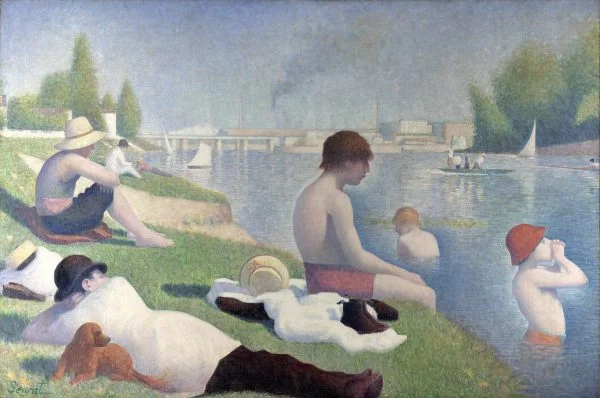
The museum ties this scene to the work that grew out of it: Seurat’s first major painting, Bathers at Asnières of 1884, held by the National Gallery in London, is set along a similar stretch of the same river. The same water, a few kilometres and two years apart.
In our Seurat gallery the same river carries two more works: The Seine at Courbevoie, which we sell with no year and no size because it is in a private collection, and Gray Weather, Grande Jatte, also held by the Metropolitan Museum. Neo-impressionism began at this water and not in a studio.
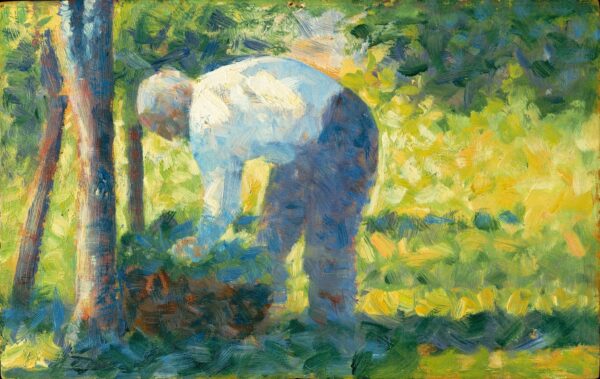
The same museum holds twenty-five works by Seurat, and several of them are small wood panels like this one. One of those is in our Seurat gallery as well: The Gardener, also painted on wood and also from these years. Put the two side by side and you see how quickly this way of working settled, and how little the painter needed to get a scene onto a board.
Wood, not canvas — and what that means for our version
The original is painted on a wood panel, not on canvas. For the painter that meant a smooth, hard ground that takes the colour at once and does not give under the brush; on wood a stroke ends where you set it down.
Our version is painted in oil on a canvas, and we do not blur that. What we carry across is the stroke and the colour; we do not imitate the ground, because canvas and wood do not behave alike and we will not promise that they do. At the small sizes the difference is least; at the large ones the canvas makes itself felt — which is exactly why this is here and not in the small print.
Why is the year a span?
Because the museum itself does not give a single year. Its own record reads 1882–83, a span, and that is how we give it. Nowhere on this page is one year of making written down as a fact, because the institution that holds the work has not written it that way.
The museum also records that the work came to it as the bequest of Mabel Choate, in memory of her father Joseph Hodges Choate. We do not print the year of that bequest, because two of the museum’s own fields for it differ by a year; where the institution is not agreed with itself, we would rather stop than pick one of its two numbers.
How is our hand-painted version made?
By hand and with a brush, never with a printer. Our painter works in oil colours on canvas, and with this subject the hardest thing is to keep the speed: the sketch has to stay a sketch and must not become a finished scene. Smooth the strokes out and the very thing that makes the work interesting disappears. That is why every hand-painted copy is one of a kind and no two are quite alike.
For this subject we have no studio photographs of our own yet. When we next paint it, we will photograph it, and the photographs will appear on this page. What holds meanwhile holds for every oil painting reproduction we make: before dispatch you receive a photograph of the very canvas painted for you, and it leaves only once you have approved it.
Which size for which wall?
The original measures 24.8 x 15.9 centimetres, width first and then height, the way we give measurements everywhere. It really is a small panel — one that fits in the hand.
Our smallest rung, 25 x 16 cm, is exactly the original rounded to whole centimetres; the museum gives the measurement itself, independently of our ladder, which is why we can say so. If you want the work at the size it was made, that is the size to choose. For a shelf or a table, 25 x 16 cm; for a living room, 50 x 30 and 60 x 40 cm; 70 x 45 and 80 x 50 cm stand on their own; 90 x 60, 120 x 75 and 150 x 100 cm turn a pocket sketch into a large work, which a broad stroke carries without difficulty.
Custom size, stretcher and frame
If none of the eight sizes fits your wall, we paint to your measurements and keep the ratio of the original, so the scene is never stretched; that is our custom size painting. You can order the painting in three forms: as a rolled canvas without a stretcher, stretched on a wooden stretcher and ready to hang, or framed; you choose the form when you order.
You choose the frame in our 3D frame viewer. At the smallest sizes the frame counts for more than at the large ones: at 25 x 16 cm a wide frame swallows the scene and a narrow one gathers it. Our separate room-placement service shows how it will look on your own wall.
Delivery and guarantee
Every copy is made to order in our studio in Slovenia, so allow 15 to 45 days depending on size. We ship it in the form you chose when ordering — rolled, stretched or framed — protected, across the EU, customs-free. You approve a photograph first, and our returns policy applies. The full range by this painter is in the Georges Seurat gallery, and his work is described in our article on Georges Seurat. A fine art reproduction of a famous painting is always made here the same way.
Frequently asked questions
Where is the original?
In New York, at The Metropolitan Museum of Art, object number 59.16.5. The museum records that it is on view in Gallery 825.
What year is it from?
The museum gives 1882–83 – a span and not a single year, so that is how we give it.
How big is the original?
The museum gives 15.9 x 24.8 centimetres by height and width, which in our width-by-height notation is 24.8 x 15.9 cm.
What is a croqueton?
A small oil sketch on a wood panel. The museum says Seurat made about seventy of them at the beginning of his career and called them that himself.
Who are the two figures in front?
Anglers. The museum says they are casting their lines while commercial barges pass behind them.
Is this painted in dots?
No. The work is from 1882–83, some years before the method of fine dots; this is an early sketch made outdoors.
Why is our version not on wood?
Because we work in oil colours on canvas. We carry the stroke and the colour across; the ground we do not imitate.
Which size should I choose?
For a living room, 60 x 40 cm. If you want the size of the original, choose 25 x 16 cm.
Can I have a size that is not on the list?
Yes. We paint to measure and keep the ratio of the sides of the original.
Is this a print?
No. The work is painted by hand in oil colours; the strokes can be seen and felt, which a print cannot imitate.
Is it suitable as a gift?
Yes. Small sizes read as personal and the subject is quiet. To leave the choice to the recipient, there is a gift voucher.
- Subject: two anglers on the Seine at the edge of Paris, barges and chimneys behind them
- Original: 24.8 x 15.9 cm, oil on a wood panel, The Metropolitan Museum of Art (59.16.5)
- Our version: a hand-painted canvas, eight sizes from 25 x 16 to 150 x 100 cm
- Important: this French painter made about seventy such panels – this is among the first by the river