

Description
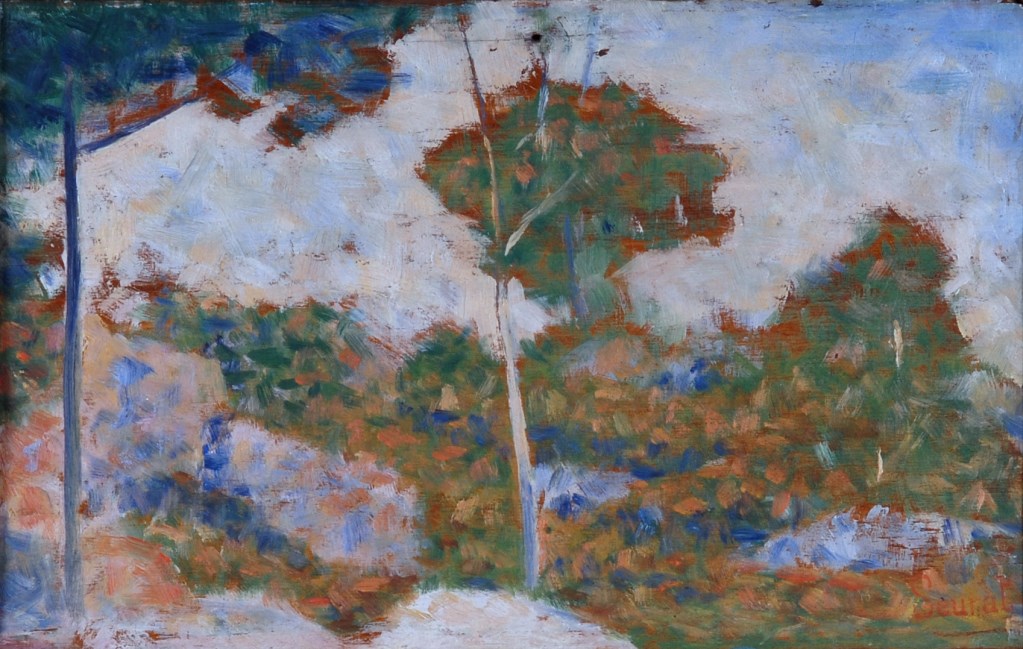
Forest at Barbizon in Autumn is a small oil painting by Georges Seurat on a wooden panel, dated 1881–1882: autumn undergrowth spreads out between thin trunks beneath a pale sky, all set down in quick, loose strokes. The original, 25 x 15.7 cm, is held by the Musée d’art et d’histoire in Neuchâtel under number AP 1648. We make it as a canvas painting, hand-painted in oils, in five sizes or to your own measurements, and before dispatch you receive a photograph of the finished work for approval.
| Title: | Forest at Barbizon in Autumn |
| Other titles: | »Forêt de Barbizon à l’automne – Paysage« |
| Painter: | Georges Seurat (1859–1891) |
| Year painted: | 1881–1882 |
| Original size: | 25 cm x 15.7 cm |
| Original technique: | Oil on wooden panel |
| Painting style: | Oil sketch – quick, loose strokes |
| Located at: | Musée d’art et d’histoire de Neuchâtel, Neuchâtel (inv. no. AP 1648) |
| Our reproduction: | hand-painted oil on canvas, 5 sizes from 25 x 16 cm to 80 x 50 cm, custom size on request |
Forest at Barbizon in Autumn – Georges Seurat
What does the painting show?
A corner of woodland with nobody in it. On the left a thin dark trunk rises from the bottom edge almost to the top, and from it a branch of dark foliage reaches into the upper left corner. In the centre grows a still slimmer, pale trunk carrying a rounded crown of green and rust-coloured leaves. On the right rises a second, lower mass of trees. The lower part of the painting is filled with dense undergrowth in which green, rust and bluish strokes weave together; on the left there is a lighter, pinkish slope, and at the bottom centre a pale patch that reads as a forest path or an opening between the bushes. Above it all stretches a pale, whitish sky with patches of blue. The title under which the museum lists the work gives both the place and the season: the forest at Barbizon in autumn.
What is on the panel?
A horizontal wooden panel, 25 cm wide and 15.7 cm high and, according to the museum record, only 0.3 cm thick; framed, it measures 42.5 x 33.5 cm. The paint went on fast, in broad, loose strokes that cross in different directions, and no form is drawn to the end. The foliage is built from short patches, the sky from longer horizontal sweeps of light colour, and the trunks are just a few narrow lines. The whole reads as an oil sketch, not as a finished painting. Anyone who expects pointillism with tiny, even dots from Seurat will not find it here: the strokes are larger, of varying length and freely placed. The photograph in this listing shows the subject and the composition; it does not guarantee the exact tones of the original.
Why does this painting matter?
Because it is direct. A panel this small leaves no room for embellishment: the French painter Georges Seurat set down trees, undergrowth and the light of an autumn day in a handful of strokes, and that speed is exactly its value. The museum record dates it to 1881–1882. It also matters for the history the museum publishes: the panel stayed in the painter’s studio, was entered under number 5 in the posthumous inventory and later belonged to the collection of Félix Fénéon. For a buyer it is a small, lively autumn scene in which you can watch a painter build a landscape out of strokes alone.
What does the painting mean?
The quiet of the woods. There is no story and there are no people, only trunks, leaves and light. The slender trunks divide the scene into vertical bands, and the undergrowth closes it at the bottom in a dense, warm mass. Autumn is named in the title, and in the painting it is hinted at by the rusty tones of the leaves among the green. The eye comes to rest on the pale patch at the bottom centre and from there travels up the light trunk to the crown and the sky. At home it feels calm and natural; its earthy tones sit well with wood, stone, linen and plants.
What happened to the original?
The museum publishes the panel’s history. Until 1891 it was in Seurat’s studio, listed as number 5 in the posthumous inventory. For 1908 the record gives Mme J. D. After 1908 it was in collection P.; here the museum names Camille Platteel (1854–1943) with a question mark. Next it belonged to Félix Fénéon (1861–1944), who acquired it on an unknown date. At the sale of Fénéon’s collection at the Hôtel Drouot auction house in Paris on 4 December 1941 it was offered under number 77 and sold to Amez-Droz. From 1941 to 1976 it was in the collection of Yvan Amez-Droz. Since 1979 it has been held by the Musée d’art et d’histoire in Neuchâtel, which received it as a bequest from Yvan and Hélène Amez-Droz. All details are taken from the museum record.
What place does it have among Seurat’s works?
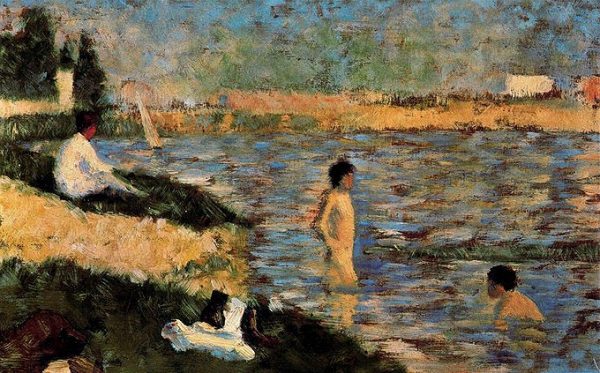
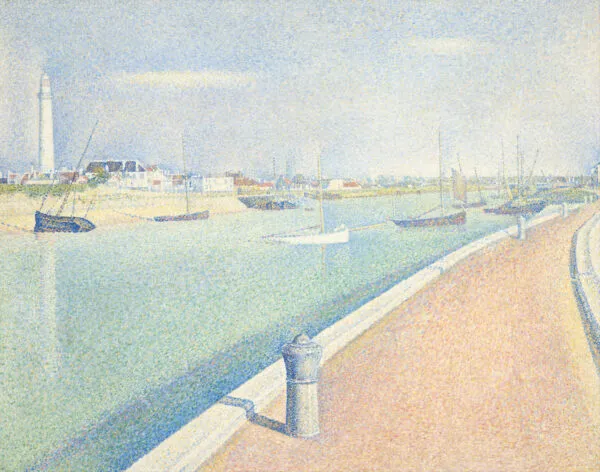
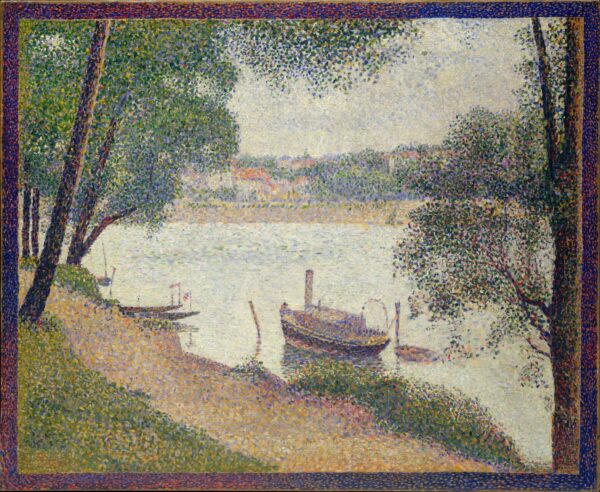
Forest at Barbizon in Autumn is one of several Seurat landscapes we offer with a forest or Barbizon in the title. Barbizon also appears in the title of Path in the Forest, Barbizon, held by the Musée d’Orsay in Paris, and in that of Figure in a Landscape at Barbizon, from the Wallraf-Richartz-Museum in Cologne. The forest is the subject, too, of In the Woods at Pontaubert, held by The Metropolitan Museum of Art in New York. Each of these works is in a different museum; with us you can hang them side by side.
How is our hand-painted version made?
With a brush and oil paint; no machine is involved at any stage. Our painter works from an image of the original and keeps what makes this panel alive: quick, loose strokes that suggest forms rather than draw them. A pointillist technique would be the wrong choice here, because the original has no dots; smoothing it into a precisely drawn landscape would be just as wrong. The original is painted on wood, ours on canvas, which you can order rolled, stretched over a stretcher bar or framed. Because everything is done by hand, no two canvases are ever exactly alike, and every hand-painted copy remains one of a kind. We do not yet have photographs of our own of a finished canvas of this subject; the first time we paint it, we will photograph it and publish the photographs here.
Which size for which wall?
If you are not sure which to choose, take 60 x 40 cm. The size closest to the original is 25 x 16 cm: the original measures 25 x 15.7 cm, so ours is exactly as wide and 0.3 cm taller. The format is horizontal, with proportions close to 8 : 5, so it fits well on a shelf, above a narrow chest of drawers or in a group of smaller works. If you want the painting to hold a wall on its own, choose a larger size: 50 x 30 and 60 x 40 cm suit a hallway or bedroom, while 70 x 45 and 80 x 50 cm stand on their own above a desk, a chest of drawers or a bed. In the larger sizes the quick strokes of the sketch grow and become even more visible. Every oil painting reproduction of this subject is made to order.
Custom size, stretcher bar and frame
If none of the five sizes suits your wall, we paint to your measurements, up to 80 x 50 cm, and keep the proportions of the original, so that the trunks, the undergrowth and the sky stay in balance; that is our custom size painting service. You can order the painting in three forms: as a rolled canvas without a stretcher, stretched on a wooden stretcher bar and ready to hang, or framed; you choose the form when you order. You choose a frame in our 3D app, which shows gold, silver, black, white and wooden profiles on this subject; the app is for choosing the frame only. To see the painting on your own wall, there is our separate room-visualisation service.
Delivery and guarantee
Each canvas is painted to order in our studio in Slovenia, so allow 15 to 45 days depending on the size. We send it in the form you chose when ordering — rolled, stretched or framed — protected for transport, within Slovenia and across the EU with no customs duty. Before dispatch you receive a photograph of the finished work for approval, and our returns policy applies to every order. You will find all of Seurat’s subjects in the Georges Seurat gallery, and our article about Georges Seurat explains when a fine art reproduction of a famous painting is truly good.
Frequently asked questions
Where is the original?
In the Musée d’art et d’histoire in Neuchâtel, under number AP 1648. The museum has held it since 1979 as a bequest from Yvan and Hélène Amez-Droz.
Are there people in the painting?
No. The panel shows only trees, undergrowth, a pale patch on the ground and the sky.
Is »Forêt de Barbizon à l’automne« the same work?
Yes. That is the French title under which the museum lists the work, with the addition »Paysage« (landscape); Forest at Barbizon in Autumn is our English title for the same panel.
Is this a print?
No. It is hand-painted oil on canvas; the brushstrokes are visible and you can feel them.
Which size should I choose?
25 x 16 cm, the size closest to the original; for a larger wall, 60 x 40 cm. The detailed guide is above.
Can I have a size that is not on the list?
Yes. We paint to measure and keep the side ratio of the original.
Is this neo-impressionism?
The museum record does not assign the painting to any movement, so neither do we. What you can see is a surface built from broad, free strokes, not from dots.
Is your version on wood as well?
No. The original is on a wooden panel; ours is painted on canvas, and you can order it as a rolled canvas without a stretcher, stretched on a wooden stretcher bar or framed.
Is the original for sale?
No. The panel is part of the museum’s collection and is not for sale. What we offer is a version painted by hand after it.
How high should I hang it?
With its centre at eye level, about 145–150 cm from the floor; hang the smaller sizes lower, nearer to where you sit.
Is it a good gift?
Yes, especially for someone who loves woods and autumn. If you would rather leave the choice to the recipient, there is our gift voucher.
- Subject: trees and autumn undergrowth in the forest at Barbizon, with a pale sky above – 1881–1882
- Original: 25 x 15.7 cm, oil paint on a wooden panel, Musée d’art et d’histoire de Neuchâtel, Neuchâtel (inv. no. AP 1648)
- Ours: hand-painted, five sizes from 25 x 16 to 80 x 50 cm, as a rolled canvas, stretched or framed — your choice
- Worth knowing: until 1891 it was in Seurat’s studio, number 5 in the posthumous inventory, and later in the collection of Félix Fénéon