




Description
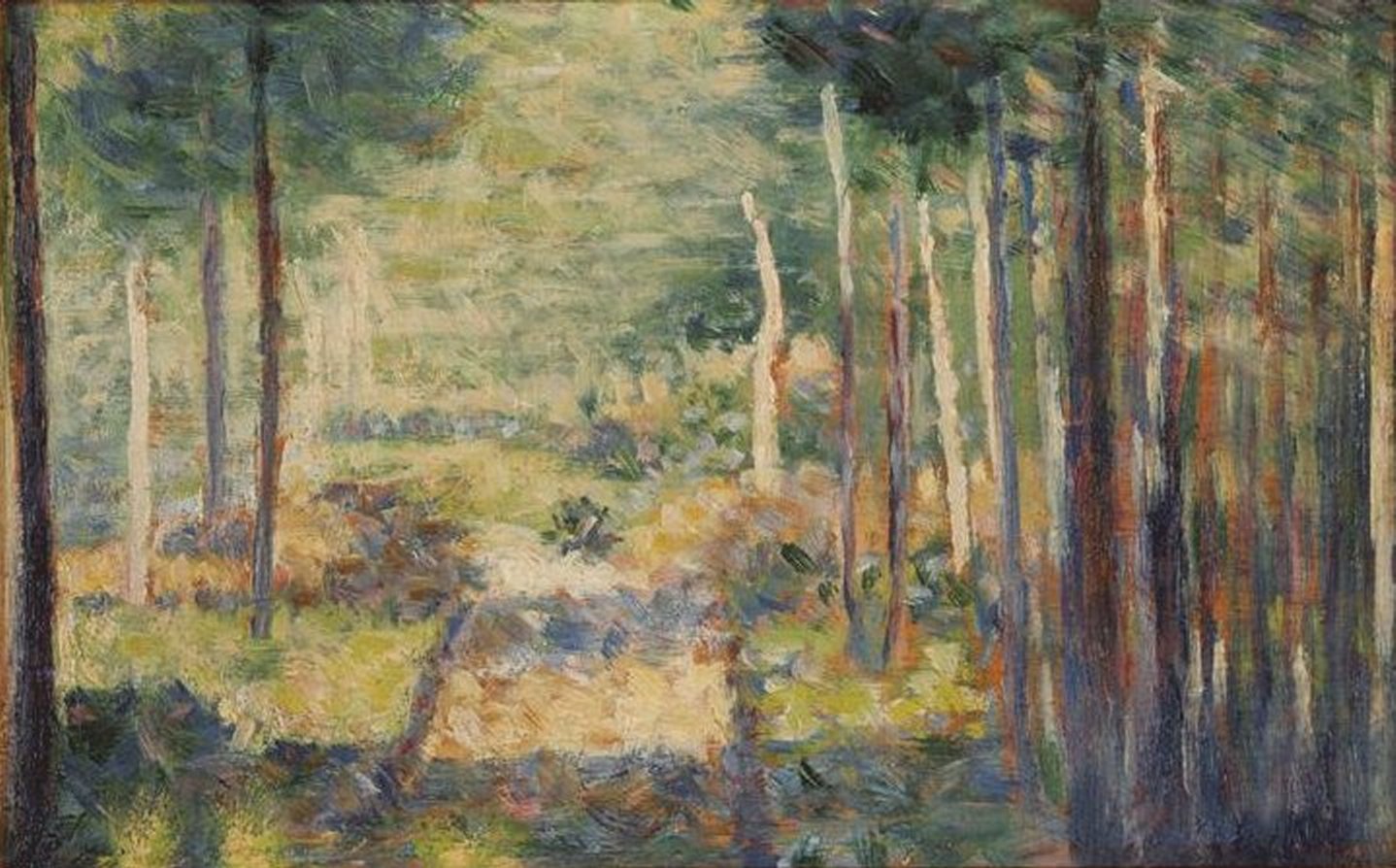
Path in the Forest, Barbizon is a small oil painting on wood by Seurat from 1883: between tall, slender trunks a path leads from the shaded foreground to a sunny clearing, and above it the treetops dissolve into green and yellow light. The original, 25.5 x 16.3 cm, is held by the Musée d’Orsay in Paris under inventory number RF 2000 22. We make it as a fine art reproduction, hand-painted in oils on canvas, in six sizes or to measure, and you approve a photograph of the finished work before dispatch.
| Title: | Path in the Forest, Barbizon |
| Other titles: | »Allée en forêt, Barbizon« |
| Painter: | Georges Seurat (1859–1891) |
| Year painted: | 1883 |
| Original size: | 25.5 cm x 16.3 cm |
| Original technique: | Oil on wood |
| Painting style: | Forest landscape – short, criss-crossing brushstrokes |
| Located at: | Musée d’Orsay, Paris (inv. no. RF 2000 22) |
| Our reproduction: | hand-painted in oils on canvas, 6 sizes from 25 x 16 cm to 90 x 60 cm, custom sizes on request |
Path in the Forest, Barbizon – Georges Seurat
Who is in the painting?
Nobody. It is a landscape without people or animals: woodland, trees and a path into the distance. The museum record, too, gives only the keywords landscape, forest path, forest and tree. Light plays the leading role. The path rises from the bottom edge to the middle, where a bright, almost white clearing opens, drawing our gaze in as if through a doorway. Tall, slender trunks stand to the left and right, some dark, others pale as if lit by the sun. The figure we might expect on a forest path never appears; the silent scene is left entirely to the viewer.
What is on the panel?
A horizontal wooden panel, 25.5 cm wide and 16.3 cm high, painted almost to the edges. The lower part lies in shade: blue, violet and dark green strokes cover the ground, crossed by slanting dark lines like the shadows of trunks. In the middle the ground lightens into cream, yellow and ochre, and left of the path orange and brownish bushes glow in the sun. On the right the trunks crowd into an almost unbroken wall of reddish-brown, blue and violet verticals; at the left edge a single dark trunk closes the scene. Several pale, almost white trunks stand in the middle band, some cut off low down. Above, the treetops melt into a soft green and yellow haze pierced by light. The strokes are short, often cross one another and in places run diagonally.
Why does this painting matter?
Because it shows how little a strong scene needs. The French painter Georges Seurat, who was born in Paris in 1859 and died there in 1891, caught a whole forest’s light on a piece of wood no bigger than a book. There are none of the even dots people associate with the word pointillism; the strokes are elongated, restless and laid one over another, and yet the colour mixes into sunlight in the eye. Its exhibitions show how highly the panel is valued: a show on French landscape at the Wildenstein gallery in New York in 1975, the Seurat exhibition in the Galeries nationales du Grand Palais in Paris in 1991 and then at the Metropolitan Museum of Art in New York in 1991–1992, an exhibition on the forest of Fontainebleau at the Musée d’Orsay in 2007, and an exhibition at the MUba Eugène Leroy in Tourcoing in 2024.
What does the painting mean?
A walk in the woods, stopped at the moment light appears between the trees. There is no story, and none to look for: the title says only that this is a forest path and the place is Barbizon. Labels such as neo-impressionism are not needed here either; the museum record simply calls it a painting, a landscape with trees and a path. That is why it feels so direct. The cool shade in front and the warm clearing beyond create a depth that visually opens up the wall. At home it brings calm, greenery and sunlight, welcome in a study, a bedroom or a reading corner.
What happened to the original?
The Musée d’Orsay publishes the panel’s history; we summarise its stages in the record’s order. First, it was listed in the inventory drawn up after the painter’s death as panel no. 68. It was then in the collection of Mrs Chevalot, the sister of the painter’s father, and passed by inheritance to Clémentine Masson, then to Jeanne Gerbier, Marguerite Richard and Mr Richard. On 24 November 1988 it was sold at public auction in Paris, at Drouot Montaigne, as lot 37. Until 2007 it was in the collection of Philippe Meyer. In 2000 the state accepted it as his gift subject to a usufruct (committee 22 June 2000, council 28 June 2000, decree 21 September 2000) and in the same year allocated it to the Musée d’Orsay, entering it in the Louvre’s inventory of paintings. In 2007 Philippe Meyer gave up the usufruct, and the painting has been in the museum since. According to the museum record, it hangs on the middle level, in room 67.
What place does this painting have among Seurat’s works?
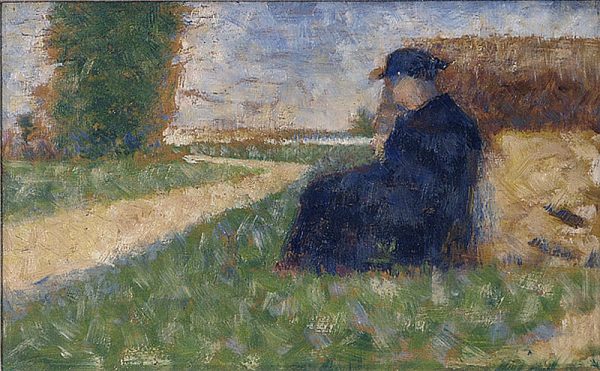
It belongs to a group of forest and country scenes we offer from various museums. Closest to it is Figure in a Landscape at Barbizon, a tiny oil study on a wooden panel held in Cologne by the Wallraf-Richartz-Museum & Fondation Corboud. The forest is also the subject of In the Woods at Pontaubert, held by the Metropolitan Museum of Art in New York; that is a much larger canvas, from 1881. From 1883, the same year as our panel, comes Peasant Woman Seated in the Grass (Paysanne assise dans l’herbe), now in New York. Together they show how Seurat observed grass, trees and light.
How is our hand-painted version made?
With a brush and oil paint, never with a printer. Our painter works from a high-resolution photograph of the original and keeps what makes this panel special: the short, criss-crossing strokes, the pale trunks and the bright clearing in the middle of the shade. A pointillist technique of even dots would be wrong here, turning a lively forest scene into a different, tidier work. Because it is all done by hand, no two canvases are ever identical, and every hand-painted copy is one of a kind. We have no photographs yet of our own finished canvas of this subject; when we paint it for the first time, we will photograph it and publish the photographs here.
Which size suits which wall?
If you are not sure which to choose, take 60 x 40 cm. Our smallest size, 25 x 16 cm, is 0.5 cm narrower and 0.3 cm shorter than the 25.5 x 16.3 cm original, so it is the closest to its size in our range. The horizontal format, close to 8 : 5, sits well above a narrow chest of drawers or a bed, or in a group of smaller works. 50 x 30 and 60 x 40 cm suit a hallway or bedroom; 70 x 45 and 80 x 50 cm hold their own above a desk, and 90 x 60 cm is the size for a living room, where the forest path becomes a real window onto greenery. Every canvas painting of this subject is made to order.
Custom size, stretcher bar and frame
If none of the six sizes suits your wall, we paint to your measurements, up to 90 x 60 cm, and keep the original’s proportions, so the path, trunks and clearing stay in balance; that is our custom size painting service. You can order the painting in three forms: as a rolled canvas without a stretcher, stretched on a wooden stretcher bar and ready to hang, or framed; you choose the form when you order. In the museum, the original sits in a frame that measures 40.6 x 31.7 cm overall. You choose the frame for our painting in our 3D app, which shows gold, silver, black, white and wooden profiles on this subject; the app is for the frame only. To see the painting on your own wall, we offer a separate room-visualisation service.
Delivery and guarantee
Each copy is painted in our studio in Slovenia, so allow 15 to 45 days depending on size. We ship it in the form you chose when ordering — rolled, stretched or framed — packed for transport, within Slovenia and across the EU without customs duty. Before dispatch you approve a photograph of the finished work, and every order is covered by our returns policy. You will find all of Seurat’s subjects in the Georges Seurat gallery, and our article about Georges Seurat also explains what a good reproduction of a famous painting looks like.
Frequently asked questions
Where is the original?
At the Musée d’Orsay in Paris, under inventory number RF 2000 22.
Are there any people in the picture?
No. The panel shows only the forest, the trunks and the path leading towards the sunny clearing.
What year is the original from?
The museum record gives 1883.
Is this a print?
No. Our painting is painted by hand, in oil on canvas; the brushstrokes are visible and can be felt.
Which size should I choose?
For a hallway or bedroom, 60 x 40 cm; for the size closest to the original, 25 x 16 cm. The detailed guide is above.
Can I have a size that is not on the list?
Yes. We paint to measure, up to 90 x 60 cm, and keep the side ratio of the original.
What is the original painted on?
On wood. The museum describes it as oil on wood, whereas our version is painted on canvas.
How did the painting reach the museum?
Philippe Meyer gave it to the state in 2000 subject to a usufruct; in 2007 he gave that up, and the panel has been in the museum since.
Is the original for sale?
No. The panel is in the public collection of a Paris museum and is not for sale, but our hand-painted version of it can hang in your home.
How high should I hang it?
With its centre at eye level, about 145–150 cm from the floor. Hang the smaller sizes lower, closer to where you sit.
Is it suitable as a gift?
Yes, a quiet forest path in sunlight pleases almost anyone. If you would rather leave the choice to the person receiving it, there is our gift voucher.
- Subject: a forest path between tall trunks, leading out of shade towards a sunny clearing – 1883
- Original: 25.5 x 16.3 cm, oil paint on wood, Musée d’Orsay, Paris (inv. no. RF 2000 22)
- Ours: hand-painted oil painting reproduction on canvas, six sizes from 25 x 16 to 90 x 60 cm, as a rolled canvas, stretched on a stretcher bar or framed — your choice
- Worth knowing: in the inventory drawn up after the painter’s death it was listed as panel no. 68