


Description
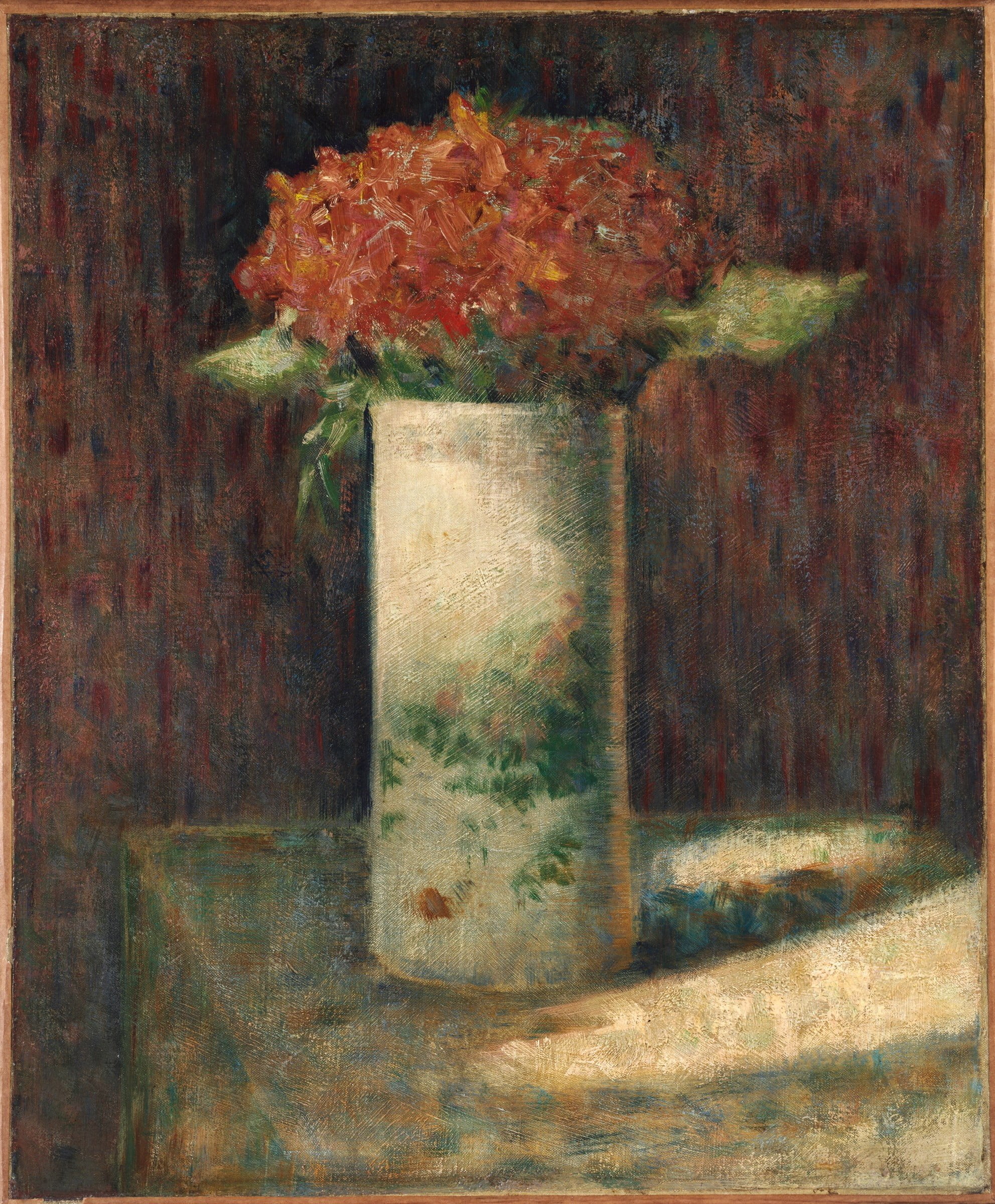
Vase of Flowers is the only still life Georges Seurat is known to have painted: a dense bunch in a plain vase, made around 1879 to 1881, when the painter was barely twenty. The original measures 38.5 x 46.3 centimetres and is held in Cambridge by the Harvard Art Museums under inventory number 1974.100. From us it is painted entirely by hand, oil on canvas, in eight sizes or to your own measurements, and before dispatch you receive a photograph of the finished work for approval.
| Title: | Vase of Flowers |
| Other titles: | Vase of Flowers · Vase de fleurs |
| Painter: | Georges Seurat (1859–1891) |
| Year painted: | circa 1879–circa 1881 |
| Original size: | 38.5 cm x 46.3 cm |
| Original technique: | Oil on canvas |
| Painting style: | Early period, before Pointillism |
| Located at: | Harvard Art Museums – Fogg Museum, Cambridge (USA) (inv. no. 1974.100) |
| Our reproduction: | hand-painted oil on canvas, 8 sizes from 38 x 45 cm to 120 x 140 cm, custom size on request |
Vase of Flowers – Georges Seurat
What is in the painting?
A bunch of flowers in a vase and nothing else. No figure, no scene, no background that explains anything — only the flowers, filling almost the whole height of the canvas, and a dark plane behind them. The museum describes that background as dappled strokes of browns with colour between them. Red dominates; the museum records that in its subject and its predominant use of red pigments the work aligns with French academic trends of the 1870s, and particularly with an interest in flower painting and with the late work of the romantic painter Eugène Delacroix. This French painter was at the very start of his career.
Why is this work unusual?
Because it is the only one of its kind. The museum calls it the only still life Seurat is known to have painted, and at the same time a rare surviving example of his early work — most of those canvases are believed to have been destroyed by the artist himself. What hangs in Cambridge is therefore a double exception: the only subject of its type in the whole body of work, and one of the few survivors from years he later rejected. A canvas painting that outlasted both chance and its author’s severity carries a value none of the large compositions has.
Where can you already see the later Seurat?
In the background, not in the flowers. The museum points out that several aspects of the work hint at the development of the painter’s signature style, pointillism, in which he juxtaposed small dabs of contrasting pure colours — and names the vertical strokes of repeated colour covering the background. The flowers are still painted the old way, dense and modelled; the plane behind them is already assembled from repeated units. Anyone who knows the late dots sees them here in embryo, two decades before the Grande Jatte.
What does the work mean?
Less than the large canvases, and that is exactly its appeal. A still life narrates nothing: it is an exercise in colour, weight and density, made so the painter could learn something he would use elsewhere. The red is warm and almost stifling, the background cool and restless; the tension between the two carries the whole picture. On a wall it works as a small, dense body of colour — a subject that asks for no explanation and can be looked at as pure painting.
What happened to the original?
The museum publishes the whole route, and it stays in the family longer than is usual with Seurat. The canvas was first with the painter himself, from about 1878; then his brother-in-law Léon Appert held it until 1925, then Appert’s daughter Mme Léon Roussel between 1925 and 1934, and after her, her son François Roussel, who sold it in 1939. The Galerie Bignou followed from 1939 to 1940, then Maurice Wertheim in New York from 1940 to 1951, who bequeathed it onward: in 1951 the work passed to the Fogg Art Museum. The museum itself notes that it was not in the possession of the Fogg until 1974 — which is where the inventory number 1974.100 comes from. That ownership history is the museum’s; we add nothing to it.
Where does it sit in Seurat’s work?
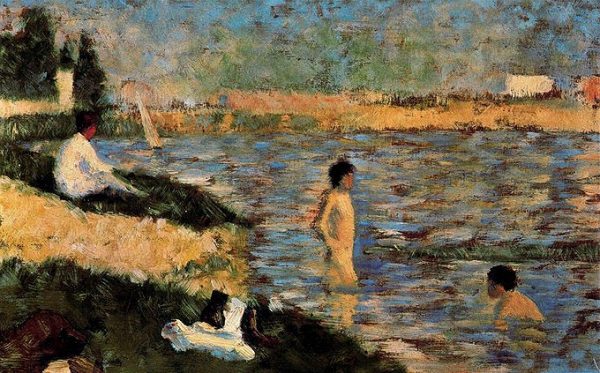
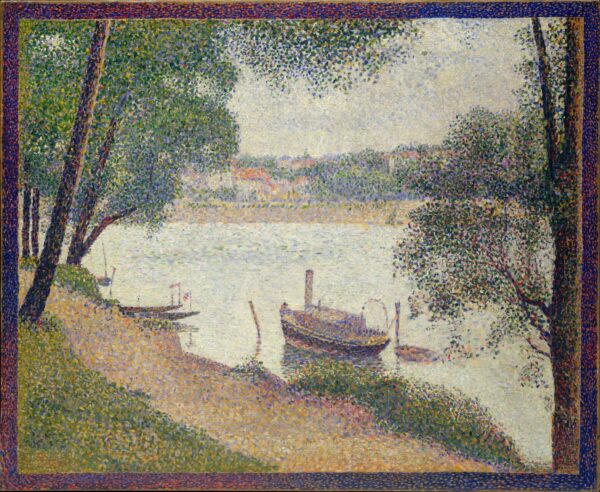
Before everything else. From the early years we also sell Figure in a Landscape at Barbizon and Peasant Woman Seated in the Grass, both studies of a person outdoors, and Bathers at Asnières, the first large canvas. The summit of that road is held by the Art Institute of Chicago, and here you will find it as Sunday Afternoon on the Island of La Grande Jatte. Vase of Flowers is the earliest of them all and the only one without a person in it. Neo-impressionism as a movement came only afterwards, long after this bunch of flowers.
How is our hand-painted version made?
By hand and with a brush, never with a printer. Our painter works in oil paint on linen and builds the surface the way it is built on the original: first the dark plane of the background with its vertical repeated strokes, then the flowers, grown dense and in layers. On this subject the red is the hard part — if it becomes too even, the bunch loses its depth. Every hand-painted copy is therefore one of a kind and no two are quite alike; this is not an oil painting reproduction printed onto canvas but a painting made from scratch. Before dispatch we photograph the piece and send you the photograph for approval.
We hold no studio photographs of the finished work for this subject at present. When it is next painted we will photograph it and the shots will appear on this page.
Which size for which wall?
If you do not know which: 60 x 70 cm. The original is small — 38.5 x 46.3 cm — and our smallest size, 38 x 45 cm, is practically one to one with it; it suits a shelf, a desk or a group of smaller works. The format is upright, close to a 5 : 6 ratio, so it sits well on a narrow wall or in an alcove: 50 x 60 and 60 x 70 cm are the everyday choice for a dining room or kitchen, 70 x 85 and 80 x 100 cm work as a standalone piece, and 90 x 110, 100 x 120 and 120 x 140 cm belong on large walls, where the bunch reaches a size it never actually had. Every fine art reproduction of this subject is made to order.
Custom size, stretcher bar and frame
If none of the eight sizes fits your wall, we paint the work to your measurements and keep the ratio of the original so the bunch is never stretched; that is our custom size painting service. You can order the painting in three forms: as a rolled canvas without a stretcher, stretched on a wooden stretcher bar and ready to hang, or framed; you choose the form when you order. You choose the frame in our 3D frame viewer: on this subject it shows every frame profile we carry, so you can compare gold, silver, black, white and natural wood — it is for choosing a frame and nothing else. To see how the work will look on your own wall, use our separate room-visualisation service.
Delivery and guarantee
Every copy is made to order in our studio in Slovenia, so allow 15 to 45 days depending on the size you choose. We ship it in the form you chose when ordering — rolled, stretched or framed — protected for transport, across the EU, customs-free. Before dispatch you receive a photograph of the finished work for approval, and our returns policy applies to every order. The full range by this painter is in the Georges Seurat gallery, and his path from the early works to broken colour is described in our article about Georges Seurat, which also explains what separates a good famous painting copy from a poor one.
Frequently asked questions
Where is the original?
In Cambridge in the United States, in the collection of the Harvard Art Museums (Fogg Museum), under inventory number 1974.100. The museum notes that it was not in the possession of the Fogg until 1974, although it was bequeathed in 1951.
What year is the painting from?
The museum dates it to about 1879 to about 1881. That is doubly loose — a “circa” and a span — so it is written that way here too, and we give no single year anywhere.
Is “Vase de fleurs” the same work?
Yes. That is the French form of the same title; in English it appears as “Vase of Flowers”. It is one and the same canvas.
Is this a print?
No. The work is painted by hand in oil on linen; the strokes are visible and can be felt, which a print cannot imitate.
Which size should I choose?
For a dining room or kitchen, 60 x 70 cm; if you want the size of the original, choose 38 x 45 cm. The full size guide is above.
Can I have a size that is not listed?
Yes. We paint to measure, keeping the side ratio of the original.
How is it delivered?
In the form you chose (rolled, stretched on a stretcher or framed), 15 to 45 days after you approve the photograph of the finished work.
What is the work about, in one sentence?
A dense red bunch against a restless ground: an exercise in colour out of which the whole method later grew.
Is it really Seurat’s only still life?
So the museum says: it is the only still life he is known to have painted, and at the same time a rare surviving example of his early work, since most of those canvases are believed to have been destroyed by the artist himself.
Is the original for sale and what is it worth?
No. The canvas is in the public collection of the Harvard Art Museums and is not for sale; a hand-painted canvas is the only way to have the subject at home.
Is it suitable as a gift?
Very. A flower subject is among the most rewarding gifts, and the smaller sizes fit almost any wall. If you would rather leave the choice to the person receiving it, there is a gift voucher.
- Subject: a dense bunch in a plain vase against a dark, dappled ground – the only still life Seurat is known to have painted
- Original: 38.5 x 46.3 cm, oil paint on canvas, Harvard Art Museums, Fogg Museum (1974.100)
- Ours: a hand-painted oil, eight sizes from 38 x 45 to 120 x 140 cm, as a rolled canvas, stretched or framed — your choice
- Worth knowing: the vertical repeated strokes in the background are the seed of the dots the painter later became known for