





Description
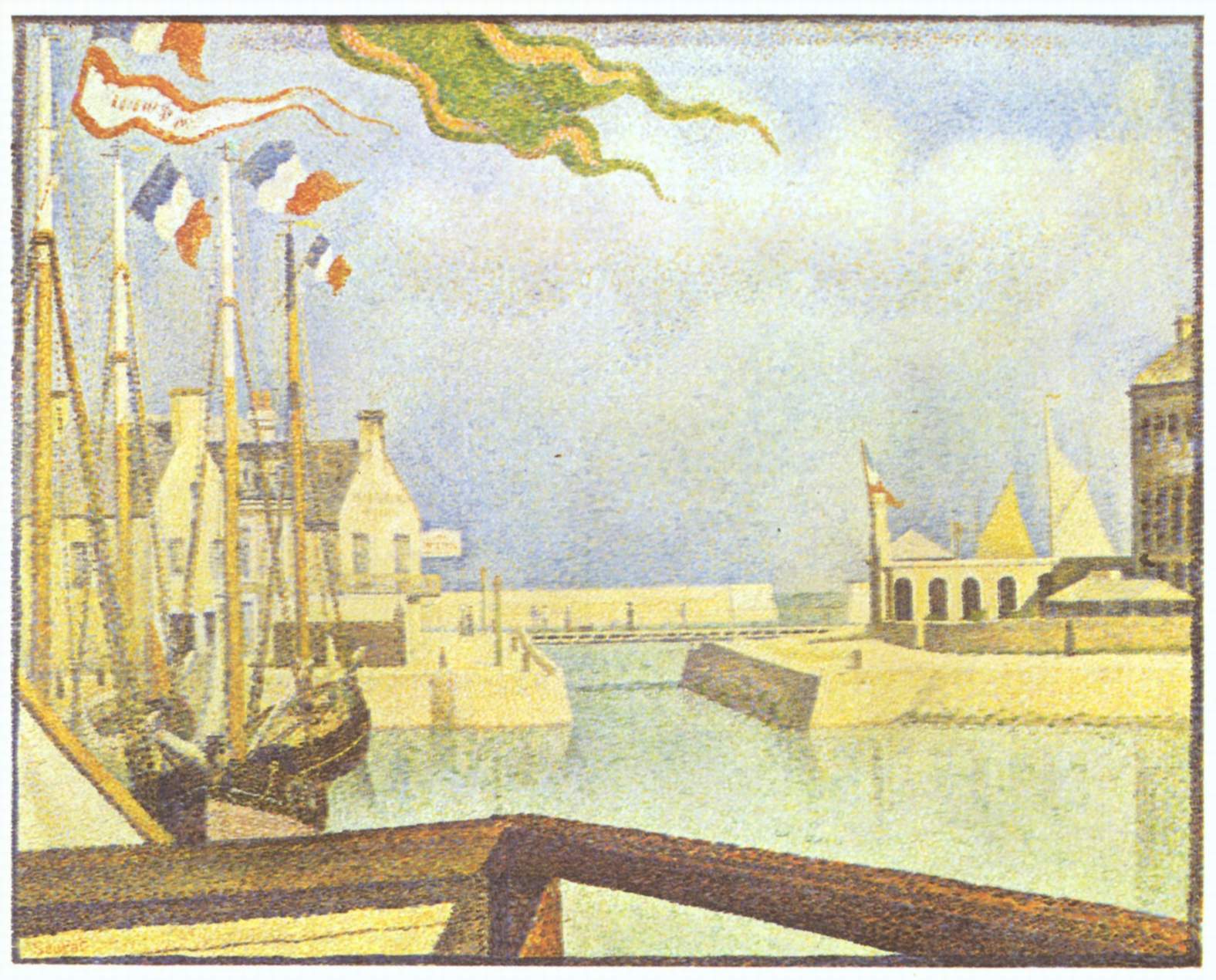
Port-en-Bessin, a Sunday is a painting by Georges Seurat from 1888: on the left, boats lie moored at a jetty with pennants and long streamers flying from their masts, in the centre the harbour channel opens towards a footbridge and a wall in the background, and in the foreground a dark railing cuts diagonally across the scene. The original, oil paint on canvas, measures 82 x 66 cm and is held by the Kröller-Müller Museum in Otterlo under number KM 106.269. We make it as a canvas painting, hand-painted in oils, in seven sizes or to your own measurements, and before dispatch you receive a photograph of the finished work for approval.
| Title: | Port-en-Bessin, a Sunday |
| Other titles: | »Port-en-Bessin, un dimanche«; Port-en-Bessin, a Sunday – the title the museum itself uses |
| Painter: | Georges Seurat (1859–1891) |
| Year painted: | 1888 |
| Original size: | 82 cm x 66 cm |
| Original technique: | Oil on canvas |
| Painting style: | Pointillism – painting with dots |
| Located at: | Kröller-Müller Museum, Otterlo (inv. no. KM 106.269) |
| Our reproduction: | hand-painted oil on canvas, 7 sizes from 46 x 38 cm to 120 x 100 cm, custom size on request |
Port-en-Bessin, a Sunday – Georges Seurat
What does the painting show?
A harbour in which everything is still. On the left, fishing boats with dark hulls are moored at the jetty, and their tall masts reach almost to the top edge. Small flags in three colours hang from the masts; at upper left a long white streamer with a red edge and an illegible inscription flutters, and across the top edge winds a broad green streamer with orange edges. Behind the boats stands a row of light-coloured houses with steep gables and chimneys, and beside them a small sign. In the centre, between two jetties, a channel of calm, bright water opens up and leads towards a thin footbridge and a long wall in the background. On the right stands a low building with a row of arched openings; above it are a pole with a flag and a few white triangular shapes that may be sails, and along the right edge rises a tall house with many windows. In the foreground a dark, angled railing cuts diagonally across the painting, as if the viewer were standing beside it. We cannot make out any people in our photograph of the original.
What is on the canvas?
A horizontal canvas on which everything, from the water to the sky, is built from small dots of pure colour laid side by side. This way of painting is known as pointillism: colours are mixed not on the palette but in the viewer’s eye. The large sky takes up almost half the painting and is light and cloudy, made of pale dots. The composition is held together by the verticals of the masts on the left, the horizontal lines of the jetties and the wall in the centre, and the dark diagonal of the railing below. Around the whole canvas runs a dark dotted border that Seurat painted himself; it is part of the work, not a wooden frame. The colours in our photograph of the original come from an older shot and have faded and yellowed, so here we describe subject and composition rather than exact shades.
Why does this painting matter?
Because it turns an entirely everyday scene into an ordered, almost solemn space. No detail stands out and everything is woven evenly into the fabric of dots, yet the flags and streamers at the top bring movement into an otherwise motionless scene. The French painter Georges Seurat paints not work in the harbour but a moment when the boats lie moored: the title tells us it is Sunday. The painted border closes the painting like a frame and is an integral part of it. The original is in the collection of the Kröller-Müller Museum in Otterlo. For a buyer it is a bright, peaceful harbour scene with plenty of sky and air.
What does the painting mean?
The museum record does not interpret the scene, so we read no more into it than the eye sees and the title says. We see a harbour on a Sunday: the boats are moored, the water in the channel is calm, flags hang from the masts. Looking across the railing, you feel as if you were standing on the shore and gazing towards the harbour mouth. The painting tells no story; it catches the quiet of a day off in a small town. At home it feels calm and bright, and the pale tones of sky and water go well with wood, linen, white walls and simple rooms.
What place does it have among Seurat’s works?
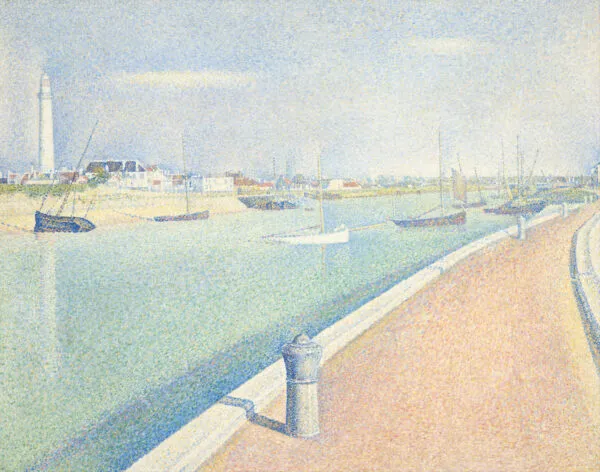
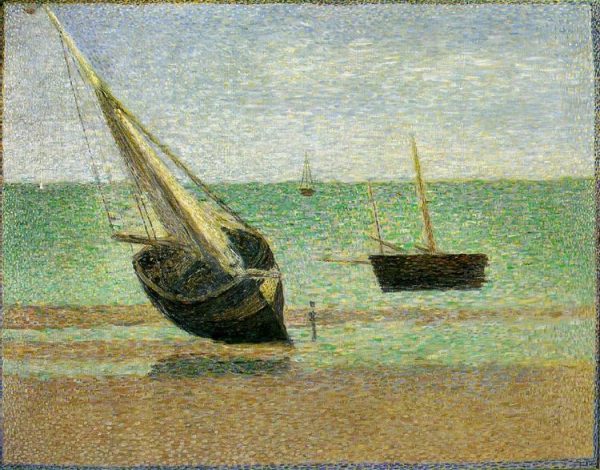
The museum dates the painting to 1888 and calls it »Port-en-Bessin, un dimanche«. From the town the titles name, we also offer Port-en-Bessin, Entrance to the Harbor, held by the Museum of Modern Art in New York, the coastal scene Seascape at Port-en-Bessin, Normandy, which is in the National Gallery of Art in Washington, and Port-en-Bessin, the Outer Harbor at Low Tide, from the Saint Louis Art Museum. If you would like several views of the same place on your wall, these canvases can hang together.
How is our hand-painted version made?
By brush and in oil paint, never by machine. Our painter works from an image of the original and sets down the dots one after another, so that, as with Seurat, the colours only mix in the eye. A pointillist technique takes patience: the sky, the water in the channel, the house walls and the flags are made of thousands of tiny touches. Our painting also includes Seurat’s painted dotted border around the edge of the canvas, because it belongs to the original work. We take particular care over the thin masts, the fluttering streamers and the dark railing in the foreground, which must stay clear without turning heavy. Since everything is done by hand, no two canvases are ever identical, and every hand-painted copy stays unique. We have no photographs of our own of a finished canvas of this subject yet; once we paint it for the first time, we will photograph it and publish the photographs here.
Which size for which wall?
If you are not sure which to choose, take 80 x 65 cm. It is our size closest to the original, which measures 82 x 66 cm: ours is 2 cm narrower and 1 cm lower. The format is horizontal, so it fits above a sofa, a chest of drawers or a bed. 46 x 38 and 50 x 40 cm suit smaller walls, hallways and a study; 60 x 50 and 70 x 60 cm fill a medium-sized wall in a bedroom or dining room by themselves; 80 x 65 and 90 x 75 cm are living-room sizes at which the dots and the painted border show well; and 120 x 100 cm, our largest size for this subject, is meant for a large, empty wall. Every oil painting reproduction of this subject is made to order.
Custom size, stretcher bar and frame
If none of the seven sizes suits your wall, we paint to your measurements, up to 120 x 100 cm, and keep the proportions of the original, so that the masts, the channel and the railing stay in balance and the painted border runs around the whole canvas; that is our custom size painting service. You can order the painting in three forms: as a rolled canvas without a stretcher, stretched on a wooden stretcher bar and ready to hang, or framed; you choose the form when you order. You choose a frame in our 3D app, which shows gold, silver, black, white and wooden profiles on this subject; it is intended for choosing the frame only. For a view of the painting on your own wall, our separate room-visualisation service is available.
Delivery and guarantee
Each canvas is painted to order in our studio in Slovenia, so please allow 15 to 45 days depending on the size. It is sent in the form you chose when ordering — rolled, stretched or framed — protected for transport, within Slovenia and across the EU with no customs duty. Before dispatch you receive a photograph of the finished work for approval, and every order is covered by our returns policy. Every Seurat subject we paint is in the Georges Seurat gallery, and our article about Georges Seurat describes when a fine art reproduction of a famous painting is really good.
Frequently asked questions
Where is the original?
In the Kröller-Müller Museum in Otterlo, under number KM 106.269.
Are there people in the painting?
We cannot make any out in our photograph of the original. The scene consists of boats, houses, jetties, the channel and the railing in the foreground.
Is the dark border around the painting part of the work?
Yes. Seurat painted the dotted border on the canvas himself, so we paint it too.
Is this a print?
No. It is hand-painted oil on canvas; the dots and brushstrokes are visible and can be felt.
Which size should I choose?
80 x 65 cm, the size closest to the original. The detailed guide is above.
Can I have a size that is not on the list?
Yes. We paint to measure, up to 120 x 100 cm, and keep the side ratio of the original.
Is this neo-impressionism?
The museum record does not assign the painting to a movement, so neither do we. What is visible is a surface of small dots of pure colour placed side by side.
Are the colours in the photograph of the original accurate?
Not entirely. The photograph comes from an older shot in which the colours have faded and yellowed; the subject, the composition and the painted border are shown in full.
Is the original for sale?
No. The canvas is in the museum’s collection and is not for sale; we can paint it by hand for your own wall.
How high should I hang it?
With its centre at eye level, about 145–150 cm from the floor; hang the smaller sizes lower, nearer to where you sit.
Is it a good gift?
Yes, especially for someone who loves the sea, boats and harbours. If you would rather leave the choice to the recipient, there is our gift voucher.
- Subject: a Sunday in the harbour of Port-en-Bessin, moored boats with flags, the channel, houses and a railing in the foreground – 1888
- Original: 82 x 66 cm, oil paint on canvas, Kröller-Müller Museum, Otterlo (inv. no. KM 106.269)
- Ours: hand-painted, seven sizes from 46 x 38 to 120 x 100 cm, as a rolled canvas, stretched or framed — your choice
- Worth knowing: Seurat painted the dark dotted border around the canvas himself and it is part of the painting; ours includes it