


Description
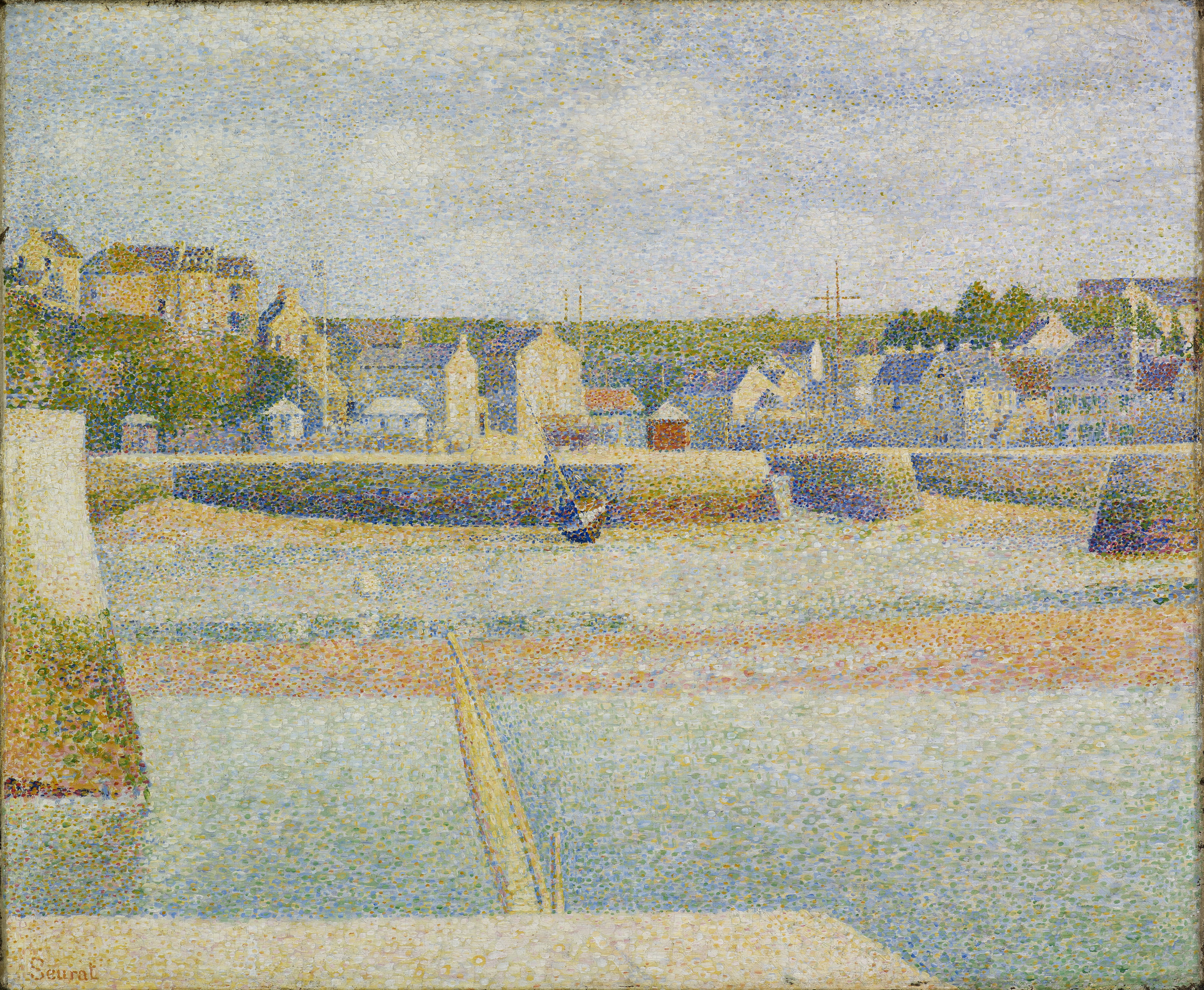
Port-en-Bessin, the Outer Harbor at Low Tide is a Georges Seurat painting of 1888, made during his summer in the Normandy resort of Port-en-Bessin: behind the harbour’s low stone walls, houses line the shore beneath a green hillside, and pale shallow water and exposed seabed fill the lower half of the canvas. The original, oil paint on canvas, 66.7 x 54.3 cm, is held by the Saint Louis Art Museum under accession number 4:1934. We make it as a fine art reproduction, hand-painted in oils on canvas, in eight sizes or to measure, and you approve a photograph of the finished work before dispatch.
| Title: | Port-en-Bessin, the Outer Harbor at Low Tide |
| Other titles: | Port-en-Bessin: The Outer Harbor (Low Tide) |
| Painter: | Georges Seurat (1859–1891) |
| Year painted: | 1888 |
| Original size: | 66.7 cm x 54.3 cm |
| Original technique: | Oil on canvas |
| Painting style: | Pointillism – painting with tiny dots of colour |
| Located at: | Saint Louis Art Museum, Saint Louis (inv. no. 4:1934) |
| Our reproduction: | hand-painted in oils on canvas, 8 sizes from 46 x 38 cm to 150 x 120 cm, custom sizes on request |
Port-en-Bessin, the Outer Harbor at Low Tide – Georges Seurat
What does the painting show?
The outer harbour of Port-en-Bessin at low tide. In the background stands a long row of houses with grey-blue and reddish roofs; larger buildings sit on a rise at the left, trees grow among the houses at the right, and a green hillside closes it all off, low beneath the sky. In front runs the low stone harbour wall, broken by openings and ending on the right in a rounded jetty. Against the wall, almost at the centre, lies a small dark boat; thin poles rise above the distant roofs. Broad, open areas fill the lower half: a pale band along the wall, a warmer pinkish-orange band below and, at the bottom, calm, pale greenish water. A tall stone jetty juts in from the left, and a narrow pale strip, like a wooden footbridge, runs diagonally from the bottom edge towards the centre. The museum expressly mentions the sail in the foreground and the flagpoles in the distance. No human figures can be made out in the photograph of the original, nor does the record mention any.
What is on the canvas?
A horizontal canvas covered edge to edge in tiny dots of colour. The sky’s pale blue, grey and pink dots merge from a distance into an even, light grey with soft clouds. The houses are dots of ochre, white, blue and violet, the hillside dense green and yellow dots. The stone walls have cool blue-violet shadows; the water below is made of green, blue and yellowish dots. This is the essence the museum stresses: small dots of colour set side by side blend into a whole at a distance. The composition rests on clear horizontal bands – sky, houses, wall, sand, water – cut only by the upright jetty at the left and the slanting footbridge below. In the lower left corner the photograph shows the inscription Seurat; the museum record lists no inscriptions.
Why does this painting matter?
Because, as the museum says, it shows Seurat’s signature dotted touch: small dots of colour that blend at a distance. Today we call it pointillism; a related term is neo-impressionism. The museum also stresses its strong geometric structure, which conveys calm and order. Its history is rich too: according to the record it was shown in 1889 and 1890, in the artist’s lifetime, and was later owned by the painter Théo von Rysselberghe. The French painter made it during a summer on the coast, building it purely from dots and calm horizontal bands.
What does the painting mean?
The museum writes that the firm geometric structure expresses the artist’s aim of making a fleeting moment feel eternal. Low tide is just such a moment: the water withdraws and returns a few hours later, yet here the harbour stays perfectly still. No waves, no hurry, no story: just light, walls, houses and a tiny sail. So at home it does not unsettle a room; it calms it. Its pale pastels suit white walls, light wood and blue or sandy furnishings.
What happened to the original?
The museum publishes the painting’s history, citing as its main source Robert Herbert’s catalogue for the exhibition »Georges Seurat, 1859-1891« of 1991–1992 (cat. no. 208). According to Susan Canning’s dissertation, it was one of two Seurat paintings sold at the 1889 exhibition of Les Vingt in Brussels; Herbert states that it was presumably bought then by G. de la Hault of Paris. De la Hault had it by 1890 at the latest, when he lent it to the 6th exhibition of the Société des artistes indépendants, and still had it in 1892, when he lent it to exhibitions in Brussels and Paris. From 1904 at the latest, and still in 1909, it belonged to the painter Théo von Rysselberghe (1862–1926) in Brussels; the catalogues of the 1905 Seurat retrospective and of the 1908–1909 exhibition list it in his collection. From 1922 at the latest until 1928 it belonged to Charles Pacquement of Paris; according to a 1934 catalogue, it was in the 1928 sale of his collection. Until 1929 it was owned by George Bernheim of Paris, who sold it to the M. Knoedler & Co. gallery (New York, London, Paris), where it was stock no. A539 from 1929 to 1934. The Saint Louis museum bought it from Knoedler on 4 January 1934. The museum adds that its records are updated regularly and may be incomplete.
What place does this painting have among Seurat’s works?
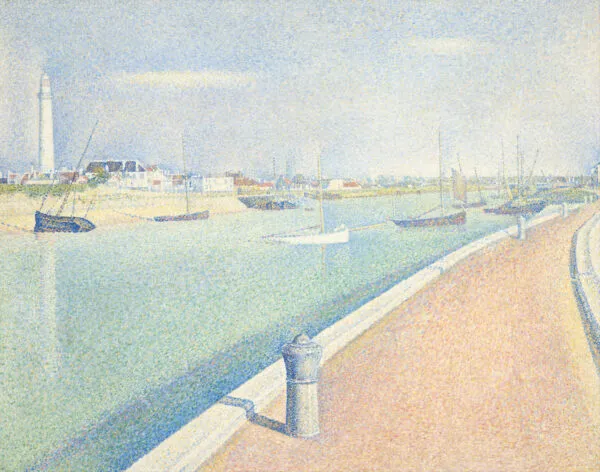
It is one of Seurat’s Port-en-Bessin canvases of summer 1888. From the same harbour and year we also offer Port-en-Bessin, Entrance to the Harbor, held by the Museum of Modern Art in New York, and Seascape at Port-en-Bessin, Normandy, held by the National Gallery of Art in Washington. From the same Normandy coast comes Boats, Low Tide, Grandcamp, which also shows low tide. For several of Seurat’s harbours on one wall, these canvases can be chosen together and hung side by side.
How is our hand-painted version made?
With a brush and oil paint, never with a printer. Our painter works from a photograph of the original and builds the canvas from tiny dots, as Seurat did: first the horizontal bands of sky, houses, wall and water, then dots of pure colour, added until at a distance they merge into a luminous whole. A pointillist technique demands patience: every dot must sit in its place. As everything is done by hand, no two canvases are ever identical, and every hand-painted copy is unique. We have no photographs yet of our own finished canvas of this subject; when we first paint it, we will photograph it and publish the photographs here.
Which size suits which wall?
If you are not sure which to choose, take 70 x 60 cm. It is the size closest to the original, which measures 66.7 x 54.3 cm: ours is 3.3 cm wider and 5.7 cm taller. The horizontal format fits above a chest of drawers, a sofa or a bed. 46 x 38 and 50 x 40 cm suit smaller walls, hallways and shelves; 60 x 50, 70 x 60 and 80 x 65 cm fill a living-room or bedroom wall on their own; 90 x 75, 120 x 100 and 150 x 120 cm are for large walls, where the dotted surface still reads from afar. Every canvas painting of this subject is made to order.
Custom size, stretcher bar and frame
If none of the eight sizes suits your wall, we paint to your measurements in the original’s proportions, so the horizontal bands stay balanced; that is our custom size painting service. You can order the painting in three forms: as a rolled canvas without a stretcher, stretched on a wooden stretcher bar and ready to hang, or framed; you choose the form when you order. You pick the frame in our 3D app, which shows gold, silver, black, white and wooden profiles on this subject; the app is for the frame only. To see the painting on your own wall, there is our separate room-visualisation service.
Delivery and guarantee
Every canvas is painted in our studio in Slovenia, so allow 15 to 45 days depending on size. We send it in the form you chose when ordering — rolled, stretched or framed — protected for transport, within Slovenia and across the EU without customs duty. You approve a photograph of the finished work before dispatch, and our returns policy covers every order. All of Seurat’s subjects are in the Georges Seurat gallery, and our article about Georges Seurat explains when a reproduction of a famous painting is truly good.
Frequently asked questions
Where is the original?
At the Saint Louis Art Museum, under accession number 4:1934. The museum bought it on 4 January 1934; according to its record it hangs in gallery 218.
When was the painting made?
In 1888, when Seurat spent the summer in the Normandy resort of Port-en-Bessin.
What does low tide in the title mean?
That the harbour is painted at low water: the sea has drawn back, leaving shallow water and pale bands of seabed in the lower half.
Is this a print?
No. Our painting is painted by hand, in oil on canvas; you can see and feel the dots and brushstrokes.
Which size should I choose?
For most walls, 70 x 60 cm, which is also the size closest to the original. The detailed guide is above.
Can I have a size that is not on the list?
Yes. We paint to measure and keep the side ratio of the original.
Why is the painting made entirely of dots?
Seurat applied paint in small dots that blend at a distance; the museum describes this as his signature touch.
Who owned the painting before the museum?
According to the museum record, G. de la Hault, the painter Théo von Rysselberghe, Charles Pacquement, George Bernheim and the M. Knoedler & Co. gallery.
Is the original for sale?
No. The canvas belongs to the Saint Louis museum and is not for sale, but we paint its subject by hand for you.
How high should I hang it?
With its centre at eye level, about 145–150 cm from the floor; hang the smaller sizes lower, closer to where you sit.
Is it suitable as a gift?
Yes, especially for lovers of the sea, harbours or Normandy. If you would rather leave the choice to the person receiving it, there is our gift voucher.
- Subject: the outer harbour of Port-en-Bessin at low tide, with houses, stone walls and a sail – 1888
- Original: 66.7 x 54.3 cm, oil paint on canvas, Saint Louis Art Museum (inv. no. 4:1934)
- Ours: hand-painted oil painting reproduction, eight sizes from 46 x 38 to 150 x 120 cm, as a rolled canvas, stretched on a stretcher bar or framed — your choice
- Worth knowing: the painter Théo von Rysselberghe once owned it; the catalogue of the 1905 Seurat retrospective lists it in his collection