







































Description
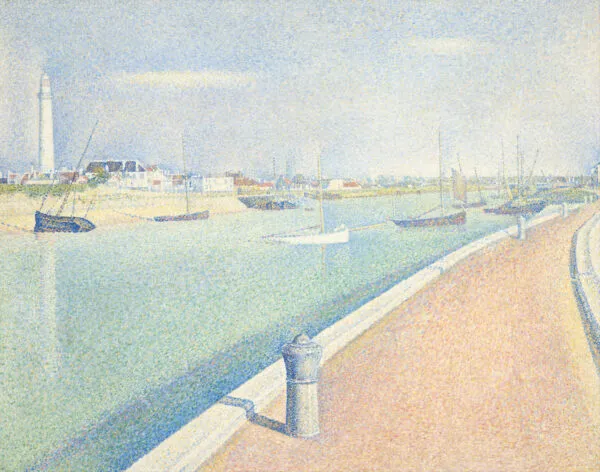
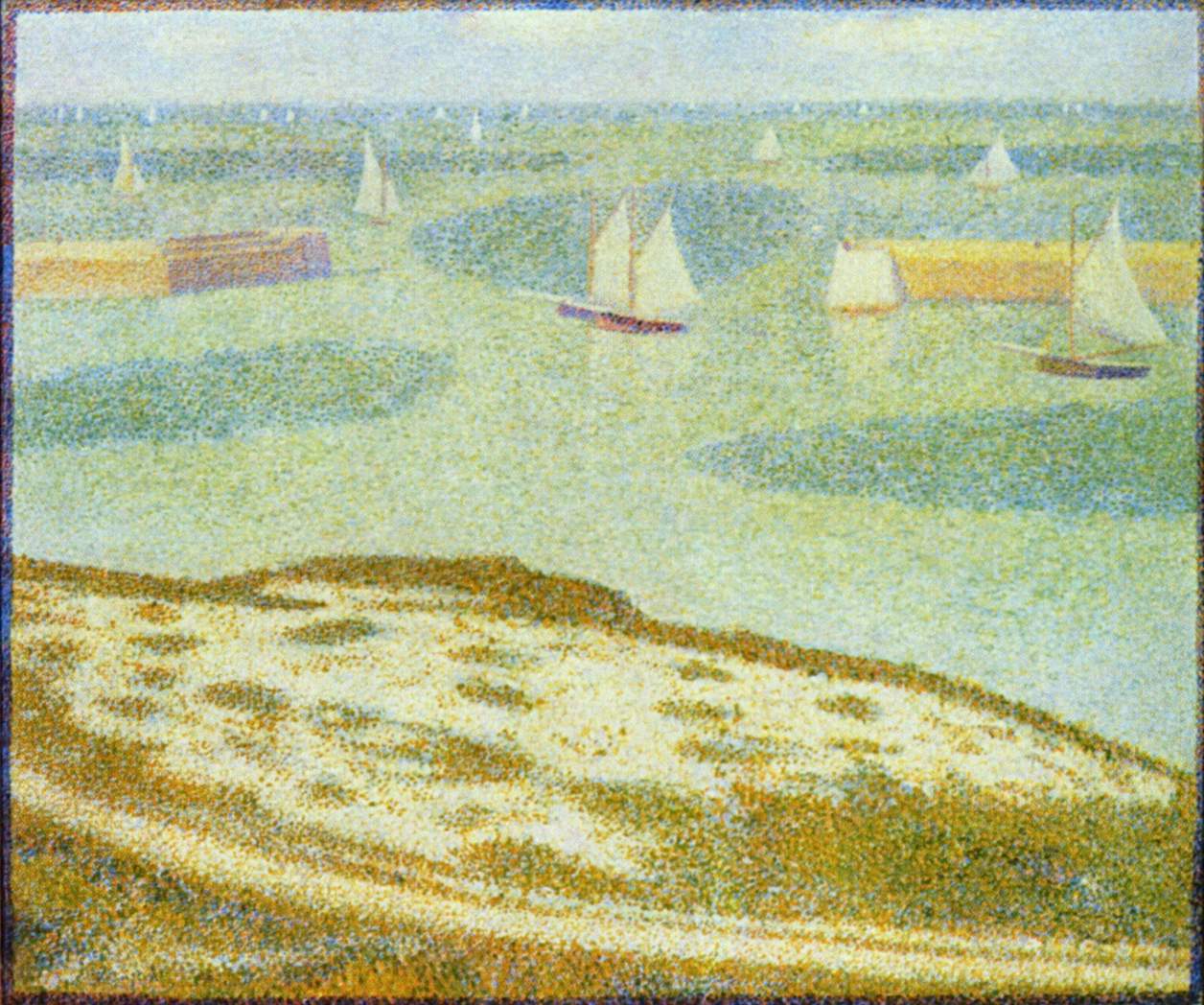
Port-en-Bessin, Entrance to the Harbor was painted in 1888, when Seurat spent the summer in a small Normandy port. The original measures 65.1 x 54.9 centimetres, is oil on canvas, and is held in New York by The Museum of Modern Art under object number 126.1934. From us it is painted entirely by hand, in four sizes or to your own measurements, up to 140 x 110 cm, and before dispatch you receive a photograph of the finished work for approval.
| Title: | Port-en-Bessin, Entrance to the Harbor |
| Other titles: | Port-en-Bessin, L’avant-port, marée haute (1892, museum: title erroneous) |
| Painter: | Georges Seurat (Paris 1859–1891) |
| Year painted: | 1888 |
| Original size: | 65.1 cm x 54.9 cm |
| Original technique: | Oil on canvas |
| Painting style: | Pointillism, the Normandy summer of 1888; neo-impressionism |
| Located at: | The Museum of Modern Art, New York (object no. 126.1934, Lillie P. Bliss Collection, in the museum since 1934) |
| Our reproduction: | hand-painted oil on canvas, 4 sizes from 70 x 55 cm to 140 x 110 cm, custom size up to 140 x 110 cm on request |
Port-en-Bessin, Entrance to the Harbor – Georges Seurat
What is on the canvas – and what does the museum not say?
The title names the entrance to the harbour. Port-en-Bessin is a small fishing port in Normandy where Seurat spent the summer of 1888, and the museum dates the work to that same year.
Here we have to stop. The Museum of Modern Art publishes the title, the year, the medium, the dimensions, the department, the exhibitions and the chain of owners – and no description at all. So we do not describe the scene in more detail than the museum’s own title names. This page used to say what fills the foreground and where the sailing boats stand; we could not support that from the museum’s record, so we dropped it, and we say here why.
What the method tells us is firm enough. A canvas painting of 1888 was made when pointillism was fully formed: the colour stands in fine dots that mix only in the viewer’s eye, which is why the light over the water holds its even, quiet value.
The summer of 1888 in Normandy
Every summer Seurat went north to the sea and brought coastal canvases back. In 1888 he was at Port-en-Bessin.
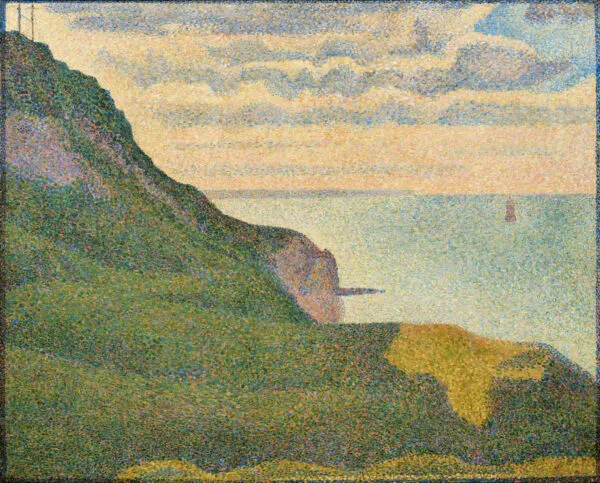
Several of them are in our Seurat gallery. Seascape at Port-en-Bessin, Normandy comes from the same harbour and the same year; Boats, Low Tide, Grandcamp from the coast where Seurat’s sea began; and Evening, Honfleur from a Normandy harbour two years earlier.
Two years later he did the same thing on the channel at Gravelines. The Channel at Gravelines, Evening is held by the same New York museum as this work, The Channel of Gravelines, Grand Fort-Philippe by London, and The Channel of Gravelines, Petit Fort-Philippe by Indianapolis.
The chain of owners, as the museum publishes it
The Museum of Modern Art includes this work too in its Provenance Research Project and publishes the whole chain of owners with seven footnotes. Because it publishes it, we set it out here — and everything that follows is the museum’s record and not a conclusion of ours.
After the painter’s death in 1891 the work was with his mother, Ernestine Seurat, in Paris. In 1899 it passed by inheritance to Léon Appert, the painter’s brother-in-law, and in 1925 to his son Maurice Appert.
Then the Paris dealer Etienne Bignou bought it, and in 1926 the London house of Alexandre Reid & Lefevre – a name that turns up in our Seurat gallery for the third time, in the museum records of both Gravelines canvases.
1926 to 1934: from London to New York and into the museum
In December 1926 Reid & Lefevre and the New York house of Knoedler & Co. owned the work jointly. In 1927 Knoedler sold it to Lillie P. Bliss in New York, and in 1934 it came with her collection to the Museum of Modern Art.
In its footnotes the museum also names the two exhibitions of those years: at the Lefevre Galleries in April and May 1926, and at Knoedler in January 1927. For the second it even gives the dealer’s stock number.
The institution that holds the work publishes this history itself.
A title the museum itself calls wrong
The most interesting detail of this work is a footnote. In 1892, a year after Seurat died, it was shown twice: at the Salon des Indépendants in Paris as no. 1100, and with the group Les XX in Brussels as no. 12. Both times under the title Port-en-Bessin, L’avant-port, marée haute, and both times lent by the painter’s mother.
The museum gives that title — and writes beside it that the title is erroneous. So we have an institution that publishes an old fact and says in the same breath that it does not hold, which is what we do in our Seurat gallery with our own stored facts.
So we carry the old title in the table, with its year and the museum’s warning attached. Neo-impressionism was only a few years old then and the names of works had not settled.
Where has it been shown?
The museum has identified this work in photographs of its own installations and publishes the list. In November and December 1929 it was in the exhibition Cezanne, Gauguin, Seurat, van Gogh; from May to October 1931 in the memorial exhibition of the collection of the late Lillie P. Bliss; in the spring of 1958 in Seurat Paintings and Drawings.
Then 1964, the Painting & Sculpture II installation between 2004 and 2005, and gallery 502, given to Lillie P. Bliss, from autumn 2021 to spring 2023.
The first date on that list is older than the museum’s ownership: in November 1929 the work was still hers, not the museum’s. The two records do not contradict each other, they complete each other. Today it does not hang — the museum notes that this work is not on view.
How is our hand-painted version made?
By hand and with a brush, never with a printer. Our painter works in oil colours on canvas, and with this subject the hardest thing is evenness: the scene is built from quiet horizontal bands, and if one of them livens up the whole balance tips. That is why every hand-painted copy is one of a kind and no two are quite alike.
For this subject we have no studio photographs of our own yet. When we next paint it, we will photograph it, and the photographs will appear on this page. What holds meanwhile holds for every oil painting reproduction we make: before dispatch you receive a photograph of the very canvas painted for you, and a fine art reproduction leaves the studio only once you have approved it.
Which size for which wall?
The original measures 65.1 x 54.9 centimetres, width first and then height, the way we give measurements everywhere. The format is landscape and only slightly drawn out.
On this work our smallest size comes closer to the original than on any other in our Seurat gallery: 70 x 55 cm is 4.9 centimetres wider and one single millimetre taller. It is not the same number, and we do not call it that — it is simply a size that lands almost exactly on this canvas. For a living room we suggest 100 x 80 or 120 x 100 cm; 140 x 110 cm, our largest size, fills a larger wall.
Custom size, stretcher and frame
If none of the four sizes fits your wall, we paint to your measurements, up to 140 x 110 cm, and keep the ratio of the original, so the scene is never stretched; that is our custom size painting. You can order the painting in three forms: as a rolled canvas without a stretcher, stretched on a wooden stretcher and ready to hang, or framed; you choose the form when you order.
You choose the frame in our 3D frame viewer. With a scene that lives on horizontal bands a wide frame quickly becomes stronger than the work: a narrow one leaves it its room. Our separate room-placement service shows how it will look on your wall.
Delivery and guarantee
Every copy is made to order in our studio in Slovenia, so allow 15 to 45 days depending on size. We ship it in the form you chose when ordering — rolled, stretched or framed — protected, across the EU, customs-free. You approve a photograph first, and our returns policy applies. The full range by this painter is in the Georges Seurat gallery, and his work is described in our article on Georges Seurat. Ordering a famous painting from us always works this way.
Frequently asked questions
Where is the original?
In New York, at The Museum of Modern Art, object number 126.1934. It came to the museum in 1934 with the Lillie P. Bliss Collection.
What year is it from?
The museum gives 1888 – a single year, so that is how we give it.
How big is the original?
The museum gives 54.9 x 65.1 centimetres by height and width, which in our width-by-height notation is 65.1 x 54.9 cm.
Why do you not describe the work in more detail?
Because the museum publishes no description of it. It gives the title, year, medium, dimensions, exhibitions and chain of owners, but no description, so we do not add one.
Is the work on view?
No. The museum notes that it is not currently on view, but it does publish the list of exhibitions it has been in.
Why does the table carry a different title?
Because in 1892 the work was shown twice under the title Port-en-Bessin, L’avant-port, marée haute. The museum gives that title and writes beside it that it is erroneous.
Who was Lillie P. Bliss?
A collector who bought the work in 1927; it came to the museum with her collection in 1934, and the museum has named a gallery after her.
Which size should I choose?
For a living room, 100 x 80 cm. The closest to the original is 70 x 55 cm, a few centimetres wider and one millimetre taller.
Can I have a size that is not on the list?
Yes. We paint to measure, up to 140 x 110 cm, and keep the ratio of the sides of the original.
Is this a print?
No. The work is painted by hand in oil colours; the strokes can be seen and felt, which a print cannot imitate.
Is it suitable as a gift?
Yes. The subject is quiet and light and suits any room. To leave the choice to the recipient, there is a gift voucher.
- Subject: the entrance to the harbour at Port-en-Bessin, the Normandy summer of 1888
- Original: 65.1 x 54.9 cm, oil, The Museum of Modern Art, New York (126.1934)
- Our version: a hand-painted canvas, four sizes from 70 x 55 to 140 x 110 cm
- Worth knowing: this French painter painted the same harbour more than once – one of those canvases is in our Seurat gallery too