


Description
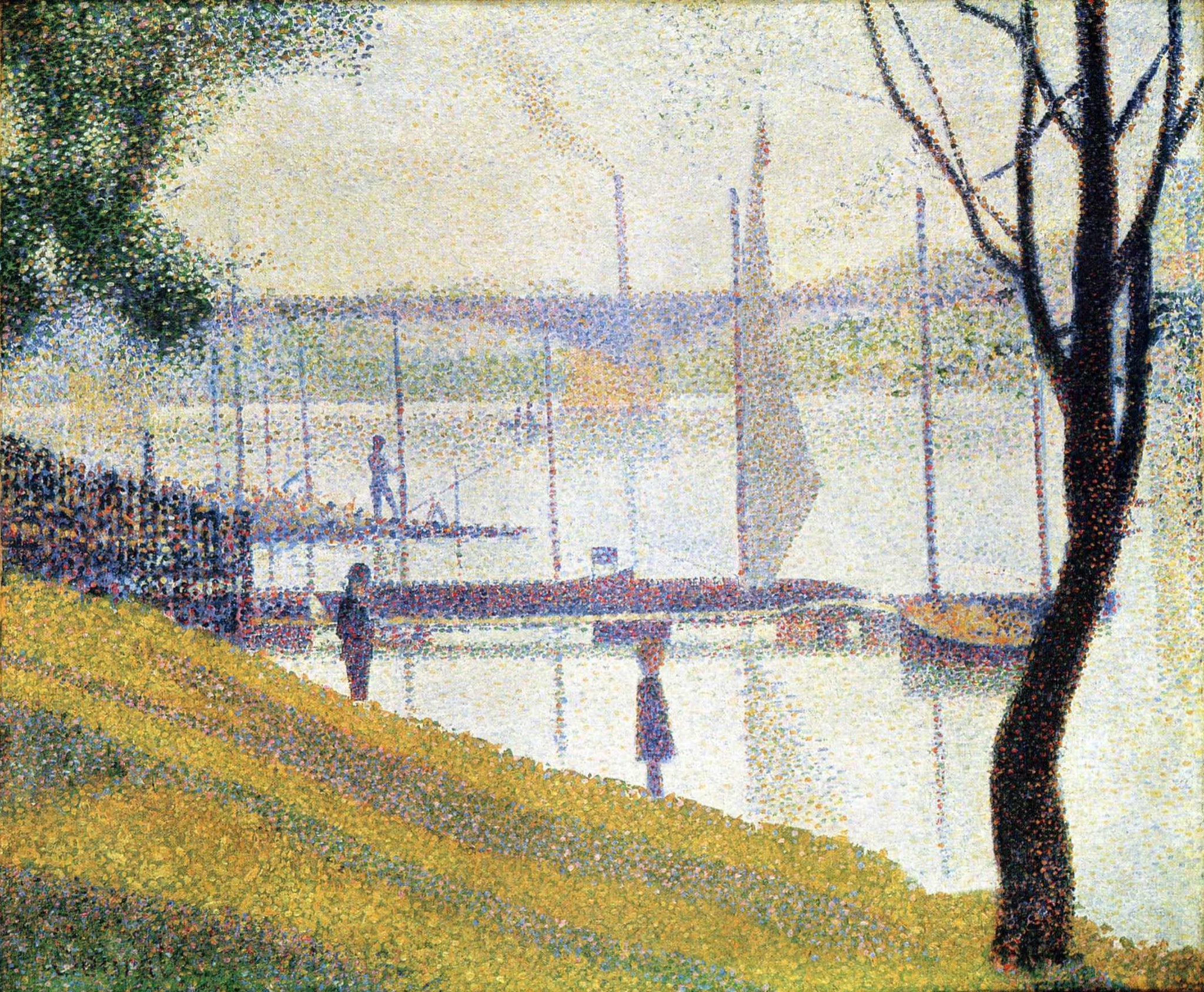
The Bridge at Courbevoie is Seurat’s painting of the Seine from about 1886–87: a long bridge crosses the still river in the background, a factory chimney smokes above it, sailing boats with tall masts are moored by the bank, and on the right a thin bare tree rises into the sky. The original, 55.3 x 46.4 cm, is held by the Courtauld Gallery in London under number P.1948.SC.394. We make it as a canvas painting, hand-painted in oils, in eight sizes or to your own measurements, and you receive a photograph of the finished work for approval before dispatch.
| Title: | The Bridge at Courbevoie |
| Other titles: | The Bridge at Courbevoie – the title the museum itself uses |
| Painter: | Georges Seurat (1859–1891) |
| Year painted: | about 1886–1887 |
| Original size: | 55.3 cm x 46.4 cm |
| Original technique: | Oil on canvas |
| Painting style: | Neo-Impressionism – painted in dots |
| Located at: | The Courtauld Gallery, London (inv. no. P.1948.SC.394) |
| Our reproduction: | hand-painted in oil on linen, 8 sizes from 46 x 38 cm to 150 x 120 cm, custom sizes on request |
The Bridge at Courbevoie – Georges Seurat
What does the painting show?
The Seine at Courbevoie, a suburb northwest of Paris, on a quiet, hazy day. A low bridge stretches across the whole width of the background, and above it smoke drifts from a factory chimney. In front of the bridge sailing boats lie at anchor; their tall, thin masts rise straight up, and one sail is furled against its mast. A man stands on a wooden landing stage on the left, and two more small figures stand on the bank, both motionless and turned towards the water. At the lower left a grassy bank slopes steeply down, a dark fence runs along the left edge, and on the right a slender tree with bare branches cuts across the pale sky like a black drawing. The museum record does not name anyone, so neither do we.
What is on the canvas?
A horizontal canvas in very light, restrained colours. Water and sky are painted in small dots of pale blue, pink and cream, so that there is hardly a boundary between them and the bridge, a thin light line, barely stands out from the background. The bank at the lower left is built of yellow, green and orange dots that cool towards the water. The masts, the chimney and the tree are the strongest dark, sharp verticals in an otherwise soft, airy image. Everything stands still: the smoke rises slowly, the water does not ripple, nobody walks. It is exactly this careful arrangement of verticals and horizontals that gives the painting its almost architectural order.
Why does this painting matter?
Because it shows Seurat after the large canvas of La Grande Jatte, applying his method to an entirely ordinary spot on the river. This French painter did not look for picturesque views; he painted a suburb where leisure and industry meet, and the sailing boats and the factory chimney stand in the same picture as equal parts of the landscape. The method we now call pointillism is carried through consistently here: every part of the canvas is built of small, separate dots. At the same time the painting shows how neo-impressionism turned quiet, almost empty scenes into a deliberate composition of lines and light. For a buyer it is a subject that looks calm and elegant on a wall, yet reveals precise work when you come close.
What does the scene mean?
The stillness of a riverside suburb, in which industry too has become part of the landscape. Seurat does not judge whether the chimney is beautiful or ugly; he sets it beside the masts and the tree as one more vertical. The figures on the bank look quietly at the water. The result is the feeling of a calm, almost frozen moment, familiar from Sunday afternoons by the water. In a room the painting feels light and airy, and its thin dark lines sit well with simple, modern furniture.
What happened to the original?
The museum publishes the painting’s route from its first owner. In 1887 it belonged to Arsène Alexandre in Paris, who sold it at his own auction on 18 May 1903 as lot 57. It then passed through the hands of the Paris dealer Georges Petit, L. W. Gutbier in Dresden, the Paris dealer Bignou and the London gallery Reid and Lefèvre. In July 1926 it was bought by the collector Samuel Courtauld, who bequeathed it in 1948 to the gallery that now bears his name. Those details are the museum’s; we add none of our own.
Where does this painting sit in Seurat’s work?
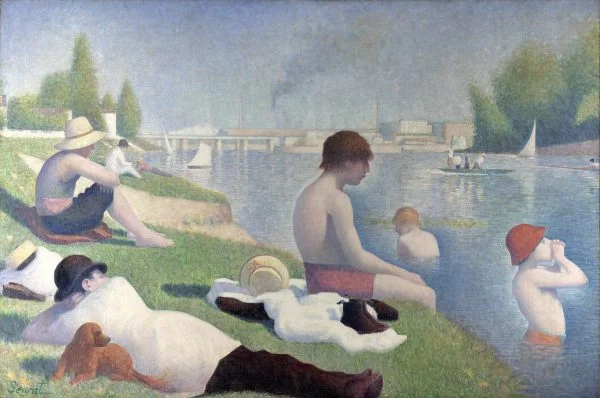
Seurat painted the Seine near Paris many times. By the same river at the same town he also painted The Seine at Courbevoie, in which a lady with a small dog stands under the trees. A few years earlier came the large canvas Bathers at Asnières, where factory chimneys also rise in the background behind the bathers, and the best known of all is Sunday Afternoon on the Island of La Grande Jatte, held by the Art Institute of Chicago. All three are in our gallery as separate products.
How is our hand-painted version made?
With a brush and oil paint, never a printer. Our painter works from a high-resolution image of the original: first the light areas of water and sky and the dark verticals of masts, chimney and tree, then everything is covered with small dots in pale tones. The dotted technique needs an especially steady hand here, because the colours sit very close to each other and a single dot set too coarsely would break the haze. Because everything is done by hand, every hand-painted copy is a one-off. We do not yet hold our own photographs of a finished canvas of this subject; the first time it is painted we will photograph it, and the photographs will appear here.
Which size for which wall?
If you are not sure which to choose, take 70 x 60 cm. The size closest to the original is 60 x 50 cm, which is 4.7 cm wider and 3.6 cm taller than it; the original’s exact size is not in our range. The format is horizontal, so it sits well above a chest of drawers, a bed or a sofa. 46 x 38 and 50 x 40 cm suit a hallway or study; 60 x 50 and 70 x 60 cm fill the wall above a desk on their own; 80 x 65 and 90 x 75 cm are the living-room sizes, and 120 x 100 and 150 x 120 cm are for large, bright walls where the airiness of the painting comes into its own. Every oil painting reproduction of this subject is made to order.
Custom size, stretcher bar and frame
If none of the eight sizes fits your wall, we paint to your measurements and keep the ratio of the original, so the bridge and the masts stay in place; that is our custom size painting service. You can order the painting in three forms: as a rolled canvas without a stretcher, stretched on a wooden stretcher bar and ready to hang, or framed; you choose the form when you order. You choose a frame in our 3D frame viewer, which shows gold, silver, black, white and natural wood profiles on this subject; it is for choosing a frame and nothing else. For a view of your own wall there is our room-visualisation service, ordered separately.
Delivery and guarantee
We paint it to order in our studio in Slovenia, so allow 15 to 45 days depending on the size. It ships in the form you chose when ordering — rolled, stretched or framed — protected for transport, across the EU customs-free. Before dispatch you approve a photograph of the finished work, and our returns policy covers every order. All of Seurat’s subjects are in the Georges Seurat gallery, and our article about Georges Seurat explains what makes a fine art reproduction good.
Frequently asked questions
Where is the original?
In the Courtauld Gallery in London, under number P.1948.SC.394, as part of Samuel Courtauld’s bequest of 1948.
Who are the people in the painting?
A man on the landing stage and two figures on the bank; the museum record does not name them, and they are anonymous visitors to the river.
Is this the same painting as The Seine at Courbevoie?
No. Both show the river at Courbevoie, but that is a different canvas, with a lady and a small dog under the trees; we sell both as separate products.
Is this a print?
No. Our painter sets every dot by hand, in oil on canvas, so the paint can be seen and felt.
Which size should I choose?
For most walls, 70 x 60 cm; for the size closest to the original, 60 x 50 cm. The full guide is above.
Can I have a size that is not listed?
Yes. We paint to measure and keep the side ratio of the original.
Why is there a smoking chimney in the picture?
Because in Seurat’s day Courbevoie was a suburb with industry; he painted the factory as calmly as the masts and the tree.
What is the painting about, in one sentence?
That even an industrial suburb on a river can be quiet, bright and ordered like a carefully made composition.
Is the original for sale?
No. The canvas is in the Courtauld Gallery’s collection and is not for sale; a hand-painted canvas from us lets you have it at home.
How high should I hang it?
Centre at eye level, about 145–150 cm from the floor; above furniture, keep the lower edge 20–25 cm above it.
Is it suitable as a gift?
Yes. A calm river subject suits almost any room. If you would rather leave the choice to the person receiving it, there is our gift voucher.
- Subject: a bridge over the Seine at Courbevoie, sailing boats, a factory chimney and a bare tree – about 1886–87
- Original: 55.3 x 46.4 cm, oil paint on canvas, The Courtauld Gallery (inv. no. P.1948.SC.394)
- Ours: a famous painting recreated by hand in oils, eight sizes from 46 x 38 to 150 x 120 cm, as a rolled canvas, stretched or framed — your choice
- Worth knowing: the masts, the chimney and the tree are the strongest dark verticals in an almost entirely light painting