










Description
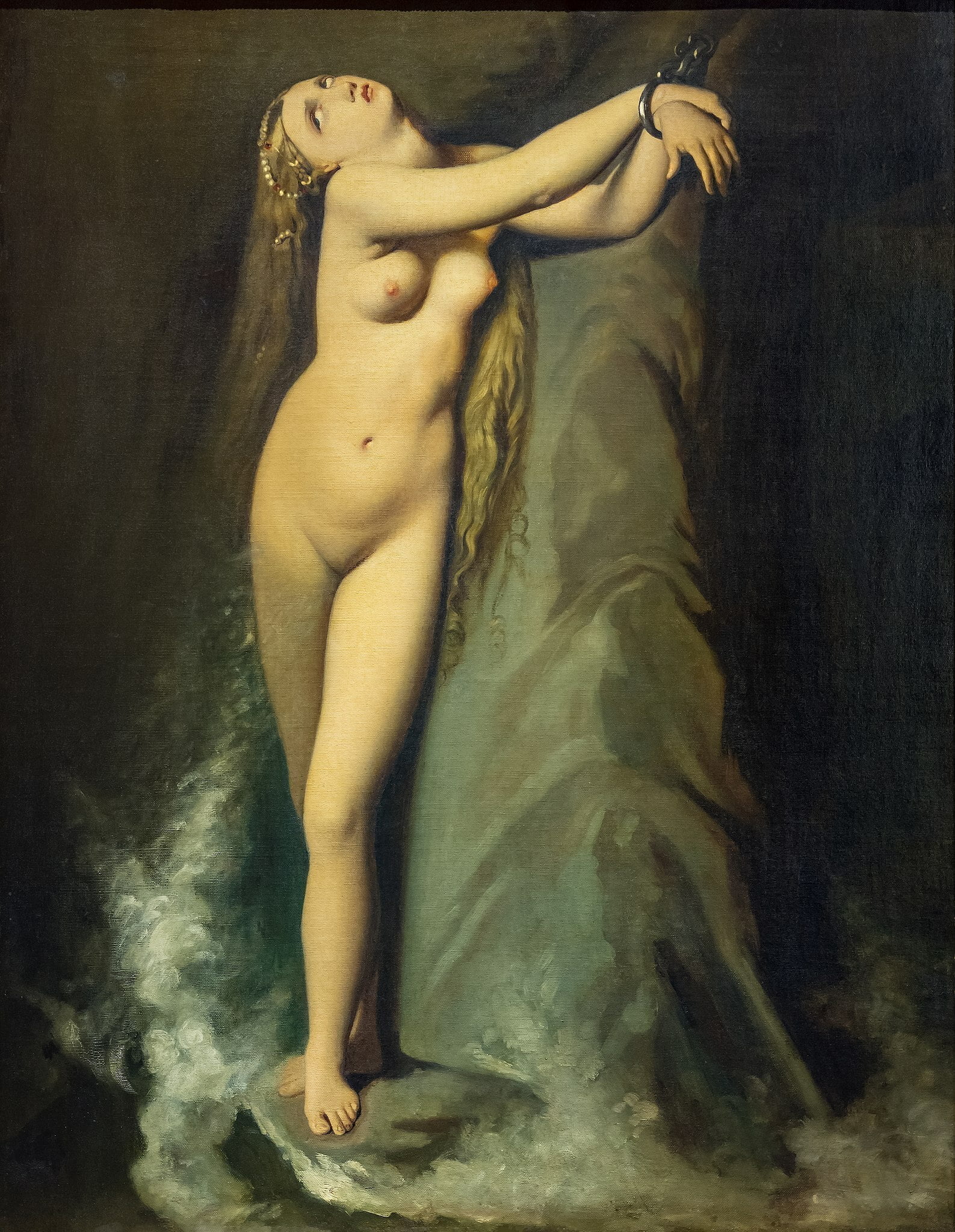
Angelica Chained to the Rock is the earliest known painting by Seurat: a copy after Ingres, painted in 1878, when he was nineteen and still in training. The original measures 66.3 x 83 centimetres and is held in Pasadena by the Norton Simon Museum under inventory number M.1997.1.4.P. From us it is painted entirely by hand, oil on canvas, in eight sizes or to your own measurements, and before dispatch you receive a photograph of the finished work for approval.
| Title: | Angelica Chained to the Rock |
| Other titles: | Angelica at the Rock (After Ingres) · Angélique au rocher |
| Painter: | Georges Seurat (1859–1891) |
| Year painted: | 1878 |
| Original size: | 66.3 cm x 83 cm |
| Original technique: | Oil on canvas |
| Painting style: | Early period, copy after Ingres |
| Located at: | Norton Simon Museum, Pasadena (inv. no. M.1997.1.4.P, not on view) |
| Our reproduction: | hand-painted oil on canvas, 8 sizes from 40 x 50 cm to 120 x 150 cm, custom size on request |
Angelica Chained to the Rock – Georges Seurat
What is in the painting?
A female figure, chained to a rock by the water, and nothing else. The body is pale and smooth, turned upward, the hands bound above the head, the rock behind her dark and hard. At her feet runs a vertical strip of churning water. There is no background in the proper sense – the scene is narrowed to a single person and her plight, and that is exactly where the distance from its model lies.
Who is it after?
After Ingres. The museum describes the work as a selective reduction of Jean-Auguste-Dominique Ingres’s Roger Freeing Angelica. Ingres’s 1819 composition comes from Ariosto’s epic Orlando Furioso and shows a knight rescuing a princess from a vicious sea monster. Seurat removed all of it: the knight, the monster and the narrative, leaving only Angelica. The title under which the museum records the work says so outright – Angelica at the Rock (After Ingres).
Why did the young painter copy?
Because that is how one learned. The museum notes that Seurat spent his early years training in the approved academic manner at the École des Beaux-Arts, where copying the masters was a regular part of the teaching. This work does not stand alone: the museum counts it among thirteen copies Seurat made after works by that famed French draftsman. A copy here is therefore not a want of invention but an exercise – and since it is dated 1878, it is the earliest canvas we know by him.
What does the work mean?
The museum offers a reading worth quoting. By isolating the female figure from her literary narrative, Seurat focuses attention on her plight: the threat of abandonment and near death on the Isle of Tears, alluded to by the vertical strip of churning water at her feet. The result is, in the museum’s words, a curious homage to the linear clarity and anatomical oddities of Ingres’s portrayal, which were widely admired by Seurat and his contemporaries. A canvas painting born of an exercise thus takes its meaning from what was left out.
What happened to the original?
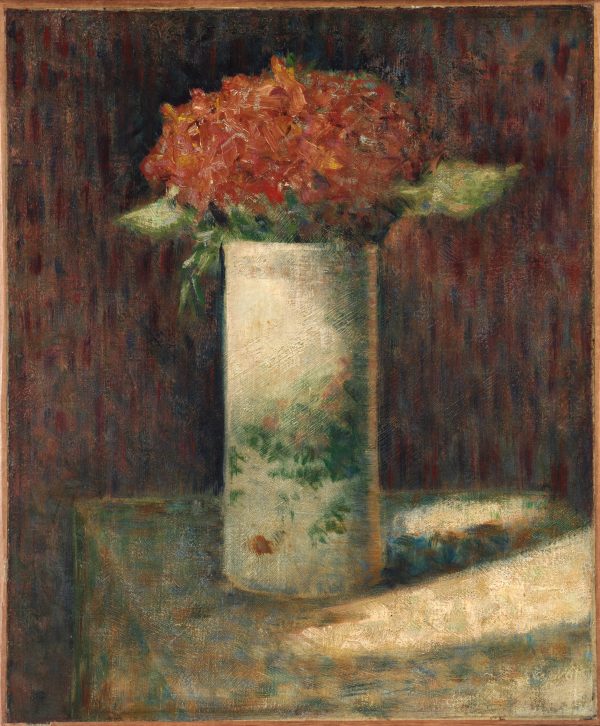
The museum publishes the whole route, and it begins in the family. The canvas was first with Léon Appert, the painter’s brother-in-law, who lived between 1837 and 1925 – the same man who opens the history of the Vase of Flowers in Cambridge. By descent it passed to Léopold Appert in Paris, after which the museum names, with a question mark, Charles Hall Thorndyke. Then came the dealer Étienne Bignou, Alphonse Bellier and Jos Hessel, who sold it on 15 March 1930 to the London house Alex. Reid & Lefevre, which on 20 February 1933 sold it back to Bignou. Between 1961 and 1972 it was in a private collection in England, until 1976 with Wildenstein & Co. in New York, who sold it on 9 April 1982 to Norton Simon. He bequeathed it in 1993 to Jennifer Jones Simon, who gave it in 1997 to the Norton Simon Art Foundation. That ownership history is the museum’s; we add nothing to it.
Where does it sit in Seurat’s work?
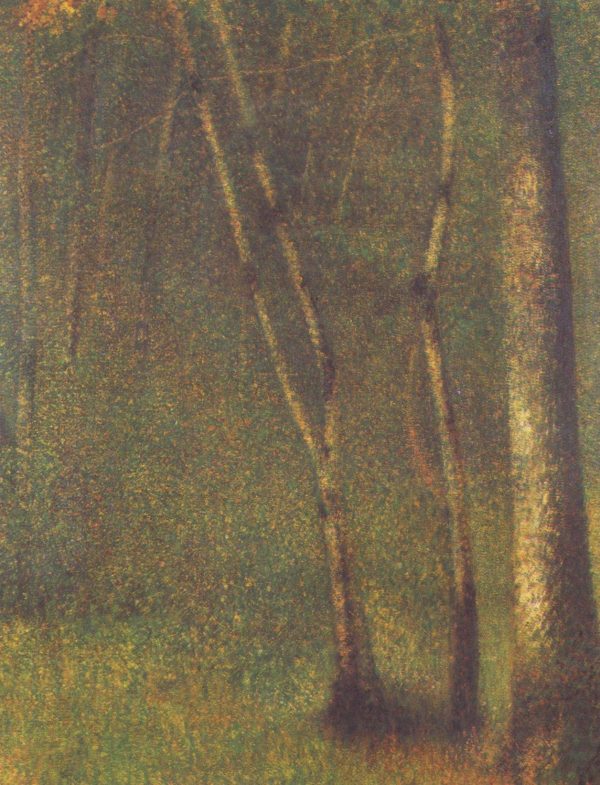
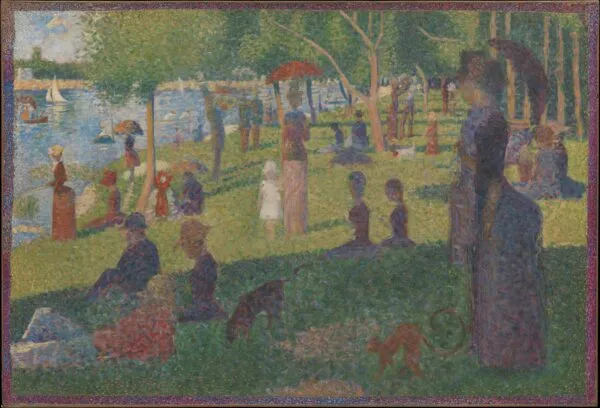
Right at the beginning – in both great catalogues of his painting it carries the number one. From the years after it we also sell In the Woods at Pontaubert and Figure in a Landscape at Barbizon, both already from nature rather than from someone else’s model. The summit of that road is held by the Art Institute of Chicago, and here you will find it as Sunday Afternoon on the Island of La Grande Jatte. Pointillism and neo-impressionism are almost ten years younger than this Angelica.
How is our hand-painted version made?
By hand and with a brush, never with a printer. Our painter works in oil paint on linen, and on this subject everything depends on the drawing: the body is smoothly modelled, with no visible strokes, so any inaccuracy in the outline shows at once. Nothing here is painted in dots; it is painted in continuous transitions, the way the painter was taught at school. Every hand-painted copy is therefore one of a kind and no two are quite alike; this is not an oil painting reproduction printed onto canvas but a painting made from scratch. Before dispatch we photograph the piece and send you the photograph for approval.
We hold no studio photographs of the finished work for this subject at present. When it is next painted we will photograph it and the shots will appear on this page.
Which size for which wall?
If you do not know which: 80 x 100 cm. The original measures 66.3 x 83 cm and our fourth size, 66 x 83 cm, is practically one to one with it – the difference is three millimetres in width. The format is upright, close to a 4 : 5 ratio, and so it asks for a narrow wall or the space between two windows: 40 x 50 and 50 x 60 cm for a shelf or a group of smaller works, 60 x 75 and 66 x 83 cm are the domestic size, 80 x 100 and 90 x 110 cm work as a standalone piece, and 100 x 125 and 120 x 150 cm want a wall of their own, where the figure reaches nearly life size. Every fine art reproduction of this subject is made to order.
Custom size, stretcher bar and frame
If none of the eight sizes fits your wall, we paint the work to your measurements and keep the ratio of the original so the figure is never stretched; that is our custom size painting service. You can order the painting in three forms: as a rolled canvas without a stretcher, stretched on a wooden stretcher bar and ready to hang, or framed; you choose the form when you order. You choose the frame in our 3D frame viewer: on this subject it shows every frame profile we carry, so you can compare gold, silver, black, white and natural wood — it is for choosing a frame and nothing else. To see how the work will look on your own wall, use our separate room-visualisation service.
Delivery and guarantee
Every copy is made to order in our studio in Slovenia, so allow 15 to 45 days depending on the size you choose. We ship it in the form you chose when ordering — rolled, stretched or framed — protected for transport, across the EU, customs-free. Before dispatch you receive a photograph of the finished work for approval, and our returns policy applies to every order. The full range by this painter is in the Georges Seurat gallery, and his path from school copies to the large canvases is described in our article about Georges Seurat, which also explains what separates a good famous painting copy from a poor one.
Frequently asked questions
Where is the original?
In Pasadena, California, in the collection of the Norton Simon Museum, under inventory number M.1997.1.4.P. The museum records it under the title Angelica at the Rock (After Ingres) and states that it is not on view.
Is this not a private collection?
No. We used to state a private collection here; that was wrong and it is corrected. The work belongs to the Norton Simon Art Foundation, and the museum publishes it with an inventory number and a detailed ownership history.
What year is the work from?
The museum dates it to 1878 — a single year, with no “circa” and no span, and that is how we give it.
Why does the style row no longer say post-impressionism?
Because a work of 1878 is a school copy after Ingres and comes a decade before that movement. We corrected it to the museum’s record, and the row now reads early period, copy after Ingres.
How large is the original?
The museum gives a height of 83 and a width of 66.3 centimetres, so 66.3 x 83 cm in our width-by-height notation. We already gave the same measurement and the museum confirmed it.
Who was Ingres and what has he to do with it?
Jean-Auguste-Dominique Ingres painted Roger Freeing Angelica in 1819. Seurat’s work is, in the museum’s words, a selective reduction of that model — the same Angelica, without the knight and without the monster.
Is it really his earliest work?
Among the paintings, yes: in both great catalogues of his painting it carries the number one, and the museum dates it to 1878.
Which size should I choose?
For a living room, 80 x 100 cm; if you want the size of the original, choose 66 x 83 cm, which matches it almost exactly. The full size guide is above.
Is this a print?
No. The work is painted by hand in oil on linen; the strokes are visible and can be felt, which a print cannot imitate.
How is it delivered?
In the form you chose (rolled, stretched on a stretcher or framed), 15 to 45 days after you approve the photograph of the finished work.
Is it suitable as a gift?
Yes, for someone who likes classical drawing and quiet, collected subjects. If you would rather leave the choice to the person receiving it, there is a gift voucher.
- Subject: Angelica chained to a rock by the water – a single figure, without the knight and without the monster
- Original: 66.3 x 83 cm, oil paint on canvas, Norton Simon Museum, Pasadena (M.1997.1.4.P)
- Ours: hand-painted in oil on linen, eight sizes from 40 x 50 to 120 x 150 cm, as a rolled canvas, stretched or framed — your choice
- Worth knowing: this French painter was nineteen – in both catalogues of his painting this work carries the number one