














Description
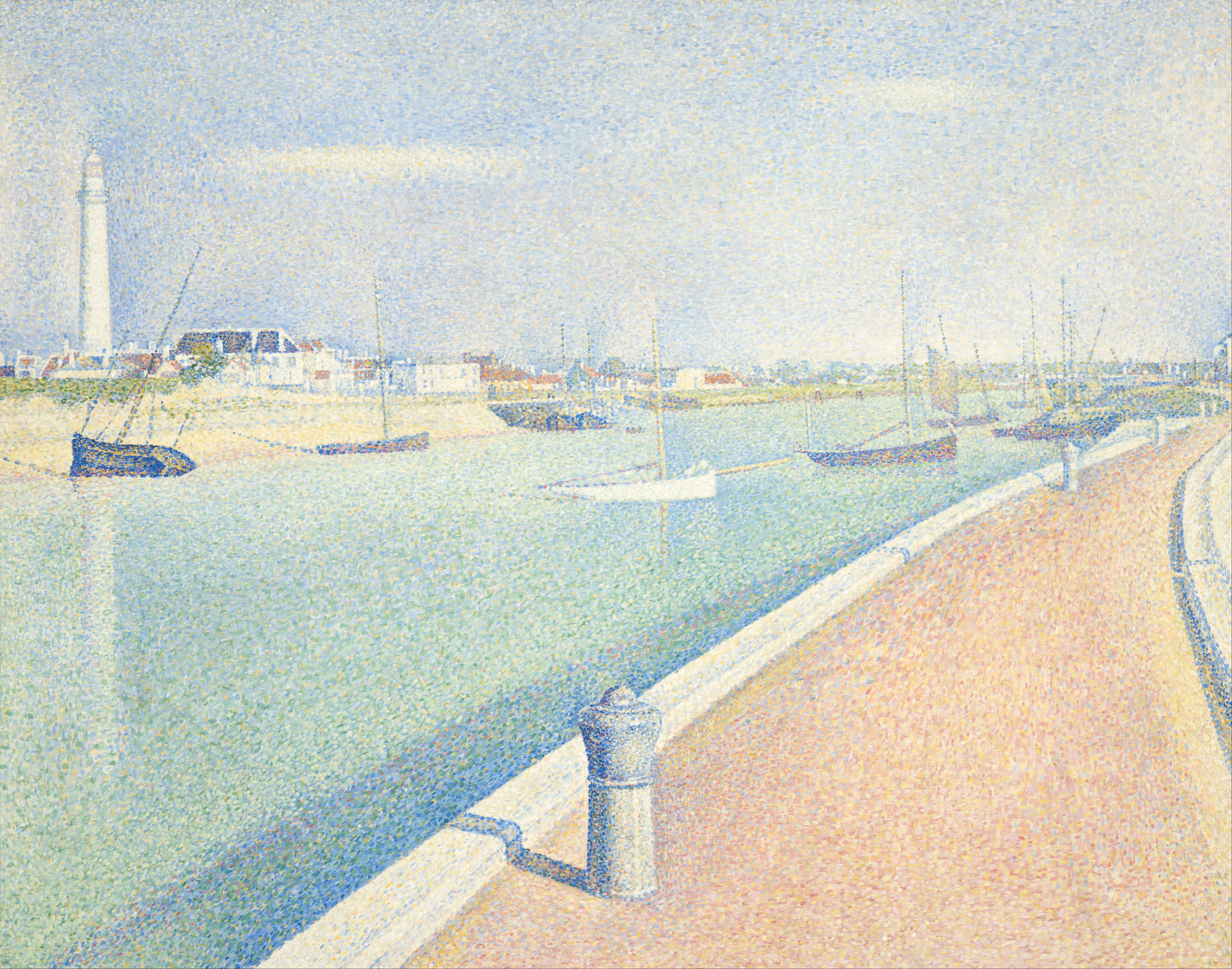
The Channel of Gravelines, Petit Fort Philippe is Seurat’s quiet harbour scene of 1890, one of the last he painted. The original measures 92.1 x 73.3 centimetres, is oil on canvas, and is held and shown by the Indianapolis Museum of Art at Newfields under accession 45.195. From us it is made as a hand-painted work, in seven sizes or to your own measurements, up to 200 x 160 cm, and before dispatch you receive a photograph of the finished work for approval.
| Title: | The Channel of Gravelines, Petit Fort Philippe |
| Other titles: | The Channel of Gravelines, Petit Fort Philippe – the museum’s own title |
| Painter: | Georges Seurat (Paris 1859–1891) |
| Year painted: | 1890 |
| Original size: | 92.1 cm x 73.3 cm |
| Original technique: | Oil on canvas |
| Painting style: | Neo-Impressionism, as the museum puts it – fine points of colour; pointillism |
| Located at: | Indianapolis Museum of Art at Newfields (accession 45.195, on display in H206) |
| Our reproduction: | hand-painted oil on canvas, 7 sizes from 70 x 55 cm to 200 x 160 cm, custom size up to 200 x 160 cm on request |
The Channel of Gravelines, Petit Fort Philippe – Georges Seurat
What is on the canvas?
A harbour in northern France, quiet and orderly. The museum describes it on its own gallery label like this: Seurat methodically applied fine points of colour and caught the purity of coastal air and light; he arranged the vertical and horizontal elements of the scene so carefully that a deftly balanced composition resulted, remarkably faithful to the actual appearance of the port.
The second half of that sentence is the part people skip. A canvas painting from this series is not an invented scene: the museum says the port looks the way it really looked. The method is scientific; the scene is not. The movement Seurat led is called neo-impressionism and his method pointillism; for this work the museum uses the first word, and both describe the same painting.
The narrow dotted border, and a frame the painter designed
A narrow dotted border runs around the edge of the canvas — the museum’s own phrase. It is not decoration: it belongs to the work, and it is also where the painter signed. The museum records the signature in blue paint on the lower right border, dated 1890, and a colourman’s stamp on the reverse, Chabod of Paris.
The frame the work sits in today is a reproduction based on the frames Seurat designed for his own seascapes. The museum explains how it works: its ultramarine blue enhances the scene’s luminosity, and the flecks of colour on it repeat the hues of the dotted border on the canvas. So the painter decided for himself where the work ends — exactly as in Gray Weather, Grande Jatte, where he added the painted border shortly before its first exhibition.
The last seascapes: Gravelines, 1890
Gravelines is a small port in northern France near the Belgian border, where Seurat went in the summer of 1890. How the museum itself sees that season is given by the title of its own 1990 exhibition: Seurat at Gravelines: The Last Landscapes. The painter died the following year, aged thirty-one.
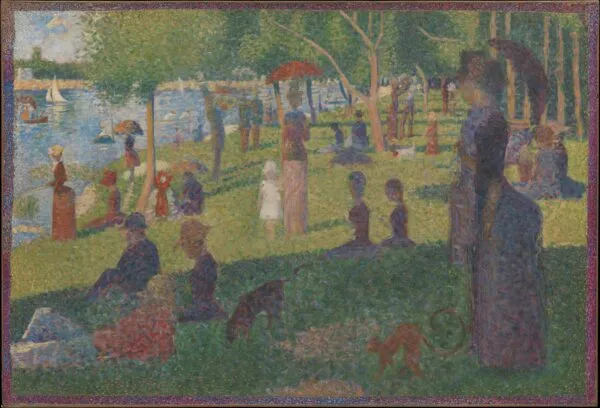
Two more scenes of the same harbour are in our gallery: The Channel of Gravelines, Grand Fort-Philippe, held by the National Gallery in London, and The Channel at Gravelines, Evening. Anyone who wants to see where this coast came from should look at the earlier sea: Boats, Low Tide, Grandcamp. And the large scene everyone knows him for is Sunday Afternoon on the Island of La Grande Jatte.
The road to Indianapolis: from Reid and Lefevre onward
The museum publishes the whole chain of owners, and because it publishes it, we give it. The work was already with the dealers Reid and Lefevre in London by 1926, then with the Bignou Gallery in New York by 1937, and with M. Knoedler & Co. in New York by 1945.
In June 1945 Caroline Marmon Fesler of Indianapolis (1878–1960) bought it and gave it that same year to the John Herron Art Institute, which became today’s Indianapolis Museum of Art at Newfields. That is why the names Fesler and Marmon appear in the museum’s credit line.
The museum even backs its statements with sources: for 1926 it cites Roger Fry’s Transformations, London 1926, and for 1927 the Bignou Gallery catalogue The Post-Impressionists. We meet the London dealers Reid and Lefevre once more in our gallery — in the chain of owners the National Gallery in London publishes.
Where has the work been shown?
The exhibition list the museum publishes is long and reaches back into the painter’s own lifetime: in 1891, the year he died, the work was at the retrospective of the Société des Artistes Indépendants. Then Le Néo-Impressionnisme in 1932, the great Seurat exhibition at the Grand Palais and at the Metropolitan Museum in 1991 and 1992, and a Seurat show at the Kröller-Müller Museum in 2014.
The newest entry is from this year: Seurat and the Sea at the Courtauld Gallery in London, 13 February to 17 May 2026. So the work was in London this spring; the museum now again records it as on display in its gallery H206.
Why did we correct the measurement?
Until today this page carried 92.7 x 73 centimetres. The museum’s own page now gives the canvas as 28-7/8 x 36-1/4 inches, which is 73.3 x 92.1 centimetres — in our notation 92.1 x 73.3 cm. The difference is a good half centimetre in width.
The old figure was not invented: the archived copy of the same museum page from 2013, which we also read, gives 28 7/8 x 36 1/2 inches — exactly 92.7 centimetres. So the museum has re-measured the work in the meantime. What the institution that holds the painting publishes today is what counts, and that is now what the table says. It also records the framed size: 36-1/8 x 43-3/4 inches, about 92 x 111 centimetres.
How is our hand-painted version made?
By hand and with a brush, never with a printer. Our painter works in oil colours on canvas, and with this subject the hardest thing is exactly what the museum calls balance: the verticals of the pier and the horizontals of the water have to stay calm, or the scene loses the very thing that makes it work. The method forgives no hurry: a dot placed without thinking shows. That is why every hand-painted copy is unique and no two are quite alike.
For this subject we have no studio photographs of our own yet. When we next paint it, we will photograph it, and the photographs will appear on this page. What holds meanwhile holds for every oil painting reproduction we make: before dispatch you receive a photograph of the very canvas painted for you, and it leaves only once you have approved it.
Which size for which wall?
The original measures 92.1 x 73.3 centimetres, width first and then height, the way we give measurements everywhere. The format is landscape but only a little wider than tall, so the scene does not need a long wall.
None of our seven sizes matches the original: 70 x 55 cm is smaller, and 100 x 80 cm is the closest and a little larger. We are not going to round that into a claim that we sell the work at its original size, because we do not. For a living room we suggest 120 x 100 or 140 x 110 cm; 160 x 130 and 180 x 140 cm fill the wall above a sofa; 200 x 160 cm is for large rooms, where the dots get the air they need.
Custom size, stretcher and frame
If none of the seven sizes fits your wall, we paint to your measurements, up to 200 x 160 cm, and keep the ratio of the original, so the scene is never stretched; that is our custom size painting. You can order the painting in three forms: as a rolled canvas without a stretcher, stretched on a wooden stretcher and ready to hang, or framed; you choose the form when you order.
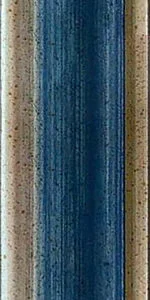
You choose the frame in our 3D frame viewer. With this subject it is worth thinking twice, because the original has its dotted border and a frame designed for it: a dark, quiet frame will work with it, a gilded and ornamented one will argue with it. Our separate room-placement service shows how it will look on your own wall.
Delivery and guarantee
Every copy is made to order in our studio in Slovenia, so allow 15 to 45 days depending on size. We ship it in the form you chose when ordering — rolled, stretched or framed — protected, across the EU, customs-free. You approve a photograph first, and our returns policy applies. The full range by this painter is in the Georges Seurat gallery, and his work is described in our article on Georges Seurat. A fine art reproduction of a famous painting is always made here the same way.
Frequently asked questions
Where is the original?
In Indianapolis, at the Indianapolis Museum of Art at Newfields, accession 45.195. The museum records that it is on display in gallery H206.
What year is it from?
1890, as the museum gives it – a single year, so that is how we write it.
How big is the original?
The museum gives 28-7/8 x 36-1/4 inches, which is 73.3 x 92.1 centimetres, in our notation 92.1 x 73.3 cm.
Why was the measurement different before?
Because the museum has since corrected it. Its page gave a width of 36 1/2 inches in 2013 and gives 36-1/4 today. Today’s figure is the one that counts.
What is the dotted border?
A narrow band of dots around the edge of the canvas, which the museum names expressly. The painter signed into it, in blue paint, dated 1890.
Is the frame original?
No. The museum says the present frame is a reproduction based on the frames Seurat designed for his own seascapes.
Where is Gravelines?
A small port in northern France near the Belgian border. The museum called its 1990 exhibition of these works the last landscapes.
Which size should I choose?
For a living room, 120 x 100 cm. The closest to the original is 100 x 80 cm, though it is a little larger.
Can I have a size that is not on the list?
Yes. We paint to measure, up to 200 x 160 cm, and keep the ratio of the sides of the original.
Is this a print?
No. The work is painted by hand in oil colours; the strokes can be seen and felt, which a print cannot imitate.
Is it suitable as a gift?
Yes. The subject is quiet and bright and suits any room. To leave the choice to the recipient, there is a gift voucher.
- Subject: the quiet harbour at Gravelines, summer 1890 – one of the last works Seurat painted
- Original: 92.1 x 73.3 cm, oil, Indianapolis Museum of Art at Newfields (45.195)
- Our version: a hand-painted canvas, seven sizes from 70 x 55 to 200 x 160 cm
- Important: this French painter signed into the dotted border of the canvas, not into the scene