


Description
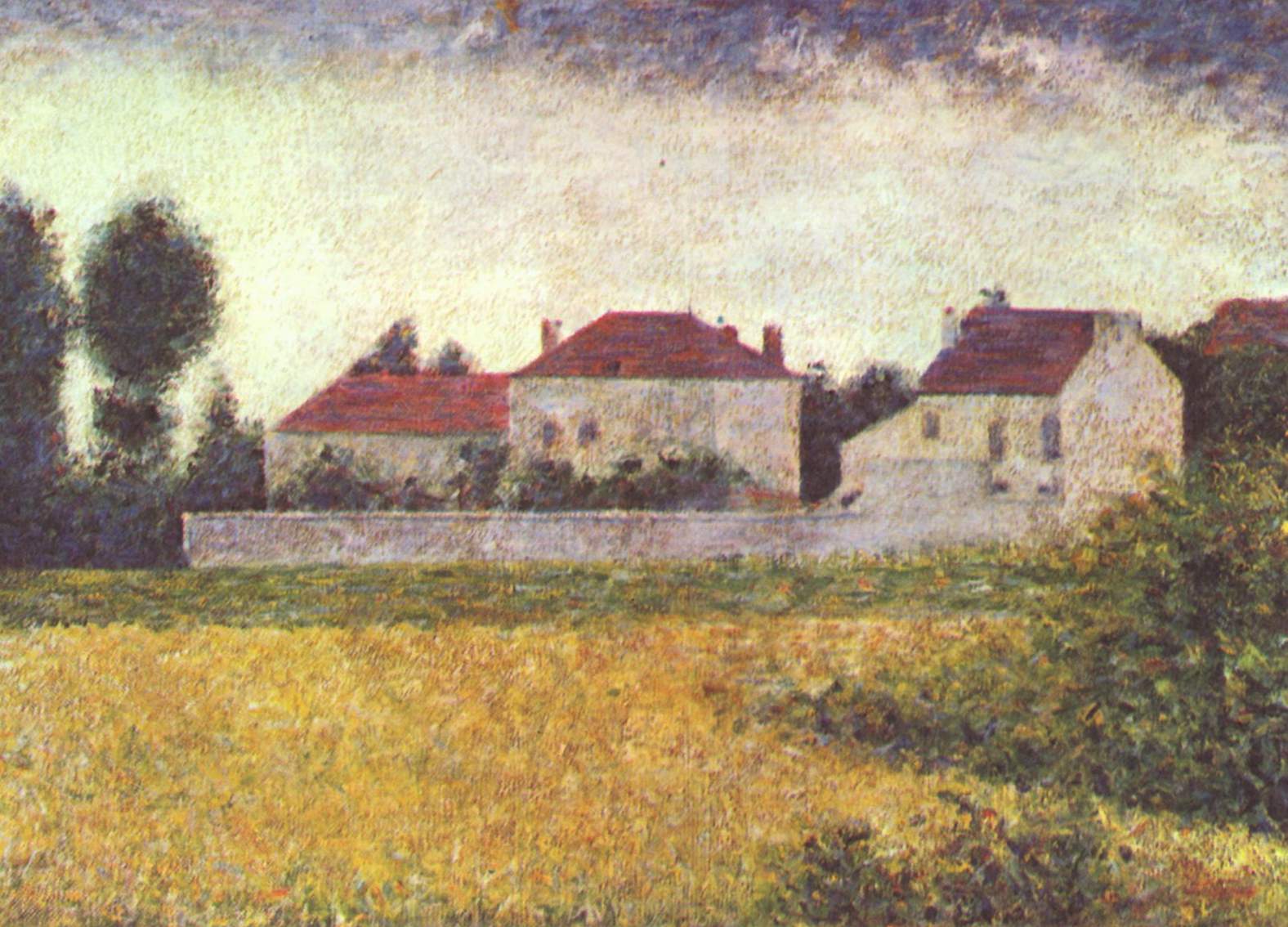
Ville-d’Avray, White Houses is an oil painting on canvas by Seurat from 1882: across a sunlit wheat field we look at a cluster of white-walled, red-roofed farmhouses, with dark trees on the left and a dense green bush on the right. The original, 46 x 33 cm, is held by the Walker Art Gallery in Liverpool under accession number WAG 6112. We make it as a fine art reproduction, hand-painted in oils on canvas, in seven sizes or to measure, and you approve a photograph of the finished work before dispatch.
| Title: | Ville-d’Avray, White Houses |
| Other titles: | »Ville D’ Avray, White Houses« |
| Painter: | Georges Seurat (1859–1891) |
| Year painted: | 1882 |
| Original size: | 46 cm x 33 cm |
| Original technique: | Oil on canvas |
| Painting style: | Simple shapes and small touches of complementary colour, before the dots |
| Located at: | Walker Art Gallery, Liverpool (inv. no. WAG 6112) |
| Our reproduction: | hand-painted in oils on canvas, 7 sizes from 25 x 16 cm to 120 x 75 cm, custom sizes on request |
Ville-d’Avray, White Houses – Georges Seurat
What does the painting show?
Farmhouses in the countryside outside Paris, as the museum describes them, seen across a sunlit wheat field. In the middle stand three houses with almost white walls and red, chimneyed roofs; the windows are mere darker patches. At the far upper right another red roof peeps out from behind the bushes. In front of the houses runs a long, low, pale wall that cuts across the scene like a line. Tall, dark trees tower on the left; on the right a dense green bush reaches from the wall to the bottom edge. The lower half is the field in yellow and golden tones, with a narrow strip of green grass before the wall. There is not a single person; the houses, field and light tell the story.
What is on the canvas?
A horizontal canvas, 46 cm wide and 33 cm high. The museum notes that simple shapes are set against complex colours, and you can see it: the houses are a few clear planes, their walls pale, the roofs brick-coloured, the low wall in front one long band. The colours, though, are anything but simple. The field is painted in small strokes of yellow, orange, green and pink that merge from a distance into sunlit wheat. The sky is pale yellowish and white, thickening at the top into a darker grey-violet band of cloud. The bush on the right, the museum records, is painted in various greens with small touches of red, blue and orange. The strokes are short and cross in places; there are no true dots yet.
Why does this painting matter?
Because it shows the painter experimenting. The museum writes that this view allowed Seurat to experiment with form and colour. It shows best in the bush on the right: according to the museum, complementary colours placed side by side create a stronger optical effect. So the green with red touches looks alive, not muddy. The French painter, the museum goes on, later developed this method more scientifically, used it rigorously and on a larger scale, painted with dots of pure colour and created the style that made him famous: pointillism. This canvas records the start of the road to his best-known paintings. For a buyer it is a very bright, calm Seurat, lovely to have in view every day.
What does the painting mean?
A quiet sunny day in the country, shown without embellishment. No event and no people: the houses stand behind the wall, the field shines in the sun, the trees are still. Seurat tells no story; he observes how light falls on a white wall and yellow wheat, and how green strengthens beside red. That stillness gives the scene its strength. At home the painting feels warm and bright; the golden field and white walls bring sunshine into a room even in winter, while the dark trees and the bush give it weight.
What happened to the original?
The museum publishes a list of previous owners that is not in order, so we give the dated entries first. Eugene Garlot, or Guilot as the record also has it, owned the painting until 1936, when it was sold. The Lefevre gallery had it from 1936 and sold it to Mrs Chester Beatty. (Alfred) Chester Beatty owned it until 1961. That year the Walker Art Gallery bought it with the help of the Art Fund. The record also names Henri Lebasque and Mrs Edith Beatty (née Dunn) as previous owners, without dates. It is now in the gallery’s permanent collection and, according to the record, on view in room 09. It appears in the gallery’s 1977 catalogue of foreign works, on page 202. All details are taken from the museum record.
What place does this painting have among Seurat’s works?
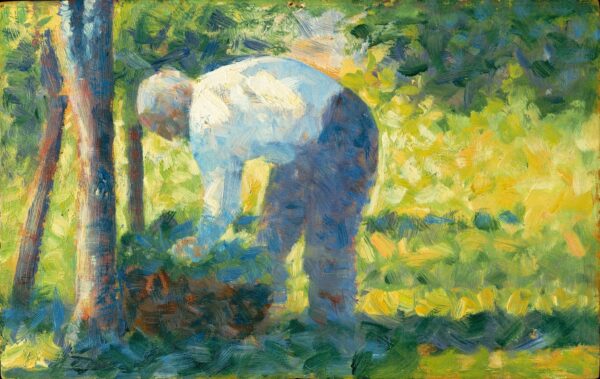
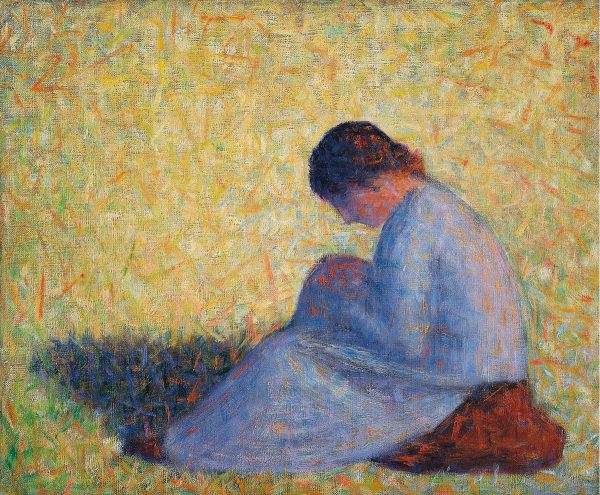
It belongs with Seurat’s early canvases, painted before the pictures made of dots. From the same years we also offer The Suburbs (La Banlieue), where white houses likewise stand behind an empty field, Farm Women at Work, with two women bent over their work in the field, and Peasant Woman Seated in the Grass (Paysanne assise dans l’herbe) from 1883, held by the Guggenheim Museum in New York. Together they show the painter testing colour in fields and by houses before his large canvases.
How is our hand-painted version made?
With a brush and oil paint, never with a printer. Our painter works from a photograph of the original and keeps what makes this canvas special: the clear planes of the houses, the small strokes in the wheat and the touches of red, blue and orange in the green bush. A pointillist technique would be wrong here, as Seurat only developed his dots later; the painting would lose its short, lively strokes. Since everything is done by hand, no two canvases are ever the same, and each hand-painted copy is unique. We have no photographs yet of our own finished canvas of this subject; when we paint it for the first time, we will photograph it and publish the photographs here.
Which size suits which wall?
If you are not sure which to choose, take 60 x 40 cm. The original measures 46 x 33 cm; the nearest size in our range is 50 x 30 cm, which is 4 cm wider and 3 cm shorter than the original. Note that all our sizes for this subject are more elongated than the original, whose side ratio is about 1.39 : 1. For exactly the original’s proportions, order it made to measure, up to 120 x 75 cm. The horizontal format suits a wall above a chest of drawers, a bed or a sofa. 25 x 16 and 50 x 30 cm suit a smaller wall or a group of works; 60 x 40 and 70 x 45 cm a hallway or bedroom; 80 x 50 and 90 x 60 cm hold their own above a desk or in a dining room; and 120 x 75 cm is our largest size for this subject, as the photograph of the original we paint from allows nothing larger. Every canvas painting of this subject is made to order.
Custom size, stretcher bar and frame
If none of the seven sizes suits your wall, or if you want the original’s proportions, we paint to your measurements, up to 120 x 75 cm, so the houses, field and bush keep the balance of the Liverpool canvas; that is our custom size painting service. You can order the painting in three forms: as a rolled canvas without a stretcher, stretched on a wooden stretcher bar and ready to hang, or framed; you choose the form when you order. You choose the frame in our 3D app, which shows gold, silver, black, white and wooden profiles on this subject; the app is for the frame only. To see the painting on your own wall, our room-visualisation service is available separately.
Delivery and guarantee
Each copy is painted in our studio in Slovenia, so allow 15 to 45 days depending on size. We send it in the form you chose when ordering — rolled, stretched or framed — protected for transport, within Slovenia and across the EU without customs duty. Before dispatch you approve a photograph of the finished work, and our returns policy covers every order. All of Seurat’s subjects are in the Georges Seurat gallery, and our article about Georges Seurat tells you when a reproduction of a famous painting is really good.
Frequently asked questions
Where is the original?
At the Walker Art Gallery in Liverpool, under accession number WAG 6112. The gallery bought it in 1961 with the help of the Art Fund.
Are there people in the painting?
No. The canvas shows only the houses, the wall, the trees, the bush and the wheat field.
What does the title mean?
Ville-d’Avray is the place named in the title; the museum describes the scene as farmhouses in the countryside outside Paris. The white houses are the ones in the middle of the painting. The museum lists the work as »Ville D’ Avray, White Houses«.
Is this a print?
No. Our painting is painted by hand, in oil on canvas; you can see and feel the brushstrokes.
Which size should I choose?
For most walls, 60 x 40 cm; for the size closest to the original, 50 x 30 cm. For the exact proportions of the original, choose a custom size up to 120 x 75 cm. The detailed guide is above.
Can I have a size that is not on the list?
Yes. We paint to measure, up to 120 x 75 cm, and, if you wish, keep the original’s side ratio of 46 : 33.
Is this already neo-impressionism?
Not yet. According to the museum record, Seurat later developed the method he was testing here more scientifically and used it on a larger scale, with dots of pure colour. This canvas dates from 1882 and has no true dots yet.
What does the painting say in one sentence?
That a few white houses behind a golden field become a painting full of light when the colours are placed side by side just right.
Is the original for sale?
No. The canvas is in the Liverpool gallery’s permanent collection and is not for sale, but we paint its subject by hand for you.
How high should I hang it?
With its centre at eye level, about 145–150 cm from the floor; hang the smaller sizes lower, closer to where you sit.
Is it suitable as a gift?
Yes, especially for someone who loves the countryside and sunny colours. If you would rather leave the choice to the person receiving it, there is our gift voucher.
- Subject: white farmhouses with red roofs beyond a sunlit wheat field – 1882
- Original: 46 x 33 cm, oil paint on canvas, Walker Art Gallery, Liverpool (inv. no. WAG 6112)
- Ours: hand-painted oil painting reproduction on canvas, seven sizes from 25 x 16 to 120 x 75 cm, as a rolled canvas, stretched on a stretcher bar or framed — your choice
- Worth knowing: touches of red, blue and orange are hidden in the green bush on the right