



Description
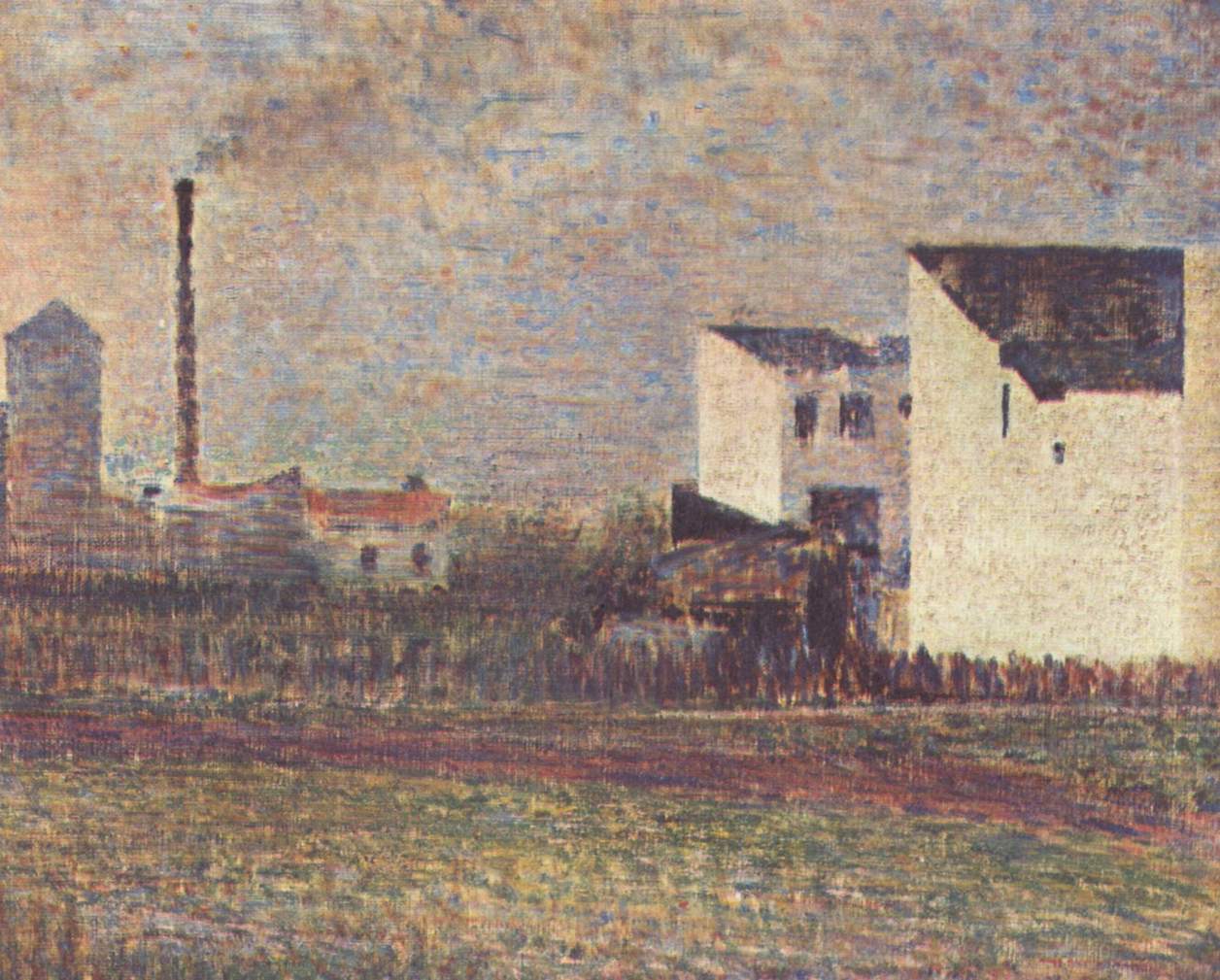
The Suburbs (La Banlieue) is an early painting by Seurat from about 1882: at the edge of town a tall factory chimney rises smoking above low roofs, plain white houses stand on the right, and an empty field stretches across the foreground. The original, 40.5 x 32.4 cm, belongs to the French State and is held by the Museum of Modern Art in Troyes under number MNPL 304. We make it as a canvas painting, hand-painted in oils, in six sizes or to your own measurements, and you receive a photograph of the finished work for approval before dispatch.
| Title: | The Suburbs (La Banlieue) |
| Other titles: | La Banlieue |
| Painter: | Georges Seurat (1859–1891) |
| Year painted: | about 1882 |
| Original size: | 40.5 cm x 32.4 cm |
| Original technique: | Oil on canvas |
| Painting style: | Early work – before the dots |
| Located at: | Museum of Modern Art, Troyes (inv. no. MNPL 304) |
| Our reproduction: | hand-painted in oil on linen, 6 sizes from 46 x 38 cm to 90 x 75 cm, custom sizes on request |
The Suburbs (La Banlieue) – Georges Seurat
What does the painting show?
The edge of town, where the houses stop and the fields begin. On the left a tall, thin factory chimney rises above everything, and grey smoke rolls out of it and spreads across the sky. Beside it stands a larger building with a square tower, low houses with red roofs line up in the middle, and on the right two large white houses stand with flat, bare walls and hardly any windows. A low fence or a line of bushes runs in front of the houses, and the lower half of the canvas is an empty field in browns, greens and violets. There is not a single person in the picture. The painter did not choose a pretty view but the most ordinary stretch of the Paris outskirts.
What is on the canvas?
A horizontal canvas in muted, earthy colours. The sky is grey and pinkish violet, painted with broad, crossing strokes that thicken here and there into darker clouds of smoke. The buildings are set down in clear, simple planes: the white walls on the right shine as the only clean light in the picture, the roofs in the middle are brick red, and the tower on the left is darker. The field below is painted in horizontal and slanting strokes of brown, olive green and violet that give the feeling of rough ground. The strokes are short and cross each other like a net; there are no dots yet. That net of strokes is typical of Seurat’s work from the early 1880s, before he developed the method he is known for.
Why does this painting matter?
Because it shows the young Seurat before he became the painter of dots. In his early years this French painter often painted the outskirts of Paris – fields, workers, factories – and this canvas is one of the clearest examples of that period. The pointillism he developed a few years later is not here yet, but everything else that interested him already is: a calm, solid composition, the clear shapes of the houses and an unusual choice of subject with no romance at all. Neo-impressionism, with all its precision, later grew out of observations like these. For a buyer it is a Seurat known mostly to connoisseurs.
What does the scene mean?
An image of the modern world as it was, without embellishment. At a time when other painters were looking for beautiful landscapes, Seurat put a factory chimney and an empty field at the centre. The painting neither condemns nor celebrates; it simply shows the town eating into the countryside. That is why it feels surprisingly modern, almost like an early photograph of an urban fringe. On a wall it feels calm and serious, and its earthy colours sit well with wood, concrete and simple furniture.
What happened to the original?
The official State record names Félix Fénéon as an earlier owner and records his sale at the Hôtel Drouot in Paris on 30 May 1947, where the painting was lot 101. It then belonged to Pierre and Denise Lévy, who gave it to the French State in 1976, and the State assigned it to the Museum of Modern Art in Troyes. The record also lists three exhibitions in Paris: at the Durand-Ruel gallery in 1934, at Paul Rosenberg’s gallery in 1936 and at Durand-Ruel again in 1938. Those details are the State record’s; we add none of our own.
Where does this painting sit in Seurat’s work?
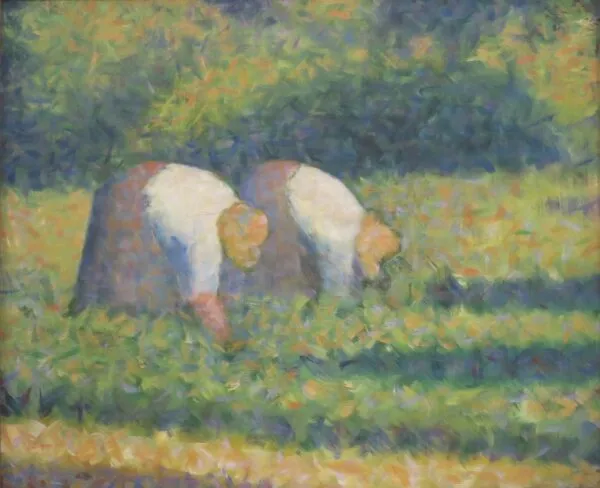
It belongs with Seurat’s early canvases of the early 1880s, when he painted work and landscape on the outskirts. From the same period we also sell The Stone Breaker, Farm Women at Work and Peasant Woman Seated in the Grass (Paysanne assise dans l’herbe). Factory chimneys appear again in the large canvas Bathers at Asnières, held by the National Gallery in London.
How is our hand-painted version made?
With a brush and oil paint, never a printer. Our painter works from an image of the original and keeps what makes this early work special: short, crossing strokes, muted colours and the solid planes of the buildings. Fine dots would be wrong here, because the canvas was painted before Seurat developed them. Because everything is done by hand, no two canvases are ever quite alike and every hand-painted copy stays a one-off. We do not yet hold our own photographs of a finished canvas of this subject; the first time it is painted we will photograph it, and the photographs will appear here.
Which size for which wall?
If you are not sure which to choose, take 60 x 50 cm. Our smallest size, 46 x 38 cm, is 5.5 cm wider and 5.6 cm taller than the original, which measures 40.5 x 32.4 cm; there is no size at the scale of the original in our range. The format is horizontal, so it suits a chest of drawers, a desk or a study. 46 x 38 and 50 x 40 cm suit smaller walls and hallways; 60 x 50 and 70 x 60 cm fill a wall on their own; 80 x 65 and 90 x 75 cm are the largest sizes we offer for this subject, because the image of the original we work from is not sharp enough for anything larger. Every oil painting reproduction of this subject is made to order.
Custom size, stretcher bar and frame
If none of the six sizes fits your wall, we paint to your measurements, up to 90 x 75 cm, and keep the ratio of the original, so the chimney and the houses stay in balance; that is our custom size painting service. You can order the painting in three forms: as a rolled canvas without a stretcher, stretched on a wooden stretcher bar and ready to hang, or framed; you choose the form when you order. You choose a frame in our 3D frame viewer, which shows gold, silver, black, white and natural wood profiles on this subject; it is for choosing a frame and nothing else. For a view of your own wall there is our room-visualisation service, ordered separately.
Delivery and guarantee
Every canvas is painted to order in our studio in Slovenia, so allow 15 to 45 days depending on the size. We ship it in the form you chose when ordering — rolled, stretched or framed — protected for transport, across the EU customs-free. Before dispatch you approve a photograph of the finished work, and our returns policy covers every order. All of Seurat’s subjects are in the Georges Seurat gallery, and our article about Georges Seurat explains when a fine art reproduction is really good.
Frequently asked questions
Where is the original?
In the Museum of Modern Art in Troyes, under number MNPL 304. It belongs to the French State, which received it in 1976 as a gift from Pierre and Denise Lévy.
Are there people in the painting?
No. The canvas shows only a factory chimney, houses and a field; the painter left the suburb empty.
Is La Banlieue the same work?
Yes. That is the original French title under which the State record lists the work; The Suburbs is our English title for the same canvas.
Is this a print?
No. The work is painted by hand in oil on canvas; the brushwork is visible and can be felt.
Which size should I choose?
For most walls, 60 x 50 cm; for the size closest to the original, 46 x 38 cm. The full guide is above.
Can I have a size that is not listed?
Yes. We paint to measure, up to 90 x 75 cm, and keep the side ratio of the original.
Why are there no dots in the painting?
Because Seurat painted it around 1882, a few years before he began to paint in dots.
What is the painting about, in one sentence?
That even the most ordinary edge of a town, with a factory chimney and an empty field, can make a serious and quiet painting.
Is the original for sale?
No. The canvas belongs to the French State and is not for sale; a hand-painted canvas from us lets you have it at home.
How high should I hang it?
Centre at eye level, about 145–150 cm from the floor; hang the smaller sizes lower, nearer where you sit.
Is it suitable as a gift?
Yes, especially for someone who loves architecture or cities. If you would rather leave the choice to the person receiving it, there is our gift voucher.
- Subject: a factory chimney, white houses and an empty field on the edge of Paris – about 1882
- Original: 40.5 x 32.4 cm, oil paint on canvas, Museum of Modern Art, Troyes (inv. no. MNPL 304)
- Ours: a famous painting recreated by hand in oils, six sizes from 46 x 38 to 90 x 75 cm, as a rolled canvas, stretched or framed — your choice
- Worth knowing: there is not a single person in the picture – the factory chimney is the main character