





Description
Turn in the Road at Auvers-sur-Oise – the canvas exhibited for decades under the wrong region’s name
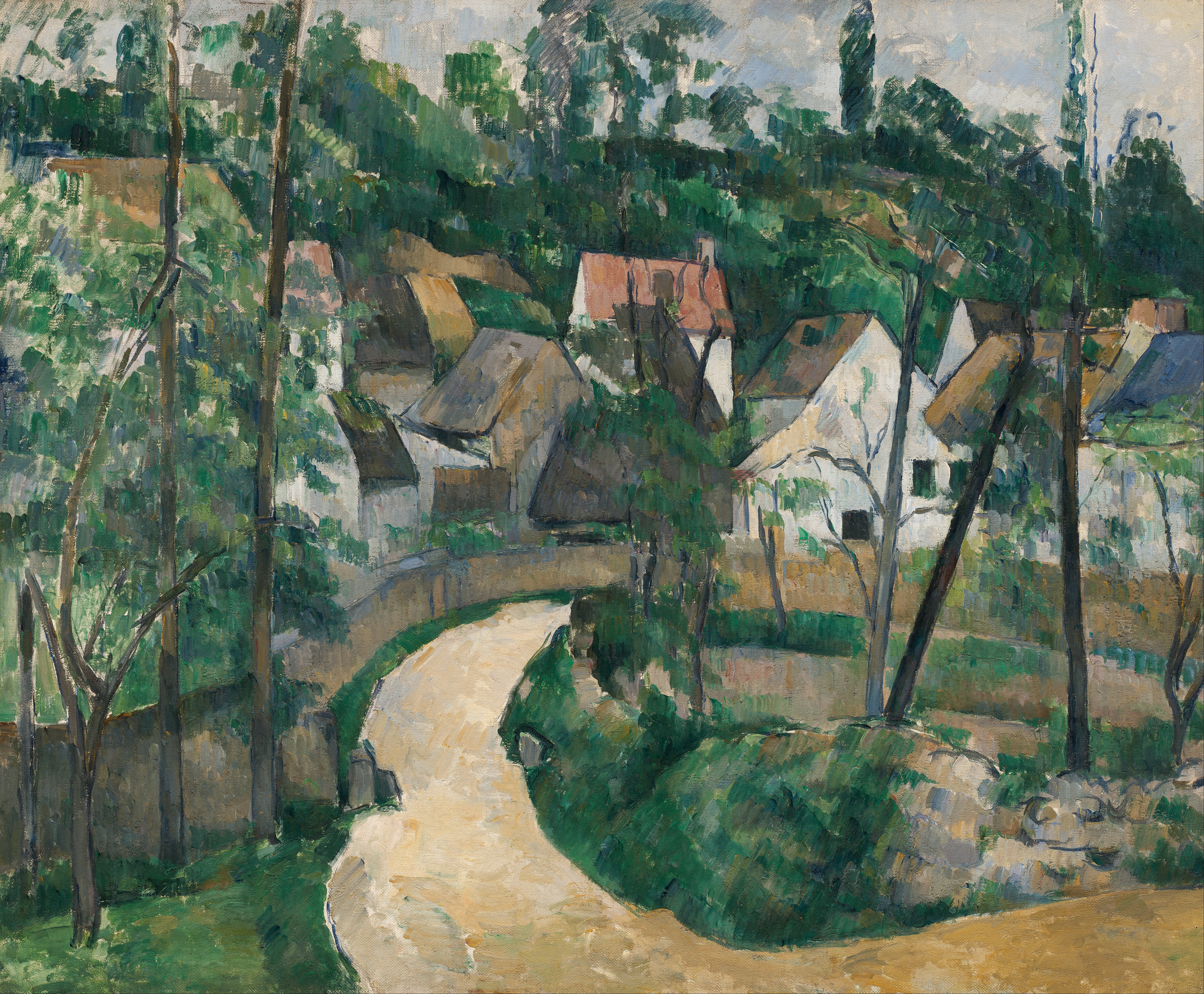
A pale ochre road comes in from the lower left, turns to the right and disappears behind a low stone wall. Beyond the wall farmhouses rise with grey and brownish roofs, and around them stand trees in green, olive and brown. There is only a little sky above the roofs. This hand-painted painting on canvas reproduces Cézanne’s work of about 1881, which measures 60 × 73 centimetres in the original and is held by the Museum of Fine Arts in Boston under the inventory number 48.525.
Four American exhibitions, one wrong title
In January 1928 the canvas was in New York at Wildenstein’s in the exhibition Paul Cézanne as number 14, lent by the Boston collector John T. Spaulding. In March and April 1929 it was at the Fogg Art Museum in Cambridge, near Boston, as number 5 with plate XXIII, and from June to November 1934 at the Art Institute of Chicago in A Century of Progress as number 292. Between these it was shown twice at the Museum of Fine Arts in Boston as well, in 1929 and in 1931–1932. Every time Spaulding lent it – and every time the same wrong place-name stood in the catalogue.
Aix or Auvers
The titles under which the canvas travelled America read Environs d’Aix, Environs d’Aix-en-Provence and Environs of Aix – the country around Aix. But the place painted is not Aix. The catalogue raisonné names among the locales Auvers-sur-Oise and Valhermeil, both in northern France, north-west of Paris; Aix lies in Provence, some seven hundred kilometres further south. The title had therefore missed not the village but the end of the country. Only the full title the catalogue uses today – La Route tournante (rue des Roches au Valhermeil, Auvers-sur-Oise) – names even the street.
Nine owners, two with a question mark
The provenance opens with a name in brackets and a question mark: (Julien-François Tanguy, Paris?). With certainty the canvas belonged to the critic and collector Théodore Duret in Paris; at the sale of his collection at the Galerie G. Petit on 19 March 1894 the work was number 3. There follow the painter Paul-César Helleu, again with a question mark Ambroise Vollard, then Claude Monet, who acquired it on 10 May 1907, and after him his son Michel Monet at Giverny. Later it was with Paul Rosenberg, the Wildenstein galleries in New York, and from 1927 John T. Spaulding in Boston, whose bequest brought it to the Museum of Fine Arts in 1948.
The auction of 1894
The sale of the Duret collection on 19 March 1894 is the one exactly dated transfer in the whole provenance to carry a lot number: the canvas was third in the sale. Duret was a writer and an advocate of the Impressionists, and his sale was one of those events after which works from the circle of sympathetic writers scattered among collectors. The buyer the record does not name; the next name in the chain is Helleu’s.
A road you cannot walk down
The construction is simple and unusual at once. The road turns and vanishes behind the wall – the viewer cannot see where it leads and cannot follow it with the eye. The wall is painted as a single light band, and the houses behind it as blocks set one beside another with no perspective diminution. The trees are painted not as individual crowns but as dense masses closing the space above the houses. That is why the work feels closed: it holds no view, only a stretch of village road and what stands around it.
The turn as a catalogue heading
Among the motifs the catalogue gives this canvas not only houses, road and wall but, separately, the route tournante, the turning road, as a heading of its own. That is not accidental: the same motif stands in the title of several works by Cézanne, and the catalogue treats it as a recurring theme. Among them is a canvas of the same measurements, 60 × 73 centimetres, also in Boston but in a different collection – which is why with this motif the ratio of the sides says nothing, and only the museum’s inventory number tells them apart.
The quiet green and ochre range suits this canvas to a living room or a dining room, where the work is not meant to shout. It is available in fifteen sizes, from 50 × 41 to 180 × 149 centimetres, all measurements in centimetres; intermediate measurements we stretch on a made-to-measure stretcher frame, and the effect of the chosen frame is shown in advance by our 3D application. From the same village comes The House of the Hanged Man at Auvers-sur-Oise, and from the south The Village of Gardanne and The Red Rock.
- Subject: Turn in the Road at Auvers-sur-Oise, Paul Cézanne, about 1881, Museum of Fine Arts, Boston
- Technique: hand-painted painting, oil on canvas, reproduction
- Sizes: 15 dimensions, custom size on request
- Of note: between 1928 and 1934 the canvas was exhibited three times in America as the country around Aix, though it shows Auvers-sur-Oise in northern France