







































Description
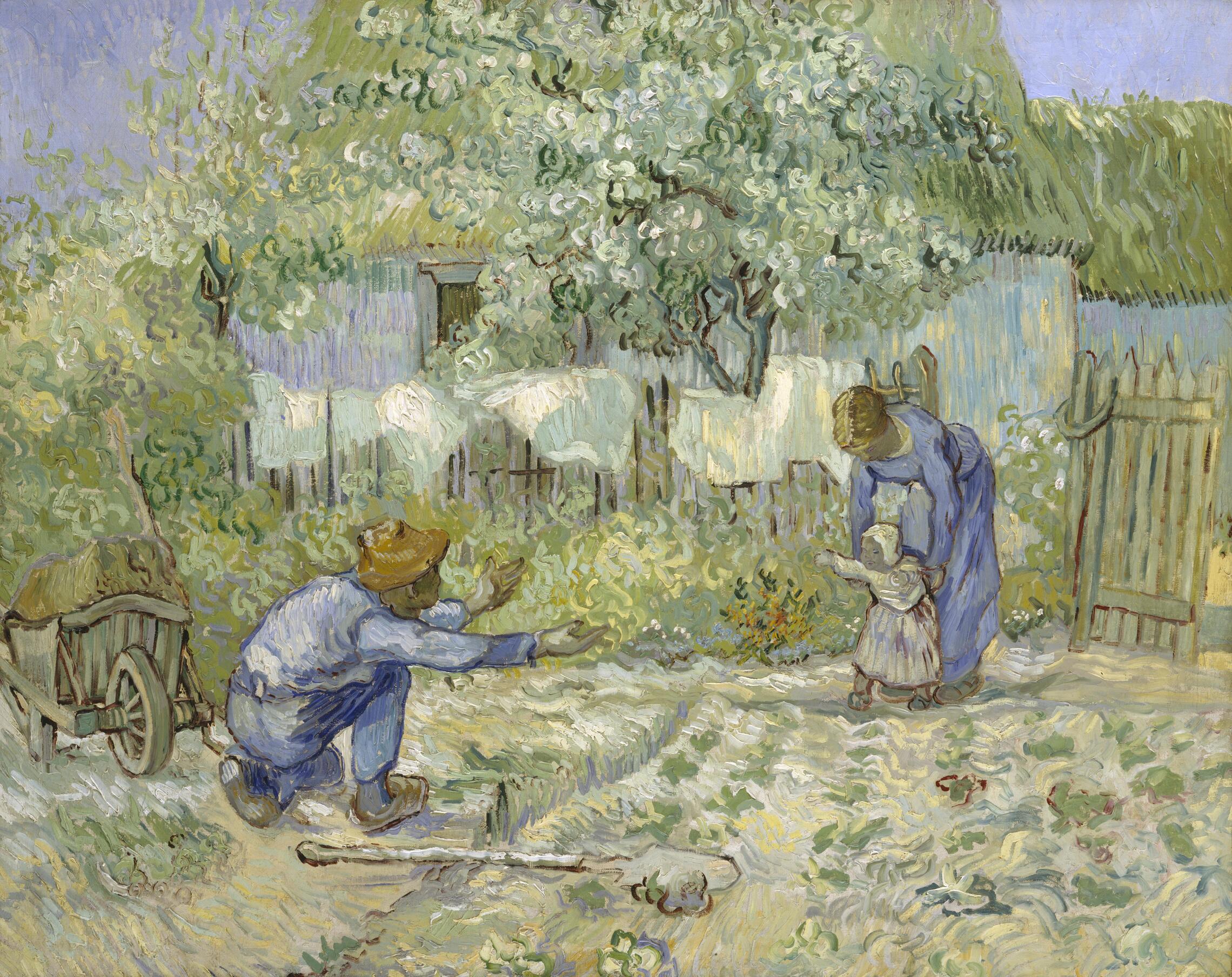
First Steps (after Millet) is the painting Vincent van Gogh made in Saint-Rémy-de-Provence in January 1890 after a work by Jean-François Millet: in a cottage garden a father in blue has put down his spade and kneels with his arms open, while the mother bends over and holds up their small child, who steps towards him. The original, oil on canvas, measures 72.4 x 91.1 cm and belongs to The Metropolitan Museum of Art in New York. We paint it by hand in oil on canvas, in 17 sizes from 50 x 40 to 190 x 151 cm or to your own measurements, and send you a photograph of the finished painting for approval before dispatch.
| Title: | First Steps (after Millet) |
| Other titles: | First Steps, after Millet · First Steps |
| Painter: | Vincent van Gogh (1853–1890) |
| Year painted: | January 1890, Saint-Rémy-de-Provence |
| Original size: | 72.4 cm x 91.1 cm |
| Original technique: | Oil on canvas |
| Painting style: | Post-Impressionism |
| Located at: | The Metropolitan Museum of Art, New York (acc. no. 64.165.2) |
| Our reproduction: | Hand-painted oil on canvas, 17 sizes or made to measure |
First Steps (after Millet) – Vincent van Gogh
What does First Steps (after Millet) show?
The scene is a small garden in front of a country house. On the left a farm worker in blue, with a straw hat, kneels on the path. His spade lies on the ground beside him and a wooden wheelbarrow stands behind him: he has stopped work and stretches out both arms. On the right, by a wooden gate, the mother in a long blue-violet dress bends forward and holds the child under the arms. The child, in a light dress, leans towards the father with one foot already off the ground.
Behind them runs a fence with white washing hung along it, and beyond it rise trees full of pale green and white leaves and the wall of the house. The canvas is painted in light greens, blues and yellows, in short, curving strokes, so that even the path and the vegetable beds seem to move.
Why did Van Gogh paint a copy after Millet?
Because Van Gogh admired Millet, the painter of rural life, and copying gave him work to do while he was a patient at the asylum in Saint-Rémy-de-Provence. According to the Met, he painted this canvas in January 1890, during his voluntary stay there. Of the copies he made at the asylum, about twenty-one were after Millet or inspired by him.
He did not have Millet’s original in front of him. His brother Theo sent him a photograph of Millet’s composition; Van Gogh squared it up, transferred it to the canvas and chose the colours himself, because his source was black and white. The English Wikipedia article on Van Gogh’s copies quotes how he saw this work: not copying, but “rather translating into another language, the one of colors”. Millet’s own version, from about 1858, is in the Lauren Rogers Museum of Art in Laurel, Mississippi.
What does First Steps (after Millet) mean?
It is a scene from everyday family life. Wikipedia describes it simply: the father, having put down his tools, holds his arms outstretched for his child’s first steps. Work stops for a moment, the parents face each other across the path, and the child is the bridge between them.
Millet painted peasants at work and at rest, and Van Gogh kept his composition while making the colour and the brushwork his own. Theo wrote to him that the copies after Millet were perhaps the best things he had done yet. Read that way, the painting is about a small, ordinary moment: a family in its garden, and a child leaving its mother’s hands for the first time.
Where does the original hang?
The original belongs to The Metropolitan Museum of Art in New York, which lists it as First Steps, after Millet, 1890, oil on canvas, 72.4 x 91.1 cm (28 1/2 x 35 7/8 in.), under the accession number 64.165.2 in its department of European Paintings.
It came to the museum in 1964 as a gift of George N. and Helen M. Richard. It is a landscape canvas, 91.1 cm across and 72.4 cm high.
First Steps (after Millet) or another Van Gogh – which should you choose?
The closest companion in our range is The Siesta, also painted at Saint-Rémy in 1890 after Millet: while remaining true to Millet’s composition, Van Gogh uses colour to show the peace of the midday rest. The Sower belongs to a subject he took from Millet and returned to again and again; Wikipedia counts over 30 works on the sower.
Almond Blossom, painted at Saint-Rémy in 1890, was his gift to Theo and his wife Jo after the birth of their son. At Eternity’s Gate is another figure painting from his time in Saint-Rémy. Choose First Steps for a family scene in light greens, The Siesta for warm yellows, The Sower for a wide field and Almond Blossom for blue sky and white flowers.
How is our hand-painted First Steps (after Millet) made?
The painter first draws the three figures, the wheelbarrow, the fence and the house, and checks the proportions against the original. Then come the trees and the sky, after them the fence, the washing and the path, then the blue clothes of the parents and the child’s light dress, and last the faces, the hands and the dark outlines. Our oil painting reproduction is painted by hand on canvas, with real impasto: the paint goes on thickly, so the brushstrokes stand up from the canvas as they do in the original and catch the light.
On this painting the relief shows most in the curving strokes of the trees, in the short strokes of the vegetable beds and the path, and in the folds of the mother’s dress. A print is completely flat; on our painting every brushstroke stands out in real paint.
Every painting is a hand-painted copy made for your order, so no two are quite the same.
Which size for which wall?
Short answer: 50 x 40 or 60 x 50 cm for a narrow wall in a hallway or a child’s room, 80 x 60 or 100 x 80 cm above a chest of drawers or a bed, and 130 x 102 or 150 x 120 cm above a sofa or on a large wall.
There are 17 sizes: 50 x 40, 60 x 50, 70 x 55, 80 x 60, 85 x 67, 92 x 73, 100 x 80, 105 x 85, 110 x 90, 120 x 100, 130 x 102, 140 x 105, 150 x 120, 160 x 127, 170 x 134, 180 x 142 and 190 x 151 cm (width x height). The original is 91.1 cm wide and 72.4 cm high, so our 92 x 73 cm size comes closest to it, and 50 x 40, 100 x 80 and 150 x 120 cm keep its proportions almost exactly. The pale greens and blues look best on a white, cream or light grey wall and in daylight. A painting for the living room should cover about two thirds of the width of the furniture below it.
Hang it with the centre of the canvas about 150 cm above the floor. Above a sofa, a bed or a sideboard, leave 20 to 30 cm between the top of the furniture and the bottom of the canvas.
What if I need a custom size or a frame?
If none of the 17 sizes fits your wall, we paint it to measure in any width and height you need. Send us the width and height you want and we will quote you a price and a delivery time. Every painting we make is mounted on a wooden stretcher, ready to hang.
Our 3D app shows each of our frame profiles on this painting, so you can compare gold, silver, black, white and natural wood. The app is for choosing the frame only. To see the painting on your own wall, use our separate room placement service. A natural wood or white frame keeps the light, airy colours of the garden, while a gold one warms the yellows of the path.
How does delivery work, and what is the guarantee?
Every painting is made to order in our studio in Slovenia, so allow 15 to 45 days depending on the size you choose. We ship it on its stretcher, carefully packed (and framed, if you chose a frame), across the EU with no customs duty. Before dispatch we send you a photograph of the finished painting to approve, and we correct anything that is not right. Our returns policy applies to every order.
You will find more of Van Gogh’s famous works among all our Vincent van Gogh paintings, and more about the painter in our article on Vincent van Gogh. If it is a present and you are not sure of the size, a wall art voucher lets the recipient choose.
Frequently asked questions
Where is the original First Steps (after Millet) today?
In The Metropolitan Museum of Art in New York. The museum lists it as First Steps, after Millet, oil on canvas, 1890, under the accession number 64.165.2. It was given to the museum in 1964 by George N. and Helen M. Richard. Van Gogh painted it in Saint-Rémy-de-Provence.
When and where did Van Gogh paint First Steps?
In January 1890, in Saint-Rémy-de-Provence in the south of France, where he was a voluntary patient at the asylum. The Met dates the painting to January 1890. It belongs to the group of copies he made there after other artists, about twenty-one of them after Jean-François Millet or inspired by his work.
Which Millet work is Van Gogh’s First Steps based on?
On Jean-François Millet’s own First Steps, made in about 1858 and now in the Lauren Rogers Museum of Art in Laurel, Mississippi. Van Gogh never worked from the original: Theo sent him a photograph of it, which he squared up and transferred to the canvas. The colours are his own, because the photograph was black and white.
Who are the figures in First Steps (after Millet)?
A farming family in the garden of their house. The father, in blue work clothes and a straw hat, has put down his spade and kneels with his arms open. The mother, in a long blue-violet dress, bends forward and holds up their small child, who takes its first steps towards him. A wheelbarrow, a fence and white washing complete the scene.
What is the meaning of First Steps (after Millet)?
It shows a small moment of family life: work stops so that a child can walk to its father for the first time. Millet painted rural life, and Van Gogh kept his composition while translating it, in his words, into another language, the one of colours. Theo called the copies after Millet perhaps the best things Vincent had done.
Is First Steps (after Millet) a good gift for new parents?
Its subject is a child’s first steps between its mother and father, so it suits a gift for a birth, a christening or a first birthday. For a child’s room, 50 x 40 or 60 x 50 cm fits beside a cot or above a chest of drawers. If you are not sure of the size, a wall art voucher lets the parents choose themselves.
How big is the original First Steps (after Millet)?
72.4 cm high and 91.1 cm wide, according to The Metropolitan Museum of Art: a medium landscape format. Our 92 x 73 cm size is almost exactly the size of the original. If you want the scene larger, there are 17 sizes up to 190 x 151 cm, as well as custom sizes in any proportions your wall needs.
Which size of First Steps suits a living room?
Above a sofa, choose 130 x 102 or 150 x 120 cm, so that the canvas painting covers a good part of the width of the sofa and the family in the garden reads from across the room. On a narrower wall or above a sideboard, 80 x 60 or 100 x 80 cm works well. For a very large wall, choose our largest size, 190 x 151 cm.
Does your First Steps (after Millet) have the raised brushstrokes of the original?
Yes. We paint it in impasto, building up each brushstroke in thick oil, so the surface is raised like Van Gogh’s original. You see this best in the curving strokes of the trees, in the short strokes of the path and the vegetable beds and in the folds of the mother’s dress, where the relief catches the light.
- Subject: in a cottage garden a father in blue kneels with open arms, his spade on the ground, while the mother holds up their child taking its first steps towards him.
- Original: January 1890, Saint-Rémy-de-Provence, oil on canvas, 72.4 x 91.1 cm, The Metropolitan Museum of Art, New York.
- Ours: a Van Gogh reproduction painted by hand in oil on canvas, in 17 sizes from 50 x 40 to 190 x 151 cm or made to measure.