







































Description
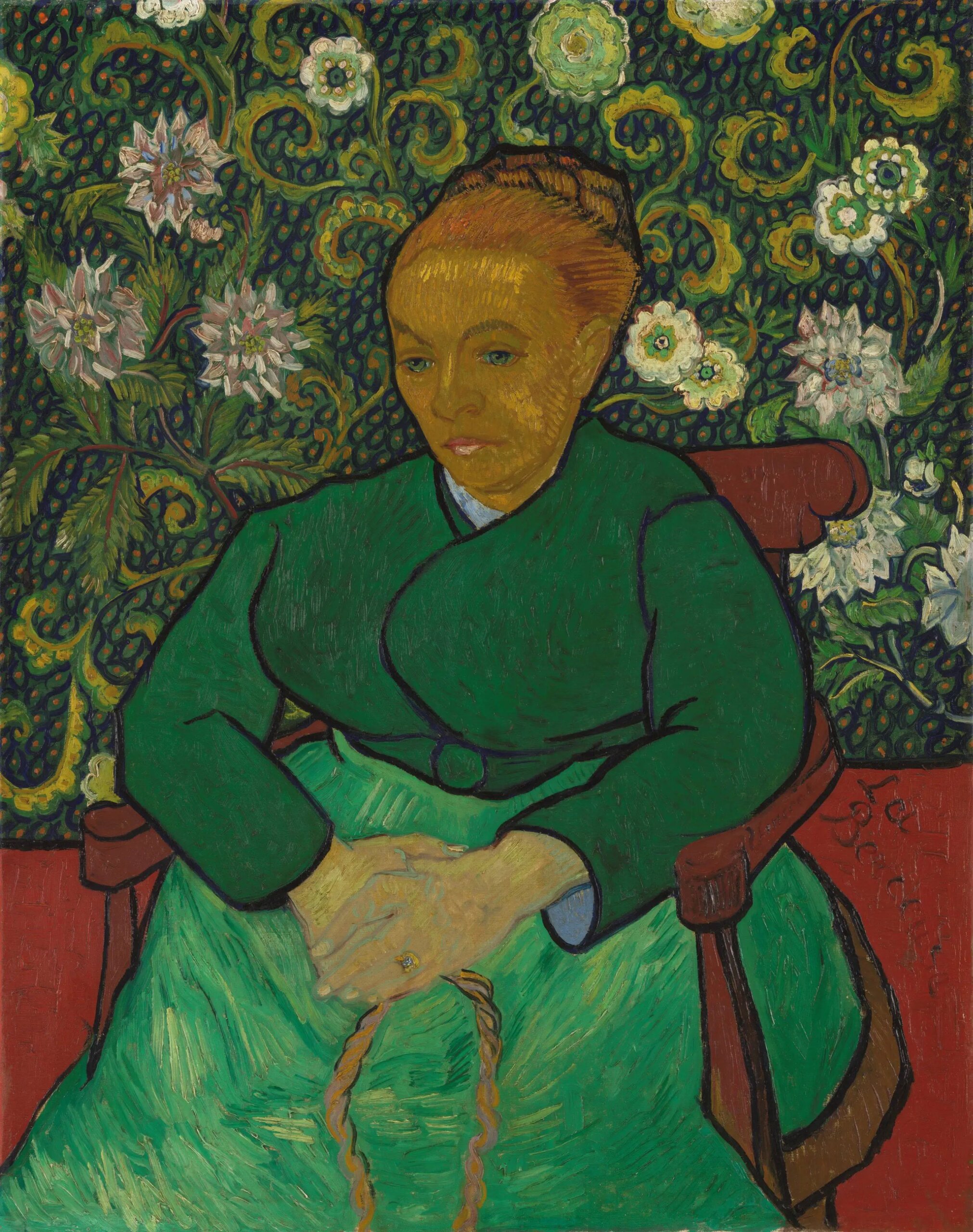
La Berceuse (Augustine Roulin) is Vincent van Gogh’s portrait of Augustine Roulin, the wife of the postman Joseph Roulin, painted in Arles: dressed in green, she sits in a red armchair, her hands folded around a twisted cord, against a dark wallpaper of scrolls and white and pink flowers. The original we paint is the Kröller-Müller Museum version in Otterlo, oil on canvas, 92 x 73 cm, dated December 1888 – January 1889. We paint it by hand in oil on canvas, in 16 sizes from 40 x 50 to 151 x 190 cm or to your own measurements, and send you a photograph of the finished painting for approval before dispatch.
| Title: | La Berceuse (Augustine Roulin) |
| Other titles: | La Berceuse (portrait of Madame Roulin) · La Berceuse (portret van Madame Roulin) |
| Painter: | Vincent van Gogh (1853–1890) |
| Year painted: | December 1888 – January 1889, Arles |
| Original size: | 92 cm x 73 cm |
| Original technique: | Oil on canvas |
| Painting style: | Post-Impressionism |
| Located at: | Kröller-Müller Museum, Otterlo (inv. KM 109.725) |
| Our reproduction: | Hand-painted oil on canvas, 16 sizes or made to measure |
La Berceuse (Augustine Roulin) – Vincent van Gogh
What does La Berceuse (Augustine Roulin) show?
Augustine Roulin sits almost square to us and fills the middle of the canvas. Her orange-red hair is plaited and gathered in a knot on top of her head, and her face is built of short yellow-ochre strokes with green in the shadows. She looks down and a little to our left, past the viewer. Her dark green jacket is drawn with heavy dark outlines and closes with a round button at the waist, with a pale blue collar at her neck. The skirt below is a lighter, brighter green, laid in long strokes.
Her hands lie folded in her lap, a ring on one finger, and from them hangs a twisted cord of orange and grey down to the lower edge. The arms of a red-brown armchair show on both sides. Behind her the wall is a dark blue-green pattern of small orange dots, crossed by yellow-green scrolls and large white and pink flowers; the Kröller-Müller Museum describes them as simplified dahlias. Below runs a band of strong red, and on the right, on that red, the words La Berceuse are written in dark letters.
Who was Augustine Roulin?
She was the wife of Joseph Roulin, the postman in Arles who became Van Gogh’s friend. According to the English Wikipedia article on the Roulin family portraits, she was born Augustine-Alix Pellicot in Lambesc on 9 October 1851 and died on 5 April 1930; she married Joseph, ten years older, on 31 August 1868. They had three children, Armand, Camille and Marcelle, and Marcelle was born on 31 July 1888, a few months before Van Gogh painted her mother as La Berceuse.
Van Gogh painted every member of the family in Arles in 1888 and 1889, and the same article says he gave the Roulins one painting for each of them. Augustine had already sat for him and for Paul Gauguin in the Yellow House the two painters shared.
What did Van Gogh want La Berceuse to say?
The title is French. The Kröller-Müller Museum explains it as ‘she who rocks the cradle’ or a lullaby, and says that Augustine uses the cord in her hand to rock her baby’s cradle, which we never see. In the museum’s reading, Van Gogh cared more about the mood of the painting than about a likeness: Augustine stands for motherhood, and the title and the colours, like the notes of a lullaby, are meant to give a feeling of comfort and warmth to anyone who looks at it.
The English Wikipedia says the colour and the setting were meant to evoke a lullaby that would comfort ‘lonely souls’. The Italian Wikipedia sees the influence of Paul Gauguin’s cloisonnism, flat areas enclosed by dark outlines, but notes that Van Gogh painted the skirt, the face and the hands in his own manner, with figure and wallpaper on the same plane.
Where is the original today?
The canvas we paint is in the Kröller-Müller Museum in Otterlo, in the Netherlands, under the inventory number KM 109.725. The museum records it as oil on canvas and dates it to December 1888 – January 1889, and its own text places the painting in the first months of 1889. The museum’s page gives no size; the Italian Wikipedia gives 1889 and 92 x 73 cm, and the English Wikipedia lists it as F504.
La Berceuse (Augustine Roulin), the other versions and the Sunflowers – which is which?
The English Wikipedia lists five versions of La Berceuse: Otterlo (this one), the Museum of Fine Arts in Boston, the Stedelijk Museum in Amsterdam, the Art Institute of Chicago and the Metropolitan Museum of Art in New York. It notes that in the Boston version the pink of the flowers has faded to white. We paint the Otterlo canvas, with its white and pink dahlias and red armchair.
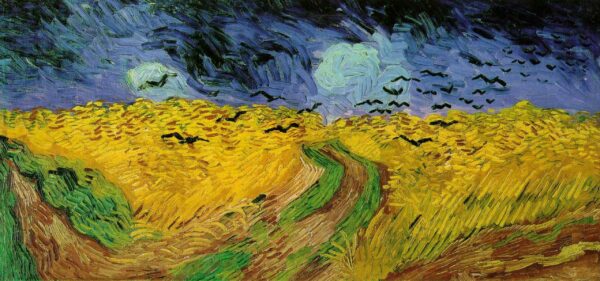
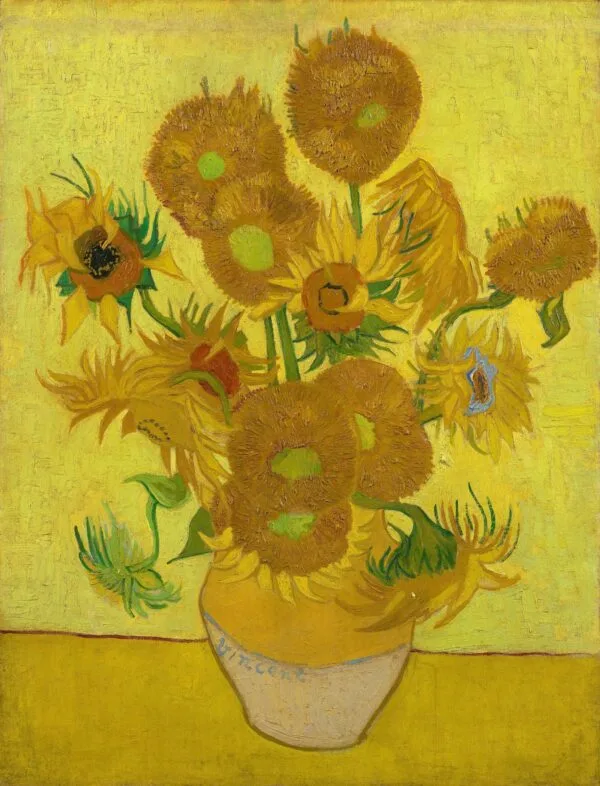
According to the same article, Van Gogh imagined it on the cabin walls of an Icelandic fishing boat, or between two paintings of sunflowers; the Italian Wikipedia describes a planned triptych, meant for ships’ cabins, with sunflowers on either side. Sunflowers I is the National Gallery canvas in London: fifteen sunflowers in a vase against a yellow background. Sunflowers II is the Neue Pinakothek canvas in Munich: twelve sunflowers against a blue-green background. Portrait of Joseph Roulin shows her husband, the postman, and The Yellow House shows the house in Arles where Van Gogh lived and worked.
Choose La Berceuse for a seated figure in deep greens and reds, her husband’s portrait if you want to hang the couple side by side, both Sunflowers for the three-part arrangement Van Gogh described, and the house for yellow walls under a deep blue sky.
How is our hand-painted version of La Berceuse (Augustine Roulin) made?
The painter first sketches the figure, the armchair, the folded hands and the line where the wallpaper meets the red, and checks the proportions against the original. Then comes the dark wallpaper with its dots, scrolls and flowers, after it the red band and the arms of the chair, then the green jacket and skirt with their dark outlines, and last the face, the orange hair, the hands and the twisted cord. Our oil painting reproduction is painted by hand on canvas, with real impasto: the paint goes on thickly, so the brushstrokes stand up from the canvas as they do in the original and catch the light.
On our version the relief shows most in the white flowers, in the long strokes of the green skirt and in the short strokes of the face and hair. A print is completely flat; on our painting every brushstroke stands out in real paint.
Every painting is a hand-painted copy made for your order, so no two are quite the same.
Which size for which wall?
Short answer: 40 x 50 or 50 x 62 cm for a narrow wall in a hallway or beside a door, 70 x 90 or 80 x 100 cm above a chest of drawers or a bed, and 100 x 130 or 120 x 150 cm on a large wall or between two windows.
There are 16 sizes from 40 x 50 to 151 x 190 cm (width x height). The original is 73 cm wide and 92 cm high, so our nearest size, 70 x 90 cm, is 3 cm narrower and 2 cm shorter, and 80 x 100 and 120 x 150 cm come close to its proportions. The deep greens and the red look best on a white, cream or light grey wall. A painting for the living room should cover about two thirds of the width of the furniture below it.
Hang it with the centre of the canvas about 150 cm above the floor. Above a sofa, a bed or a sideboard, leave 20 to 30 cm between the top of the furniture and the bottom of the canvas.
What if I need a custom size or a frame?
If none of the 16 sizes fits your wall, we paint it to measure in any width and height you need. Send us the width and height you want and we will quote you a price and a delivery time. Every painting we make is mounted on a wooden stretcher, ready to hang.
Our 3D app shows each of our frame profiles on this painting, so you can compare gold, silver, black, white and natural wood. The app is for choosing the frame only. To see the painting on your own wall, use our separate room placement service. A gold frame picks up the orange hair and the yellow-green scrolls, while a black or a natural wood one goes with the dark wallpaper and the deep green of the dress.
How does delivery work, and what is the guarantee?
Every painting is made to order in our studio in Slovenia, so allow 15 to 45 days depending on the size you choose. We ship it on its stretcher, carefully packed (and framed, if you chose a frame), across the EU with no customs duty. Before dispatch we send you a photograph of the finished painting to approve. Our returns policy applies to every order.
You will find more of Van Gogh’s famous works among all our Vincent van Gogh paintings, and more about the painter in our article on Vincent van Gogh. If it is a present and you are not sure of the size, a wall art voucher lets the recipient choose.
Frequently asked questions
Where is the original of La Berceuse (Augustine Roulin) today?
In the Kröller-Müller Museum in Otterlo, in the Netherlands, under the inventory number KM 109.725. The museum dates it to December 1888 – January 1889 and records it as oil on canvas. It is one of the five versions listed by the English Wikipedia, and it is the one we paint by hand.
What does the word berceuse mean?
It is French. The Kröller-Müller Museum translates La Berceuse as ‘she who rocks the cradle’ or a lullaby, and the English Wikipedia gives Van Gogh’s own sense as ‘our lullaby or the woman rocking the cradle’. The cord in Augustine’s hands is the string with which she rocks her baby’s cradle, which is never shown in the painting.
Who is the woman in La Berceuse?
Augustine Roulin, born Augustine-Alix Pellicot in Lambesc in 1851, the wife of Joseph Roulin, the postman who became Van Gogh’s friend in Arles. They had three children, Armand, Camille and Marcelle; Marcelle was born in July 1888, a few months before this canvas. Van Gogh painted every member of the family, and Augustine several times. She died in 1930.
When and where did Van Gogh paint La Berceuse?
In Arles, in the south of France, in the winter of 1888 to 1889. The Kröller-Müller Museum dates its canvas to December 1888 – January 1889, and its text places it in the first months of 1889. The English Wikipedia dates three of the other versions January, February and March 1889, so he went on painting the subject into the spring.
How many versions of La Berceuse did Van Gogh paint?
The English Wikipedia lists five: in the Kröller-Müller Museum in Otterlo, the Museum of Fine Arts in Boston, the Stedelijk Museum in Amsterdam, the Art Institute of Chicago and the Metropolitan Museum of Art in New York. All show Augustine seated with the cord in her hands in front of a flowered wallpaper. The Otterlo canvas is the version we paint by hand in oil on canvas.
How big is the original of La Berceuse?
92 cm high and 73 cm wide, an upright portrait format; the museum’s page gives no size, so we follow the Italian Wikipedia. Our nearest size, 70 x 90 cm, is 3 cm narrower and 2 cm shorter than the original. There are 16 sizes from 40 x 50 to 151 x 190 cm, and we also paint it to measure in any proportions you need.
Which size of La Berceuse suits a living room?
Above a sofa, choose 100 x 130 or 120 x 150 cm, so that the canvas painting holds its own against the width of the sofa and the seated figure reads clearly from across the room. On a narrower wall or above a sideboard, 70 x 90 or 80 x 100 cm is enough, and 151 x 190 cm suits a high wall.
Does your copy of La Berceuse (Augustine Roulin) have the raised brushstrokes of the original?
Yes. We paint it in impasto, building up each brushstroke in thick oil, so the surface is raised like Van Gogh’s original. You see this best in the white and pink flowers of the wallpaper, in the long strokes of the green skirt and in the short strokes of the face, where the relief catches the light from the side.
- Subject: Augustine Roulin, the postman’s wife, dressed in green and seated in a red armchair, holding the cord of an unseen cradle, in front of a wallpaper of scrolls and dahlias.
- Original: December 1888 – January 1889, Arles, oil on canvas, 92 x 73 cm, Kröller-Müller Museum, Otterlo.
- Ours: a Van Gogh reproduction painted by hand in oil on canvas, in 16 sizes from 40 x 50 to 151 x 190 cm or made to measure.
- Worth knowing: each painting is made to order, so allow 15 to 45 days, and our 3D app lets you try every frame on this painting before you order.