







































Description
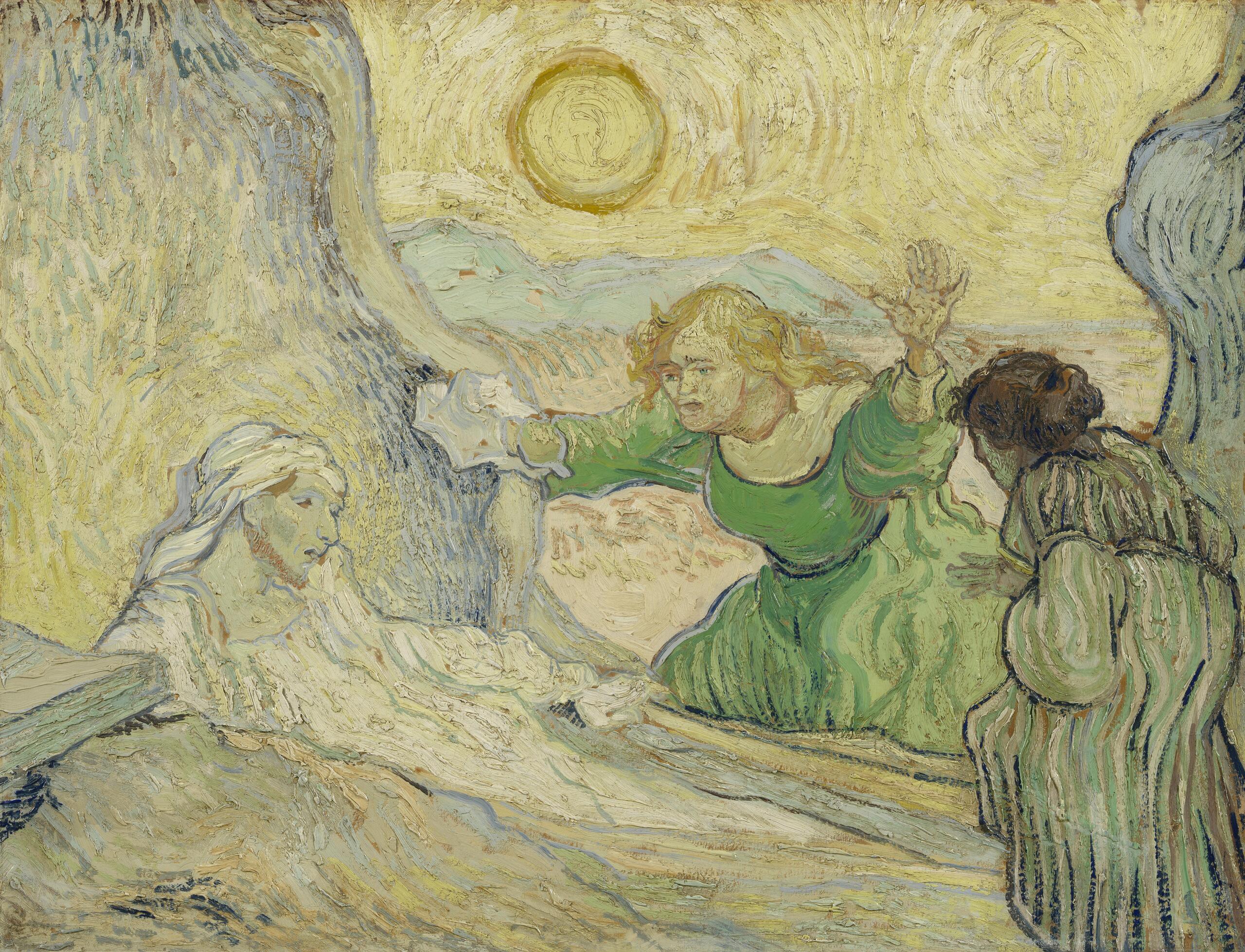
The Raising of Lazarus (after Rembrandt) is the painting Vincent van Gogh made in Saint-Rémy-de-Provence in May 1890 after a detail of Rembrandt’s etching of the same subject: at the left the dead Lazarus lies in a rock tomb, his head wrapped in white, a woman in green flings her arms wide and a second woman leans in, under a large yellow sun. The original, oil on paper, measures 50 x 65.5 cm and belongs to the Van Gogh Museum in Amsterdam. We paint it by hand in oil on canvas, in 17 sizes from 50 x 40 to 190 x 145 cm or to your own measurements, and send you a photograph of the finished painting for approval before dispatch.
| Title: | The Raising of Lazarus (after Rembrandt) |
| Other titles: | The Raising of Lazarus · The raising of Lazarus (after a detail from an etching by Rembrandt) |
| Painter: | Vincent van Gogh (1853–1890) |
| Year painted: | May 1890, Saint-Rémy-de-Provence |
| Original size: | 50 cm x 65.5 cm |
| Original technique: | Oil on paper |
| Painting style: | Post-Impressionism |
| Located at: | Van Gogh Museum, Amsterdam (inv. s0169V1962) |
| Our reproduction: | Hand-painted oil on canvas, 17 sizes or made to measure |
The Raising of Lazarus (after Rembrandt) – Vincent van Gogh
What does The Raising of Lazarus (after Rembrandt) show?
At the lower left, in a cave of pale rock, Lazarus lies on his back in a light shroud, his head wrapped in a white cloth, the stone edge of the tomb in front of him. Above him the rock rises in long strokes of cream, yellow and pale blue-green.
In the centre a woman with orange hair, in a green dress, throws her arms wide as she leans over him. At the right edge a second woman, with dark hair and a dark striped garment, bends forward and looks on. Behind them lie blue hills, and a large yellow sun with a ring around it stands in a sky of curving yellow strokes. There is no Christ in the scene.
Why did Van Gogh copy Rembrandt’s Raising of Lazarus?
Because his brother Theo had just sent him reproductions of Rembrandt etchings, a birthday present according to the editors of the letters. On or about 1 May 1890 Vincent, a patient at the asylum in Saint-Rémy, thanked him and singled one out: “But the Lazarus! Early this morning I looked at it.” The editors identify the sheet as a heliogravure, published by Amand-Durand, of the fifth state of Rembrandt’s etching The raising of Lazarus, and say the painting was based on it.
In his letter to Theo of about 2 May 1890 he drew a small sketch after the painting: three figures from the background of the Lazarus etching, the dead man and his two sisters. He listed the colours: the cave and the corpse violet, yellow and white; the woman taking the handkerchief from the man’s face dressed in green, with orange hair; the other with black hair and a striped garment; behind them blue hills and a yellow rising sun. In his words, the combination of colours would itself speak of what the chiaroscuro of the etching expressed.
What does The Raising of Lazarus (after Rembrandt) mean?
The subject comes from the Gospel of John, in which Jesus calls his friend Lazarus back to life from the tomb. Van Gogh painted only part of Rembrandt’s composition. In the Van Gogh Museum’s reading, he left out the main figure, Christ with his arm raised, and focused on the theme of human suffering. The museum suggests that he probably identified with Lazarus in the tomb, which would explain why he gave the figure a red beard. It names the two women by the grave as two acquaintances from Arles: Mrs Roulin, in the green dress, and Mrs Ginoux, in a dark dress with colourful stripes.
Where is the original today, and how did it get there?
The original belongs to the Van Gogh Museum in Amsterdam, which lists it as The Raising of Lazarus (after Rembrandt), Saint-Rémy-de-Provence, May 1890, oil on paper, 50 x 65.5 cm, under the object number s0169V1962. The museum adds that a few of the pigments have faded considerably, which has largely done away with the original contrast between the warm colours in the background and the cold colours of Lazarus in the foreground.
After May 1890 it was with Theo in Paris. After his death in January 1891 it passed to his widow, Jo van Gogh-Bonger, and their son, Vincent Willem. It was lent to the Rijksmuseum from 1917 to 1919 and to the Stedelijk Museum from 1931. In 1962 Vincent Willem transferred it to the Vincent van Gogh Foundation, and it has been in the museum since the building opened in 1973.
The Raising of Lazarus (after Rembrandt) or another Van Gogh – which should you choose?
Like this Lazarus, four paintings in our range are copies Van Gogh made after other artists. Pietà (after Delacroix) and The Good Samaritan follow works by Eugène Delacroix; in the letter in which he sketched the Lazarus, Van Gogh wrote that he had also attempted the Samaritan. First Steps and The Siesta follow Jean-François Millet.
Choose the Lazarus for a wide wall and a scene lit by a strong yellow sun, the Pietà or The Good Samaritan for another subject from the Bible, and First Steps or The Siesta for a scene from country life.
How is our hand-painted Raising of Lazarus (after Rembrandt) made?
The painter first draws Lazarus, the two women, the edge of the tomb and the line of the hills, and checks the proportions against the original. Then come the yellow sky and the sun, the blue hills and the pale rock, then the green dress and the striped garment, and last the faces, the hands and the white cloth around Lazarus’ head. Our oil painting reproduction is painted by hand on canvas, with real impasto: the paint goes on thickly, so the brushstrokes stand up from the canvas as they do in the original and catch the light.
On this painting the relief shows most in the curving strokes of the sky around the sun, in the long strokes of the rock and in the folds of the green dress. A print is completely flat; on our painting every brushstroke stands out in real paint.
Every painting is a hand-painted copy made for your order, so no two are quite the same. Van Gogh painted his on paper; ours is on canvas.
Which size for which wall?
Short answer: 50 x 40 or 63 x 48 cm for a narrow wall in a hallway or beside a door, 90 x 70 or 110 x 75 cm above a chest of drawers or a bed, and 150 x 110 or 155 x 120 cm above a sofa or on a large wall.
There are 17 sizes: 50 x 40, 60 x 40, 60 x 43, 63 x 48, 70 x 50, 70 x 53, 80 x 60, 90 x 70, 95 x 76, 110 x 75, 120 x 90, 130 x 103, 150 x 110, 155 x 120, 163 x 130, 180 x 135 and 190 x 145 cm (width x height). The original is 65.5 cm wide and 50 cm high, so our 63 x 48 cm size comes closest to it, and 70 x 53, 120 x 90 and 190 x 145 cm keep its proportions almost exactly. The yellow sky and the green dress look best on a white, cream or light grey wall and under warm light. A painting for the living room should cover about two thirds of the width of the furniture below it.
Hang it with the centre of the canvas about 150 cm above the floor. Above a sofa, a bed or a sideboard, leave 20 to 30 cm between the top of the furniture and the bottom of the canvas.
What if I need a custom size or a frame?
If none of the 17 sizes fits your wall, we paint it to measure in any width and height you need. Send us the width and height you want and we will quote you a price and a delivery time. Every painting we make is mounted on a wooden stretcher, ready to hang.
Our 3D app shows each of our frame profiles on this painting, so you can compare gold, silver, black, white and natural wood. The app is for choosing the frame only. To see the painting on your own wall, use our separate room placement service. A gold frame picks up the yellow sun and sky, while a dark wood or black one gives the pale rock and the blue hills a firm edge.
How does delivery work, and what is the guarantee?
Every painting is made to order in our studio in Slovenia, so allow 15 to 45 days depending on the size you choose. We ship it on its stretcher, carefully packed (and framed, if you chose a frame), across the EU with no customs duty. Before dispatch we send you a photograph of the finished painting to approve. Our returns policy applies to every order.
You will find more of Van Gogh’s famous works among all our Vincent van Gogh paintings, and more about the painter in our article on Vincent van Gogh. If it is a present and you are not sure of the size, a wall art voucher lets the recipient choose.
Frequently asked questions
Where is the original Raising of Lazarus (after Rembrandt) today?
In the Van Gogh Museum in Amsterdam, which credits it to the Vincent van Gogh Foundation. The museum lists it under the object number s0169V1962 as oil on paper, painted in Saint-Rémy-de-Provence in May 1890. It has been in the museum since the building opened in 1973.
When and where did Van Gogh paint The Raising of Lazarus?
In May 1890, in Saint-Rémy-de-Provence in the south of France, where he was a patient at the asylum. He thanked Theo for the Rembrandt etchings on or about 1 May 1890 and described the finished painting, with a small sketch, in a letter of about 2 May. In that letter he also asked Theo to arrange his move north.
Which work by Rembrandt is Van Gogh’s Lazarus based on?
On Rembrandt’s etching The raising of Lazarus, which Van Gogh knew from a reproduction Theo had sent him. According to the editors of his letters, it was a heliogravure of the fifth state of the etching, published by Amand-Durand. Van Gogh painted only a detail of it: the dead man and his two sisters, figures that in Rembrandt’s etching stand in the background.
Why is Christ missing from Van Gogh’s Raising of Lazarus?
Because Van Gogh left him out. The Van Gogh Museum writes that he used only part of Rembrandt’s composition and omitted the main figure, Christ with his arm raised, focusing on the theme of human suffering. In the museum’s reading he probably identified with Lazarus in the tomb, which would explain why he gave the figure a red beard.
Who are the two women in The Raising of Lazarus (after Rembrandt)?
In the story they are Lazarus’ sisters, Martha and Mary; Van Gogh himself called the figures the dead man and his two sisters. The Van Gogh Museum identifies the women as two acquaintances from Arles: Mrs Roulin in the green dress and Mrs Ginoux in the dark dress with colourful stripes.
What is the story of the raising of Lazarus?
It is told in the Gospel of John. Lazarus of Bethany, the brother of Martha and Mary, falls ill and dies, and has lain in the tomb for four days when Jesus arrives. Jesus has the stone taken away and calls him out, and Lazarus walks out alive, still bound in his grave clothes, with a cloth around his face.
How big is the original Raising of Lazarus?
50 cm high and 65.5 cm wide, according to the Van Gogh Museum, and it is painted in oil on paper, not on canvas. Our 63 x 48 cm size comes closest to it. We paint our version in oil on canvas, in 17 sizes up to 190 x 145 cm, and also to measure in any proportions your wall needs.
Which size of The Raising of Lazarus suits a living room?
Above a sofa, choose 150 x 110 or 155 x 120 cm, so that the canvas painting covers a good part of the width of the sofa and the yellow sun reads clearly from across the room. On a narrower wall or above a sideboard, 90 x 70 or 110 x 75 cm works well. For a very large wall, choose our largest size, 190 x 145 cm.
Does your Raising of Lazarus have the raised brushstrokes of the original?
Yes. We paint it in impasto, building up each brushstroke in thick oil, so the surface is raised like Van Gogh’s original. You see this best in the curving strokes of the yellow sky around the sun, in the long strokes of the pale rock and in the folds of the green dress, where the relief catches the light.
- Subject: the dead Lazarus in his rock tomb, a woman in green with her arms flung wide and a second woman leaning in, under a large yellow sun.
- Original: May 1890, Saint-Rémy-de-Provence, oil on paper, 50 x 65.5 cm, Van Gogh Museum, Amsterdam.
- Ours: a Van Gogh reproduction painted by hand in oil on canvas, in 17 sizes from 50 x 40 to 190 x 145 cm or made to measure.
- Worth knowing: each painting is made to order, so allow 15 to 45 days, and our 3D app lets you try every frame on this painting before you order.