







































Description
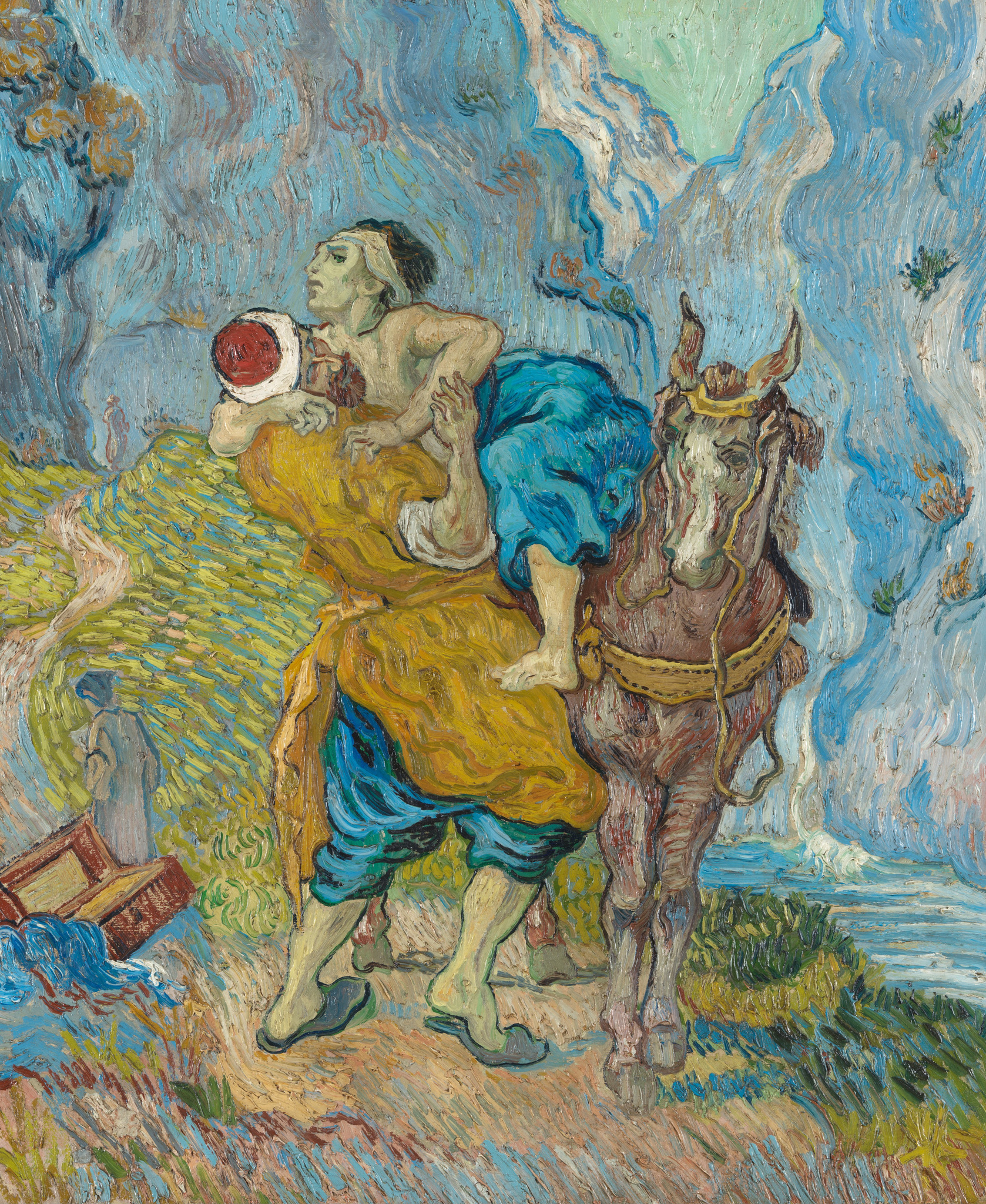
The Good Samaritan (after Delacroix) is the painting Vincent van Gogh made in Saint-Rémy-de-Provence in early May 1890 after a print of a work by Eugène Delacroix: on a road through a rocky ravine, a man in a yellow garment and blue trousers heaves a wounded, half-naked traveller onto a brown horse, while an empty chest lies open on the ground and small figures walk away in the distance. The original, oil on canvas, measures 73 x 59.5 cm and is in the Kröller-Müller Museum in Otterlo. We paint it by hand in oil on canvas, in 16 sizes from 40 x 50 to 135 x 160 cm or to your own measurements, and send you a photograph of the finished painting for approval before dispatch.
| Title: | The Good Samaritan (after Delacroix) |
| Other titles: | De barmhartige Samaritaan (naar Delacroix) · The Good Samaritan |
| Painter: | Vincent van Gogh (1853–1890) |
| Year painted: | early May 1890, Saint-Rémy-de-Provence |
| Original size: | 73 cm x 59.5 cm |
| Original technique: | Oil on canvas |
| Painting style: | Post-Impressionism |
| Located at: | Kröller-Müller Museum, Otterlo (inv. KM 104.010) |
| Our reproduction: | Hand-painted oil on canvas, 16 sizes or made to measure |
The Good Samaritan (after Delacroix) – Vincent van Gogh
What does The Good Samaritan (after Delacroix) show?
In the centre of the tall canvas the Samaritan, in a long yellow garment, blue trousers and pale slippers, braces his legs and pushes a wounded man up onto the back of a brown horse. The wounded man is half naked, his head bound in a white cloth, a blue cloth slipping from his legs; he clings to his helper’s shoulders as he is lifted.
At the lower left lies an open chest, empty, with a blue cloth beside it: what the robbers left behind. Further back, on the road that climbs out of the ravine, small figures walk away. The rocks around them swirl in bands of blue, white and green, and at the right a stream runs past.
Why did Van Gogh copy a painting by Delacroix?
Because copying let him keep working at a difficult time. According to the Kröller-Müller Museum, he made this painting following another serious breakdown, at the asylum of Saint-Paul in Saint-Rémy-de-Provence, where, as Wikipedia records, he had admitted himself. There he copied more than 30 works by artists he admired.
He worked from a black-and-white reproduction, which the museum calls an engraving, and made what it describes as his own translation in colour and on canvas, based on his memories of Delacroix’s painting. The English Wikipedia article on Van Gogh’s copies quotes his letter on why he did it: he started making them inadvertently and found that he could learn from them and that they gave him “a kind of comfort”.
What does The Good Samaritan (after Delacroix) mean?
The subject is a parable from the Gospel of Luke. A traveller is robbed and left by the road; two men pass him by, and a Samaritan, a stranger, stops, binds his wounds and puts him on his own animal. The story answers the question of who acts as a neighbour.
In the museum’s reading, the choice of subject is no coincidence: the Samaritan is the compassionate man who interrupts his journey to help a defenceless man, and Van Gogh himself also had to recover. The museum suggests that with this painting he may also be alluding to his brother Theo, his own good Samaritan who was always there for him.
Where is the original?
The original is in the Kröller-Müller Museum in Otterlo, in the Netherlands, which lists it as The Good Samaritan (after Delacroix), early May 1890, oil on canvas, under the inventory number KM 104.010. The museum’s record gives the canvas as 73 cm high and 59.5 cm wide.
The museum sees Delacroix as Van Gogh’s spiritual mentor in colour, and points to the contrasts of blue and violet against yellow, and of red against green, and to the heavy lines and wavy brushwork. It quotes Van Gogh on his method: “The vague consonance of colours that are in the same sentiment, if not right – that’s my own interpretation.”
The Good Samaritan (after Delacroix) or another Van Gogh – which should you choose?
Wikipedia calls such works “translations”: rather than replicate other artists, Van Gogh sought to translate their subjects through his own colour and technique. Three of the closest companions in our range belong to that group. Pietà (after Delacroix), from 1889, follows a lithograph of another Delacroix painting. The Siesta, from 1890, follows Jean-François Millet’s Noon: Rest, and Prisoners’ Round follows a print by Gustave Doré.
The fourth, At Eternity’s Gate, is another figure painting from the same period of his life. Choose the Samaritan for a tall wall and a story of help, the Pietà for a quiet corner, The Siesta for warm yellows and Prisoners’ Round for a darker note in a study.
How is our hand-painted version of The Good Samaritan (after Delacroix) made?
The painter first draws the two figures, the horse and the road, and checks the proportions against the original. Then come the swirling rocks and the sky, after them the stream and the bank, then the yellow garment and the blue trousers, the horse and the chest, and last the faces, the hands and the dark outlines. Our oil painting reproduction is painted by hand on canvas, with real impasto: the paint goes on thickly, so the brushstrokes stand up from the canvas as they do in the original and catch the light.
On this painting the relief shows most in the wavy strokes of the rocks, in the folds of the yellow garment and in the short strokes of the grass along the road. A print is completely flat; on our painting every brushstroke stands out in real paint.
Every painting is a hand-painted copy made for your order, so no two are quite the same.
Which size for which wall?
Short answer: 40 x 50 or 55 x 66 cm for a narrow wall in a hallway or beside a door, 64 x 80 or 80 x 100 cm above a chest of drawers or a bed, and 100 x 120 or 120 x 140 cm above a sofa or on a tall wall.
There are 16 sizes: 40 x 50, 55 x 66, 60 x 70, 64 x 80, 70 x 85, 75 x 90, 80 x 100, 85 x 105, 90 x 110, 93 x 115, 100 x 120, 105 x 125, 110 x 130, 120 x 140, 127 x 150 and 135 x 160 cm (width x height). The original is 59.5 cm wide and 73 cm high, so our 60 x 70 and 64 x 80 cm sizes come closest to it; 40 x 50, 64 x 80 and 80 x 100 cm keep its proportions almost exactly. The strong yellow and blue look best on a white, cream or light grey wall and under warm light. A painting for the living room should cover about two thirds of the width of the furniture below it.
Hang it with the centre of the canvas about 150 cm above the floor. Above a sofa, a bed or a sideboard, leave 20 to 30 cm between the top of the furniture and the bottom of the canvas.
What if I need a custom size or a frame?
If none of the 16 sizes fits your wall, we paint it to measure in any width and height you need. Send us the width and height you want and we will quote you a price and a delivery time. Every painting we make is mounted on a wooden stretcher, ready to hang.
Our 3D app shows each of our frame profiles on this painting, so you can compare gold, silver, black, white and natural wood. The app is for choosing the frame only. To see the painting on your own wall, use our separate room placement service. A gold frame picks up the yellow garment, while a dark wood or black one gives the blue rocks a firm edge.
How does delivery work, and what is the guarantee?
Every painting is made to order in our studio in Slovenia, so allow 15 to 45 days depending on the size you choose. We ship it on its stretcher, carefully packed (and framed, if you chose a frame), across the EU with no customs duty. Before dispatch we send you a photograph of the finished painting to approve, and we correct anything that is not right. Our returns policy applies to every order.
You will find more of Van Gogh’s famous works among all our Vincent van Gogh paintings, and more about the painter in our article on Vincent van Gogh. If it is a present and you are not sure of the size, a wall art voucher lets the recipient choose.
Frequently asked questions
Where is the original Good Samaritan (after Delacroix) today?
In the Kröller-Müller Museum in Otterlo, in the Netherlands. The museum lists it as oil on canvas, painted in early May 1890, under the inventory number KM 104.010, with the Dutch title De barmhartige Samaritaan (naar Delacroix). Van Gogh painted it in Saint-Rémy-de-Provence, at the asylum where he made his copies after other artists.
When and where did Van Gogh paint The Good Samaritan (after Delacroix)?
In early May 1890, at the asylum of Saint-Paul in Saint-Rémy-de-Provence, where he had admitted himself. The Kröller-Müller Museum dates it to early May 1890 and says he made it following another serious breakdown. It belongs to the group of more than 30 copies after other artists that he painted during his stay at the asylum.
Which work by Delacroix is Van Gogh’s Good Samaritan based on?
On Eugène Delacroix’s painting The Good Samaritan, which Van Gogh knew from a black-and-white reproduction; the Kröller-Müller Museum calls it an engraving. He did not imitate it slavishly: the colours are his own, chosen from his memories of Delacroix’s painting. Wikipedia records that he already wished to copy this Good Samaritan in 1889, along with other works.
What is the parable of the Good Samaritan?
It is a story Jesus tells in the Gospel of Luke. A traveller on the road from Jerusalem to Jericho is robbed and left half dead. A priest and a Levite see him and pass by on the other side. A Samaritan, a stranger to him, stops, binds his wounds, sets him on his own animal and pays an innkeeper to care for him.
Who are the figures in the background of The Good Samaritan (after Delacroix)?
They are the travellers who did not stop. In the parable a priest and then a Levite pass the wounded man by before the Samaritan arrives, and in the painting small figures walk away along the road in the distance at the left. The open, empty chest in the foreground shows what the robbers left behind.
Why did Van Gogh choose the Good Samaritan as a subject?
The Kröller-Müller Museum suggests it was no coincidence: the Samaritan interrupts his journey to help a defenceless man, and Van Gogh himself was recovering from a breakdown. The museum also reads the painting as a possible allusion to his brother Theo, his own good Samaritan. Wikipedia links the choice to his reading of The Imitation of Christ.
How big is the original Good Samaritan (after Delacroix)?
73 cm high and 59.5 cm wide, according to the Kröller-Müller Museum, a medium portrait format. Our 60 x 70 and 64 x 80 cm sizes come closest to it. If you want the scene larger, there are 16 sizes up to 135 x 160 cm, as well as custom sizes in any proportions you need for your wall.
Which size of The Good Samaritan (after Delacroix) suits a living room?
Above a sofa, choose 100 x 120 or 120 x 140 cm, so that the canvas painting covers a good part of the width of the sofa and the figures read from across the room. On a narrower wall or above a sideboard, 64 x 80 or 80 x 100 cm works well. For a high wall or a stairwell, choose our largest size, 135 x 160 cm.
Does your Good Samaritan (after Delacroix) have the raised brushstrokes of the original?
Yes. We paint it in impasto, building up each brushstroke in thick oil, so the surface is raised like Van Gogh’s original. You see this best in the wavy strokes of the blue and white rocks, in the folds of the yellow garment and in the grass along the road, where the relief catches the light.
- Subject: in a rocky ravine, the Samaritan in yellow and blue lifts a wounded, half-naked man onto a brown horse; an empty chest lies open on the ground, small figures walk away.
- Original: early May 1890, Saint-Rémy-de-Provence, oil on canvas, 73 x 59.5 cm, Kröller-Müller Museum, Otterlo.
- Ours: a Van Gogh reproduction painted by hand in oil on canvas, in 16 sizes from 40 x 50 to 135 x 160 cm or made to measure.