







































Description
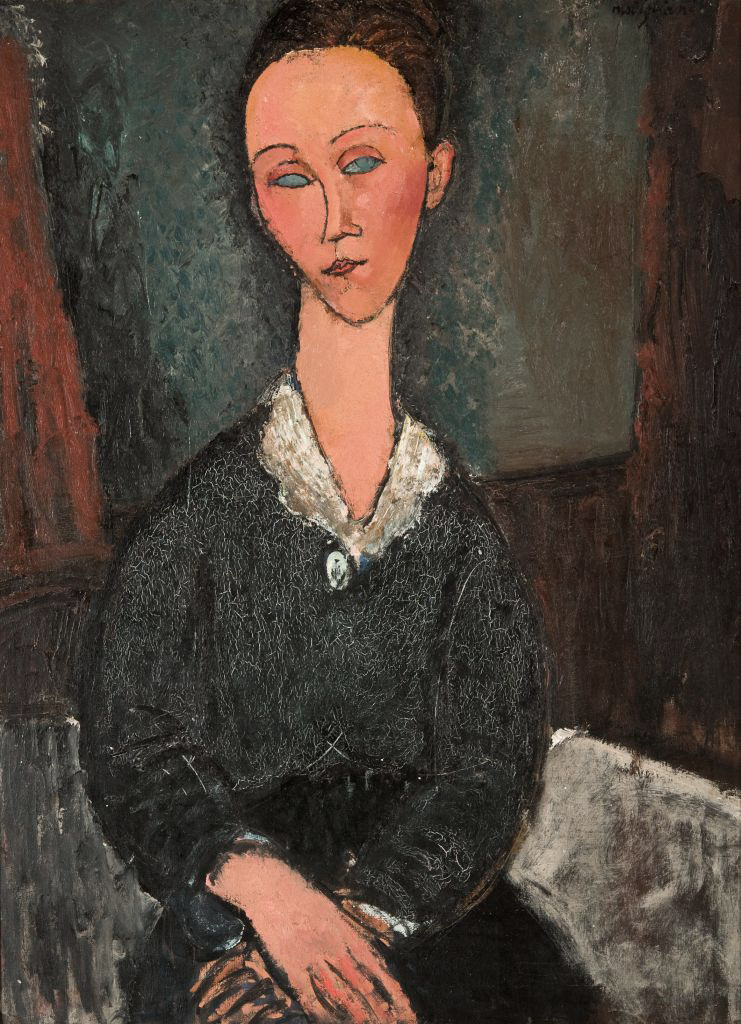
Woman with a White Collar is a canvas of 1917 in the Musée de Grenoble, under the number MG 2195. A young woman sits facing us in a dark green-black knitted top with a white lace collar, hands together low in her lap. With us it is made as a hand-painted copy, oil on canvas, to order, in eight sizes or in a size you give us; before dispatch we send you a photograph of the finished canvas.
| Title: | Woman with a White Collar |
| Other titles: | Femme au col blanc — Portrait de Lunia Czechowska, the museum’s and the catalogues’ titles |
| Painter: | Amedeo Modigliani (1884–1920) |
| Year of creation: | 1917 — the museum’s year |
| Original size (width × height): | 60.2 × 81 cm — the museum’s measurement; the catalogues also print 60 × 81 and 60 × 92 |
| Original technique: | oil on canvas |
| Painting style: | expressionism, École de Paris |
| Located: | Musée de Grenoble (inv. MG 2195, bought from Bernheim-Jeune in 1923, room 33) |
| Our reproduction: | hand-painted copy, oil on canvas, eight sizes or a custom size |
Woman with a White Collar – Amedeo Modigliani
What is on the canvas?
A young woman sits facing us, cut off just below the waist, her hands together low in the picture where the canvas ends. Her hair is dark brown, drawn back smoothly from a high forehead so that both ears show. The face is a long oval in orange-cream, drawn round with a dark contour, with a rose flush on each cheek, thin arched brows, a nose made of one long line and a small dark red mouth; the eyes are pale blue-green almonds with no pupils. The neck is long. She wears a dark green-black knitted top, and its whole surface is scratched over with a fine web of pale strokes, so that the black is never flat. At the throat is a white lace collar in a wide V, and at the point of the V a small pale blue-grey brooch. Behind her the wall is a dull brick red at the left, a mottled dark blue-green behind the head, brown and grey at the right, with a broad brown band across the middle and a large pale grey shape at the lower right. The signature is at the top right corner.
The first Modigliani a museum ever bought
The museum states it plainly on its own page: this is the first painting by the artist to be acquired by a museum. It bought the canvas from the Galerie Bernheim-Jeune in 1923, three years after Modigliani died; the catalogues add the detail, that Bernheim-Jeune had taken it from Léopold Zborowski on 7 February 1921 and sold it to Grenoble on 22 December 1923 for 2,880 francs. It is worth holding the two dates together. In 1921 the painter had been dead a year and his work was still being placed by the dealer who had kept him alive; by the end of 1923 a public collection had put a price on it and hung it. If the museum is right, every other museum-owned work on this shelf reached its collection after this one did. Zborowski is on this shelf himself as Portrait of Léopold Zborowski, and he is the dealer through whom most of the École de Paris passed.
The record of the original, and who is sitting
The museum names the sitter: Lunia Czechowska, a young Polish woman who had taken refuge with Zborowski and his wife Hanka, and whom Modigliani made one of his favourite models until the end of his life. She is on this shelf again as Portrait of Lunia Czechowska in a White Blouse, and the household she lived in is here too, as Madame Hanka Zborowska. She also wrote: Ceroni’s catalogue of 1958 prints her memoirs after the plates, so the woman in this picture is one of the sources for the painter’s life. The museum reads the pose as Cézannian — seen from the front, seated, hands crossed on the knees, the head slightly inclined — and the face as held between the hieratic form of African masks and the soft modelling of Byzantine icons, with the gaze deliberately blurred in the way the empty eye-sockets of a mask are empty. African masks are named by a second museum on this shelf, for Boy in Short Pants in Dallas: two collections, two continents, the same source. On the measurements the record splits three ways — the museum gives 81 × 60.2 cm, Pfannstiel and Patani 81 × 60, Parisot and a Milan exhibition of 1958 as much as 92 × 60. The museum’s photograph is not precise enough to settle it: its proportion is 2.8 per cent from the museum’s own figure and 2.4 from the 81 × 60, so it rules out the 92 × 60, which is 9.8 per cent away, but cannot separate the other two, which differ from each other by a third of one per cent. We print the museum’s. The work also has its own Wikidata entry. The whole selection is in the Amedeo Modigliani gallery.
Where has the picture been?
Three owners in a hundred and nine years, which on this shelf is almost nothing. Zborowski had it, Bernheim-Jeune bought it from him in February 1921, and Grenoble bought it from Bernheim-Jeune in December 1923; it has not moved since, and it hangs in room 33. The canvas is signed modigliani at the upper right — the fourth work running on this shelf to be signed in that corner. We have written a longer article about the painter and the circle he worked in.
How is our hand-painted version made?
A painter paints it, with a brush, in oil on canvas, to your order. Every canvas painting takes some weeks, and each copy comes out slightly its own; that is the consequence of a person working rather than a machine. The hard passage here is the top. It is a dark green-black, and it is not a flat area: the whole of it is scored with a fine net of pale strokes, dry and quick, and a copy that fills it in smoothly loses the picture entirely. The white collar and the little brooch are the only true lights, so they must stay clean and small. The face is orange-cream with a rose flush and a dark line drawn round the whole oval — that line is the drawing, and softening it flattens the head. The eyes are blue-green and blank and stay blank. Before dispatch you receive a photograph of the finished canvas and approve it. It is never a print.
Which size for which wall?
For this motif we suggest 60 × 80 cm, which is the original’s own size to within a centimetre. Six of the eight rungs on this ladder are exactly three to four, and the original is a shade narrower than that, so all six sit the same 0.91 per cent from its shape — 30 × 40, 45 × 60, 60 × 80, 75 × 100, 90 × 120 and 150 × 200 cm are equally right on proportion and the choice is only about scale. For a wall that needs more, 90 × 120 cm. The picture is quiet and close-toned and it does not want to be seen from across a room; it belongs where someone stands near it. The dark green-black carries on white and on warm grey and vanishes on a dark wall. A post-impressionist painting in a size that is not on the list is no trouble: we make it to order.
Frequently asked questions
Where is the original?
In the Musée de Grenoble, accession number MG 2195, in room 33.
Who is the woman?
Lunia Czechowska, a young Polish woman living with the painter’s dealer Léopold Zborowski and his wife, and one of Modigliani’s regular models.
Why does she seem not to be looking at anything?
Because the painter blurred the gaze on purpose. The museum connects it to the empty eye-sockets of African masks.
How closely does it follow the original’s proportions?
The original measures 60.2 × 81 cm, and that is exactly the size we list: 60 x 80 cm. The proportions are the original’s, with no deviation. The catalogues do not agree on the size and give 60.2 × 81 cm; 60 × 81 cm; 60 × 92 cm; the comparison above starts from the first of them.
- Subject: a young woman seated square to us, dark green-black knitted top scored with pale strokes, white lace collar, small brooch at the throat
- Original: 60.2 × 81 cm, oil on canvas, 1917, Musée de Grenoble, inv. MG 2195
- Ours: hand-painted oil on canvas, eight sizes or a custom size, with a photograph to approve before dispatch
- Worth knowing: the museum calls this the first Modigliani ever bought by a museum, three years after his death, and names the sitter as Lunia Czechowska
The eyes on this canvas are painted without pupils. We counted all 76 Modigliani works on this shelf: 53 are like that, 17 are not – work by work.