



Description
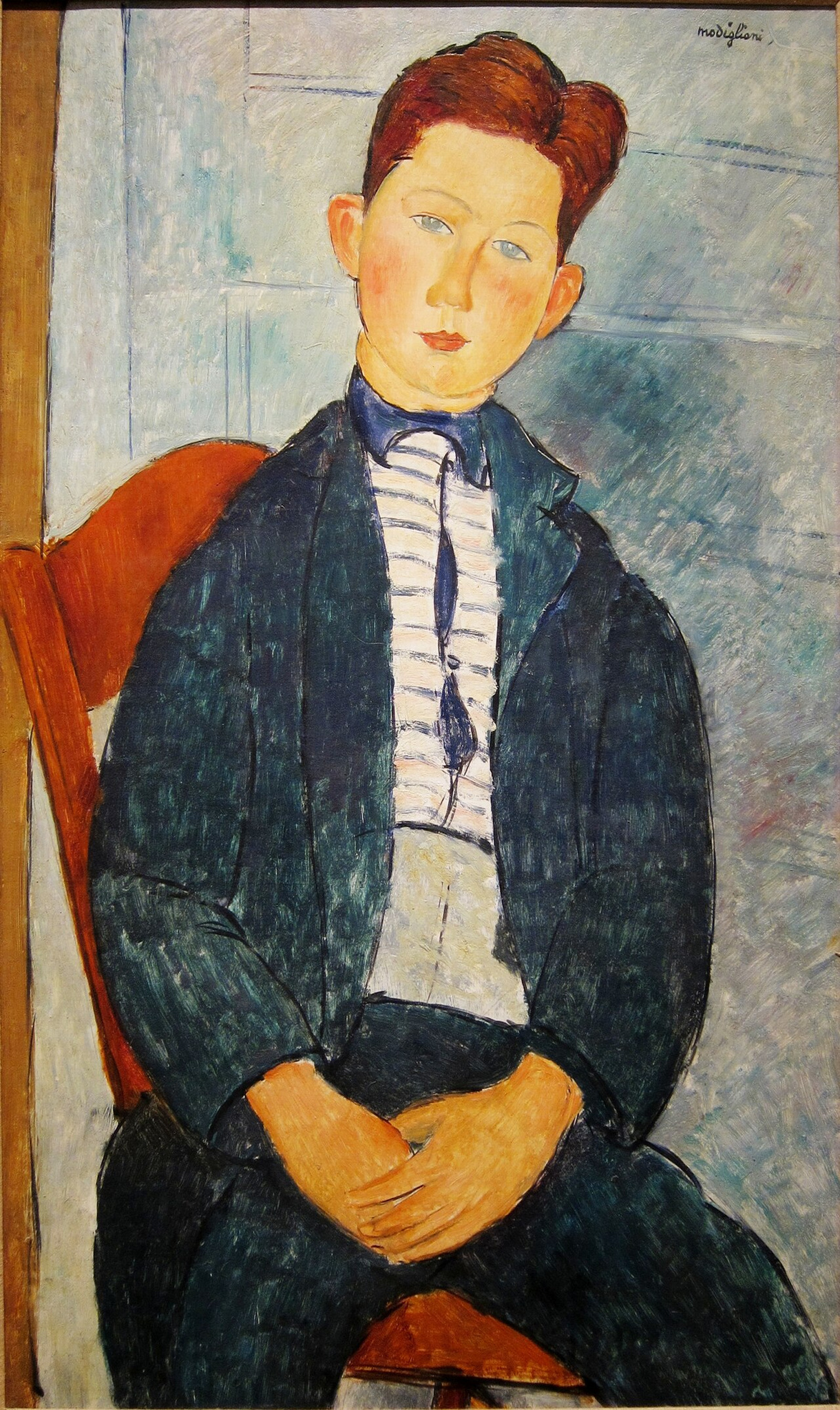
Boy in a Striped Sweater is a canvas of 1918 held by the Metropolitan Museum of Art in New York under the number 1999.363.56. A boy sits in a chair with his hands folded in his lap, in a teal-blue jacket open over a white and blue striped sweater. With us it is made as a hand-painted copy, oil on canvas, to order, in eight sizes or in a size you give us; before dispatch we send you a photograph of the finished canvas.
| Title: | Boy in a Striped Sweater |
| Other titles: | Le Chandail rayé (the French form used in catalogues) |
| Painter: | Amedeo Modigliani (1884–1920) |
| Year of creation: | 1918 (the museum gives it plainly, with no circa) |
| Original size (width × height): | 54.6 × 91.4 cm |
| Original technique: | oil on canvas |
| Painting style: | expressionism, École de Paris |
| Located: | The Metropolitan Museum of Art, New York (inv. 1999.363.56, Jacques and Natasha Gelman Collection, 1998) |
| Our reproduction: | hand-painted copy, oil on canvas, eight sizes or a custom size |
Boy in a Striped Sweater – Amedeo Modigliani
What is on the canvas?
The boy sits in a chair whose red-orange back shows at the left, with a pale tan vertical band beyond it. His auburn hair is swept up from a pale oval face with pink cheeks. The eyes are pale blue-grey almonds and they carry pupils; the mouth is small and orange, the ears large. He wears a dark teal-blue jacket, open over a white and blue horizontally striped sweater with a dark blue collar and a long dark placket, and dark blue trousers below. Both hands are folded in his lap with the fingers interlaced. The ground is a pale blue-grey wall carrying faint drawn lines. The signature modigliani stands at the upper right.
Why is a child unusual here?
Because most of this shelf is adults — dealers, painters, poets, the people Modigliani worked among in the circle we now call the École de Paris. A child sits differently: this boy is not posed as a type or a study of form but simply put in a chair and asked to stay still, and he has done it with the particular stiffness of someone being good. The striped sweater is what makes the canvas, and not only as a name. Almost everything else here is a flat field of colour; the stripes are the one place with a rhythm, and they run horizontally across a picture that is otherwise strongly vertical. That is the tension the whole thing rests on.
The record of the original, and what the museum does not say
The original is oil on canvas. The museum measures it 91.4 cm high and 54.6 cm wide; we give width first, so on our page it reads 54.6 × 91.4 cm. The year 1918 is given plainly, without a circa — worth noting on a shelf where several works carry a hedge. The number is 1999.363.56 and the acquisition is one line: the Jacques and Natasha Gelman Collection, 1998. Before that the museum publishes no ownership history at all, so we state none — neither that it was clear nor that it was troubled. The museum also does not mention a signature. It is plainly there on the photograph, modigliani at the upper right, and we read it ourselves; where we can see more than the institution publishes we give it as our own observation and not as theirs. The museum’s own page rate-limits automated readers, so the link above is registered against the museum’s public API record, which answers with this work’s artist, title, accession and date. The work also has its own Wikidata entry.
The motif among the painter’s works
Two more of this museum’s Modiglianis stand on this shelf, so the New York canvases can be read together: The Italian Woman and Jeanne Hébuterne in a White Chemise. For the other young sitters there is The Boy and The Young Apprentice — the same years and the same steadiness, and in all three cases a child painted without sentiment. The whole selection is in the Amedeo Modigliani gallery, and we have written a longer article about the painter.
How is our hand-painted version made?
A painter paints it, with a brush, in oil on canvas, to your order. Every canvas painting takes some weeks, and each copy comes out slightly its own; that is the consequence of a person working rather than a machine. On this motif the stripes are the work. They have to keep their spacing as the sweater turns over the shoulders and the chest, because stripes that stay evenly spaced across a curved body stop being cloth and become wallpaper. They also carry the picture’s only rhythm, so painting them too faint loses the subject and painting them too hard turns a boy into a pattern. The interlaced fingers are the second care: they are small, and they are what makes him look like a child sitting still rather than a small adult. Before dispatch you receive a photograph of the finished canvas and approve it. It is never a print.
Which size for which wall?
For this motif we suggest 60 × 100 cm, which of the sizes we offer also follows the proportions of the original most closely. One thing we will not paper over: the original is markedly tall and narrow, and our formats are about four per cent less elongated, so the figure sits a little wider in our canvas than in the museum’s. We report the original’s proportions as the museum gives them and describe ours as what it is. The subject is calm and friendly, with no harsh colour — a teal-blue jacket, a white stripe, one warm plane of face — so it suits a child’s room, a hallway or a dining room, and because the boy is seated and looks straight out it takes being hung low and close to. A post-impressionist painting in a size that is not on the list is no trouble: we make it to order.
Frequently asked questions
Where is the original?
In the Metropolitan Museum of Art, New York, accession number 1999.363.56, from the Jacques and Natasha Gelman Collection since 1998.
Who is the boy?
The museum does not name him, and we do not invent a name. The title describes what he is wearing.
Is Le Chandail rayé the same work?
Yes. That is the French form of the same title; it is the same canvas.
How closely does it follow the original’s proportions?
The original measures 54.6 × 91.4 cm. The closest of our sizes is 60 x 100 cm, which departs from the original’s proportions by 0.44%.
- Subject: a seated boy, hands folded with fingers interlaced, teal-blue jacket over a white and blue striped sweater, a pale blue-grey wall behind
- Original: 54.6 × 91.4 cm, oil on canvas, 1918, Metropolitan Museum of Art, inv. 1999.363.56
- Ours: hand-painted oil on canvas, eight sizes or a custom size, with a photograph to approve before dispatch
- Worth knowing: the horizontal stripes are the only rhythm in an otherwise vertical picture — and our formats are about 4% less elongated than the original
The eyes on this canvas are painted without pupils. We counted all 76 Modigliani works on this shelf: 53 are like that, 17 are not – work by work.