Description
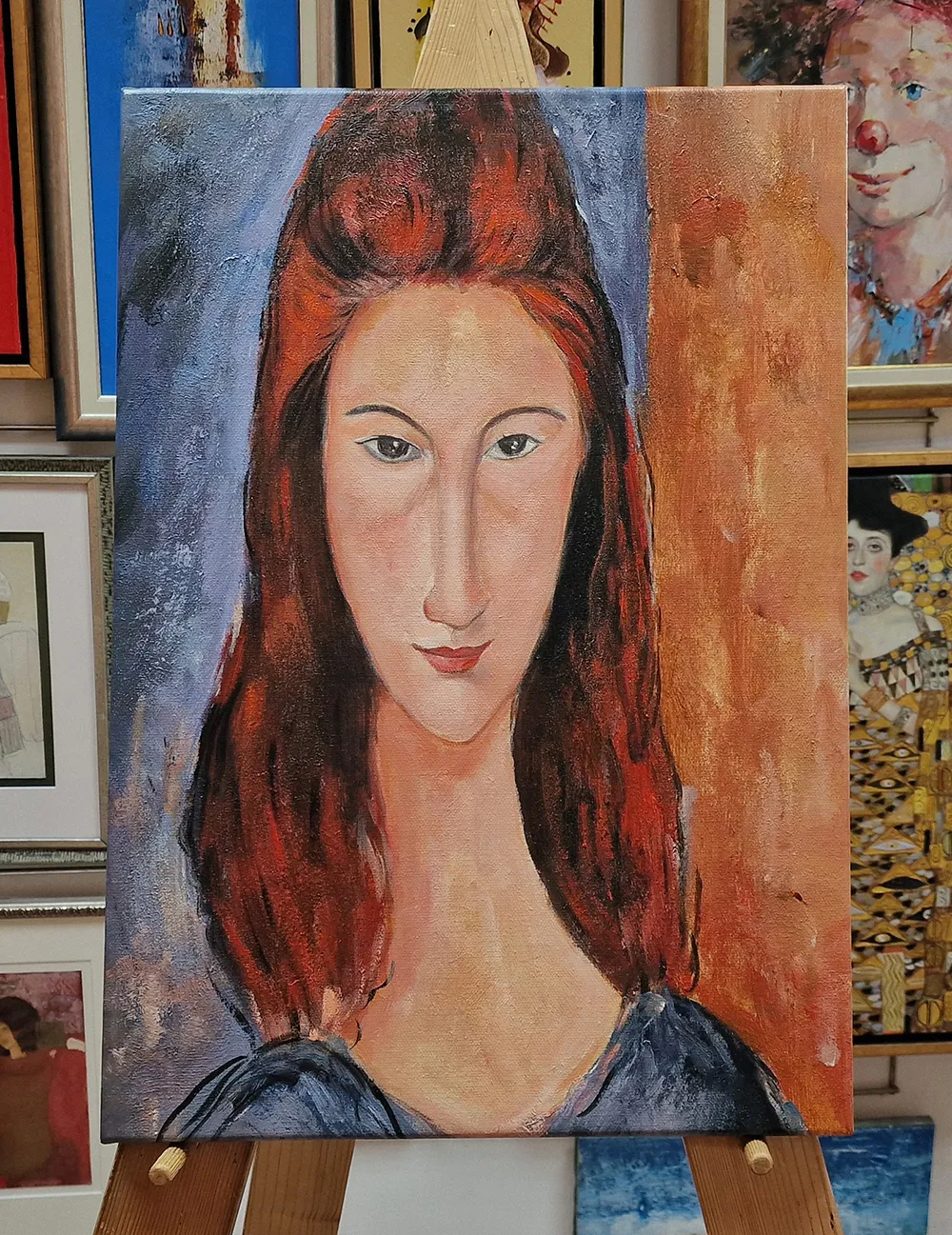
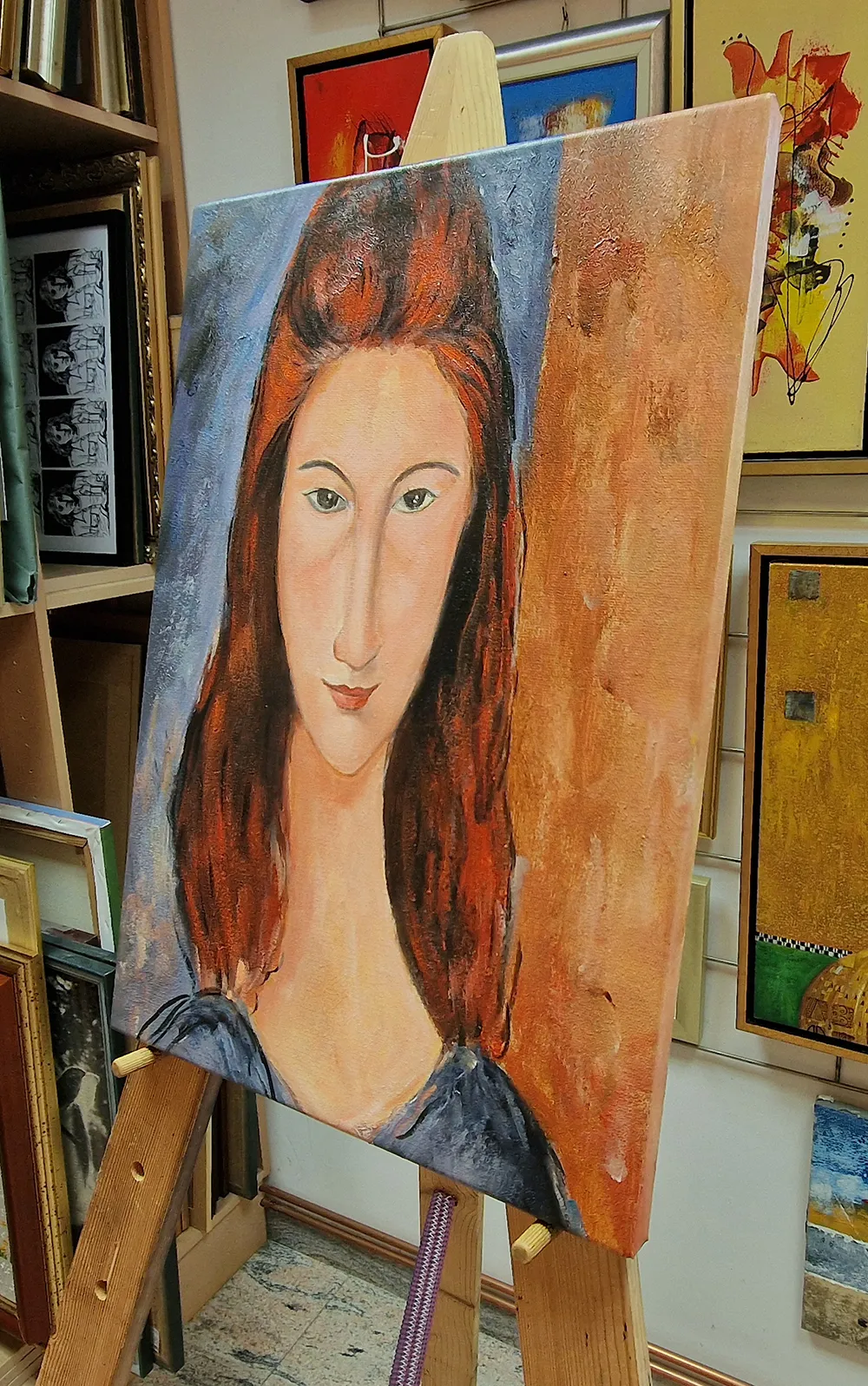
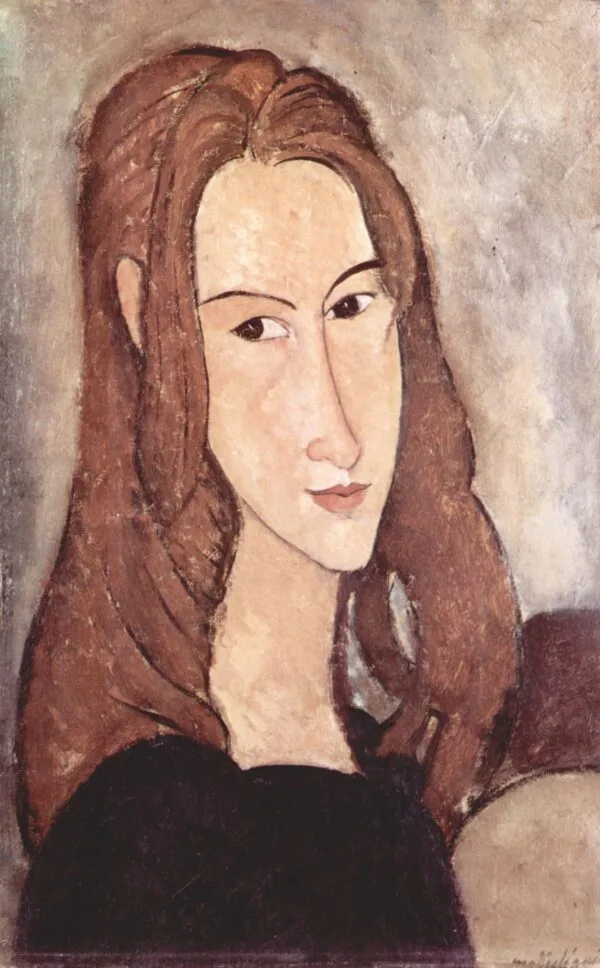
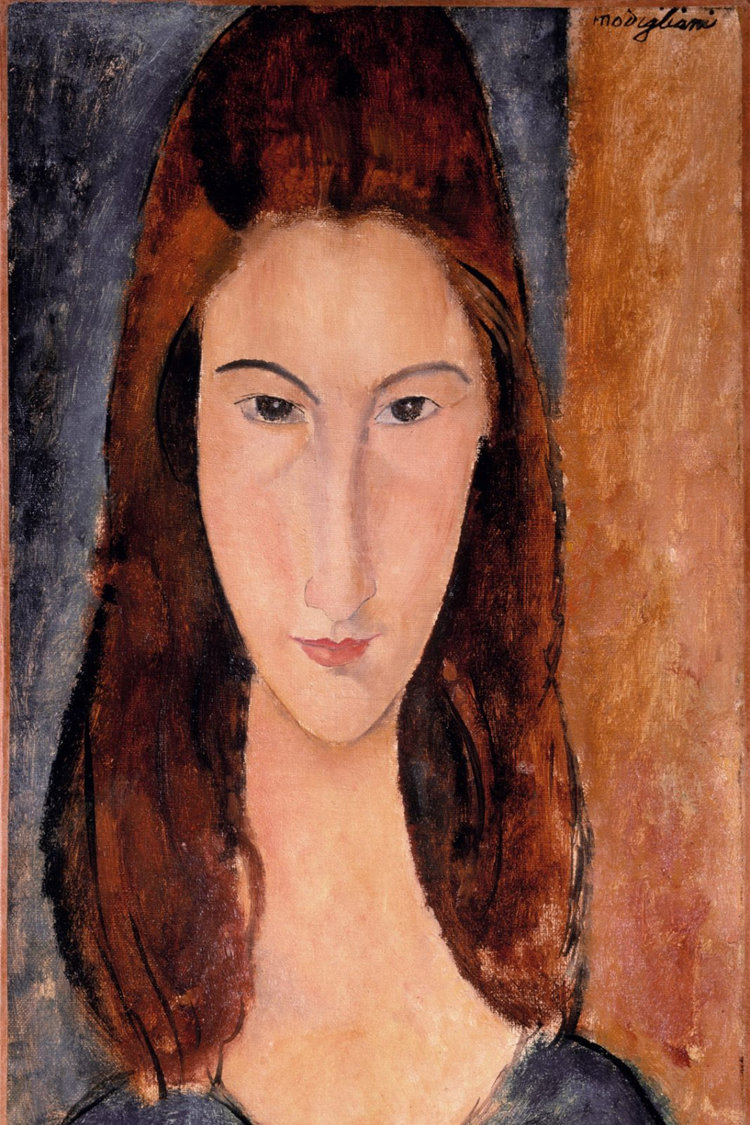
Portrait of Jeanne Hébuterne I is an oil on canvas painted by Amedeo Modigliani in 1919; the original measures 55 × 38 cm, is in a private collection, and is recorded in Italian as Busto di Jeanne Hébuterne. The sitter is Jeanne Hébuterne, the painter’s partner and a painter herself, in a narrow upright crop taking in the head and shoulders. Our canvas painting is a hand-painted copy of that work: an academy-trained painter makes it in oils on cotton canvas, in eight sizes from 38 × 55 cm to 120 × 170 cm or in a measurement you give us, and before dispatch we photograph it and send you the photograph for approval.
| Title: | Portrait of Jeanne Hébuterne I |
| Other titles: | Busto di Jeanne Hébuterne · Portrait de Jeanne Hébuterne · Porträt der Jeanne Hébuterne |
| Painter: | Amedeo Modigliani (1884–1920) |
| Year: | 1919 |
| Original size (height × width): | 55 × 38 cm |
| Original technique: | Oil on canvas |
| Style: | Modern art, École de Paris |
| Location: | Private collection – record of the work (no accession number) |
| Our reproduction: | hand-painted oil on canvas, eight sizes from 38 × 55 cm to 120 × 170 cm, made to measure on request |
Portrait of Jeanne Hébuterne I – Amedeo Modigliani
Who is the sitter?
Jeanne Hébuterne, born in 1898, a painter and art student who met Modigliani in Paris in 1917 and stayed with him to the end. Mother of their daughter, she died in January 1920, two days after the painter, aged twenty-one. Modigliani painted her about twenty-five times, more often than anyone else; that series is the most personal part of his work. There is no client and no fee: the model is the person he lived with. That is why the portraits of Jeanne Hébuterne differ from those of the dealers and poets of the same months — they look out more quietly and perform less.
What is on the canvas?
The crop is narrow and upright: head and shoulders, no hands, no room around the figure. The face is elongated, the neck long and tilted — Modigliani’s most recognisable trait, softer here than in his commissioned portraits. The eyes are painted with irises and a rim of white, and the gaze meets the viewer directly: this is one of the portraits in which he did not leave the eye blank. The stillness comes from the long neck and the narrow, symmetrical face. The hair is dark and laid smoothly against the face, the skin in warm ochre and pink, the ground closed and neutral, with no furniture or window. The range is narrow: a few warm flesh tones, the dark mass of the hair, a cooler ground that pushes the figure forward. Because the canvas is small the head sits large on it, and the work reads more as nearness than as a portrait set in a room.
Why does this work matter?
Because it shows Modigliani painting someone he need not persuade. In a commissioned portrait the sitter arranges themselves; here they do not. Behind the form stand his years as a sculptor and the African and Cycladic heads studied before he returned to painting: the long neck and oval face come from there. In colour, behind it stands a post-impressionist painting of Cézanne’s kind, in which a head is built from planes and not from details. In Paris Modigliani belonged to the circle of immigrant painters we now call the École de Paris, and there the portrait was a central task, not a sideline. That is why this small canvas teaches more than many large ones: everything by which the painter is recognised is on it.
What does the work mean?
It means a look at a person who was not sitting for money. The emptiness of the eyes is often read as mystery, but it is something simpler: the painter does not tell us what the sitter is thinking, because he does not know and does not invent. He gives form, colour and bearing, and leaves the interior alone. It is that restraint which keeps the work from turning sentimental, although we know how the story ended. If you want one thought to take away: nearness is not the same as explanation.
Is this the same portrait as Portrait of Jeanne Hébuterne II?
No. We carry six numbered portraits of Jeanne Hébuterne, because Modigliani painted many and because most have no settled English title; the number is our marking, not the painter’s. This first one is a small upright canvas with head and shoulders. See also Portrait of Jeanne Hébuterne II, Portrait of Jeanne Hébuterne III, Portrait of Jeanne Hébuterne IV and Portrait of Jeanne Hébuterne V; the most distinct in dress and colour is Portrait of Jeanne Hébuterne in Black and Red Dress. The full selection is in the Amedeo Modigliani gallery, and about the painter we have written a longer article. The work is also recorded in the catalogue of his works.
How is our hand-painted version made?
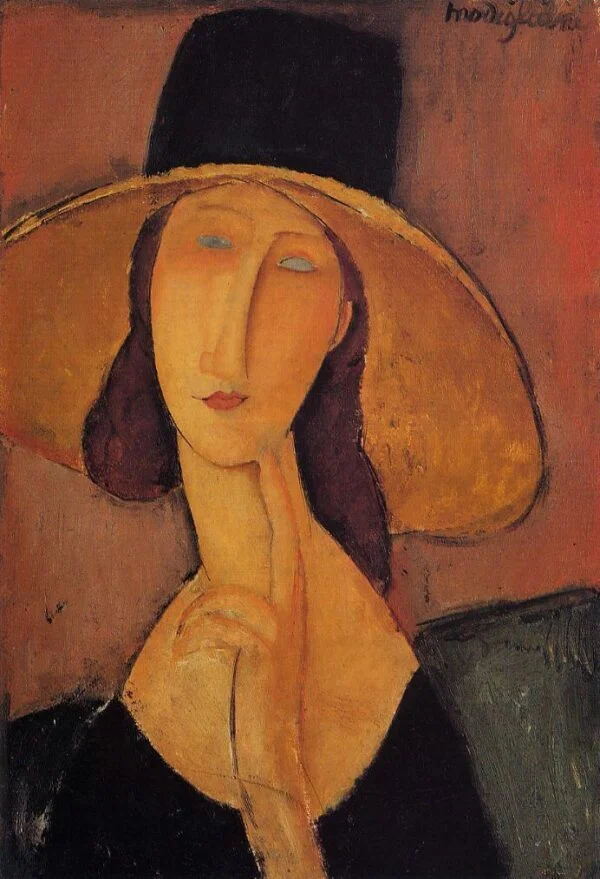
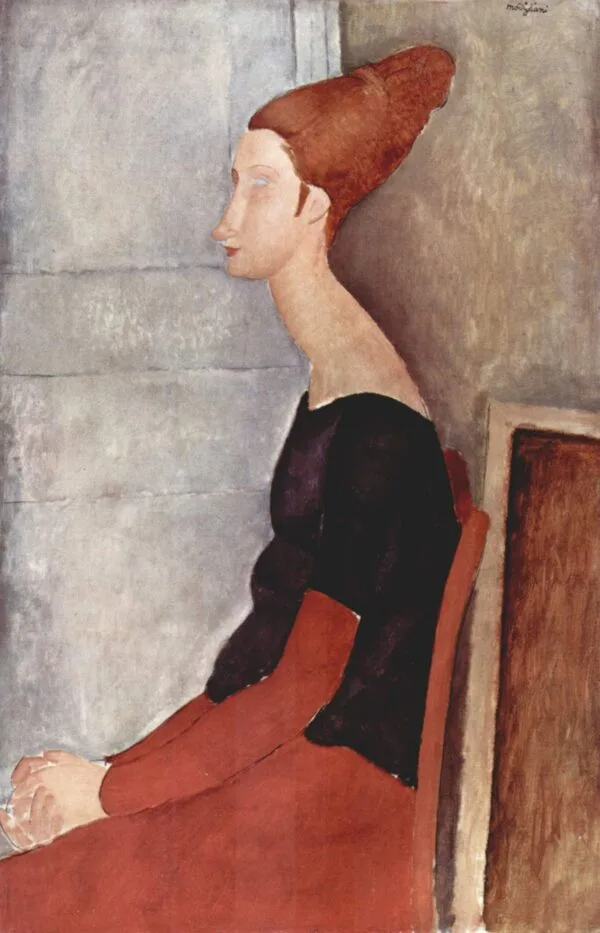
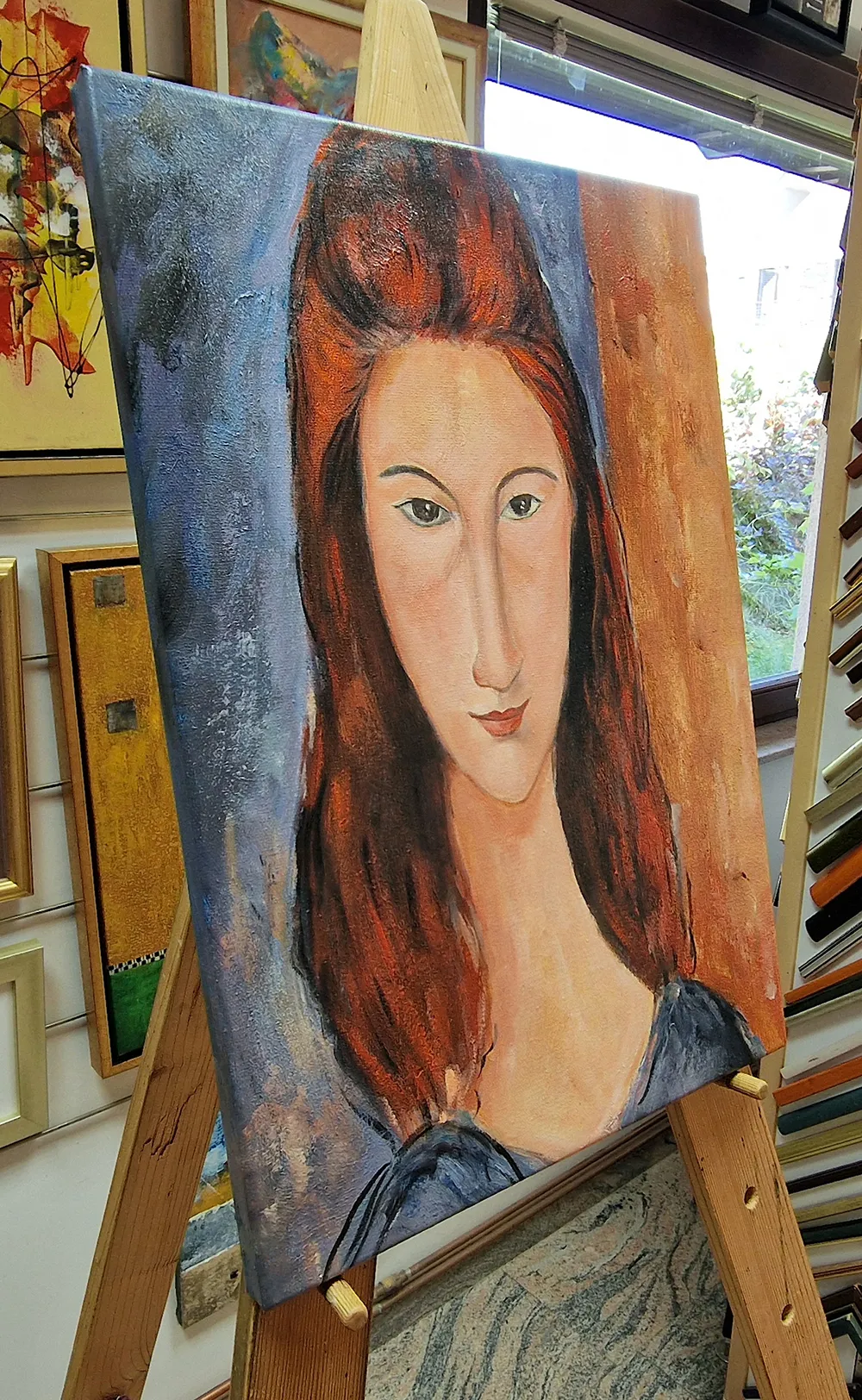
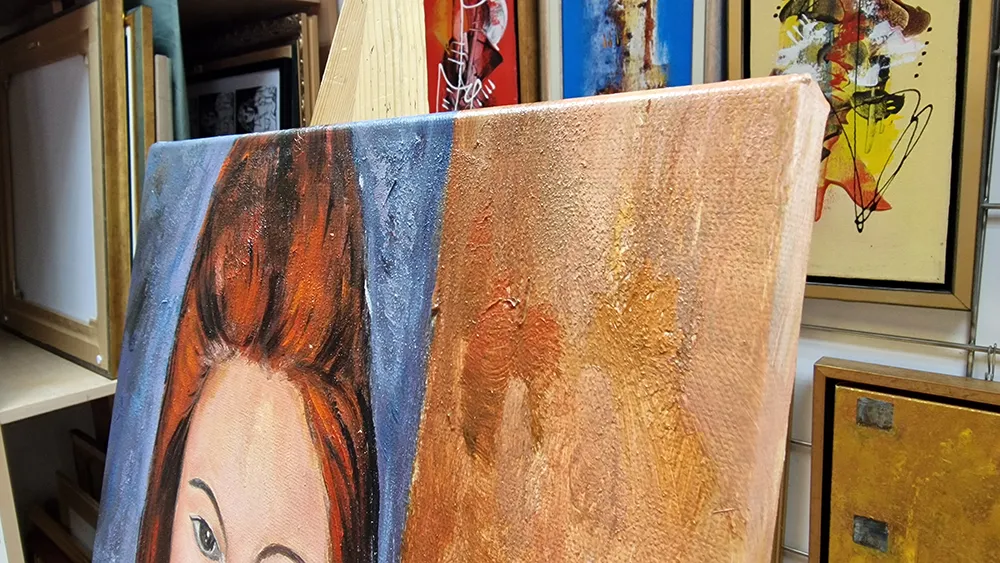
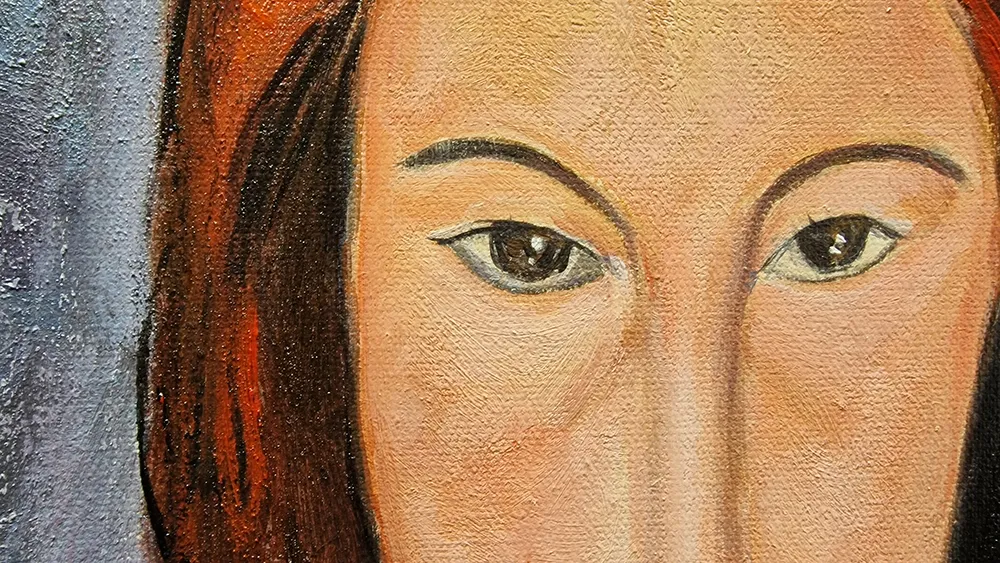
The work is made by an academy-trained painter in oils on cotton canvas, stretched over a wooden frame. It is not a print: every stroke is laid on by hand, so your canvas always differs a little from our reference in brushwork and in the thickness of the paint. The first photograph on this page shows such a hand-painted canvas of ours, taken in the studio — not the original, but the article you receive. The fourth and fifth photographs show the same canvas in a landscape frame, that is, the same work from another distance. The painter begins with the dark mass of the hair and the ground, which decide how light the skin will look, and only then draws the face. Once the paint is dry we photograph the work and send you the photograph for approval.
Which size for which wall?
For most homes 60 × 90 cm is the right choice. What is particular about this work is the smallest size: 38 × 55 cm is exactly the size of the original, so you receive a canvas at one to one — sensible above a desk, on a shelf, or on a narrow hallway wall where it is seen close up. The middle sizes, 50 × 70 and 70 × 100 cm, go above a chest of drawers or in a bedroom. The large ones, 80 × 120, 90 × 130, 100 × 150 and 120 × 170 cm, ask for an empty wall and distance; there the head is larger than life and the work becomes the main object in the room, which with a portrait is not always wanted. The format is upright and carries a narrow, tall wall well, beside a door or between two windows.
Custom size, stretcher bar and frame
If your wall calls for a measurement not on the list, we will make it. Give us height and width in centimetres; we check whether the ratio carries the crop and tell you what changes at the edges — with a head crop this tight it shows first above the crown and below the shoulders. You can choose whether we send it stretched or rolled in a tube. For this work, besides the unframed version, a frame from our range is available, so you can receive it ready to hang. With placement we help by visualisation, setting the work into a photograph of your wall before you buy. If you are looking for a work we do not carry, see paintings made by order.
Delivery and guarantee
We deliver across Europe to your address, the canvas held away from the outer wall of the packaging. Making time depends on the size and on how busy the studio is; we give an estimate when you order and tell you if it changes. We stand behind workmanship and material: if the work arrives damaged or does not match the photograph you approved, we put it right or repaint it at our cost. Because you see it photographed before dispatch, most questions are settled before the parcel leaves.
Frequently asked questions
Where is the original?
In a private collection. Not being in a public museum it has no accession number, and we give none.
Who was the woman shown?
Jeanne Hébuterne, a painter and Modigliani’s partner. She died in January 1920, two days after him.
Is Busto di Jeanne Hébuterne the same work?
Yes. That is the Italian title of the same canvas; in German it is recorded as Porträt der Jeanne Hébuterne.
Which size should I choose?
If you cannot decide, 60 × 90 cm. For a desk or a shelf, 38 × 55 cm, the size of the original; above a chest of drawers, 70 × 100 cm.
What is it about, in one sentence?
That the most personal portrait is the one trying to prove nothing.
Is the original for sale and what is it worth?
We neither sell nor value the original. It is privately held and not on the market.
How high should I hang it?
The centre about 145 cm above the floor. At the small sizes the work sits better where you pass close to it than in the middle of a large empty wall.
Is it suitable as a gift?
It is. The portrait is quiet, and the smallest size is that of the original — a gift explained in one sentence.
How closely does it follow the original’s proportions?
The original measures 38 × 55 cm, and that is exactly the size we list: 38 x 55 cm. The proportions are the original’s, with no deviation.
- Subject: Jeanne Hébuterne in a narrow upright crop, head and shoulders, long tilted neck, eyes without pupils
- Original: 55 × 38 cm, oil on canvas, 1919, private collection, no accession number
- Ours: hand-painted oil on canvas, eight sizes from 38 × 55 to 120 × 170 cm; the smallest is one to one with the original
- Worth knowing: the eyes are closed dark areas — the painter does not say where the sitter is looking, and that is exactly why the work never turns sentimental
The eyes on this canvas do have pupils. Of the 76 Modigliani works on this shelf 17 are like that, and 53 have no pupils – work by work.